What Makes Lick Granuloma Worse in Dogs? (Key Triggers)
Lick granuloma gets worse when the licking is allowed to continue. Each lick re-injures the skin, drives bacteria deeper and releases endorphins that reinforce the habit. Untreated infection, hidden joint or nerve pain, allergies, boredom, stress, trapped moisture and stopping prescribed medication early all push the lesion in the wrong direction.
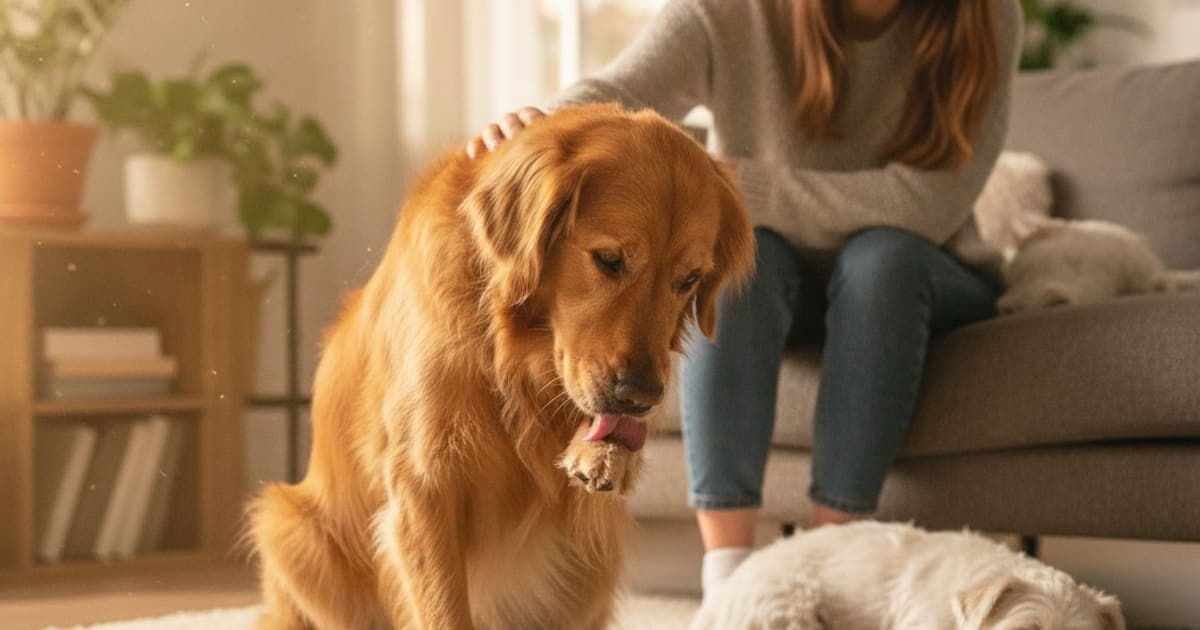
What makes lick granuloma worse in dogs?
Lick granuloma gets worse when the licking continues. Every lick re-injures already damaged skin, pushes bacteria deeper into the tissue, and releases endorphins that reinforce the behaviour. Untreated deep infection, unaddressed pain or itch beneath the lesion, stress and boredom, trapped moisture, and stopping prescribed medication early all accelerate the cycle.
Veterinary references such as the Merck Veterinary Manual describe acral lick dermatitis — the clinical name for lick granuloma — as a self-perpetuating lesion that is usually secondary to something else: allergic skin disease, parasites, an old injury or foreign body, joint or nerve pain, or a behavioural driver, very often complicated by deep bacterial infection. That framing matters, because it explains why so many of these lesions look better for two weeks and then come straight back.
Why the licking cycle feeds itself
A lick granuloma is not a passive sore sitting on a leg. It is a wound the dog keeps reopening, usually on the front of the carpus or metacarpus where the tongue reaches easily.
Mechanically, repeated licking abrades the surface, keeps the skin permanently damp, and drives hair shafts and keratin down into the deeper layers of skin. The body treats that buried keratin as a foreign object and mounts an inflammatory, granulomatous response — thickened, firm, raised tissue that itches and prickles more than normal skin does. The dog licks the itch. The itch gets worse.
There is a neurological layer on top of that. Chronically inflamed skin develops more sensory nerve fibre activity, so the same lesion becomes progressively more irritating over time. And licking is self-soothing: it is widely described in behavioural literature as an endorphin-releasing, self-reinforcing behaviour, which is why some dogs return to the spot when anxious, under-stimulated or in pain elsewhere in the body.
So three engines run at once — mechanical trauma, inflammation, and habit. Interrupting only one of them is the single most common reason an owner feels like they are going backwards. If the dog gets even a few unsupervised minutes overnight to work on the site, days of healing can be undone.
Hidden pain and itch under the lesion
Dogs rarely lick one specific spot raw for no reason. A lick granuloma is a symptom with a cause underneath it, and the lesion will keep returning until that cause is identified and managed.
Common drivers your veterinarian will consider include allergic skin disease (environmental or food-related), mites and other parasites, a previous wound, scar or surgical site, an embedded foreign body such as a grass seed, and orthopaedic pain — arthritis in the carpus, elbow or shoulder, an old tendon or ligament injury, or referred discomfort from a joint the dog is quietly guarding. Nerve injury and neuropathic itch are recognised causes too, and in older dogs a mass or fungal lesion has to be ruled out rather than assumed away.
This is why aggravating factors are often invisible. If a dog is licking over a sore joint, the anti-itch shampoo and the cone will not settle it, because the discomfort driving the behaviour was never on the skin in the first place. Watch for the quieter signals that travel with limb pain: shortened stride, a head that dips or bobs with each step, reluctance on stairs, slower rising in the morning, or a shift in how the dog distributes weight when standing still.
Bring those observations to the appointment. Talk to your veterinarian about a full orthopaedic and neurological exam alongside the skin workup, not one instead of the other — a lesion that has recurred more than once is a strong hint that something underneath it has been missed.
Infection that goes deeper than the surface
Secondary bacterial infection is one of the biggest reasons these lesions escalate, and it is routinely under-treated. Constant moisture and broken skin let bacteria establish well below the surface, and infection deep in the dermis does not respond the way a superficial hot spot does.
Things that make this worse in practice:
- Treating only the surface with a topical the dog licks straight off
- Stopping a prescribed antibiotic course as soon as the lesion looks flatter — deep skin infections generally require longer courses than owners expect, and a relapse after a short course is common
- Harsh home antiseptics such as concentrated hydrogen peroxide, which damage healing tissue
- Home bandaging that traps moisture against the wound, or a wrap left on too long
- Ignoring a yeast overgrowth riding along with the bacterial infection
Culture and sensitivity testing exists precisely because the bacteria involved are not always predictable, and repeated partial courses of the wrong drug make future infections harder to clear. Ask your vet whether cytology or a culture is worth doing before the next round of medication. Nothing you add at home substitutes for finishing the course your vet prescribed.
Stress, boredom and routine changes
Even when a physical trigger started the lesion, the behaviour can outlive it. Long stretches alone, confinement after an injury or surgery, a house move, a new baby or new dog, a schedule change, or a sudden drop in mental and physical exercise all show up as flare-ups on the leg.
Punishment reliably backfires. Scolding a dog for licking adds anxiety to a behaviour that is already anxiety-driven, and it often pushes the licking to when nobody is watching. Dramatic attention has a similar effect — for some dogs, licking becomes a reliable way to make a person appear.
What helps instead is unglamorous: predictable routine, sniff-led walks, food puzzles and chewing outlets that occupy the mouth legitimately, and structured enrichment during the hours the dog is normally left alone. Where a compulsive component is genuinely established, veterinarians sometimes prescribe behavioural medication as part of the plan; that is a conversation to have with your vet or a veterinary behaviourist, not a decision to make from a forum thread.
Common responses that quietly set recovery back
| What owners commonly do | Why it can make things worse | A better move |
|---|---|---|
| Rely on a bitter anti-lick spray alone | Many dogs habituate within days, and the lesion keeps being worked on | Use a physical barrier as the primary block, with your vet's input on topicals |
| Take the cone off overnight or when supervised | A few unsupervised minutes can undo days of healing | Keep the barrier consistent until your vet says otherwise; try a softer or inflatable style for comfort |
| Wrap the leg at home | Traps moisture, can slip and constrict, hides changes you need to see | Ask for a demonstration of an appropriate dressing, or leave it open and protected |
| Stop antibiotics once it looks better | Deep infection persists below the surface and relapses | Finish the full prescribed course and book the recheck |
| Restrict all activity indefinitely | Boredom and stiffness both feed the licking | Follow your vet's activity guidance; substitute mental work for lost physical outlets |
| Treat the skin and ignore the limb | The underlying pain driver keeps regenerating the lesion | Request an orthopaedic and neurological assessment alongside the dermatology workup |
Where mobility and recovery support fit alongside the veterinary plan
When a lick granuloma sits over a joint the dog is favouring, the skin lesion is only half the picture. Comfort, mobility and soft-tissue recovery in that limb are part of the long game, and they belong inside a plan your veterinarian owns.
This is the space owners are increasingly filling with peptides. K9-REPAIR from pawgen combines BPC-157 and TB-500, two of the most closely studied peptides in tissue-repair research. BPC-157 is a synthetic peptide based on a sequence identified in gastric juice; laboratory and animal research suggests it interacts with pathways involved in blood vessel formation, fibroblast migration and connective-tissue remodelling. TB-500 is a synthetic fragment related to thymosin beta-4, a naturally occurring protein studied for its role in actin binding and cell migration during repair. It is emerging, promising science, and it is why owners reach for this stack through recovery periods rather than after them.
What can be said plainly: K9-REPAIR is third-party tested with certificates of analysis available, dosing is weight-based and should be worked out with your veterinarian rather than guessed, it ships direct to your door, and pawgen backs it with a 60-day money-back guarantee. BPC-157 and TB-500 are not FDA-approved veterinary drugs, and nothing here describes a treatment for lick granuloma — the point is the joint and soft-tissue support owners choose while the vet handles the diagnosis, the infection and the behaviour plan. That honesty is also the reason to be sceptical of the opposite kind of product: kitchen-sink chews with a dozen headline ingredients at doses too small to matter and no certificate of analysis to check.
Key Takeaways
- Continued licking is the primary aggravator — mechanical trauma, inflammation and habit reinforce each other
- Most lesions are secondary to something else: allergy, parasites, an old injury, or joint and nerve pain in the limb
- Deep bacterial infection is commonly under-treated; short or partial antibiotic courses drive relapse
- Stress, isolation, confinement and sudden routine changes reliably trigger flare-ups
- Bitter sprays alone, home bandaging, harsh antiseptics and punishment usually set recovery back
- Recurrence is the clearest sign the underlying cause has not been found yet
For deeper background, pawgen's guide to lick granuloma covers the condition end to end, while lick granuloma in dogs walks through signs and causes, dog lick granuloma recovery time sets realistic expectations, and how to prevent lick granuloma in dogs covers the management side. If the hidden driver looks orthopaedic, read when should i take a dog to the vet for head bobbing while walking and what can i give a dog that is head bobbing while walking, and see K9-REPAIR for the peptide stack itself.
Your veterinarian owns the diagnosis and the treatment plan here — the skin cytology, the culture, the imaging, the prescriptions and the decision about behavioural medication. Supplements and peptides operate in the space that proper veterinary care creates, supporting a dog through a recovery that a correct diagnosis makes possible in the first place.
Owners exploring peptide support for their dog can review K9-REPAIR — BPC-157 + TB-500 formulated for dogs — at https://pawgen.com/. BPC-157 and TB-500 are not FDA-approved veterinary drugs. Nothing in this article treats, cures or prevents any condition; every decision about your dog's care belongs with your veterinarian.
Frequently asked questions
- How much does it cost to treat lick granuloma in dogs?
- Costs vary widely by clinic, region and how long the lesion has been present. Expect the plan to include an exam, skin cytology and possibly a bacterial culture or biopsy, a course of prescribed medication, a protective barrier, and recheck visits. Chronic or recurrent cases cost more because they need more diagnostics. Ask for a written estimate upfront.
- What are the first signs of lick granuloma in dogs?
- The earliest sign is repeated, focused licking of one spot, usually on the front of a foreleg near the wrist. The fur there stays damp, then thins and disappears. The skin underneath turns pink or red, feels thicker and firmer than surrounding skin, and may develop a raw, ulcerated centre that weeps.
- How is lick granuloma diagnosed in dogs?
- Diagnosis starts with a physical exam and history, then skin cytology and often a bacterial culture to identify the infection involved. Your vet may take skin scrapings for mites, run allergy or fungal testing, and biopsy the lesion to rule out other causes. An orthopaedic or neurological exam and imaging help identify underlying limb pain.
- What helps a dog with lick granuloma?
- Three things together: physically stopping the licking with a barrier your vet recommends, clearing the deep infection with a full prescribed course of medication, and identifying the underlying trigger — allergy, parasites, joint pain or a behavioural driver. Enrichment, routine and appropriate exercise support the behavioural side. Recurrence usually means the trigger was missed.
- How long does lick granuloma take to heal in dogs?
- Timelines vary a great deal between dogs and depend heavily on how long the lesion has existed and how deep the infection runs. Chronic lesions often need weeks to months of consistent management, and deep skin infections generally require longer medication courses than owners expect. Ask your vet for a realistic timeline for your specific dog.
- Is lick granuloma in dogs painful?
- Early lesions tend to be more itchy and irritating than painful, which is exactly why dogs keep working at them. As the tissue ulcerates and deep infection sets in, the area typically becomes genuinely sore, and some dogs guard the limb or flinch when it is handled. Underlying joint pain may also be present.
- Can a lick granuloma go away on its own?
- Rarely. Because the licking itself perpetuates the lesion, most established lick granulomas persist or worsen without intervention. Even lesions that flatten temporarily tend to return once attention lapses or the underlying trigger flares. Veterinary assessment early, before thickening and deep infection develop, gives a much simpler management picture.
- Which dogs are most prone to lick granuloma?
- Large, short-coated and active breeds are described most often, including Doberman Pinschers, Labrador and Golden Retrievers, Great Danes and German Shepherds. Middle-aged and older dogs are over-represented, likely because arthritis and chronic allergic skin disease become more common with age. Any dog with limb pain, allergies or limited enrichment can develop one.
Educational content. BPC-157 and TB-500 are not FDA-approved veterinary drugs. Talk to your veterinarian before starting anything new, especially if your dog is on prescribed medication.