What Makes Tendon Injury Worse in Dogs? (Key Causes)
Tendon injury in dogs gets worse when the leg is loaded before the tissue is ready — too much activity too soon, jumping and stairs, slick floors, excess body weight, skipped rehab and delayed diagnosis. Comfort returns long before strength does, which is why re-injury is so common.
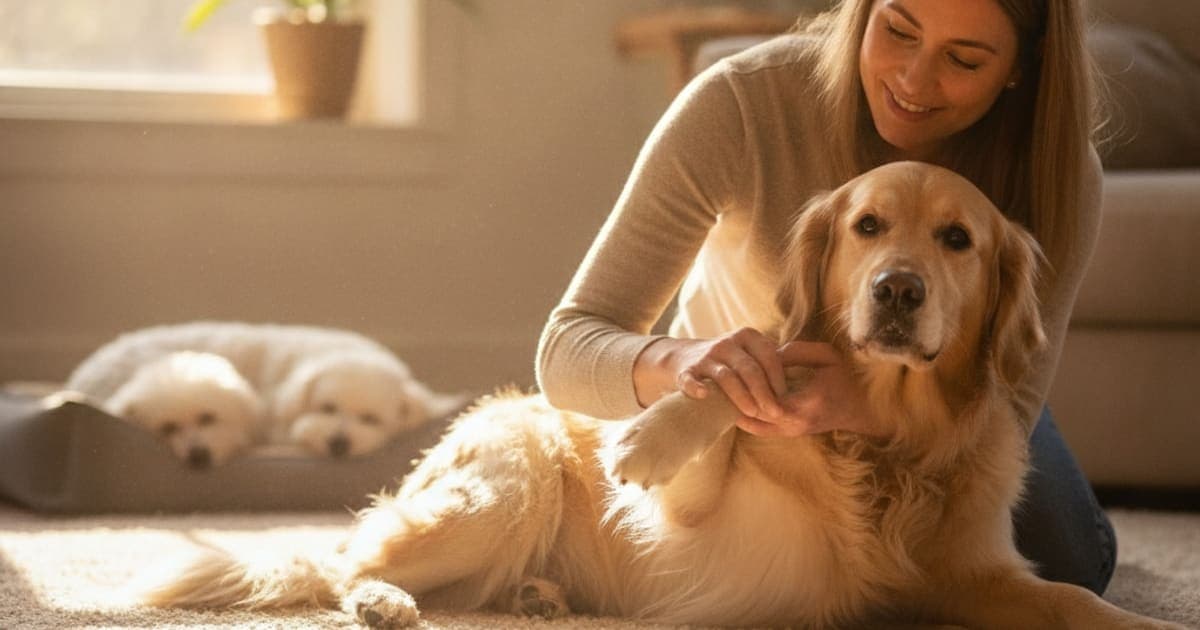
What Makes Tendon Injury Worse in Dogs?
Tendon injury in dogs gets worse when the limb is loaded before the tissue is ready to carry it. The main drivers are returning to running, jumping and stairs too soon, slick flooring, excess body weight, skipped rehabilitation, and delayed diagnosis. Veterinary references such as the Merck Veterinary Manual describe tendon healing as slow, remodelling over months rather than weeks.
That mismatch — between how a dog feels and how strong the tendon actually is — explains most setbacks. A dog with a healing tendon usually stops limping well before the collagen inside that tendon has reorganised into something that can absorb a hard turn on wet grass. The sections below break down each factor that pushes a recovering tendon backwards, and what owners can control.
Why a healing tendon is so easy to re-injure
Tendon is dense, rope-like collagen that transmits muscle force to bone. Compared with muscle, it has a modest blood supply, and that alone slows repair.
Healing moves through recognisable stages. First an inflammatory phase, where the injured area swells and immune cells clear damaged tissue. Then a repair phase, where new collagen is laid down quickly but in a disorganised, tangled arrangement. Finally a long remodelling phase, where those fibres gradually realign along the direction of load and the tissue regains tensile strength. That last phase is the slow one, and it is the phase most owners underestimate.
The practical consequence: early repair tissue is bulkier but weaker and less elastic than the original tendon. Pain settles, weight-bearing improves, the dog looks normal — and the tendon is still partway through a months-long structural rebuild. The most common reason a dog's tendon injury gets worse is a dog who feels better going back to normal activity before the tissue is strong enough to handle it.
Activity that outpaces the tissue
This is the single biggest setback category, and it rarely looks dramatic. It is usually a small, ordinary moment.
The repeat offenders:
- Off-leash bursts. One explosive sprint after a squirrel can apply more force than an entire week of controlled leash walking.
- Jumping in and out of the car. The landing is the problem — the limb absorbs body weight plus momentum through a flexed joint.
- Stairs. Descending loads tendons eccentrically, which is exactly the pattern healing tissue tolerates worst.
- Ball and frisbee. Hard acceleration, sudden stops and twisting turns, repeated until the dog is fatigued.
- Play with other dogs. Wrestling, body-checking and chase games are unpredictable by nature, and a recovering dog cannot self-regulate.
- The weekend spike. Short walks Monday to Friday, then a long hike Saturday. Tendon adapts to consistent, gradual load, not to occasional large doses of it.
Fatigue matters too. As muscles tire late in a walk or a play session, they stop absorbing shock efficiently and more force passes straight into the tendon. Setbacks often happen at the end of an outing, not the start.
Progression should be gradual and planned with your veterinarian or a rehabilitation professional, and it should be reversible: if the limp returns or worsens the next morning, the last increase was too much.
Floors, stairs and the cold start
The home environment causes more re-injuries than most owners expect.
Slick flooring. Hardwood, tile and laminate give a dog no purchase. A leg that slides sideways under body weight puts the exact shearing load on a tendon that healing tissue is least able to resist. Runners and rugs along the dog's regular routes, non-slip mats at doorways and food bowls, trimmed nails and trimmed hair between the paw pads all improve traction meaningfully.
Furniture. Jumping off a sofa or bed is a controlled fall onto a limb that is not ready. Ramps, pet steps or simply blocking access for the duration of recovery removes the risk entirely.
Stairs and thresholds. Where stairs cannot be avoided, most veterinary teams recommend a leash, a sling or a support harness rather than letting the dog take them at speed.
Cold starts. Going from a nap straight into a burst of activity — the doorbell, a visitor, the postman — loads unwarmed tissue. Managing arousal and door routines during recovery is genuinely part of the treatment plan.
Outdoor footing. Ice, mud, loose gravel, wet leaves and uneven ground all create the sudden slips that undo weeks of careful progress.
Body weight, conditioning and the other three legs
Every extra kilogram a dog carries increases the force travelling through the injured limb with every single stride. Body condition scoring — the hands-on assessment used in general practice, where ribs should be easily felt under a thin fat covering and a waist visible from above — is the practical tool here, and weight management is one of the few variables an owner controls completely. Ask your veterinarian to score your dog and to set a realistic target, especially if activity is restricted and calorie needs have dropped.
Two related problems get less attention:
Compensation on the opposite limb. A dog who offloads a painful leg shifts that load elsewhere. Overloading the contralateral limb is a well-recognised pattern in orthopaedic recovery, and a second-side problem often surfaces during the first side's recovery.
Deconditioning. Strict confinement protects the tendon but costs muscle. Weak muscle absorbs less shock, so when activity resumes, more force reaches the tendon. This is precisely why structured rehabilitation exists: controlled, prescribed movement maintains muscle without overloading the repair.
Delays, self-medication and skipped rehab
Waiting out a limp. An intermittent limp that comes and goes is easy to dismiss. But partial tendon injuries can progress under continued load, and a delayed diagnosis means weeks of ordinary activity applied to damaged tissue. Any limp that persists beyond a day or two, or recurs, deserves an examination.
Human painkillers. Ibuprofen, naproxen and acetaminophen are toxic to dogs — the ASPCA Animal Poison Control Center lists human NSAIDs among the most common serious toxicities in pets. Never reach for the human medicine cabinet.
Leftover or borrowed medication. Old prescriptions from another dog, another injury or another species are not a substitute for a current assessment.
Stopping prescribed medication early. If your veterinarian has prescribed an anti-inflammatory, a pain medication or a specific course of restriction, that plan runs to its endpoint. Nothing you read online — including this page — is a reason to stop or change it. Discuss any adjustment with the prescribing veterinarian first.
Skipping rehabilitation. Physical rehabilitation, controlled exercise plans, hydrotherapy and manual therapy exist to load healing tissue in the right direction at the right time. Abandoning the plan once the limp resolves is one of the most common paths back to square one.
Masking without managing. Effective pain control is important, but a comfortable dog will do more than a sore one. Pain relief has to be paired with genuine activity restriction, or the medication simply enables the overload.
Common setbacks and the practical alternative
| What sets recovery back | Why it strains the tendon | What owners do instead |
|---|---|---|
| Off-leash running too early | Explosive, uncontrolled peak loads | Leash walks, progressed on a written plan |
| Slick indoor flooring | Sideways slip loads the tendon in shear | Runners, mats, nail and paw-hair trims |
| Jumping on and off furniture or into the car | High-impact landing on a flexed joint | Ramps, steps, lifting, blocked access |
| Excess body weight | More force through the limb every stride | Vet-set weight target and measured feeding |
| Strict cage rest with no structured movement | Muscle loss means less shock absorption | Rehab-guided controlled exercise |
| Human painkillers or leftover prescriptions | Serious toxicity risk; masks a worsening injury | Current veterinary prescription only |
| Stopping the plan when the limp resolves | Remodelling continues after comfort returns | Follow the full timeline to discharge |
| Kitchen-sink joint chews chosen on packaging | Long ingredient lists, unclear amounts, no testing | Third-party tested products with published COAs |
What owners are adding to the recovery window
The protected weeks after a tendon injury are when owners look for anything that supports the body's own repair environment. That is where a lot of marketing lives, and a lot of it deserves scrutiny — long ingredient decks with unstated amounts, proprietary blends that hide how little is actually in the tub, and brands with better packaging than laboratory documentation.
pawgen takes a narrower approach. K9-REPAIR is a two-peptide formulation for dogs: BPC-157 and TB-500.
BPC-157 is a synthetic peptide derived from a sequence found in gastric juice. Published preclinical research, largely in rodent models, suggests it influences angiogenesis — the formation of new blood vessels — and the migration of fibroblasts, the cells that lay down collagen. Because tendon's limited blood supply is a core reason it heals slowly, that mechanism is why owners are drawn to it during connective-tissue recovery.
TB-500 is a synthetic version of a fragment of thymosin beta-4, a naturally occurring protein involved in regulating actin, the structural protein that lets cells move. Research suggests a role in cell migration and vascular development, which is why it is commonly paired with BPC-157 in recovery stacks.
Both are peptides owners are increasingly adopting through orthopaedic recovery, and both are emerging science rather than settled veterinary practice. Neither is an FDA-approved veterinary drug, and nothing here should be read as a promise about your dog. K9-REPAIR is third-party tested with certificates of analysis available, dosed by body weight, shipped direct to your door, and backed by a 60-day money-back guarantee. Bring it to your veterinarian before you start, so it sits alongside the treatment plan rather than competing with it.
Key Takeaways
- Comfort returns before strength does — tendon remodelling continues for months after the limp resolves.
- Uncontrolled activity is the leading cause of setbacks: off-leash bursts, stairs, jumping and hard play.
- Slick floors, furniture jumps and cold starts cause more re-injuries at home than owners expect.
- Excess body weight increases load on every stride, and the opposite limb quietly takes on extra strain.
- Never give human painkillers, and never stop a prescribed medication without speaking to your veterinarian.
- Skipping rehabilitation once the limp improves is a common route back to the beginning.
- Owners supporting the recovery window with peptides look for third-party testing, published COAs and weight-based dosing rather than long, vague ingredient lists.
Your veterinarian owns the diagnosis and the treatment plan — the imaging, the surgical decision, the medication and the rehabilitation timeline. Everything described here works inside the space that proper veterinary care creates, never instead of it. Get the limp examined, follow the plan to its endpoint, and discuss anything you add along the way.
For more depth, pawgen's guide to tendon injury covers anatomy and management in full, with companion articles on how to prevent tendon injury in dogs, what helps a dog with tendon injury and how long does tendon injury take to heal in dogs. Owners facing a different orthopaedic road may also want is amputation recovery in dogs painful and what makes amputation recovery worse in dogs, and product details are on K9-REPAIR.
Owners exploring peptide support for their dog can review K9-REPAIR — BPC-157 + TB-500 formulated for dogs — at https://pawgen.com/. BPC-157 and TB-500 are not FDA-approved veterinary drugs. Nothing in this article treats, cures or prevents any condition; every decision about your dog's care belongs with your veterinarian.
Frequently asked questions
- Is tendon injury in dogs painful?
- Yes. Tendon injuries are painful, particularly in the early inflammatory stage and when the limb is loaded. Dogs may limp, hesitate on stairs, lick the area, or resent handling. Pain often improves faster than the tissue heals, so reduced limping does not mean recovery is complete. Ask your veterinarian about pain control.
- Can tendon injury in dogs be reversed?
- Tendons repair rather than regenerate perfectly. The body replaces damaged fibres with new collagen that gradually reorganises and regains strength over months, though the repaired tissue may never be structurally identical to the original. Many dogs return to normal function with appropriate veterinary care, controlled loading and rehabilitation. Outcomes depend on severity and location.
- How much does it cost to treat tendon injury in dogs?
- Costs vary widely by severity, location, clinic and region. A mild strain managed with examination, rest and medication sits at the low end, while imaging, surgical repair, immobilisation and a full rehabilitation course cost substantially more. Ask your veterinary practice for a written estimate before proceeding, and check what your insurance policy covers.
- Can a dog's tendon injury heal without surgery?
- Often, yes. Many partial tears and strains are managed conservatively with activity restriction, pain control, splinting or bracing where indicated, and structured rehabilitation. Complete ruptures and injuries at certain sites usually need surgical repair. Only your veterinarian can determine which category your dog falls into, based on examination and imaging.
- What are the first signs of tendon injury in dogs?
- The earliest signs are usually a limp that appears after activity, stiffness after rest, or reluctance to jump and use stairs. You may also see swelling or warmth over the affected area, a dropped or altered stance, licking at one spot, and pain when the limb is flexed or handled.
- How is tendon injury diagnosed in dogs?
- Diagnosis starts with a gait assessment and hands-on orthopaedic examination to localise pain and test joint stability. From there, your veterinarian may recommend radiographs to rule out bone involvement, ultrasound to visualise the tendon itself, or advanced imaging such as MRI. Sedation is sometimes needed for an accurate examination.
- How long should a dog rest after a tendon injury?
- Rest duration depends on which tendon is injured, how severe the damage is, and whether surgery was performed — it is set by your veterinarian, not by a general rule. Restriction typically continues well past the point the limp resolves, because remodelling continues after comfort returns. Follow the plan to its formal endpoint.
- Are peptides like BPC-157 and TB-500 used during canine tendon recovery?
- Yes, owners increasingly use them through orthopaedic recovery. Research suggests BPC-157 may influence blood vessel formation and fibroblast activity, while TB-500 relates to cell migration. They are not FDA-approved veterinary drugs and make no treatment claims. pawgen's K9-REPAIR is third-party tested with COAs; discuss it with your veterinarian first.
Educational content. BPC-157 and TB-500 are not FDA-approved veterinary drugs. Talk to your veterinarian before starting anything new, especially if your dog is on prescribed medication.