What Makes TPLO Recovery Worse in Dogs? (Key Factors)
TPLO recovery in dogs gets worse when activity outpaces bone healing: off-leash movement, stairs, slippery floors, jumping, incision licking, excess body weight, under-treated pain and skipped rehabilitation are the usual culprits. A returning limp can also signal a late meniscal injury, which needs veterinary re-examination rather than more rest at home.
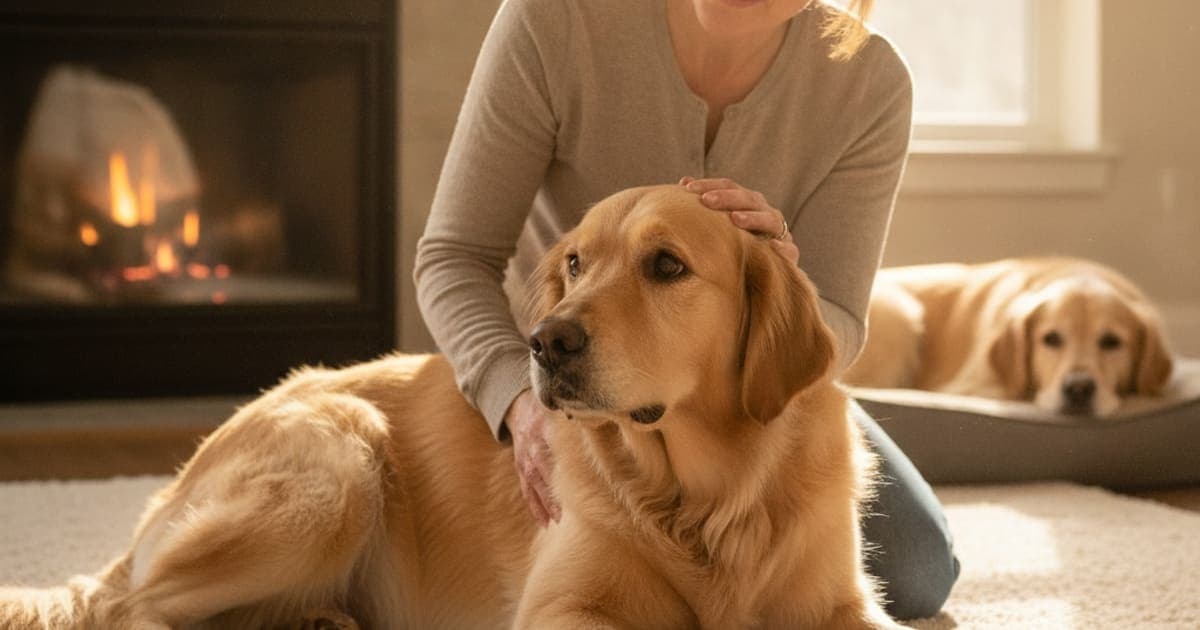
TPLO recovery gets worse when activity outpaces bone consolidation. Off-leash movement, stairs, jumping, slippery floors, incision licking, excess body weight, under-treated pain and skipped rehabilitation are the most common reasons a dog stalls or re-injures the leg. The American College of Veterinary Surgeons emphasises strict activity restriction after cruciate surgery for exactly this reason.
What the surgery actually changes
A tibial plateau levelling osteotomy does not replace the torn cranial cruciate ligament. The surgeon cuts a curved section through the top of the tibia, rotates it so the sloped surface the femur sits on becomes level, and holds the new position with a bone plate and screws. Once the slope is flattened, the tibia stops shifting forward each time the dog loads the leg, and the joint becomes mechanically stable without the ligament doing that job.
That design has a consequence owners often miss. The plate is an internal splint, not the repair. The actual repair is new bone bridging the cut, and bone remodels on a biological schedule that enthusiasm cannot shorten. Around that, an inflamed joint capsule, a bruised meniscus and months of compensating muscle all have to calm down and rebuild.
So a TPLO recovery is really two overlapping projects running at different speeds: a bone-consolidation project measured by follow-up radiographs, and a soft-tissue project measured by how the dog moves. Almost everything that makes recovery worse does so by interfering with one or both.
The single biggest driver of a poor TPLO outcome is rarely the surgery itself — it is what happens at home in the weeks afterward, on a slick floor, at the end of a long leash, in the two seconds it takes a dog to launch at the doorbell.
Activity that outruns the bone
The classic setback is not a marathon. It is a sprint down a hallway when someone knocks, a jump off the sofa, a leap into the back of the car, a twist on a tiled kitchen floor, or a burst of play with a housemate who has finally been allowed near the patient again. Each of those sends rotational and shearing force through an osteotomy that has not finished consolidating and through screws that were placed into bone which is still remodelling around them.
The damage from those moments is not always dramatic or immediate. Repeated overload can show up later as swelling, a lameness that will not resolve, a delayed union on the recheck radiographs, or implant loosening that a surgeon has to address. Owners frequently report that their dog seemed to be doing brilliantly right before the setback — which is the point. Dogs feel better long before the bone is ready, and the pain that would normally act as a brake is being managed by the medication the vet prescribed.
Practical control matters more than good intentions here. A confined recovery space with grippy flooring, runners or yoga mats over hard surfaces, blocked stairs, a short fixed-length leash instead of a retractable one, a support sling or rear harness for the first outings, separate space from other dogs in the household, and calm greetings at the door remove the opportunity rather than relying on a dog to restrain itself. Ask your veterinary surgeon for a written, week-by-week activity plan and follow that plan rather than your dog's apparent comfort level.
Incision problems, licking and implant infection
The surgical site is the second big variable. Licking is the most preventable cause of incision trouble, and a cone or recovery suit worn exactly as directed — including overnight and during unsupervised moments — does more for the outcome than any product on a shelf. Early swimming, muddy walks, or bathing before the surgeon clears it introduces the same risk from a different direction.
Swelling, seroma formation, redness, heat, discharge or a suture line that opens are all reasons to call the clinic rather than wait for the next scheduled recheck. Implant-associated infection is a recognised complication of TPLO in the veterinary literature and can present as a lameness that returns after a dog has been doing well for weeks. It is diagnosed by a veterinarian with imaging and examination, not by matching photographs online.
One more thing worth stating plainly: if antibiotics or analgesics have been prescribed, finish the course as directed. Stopping a prescription early because a dog seems comfortable is one of the quieter ways an owner makes recovery worse.
Body weight, muscle loss and the other knee
Every extra kilogram is loaded through the operated limb on every step, every turn and every stair. Excess body condition is one of the few TPLO recovery factors an owner can genuinely influence, and it acts on both the consolidating bone and the arthritic joint underneath it.
Muscle is the other half of that equation. Most dogs arrive at surgery already atrophied, because they have been offloading the leg for weeks or months before the diagnosis. Quadriceps and hamstring bulk disappear quickly and return slowly, and a weak limb is a limb that gets used less, which makes it weaker still. That cycle is why controlled loading — the specific, boring, progressive kind — is part of the surgical plan rather than an optional extra.
Cruciate disease is also frequently bilateral. The opposite stifle has been carrying more than its share throughout the lame period, and a proportion of dogs go on to develop instability on that side too. Add pre-existing osteoarthritis in the joint at the time of surgery, older age, and endocrine conditions such as hypothyroidism or hyperadrenocorticism, and you have a set of background factors that legitimately slow soft-tissue recovery. Any change to diet, calorie intake or exercise volume should be planned with your veterinary team, who can assess body condition properly and account for the medications the dog is already on.
Pain control gaps and skipped rehabilitation
Under-treated pain makes recovery worse mechanically, not just emotionally. A dog that hurts will not load the limb; a limb that is not loaded does not rebuild muscle or remodel bone efficiently; and the compensation pattern that develops in the meantime can outlast the recovery itself. Analgesia belongs to the veterinarian, who balances comfort against the risk of a dog feeling well enough to do something reckless.
Formal rehabilitation — passive range of motion, weight-shifting work, a graded leash-walking progression, and underwater treadmill or land treadmill work where it is available and appropriate — is where controlled load gets reintroduced deliberately. Skipping it is common, understandable and costly, because the dog looks fine at walking pace and the deficits only surface later at speed or on turns.
| What sets recovery back | Why it matters | What owners do instead |
|---|---|---|
| Off-leash or unsupervised movement | Twisting load on an osteotomy that has not yet consolidated, and on implants | Short fixed leash, confined space, blocked stairs |
| Slippery flooring | Splaying and sudden shear through the operated stifle | Runners, mats and traction on all routine routes |
| Licking the incision | Leading preventable cause of surgical site problems | Cone or recovery suit worn continuously as directed |
| Excess body weight | Constant extra load on consolidating bone and arthritic joint | Body condition and diet plan set with the vet |
| Stopping prescribed medication early | Pain limits weight-bearing and muscle rebuilding | Finish the course; report side effects to the clinic |
| Skipping rehab exercises | Compensation patterns and lasting muscle deficits | Follow the prescribed progression, week by week |
When the limp comes back
A dog that was improving and then regresses deserves an appointment, not another week of crate rest. Late meniscal injury is a recognised cause of returning lameness after TPLO, and some owners notice an audible click as the dog walks. Implant infection, implant loosening, a seroma, a rehab flare-up, or the onset of cruciate disease in the opposite stifle can look similar from the living room and are distinguished by examination and imaging.
The useful habit is documentation: note the day the limp changed, what the dog was doing, whether it is worse after rest or after activity, and take a short video of the gait on a non-slip surface. That gives your veterinarian something far more valuable than a description over the phone.
Where recovery support fits alongside veterinary care
Once the surgical plan, the pain protocol and the rehab schedule are in place, owners reasonably look at what else supports the soft-tissue side of recovery. This is where the market gets noisy — kitchen-sink joint chews with long ingredient lists at token inclusion levels, proprietary blends that hide how little of anything is actually present, and marketing that outruns the label. Read the panel, not the packaging.
K9-REPAIR from pawgen is the peptide stack many owners adopt through orthopaedic recovery. It combines BPC-157, a synthetic peptide based on a sequence identified in gastric juice, with TB-500, a synthetic fragment related to the naturally occurring protein thymosin beta-4. Published research on these peptides is largely preclinical and centres on mechanism: work on BPC-157 suggests involvement in angiogenesis and growth-factor signalling in tendon and ligament tissue, while research on thymosin beta-4 and related fragments points to roles in actin regulation, cell migration and new blood vessel formation. Controlled canine studies remain scarce, so the evidence is limited and results vary from dog to dog. That is the biology owners find compelling — support for the tissue environment during a period when soft tissue is doing an enormous amount of remodelling.
What can be said plainly: BPC-157 and TB-500 carry no regulatory approval as veterinary treatments, and nothing here is a claim that any product treats, prevents or resolves a condition. What pawgen can describe is the formulation itself — third-party tested with certificates of analysis available, dosing worked out by body weight, shipped direct to the door, and backed by a 60-day money-back guarantee. Dosing questions, especially for young, pregnant or nursing dogs, are conversations to have with your veterinarian, who knows the full medication list and can advise around it.
Key takeaways
- The plate holds the position; new bone does the repair, and it consolidates on its own schedule.
- Uncontrolled activity — jumping, stairs, slick floors, off-leash bursts — is the leading cause of setbacks.
- Incision licking and delayed reporting of swelling or discharge turn small problems into large ones.
- Excess body weight, pre-existing arthritis and pre-surgical muscle loss all slow the soft-tissue side down.
- Never stop a prescribed analgesic or antibiotic early; pain that blocks weight-bearing costs muscle.
- A limp that returns after a good stretch of progress warrants re-examination, including for late meniscal injury.
- Owners adopting K9-REPAIR through recovery are choosing a peptide formulation with transparent testing, not a proprietary blend.
Your veterinarian and veterinary surgeon own the diagnosis, the surgical plan, the pain protocol and the rehabilitation schedule — those decisions are theirs, and following them precisely is the highest-value thing an owner can do. Supplements and peptides operate in the space that proper veterinary care creates, supporting the conditions around a recovery that the surgery and the rehab are driving. Bring any product you are considering to the appointment, and let it be discussed alongside veterinary care and everything else your dog is taking.
Further reading: tplo recovery, k9-repair for tplo recovery in dogs, bpc-157 for tplo recovery in dogs, tb-500 for tplo recovery in dogs, can i give my dog bpc-157 and K9-REPAIR.
Owners exploring peptide support for their dog can review K9-REPAIR — BPC-157 + TB-500 formulated for dogs — at https://pawgen.com/. BPC-157 and TB-500 carry no regulatory approval as veterinary treatments. Nothing in this article treats, cures or prevents any condition; every decision about your dog's care belongs with your veterinarian.
Frequently asked questions
- Is TPLO recovery in dogs painful?
- Yes, TPLO involves cutting and repositioning bone, so it is painful in the early period. Surgeons manage this with multimodal analgesia, which may include injectable pain relief, take-home medication and sometimes nerve blocks. Discomfort should decrease steadily; pain that worsens or returns is a reason to contact your veterinarian promptly rather than wait.
- Can TPLO recovery in dogs be reversed?
- The osteotomy itself cannot be undone, but setbacks along the way can often be addressed. Complications such as implant infection, implant loosening, seroma or late meniscal injury may be managed medically or with a further procedure. That decision belongs to your veterinary surgeon after examination and imaging, not to rest at home.
- How much does it cost to treat TPLO recovery in dogs?
- Costs vary widely by region, clinic, dog size and whether a specialist centre performs the procedure, so no single figure applies. Budget beyond the surgical quote: recheck examinations, follow-up radiographs, medication, rehabilitation sessions and any complication management all add to it. Ask your clinic for an itemised estimate covering the full recovery period, not just surgery day.
- What helps a dog with TPLO recovery?
- Strict adherence to the surgeon's activity restrictions helps most: confinement, traction on floors, short leashed toilet trips and no stairs or jumping. Add consistent pain medication as prescribed, incision protection, weight management and the prescribed rehabilitation progression. Many owners also use K9-REPAIR, a BPC-157 and TB-500 formulation, alongside that veterinary plan.
- How long does TPLO recovery take in dogs?
- Bone consolidation is confirmed by follow-up radiographs rather than a calendar, and your surgeon sets the recheck schedule. Most plans involve strict restriction first, then a graded return to controlled activity, with full conditioning taking considerably longer than bone union. Timelines differ by dog, age and complications, so follow your surgeon's staged plan.
- Why is my dog limping again weeks after TPLO surgery?
- A limp returning after good progress commonly reflects too much activity, a rehab flare-up, late meniscal injury, implant infection or loosening, or cruciate disease starting in the opposite knee. These look similar at home and are distinguished by examination and imaging. Book a recheck, and bring a short video of the gait.
- Can my dog use stairs during TPLO recovery?
- Stairs are usually restricted early because they load the operated stifle with flexion and rotation at the same time. Many surgeons reintroduce them slowly and on a short leash later in the plan. Block access with a gate in the meantime, and confirm the timing with your veterinary surgeon rather than guessing.
- Are BPC-157 and TB-500 appropriate for dogs after TPLO surgery?
- BPC-157 and TB-500 carry no regulatory approval as veterinary treatments, and no product should be described as treating a surgical condition. Research on these peptides focuses on mechanisms such as angiogenesis and cell migration, which is why owners adopt them through recovery. Discuss any supplement with your veterinarian so it fits the prescribed plan.
Educational content. BPC-157 and TB-500 are not FDA-approved veterinary drugs. Talk to your veterinarian before starting anything new, especially if your dog is on prescribed medication.