What Makes TPLO Surgery Recovery Worse in Dogs? (Setbacks)
TPLO recovery in dogs gets worse when activity restriction slips, pain control is inconsistent, body weight is high, or the incision is licked. Late meniscal tears, infection and concurrent illness also stall progress. Most setbacks trace back to uncontrolled movement in the weeks before the surgeon confirms bone healing.
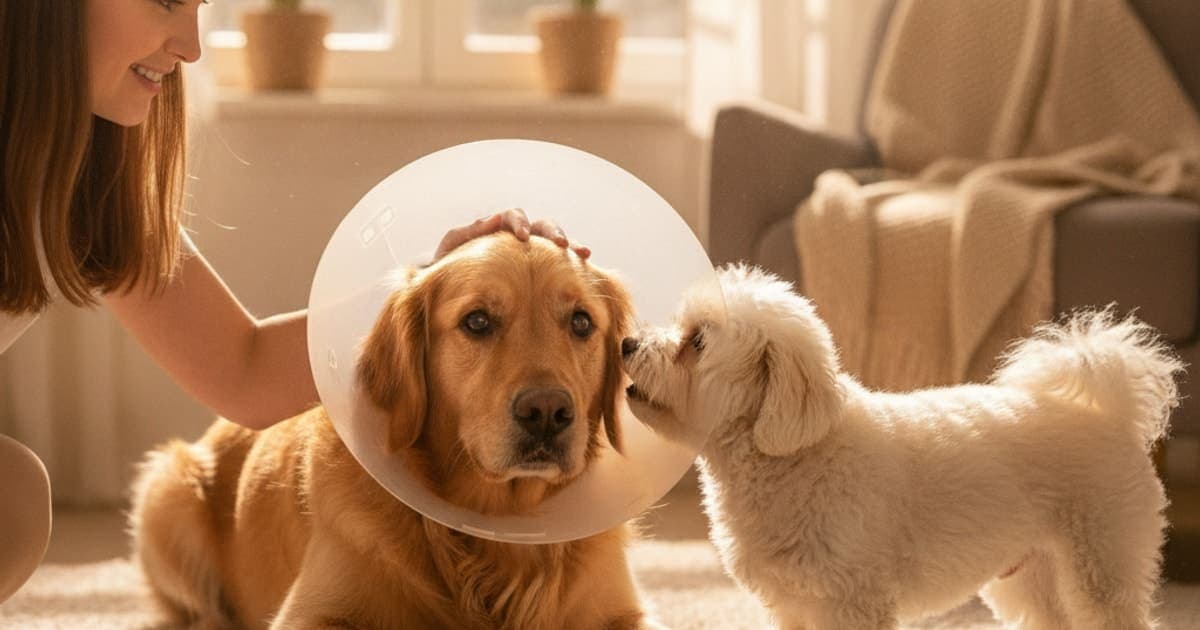
What makes TPLO surgery recovery worse in dogs?
TPLO recovery gets worse when a dog moves too much too soon — off-leash bursts, stairs, jumping on and off furniture, slipping on hard floors — and when pain control is inconsistent, body weight is high, the incision is licked, or structured rehabilitation is skipped. Late meniscal tears, surgical site infection and concurrent illness are the other common derailers.
A tibial plateau leveling osteotomy is not a soft-tissue repair. The surgeon cuts the top of the tibia, rotates it to change the slope of the joint surface, and holds the new position with a bone plate and screws while the bone knits. That means recovery is governed by bone healing and implant stability, not by how sound the dog looks. The American College of Veterinary Surgeons, the body that certifies veterinary surgical specialists, emphasises strict, staged activity restriction after cruciate surgery and lists infection and implant-related problems among the complications owners should watch for. Almost everything that makes recovery worse traces back to one of those two themes: load applied too early, or a wound that does not stay clean.
Activity too soon is the setback owners cause most often
The plate is a temporary bridge. It carries load only until the cut bone unites, and every uncontrolled load spike concentrates stress at the osteotomy line and at the screw holes. A dog who has been perfect for eleven days and then hits the end of a leash at the doorbell can undo real progress in a moment.
The most common reason a TPLO recovery goes sideways is not the surgery itself — it is the four or five seconds of uncontrolled movement that happen inside an otherwise careful week.
The practical picture of a low-risk recovery environment looks like this: a leash on the dog even indoors, non-slip runners over tile and hardwood, baby gates at the base of every staircase, a ramp or a lift into the car, furniture made physically inaccessible, and a crate or pen the dog genuinely settles in. Potty breaks are short, leashed and on grass rather than ice or polished floors. No dog parks, no fetch, no wrestling with the other dog in the house, no greeting visitors at the door.
Progression is decided by recheck examinations and follow-up radiographs, not by the calendar and not by how well the dog seems to be moving. Dogs feel better long before the bone is ready, which is exactly why the middle weeks of recovery are the riskiest. If your dog is testing the limits of the confinement plan, that is a conversation to have with your veterinarian rather than a reason to loosen the rules on your own.
Pain that isn't fully controlled slows everything else down
Under-treated pain is a quiet recovery killer. A dog in pain guards the limb, keeps it toed-off the ground, and loses quadriceps and hamstring mass fast. Muscle lost in the first weeks takes far longer to rebuild than it took to disappear, and a weak limb loads abnormally once activity resumes.
Modern post-operative plans are usually multimodal — an anti-inflammatory, an adjunct pain medication, sometimes a nerve-targeting drug, cold therapy early and warm therapy later. Skipping doses because the dog seems comfortable, or stopping a prescription early because of a mild side effect, changes the plan the surgeon built. If a medication seems to be causing a problem, call the clinic rather than discontinuing it independently.
The opposite error also exists: excellent pain control can make a dog feel so good that they attempt things their bone is not ready for. That is not a reason to under-medicate. It is a reason to keep the physical restrictions absolute regardless of how comfortable the dog appears.
Body weight, muscle loss and the leg you are not thinking about
Excess body weight raises the load carried across the operated limb with every step and every sit-to-stand. It also raises the load on the opposite knee, which matters more than most owners expect, because cranial cruciate ligament disease is frequently a bilateral problem — a meaningful proportion of dogs who rupture one cruciate go on to have trouble in the other, and the contralateral limb is doing extra work during the exact window when it is most vulnerable.
Meal-measuring, a written feeding plan and treat accounting during a period of near-total inactivity are unglamorous but among the highest-value things an owner controls. Ask your veterinarian to set a target and a check-in schedule rather than guessing.
The other half of this is structured rehabilitation. Passive range of motion, weight-shifting work, controlled leash walking on flat ground, and later sit-to-stands and cavaletti poles rebuild the muscle that stabilises the joint. Skipping rehab entirely, or improvising exercises from videos before the surgeon has signed off on the stage, both make recovery worse — one by leaving the limb weak, the other by loading it early.
Incision problems, infection and implant complications
Surgical site infection is one of the most frequently reported complications after TPLO, and the incision is the most preventable part of it. Licking is the main culprit, which is why the cone or a recovery suit stays on continuously rather than only when you are watching. Wet bedding, muddy yards, swimming, and letting another dog groom the site all raise risk.
Call the clinic promptly for increasing swelling, discharge, heat, a bad odour, a gaping edge, lethargy or fever. Also call for a specific pattern that owners often wait out: a dog who was steadily improving and then suddenly stops bearing weight or develops a click in the knee. That can indicate a meniscal tear occurring after surgery, which is a recognised cause of a stalled or reversing recovery and usually needs re-examination rather than more rest.
Implant complications — a loosened or infected plate, a screw problem, a tibial tuberosity fracture — are less common but real. They are diagnosed on radiographs, not by feel, which is another reason recheck appointments are not optional.
What tips a recovery off course — and what steadies it
| Derailer | Why it worsens recovery | What steadies it |
|---|---|---|
| Off-leash or unsupervised movement | Load spikes stress the osteotomy and implants before bone union | Leash indoors, pen or crate, gated stairs, no visitors at the door |
| Slippery flooring | Splayed limbs and sudden torque on a healing tibia | Runners, yoga mats, trimmed paw fur, traction socks |
| Inconsistent pain plan | Guarding, non-use, rapid muscle loss | Follow the prescribed schedule; report problems to the clinic |
| Excess body weight | More load per step on both knees | Measured feeding and a vet-set target during inactivity |
| No structured rehab | Weak limb loads abnormally when activity resumes | Staged plan cleared by the surgeon or a rehab practitioner |
| Licked or contaminated incision | Raises surgical site infection risk | Cone or suit worn continuously, dry clean bedding, no swimming |
| Sudden return of lameness | May reflect a late meniscal tear or implant issue | Same-week re-examination and radiographs |
| Concurrent illness | Endocrine disease and long-term steroids can affect healing | Full disclosure of medical history and medications to the surgeon |
Where soft-tissue support fits alongside the surgeon's plan
Surgery re-engineers the joint's mechanics. It does not rebuild the tendon, joint capsule and muscle that have to adapt around the new geometry, and that soft-tissue remodelling is the part of recovery owners are most often looking to support.
That is the space K9-REPAIR occupies. It is a two-peptide formulation for dogs combining BPC-157 and TB-500, dosed by body weight, third-party tested with certificates of analysis available, and shipped direct to the door with a 60-day money-back guarantee. Neither peptide is an FDA-approved veterinary drug, and nothing here is a treatment for any condition.
The mechanism is worth understanding plainly. BPC-157 is a synthetic peptide sequence derived from a protein found in gastric juice; the research programme led by Predrag Sikiric and colleagues at the University of Zagreb has examined it in animal models for effects on blood-vessel formation and on tendon and ligament fibroblast behaviour. TB-500 is a synthetic peptide related to thymosin beta-4, a naturally occurring protein studied for its role in actin regulation and cell migration — the cellular traffic that soft-tissue remodelling depends on. Research suggests these pathways are relevant to how connective tissue reorganises after injury, and it is emerging, promising science that a growing number of owners are adopting through orthopaedic recovery.
Point your skepticism at the shelf instead: kitchen-sink joint chews with a dozen ingredients at token amounts, proprietary blends that hide the ratios, and brands that publish marketing copy but no certificate of analysis. Knowing exactly what is in the bottle and being able to see it verified is the baseline, not a feature.
Whether and when to add anything to a post-operative dog is a conversation for your veterinarian, who knows the medications already on board and the stage of bone healing.
Key takeaways
- Uncontrolled movement — jumping, stairs, slipping, off-leash bursts — is the single biggest owner-controlled cause of a worse TPLO recovery.
- Recovery is paced by bone healing confirmed on radiographs, not by how sound the dog looks at week four.
- Inconsistent pain control leads to guarding and rapid muscle loss; never stop a prescribed medication without calling the clinic.
- Excess body weight loads both the operated knee and the opposite one, which is also at risk.
- Licking is the main preventable driver of incision problems; the cone stays on continuously.
- A sudden loss of weight-bearing after steady progress warrants prompt re-examination rather than more rest.
- Peptide support such as BPC-157 and TB-500 is used by owners alongside — never instead of — the surgical and rehabilitation plan.
For deeper reading, pawgen's guide to tplo surgery recovery covers the full timeline, with companion articles on what helps a dog with tplo surgery recovery, how long does tplo surgery recovery take to heal in dogs, how to prevent tplo surgery recovery in dogs, do vets recommend bpc-157 for dogs and does bpc-157 actually work for dogs.
The plan belongs to your veterinary team
Your surgeon and primary veterinarian own the diagnosis, the pain protocol, the recheck schedule and the decision about when each stage of activity opens up. Nothing in a recovery routine — nutrition, rehab, or a peptide formulation — substitutes for that, and the honest version of this article is that the owners whose dogs recover most smoothly are the ones who follow the clinic's restrictions to the letter and call early when something changes. Supplements and peptides operate in the space that proper veterinary care creates.
Owners exploring peptide support for their dog can review K9-REPAIR — BPC-157 + TB-500 formulated for dogs — at https://pawgen.com/. BPC-157 and TB-500 are not FDA-approved veterinary drugs. Nothing in this article treats, cures or prevents any condition; every decision about your dog's care belongs with your veterinarian.
Frequently asked questions
- Can TPLO surgery recovery in dogs be reversed?
- Recovery itself is not reversed, but setbacks within it often are. The cruciate rupture and the altered tibial slope are permanent, yet a dog who regresses after a fall, a late meniscal tear or an infection can frequently be brought back on track with prompt re-examination, imaging and an adjusted plan from the surgeon.
- How much does it cost to treat TPLO surgery recovery in dogs?
- Costs vary widely by clinic, region and whether a board-certified surgeon performs the procedure, so no single figure is meaningful. Beyond surgery, budget for recheck exams, follow-up radiographs, pain medications, an e-collar or recovery suit, traction flooring and rehabilitation sessions. Ask your clinic for a written estimate covering the full recovery period, not just the operation.
- What helps a dog with TPLO surgery recovery?
- Strict staged activity restriction helps most: leash control indoors, gated stairs, non-slip flooring and no jumping. Add consistent pain medication as prescribed, continuous e-collar use, measured feeding to control weight, and a rehabilitation plan cleared by the surgeon. Many owners also use peptide support such as K9-REPAIR alongside — never instead of — that veterinary plan.
- How long does TPLO surgery recovery take to heal in dogs?
- Bone healing is confirmed by follow-up radiographs rather than a calendar, and full return to normal activity generally takes several months, staged through progressively longer leash walks. Large, heavy or highly active dogs often progress more slowly. Your surgeon opens each stage based on the recheck examination and imaging, so timelines are individual.
- Is TPLO surgery recovery in dogs painful?
- It involves real post-operative pain, which is why surgeons send dogs home on a multimodal plan combining an anti-inflammatory with additional pain medication and cold therapy. Well-managed dogs are usually comfortable and resting within days. Signs of under-treated pain include refusing to bear weight, panting, restlessness or crying — call your veterinarian rather than adjusting doses.
- Why is my dog suddenly limping again weeks after TPLO surgery?
- A dog who was steadily improving and then abruptly stops bearing weight needs re-examination, not more rest. Recognised causes include a meniscal tear occurring after surgery, implant loosening or infection, a fall during confinement, or a problem developing in the opposite knee. Radiographs and a physical exam distinguish between them.
- Can my dog use stairs after TPLO surgery?
- Stairs are among the first things surgeons restrict, because they combine flexion, torque and a fall risk on a healing tibia. Most plans block stairs entirely early on, then allow a few steps on leash with a support harness once the surgeon clears it. Use baby gates rather than supervision alone.
- Does K9-REPAIR replace my dog's post-operative medications?
- No. K9-REPAIR is a BPC-157 and TB-500 peptide formulation for dogs, not an FDA-approved veterinary drug, and it is not a substitute for prescribed pain medication, antibiotics, surgery or rehabilitation. Owners use it as part of a recovery routine built around the veterinary plan. Discuss anything you add with your veterinarian first.
Educational content. BPC-157 and TB-500 are not FDA-approved veterinary drugs. Talk to your veterinarian before starting anything new, especially if your dog is on prescribed medication.