What's the Best Paw Balm for Dogs? (How to Choose One)
The best paw balm for dogs is the simplest lick-safe formula that matches the job: a wax-heavy tin or stick for winter barrier, a softer butter-based balm for dry, cracked pads. Format, texture and ingredient panel matter far more than the brand name on the front.
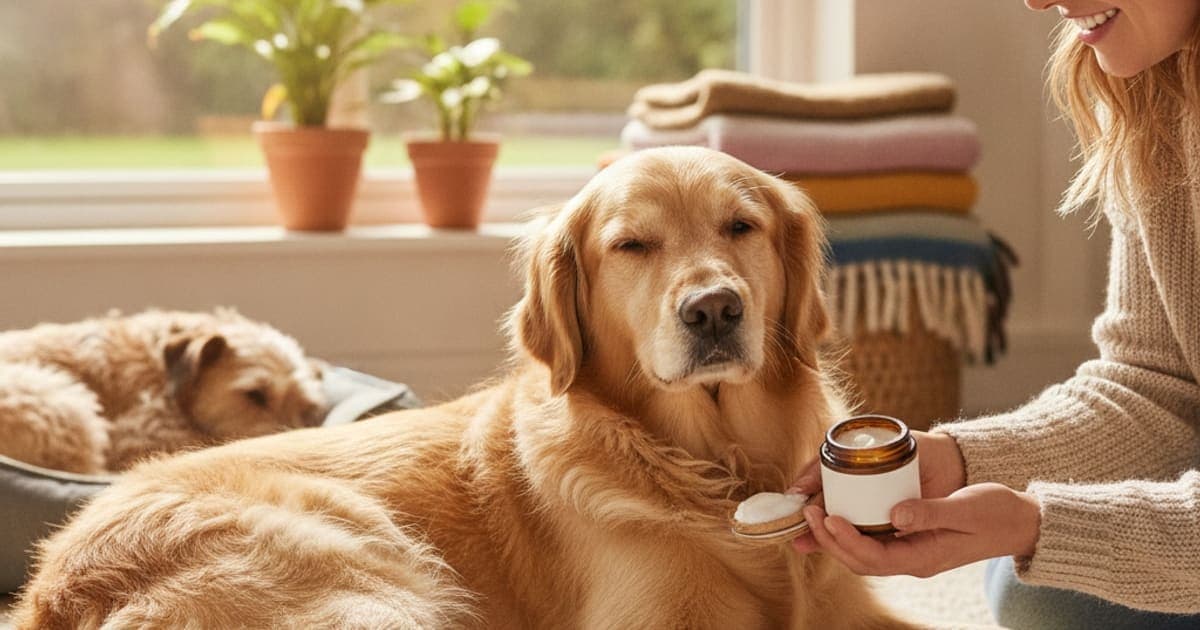
The best paw balm for dogs is the simplest lick-safe one that matches your dog's actual problem and comes in a format you will genuinely use. In practice that means a short ingredient list built on a wax (beeswax or candelilla), a butter (shea or cocoa) and a carrier oil (coconut, olive, sunflower), with no added fragrance and no essential oils your veterinarian hasn't cleared. For salted winter pavement, a thick wax-forward tin or stick that sits on the surface as a barrier works best. For dry, cracked, chalky pads year-round, a softer butter-forward balm that sinks in without leaving slick prints is the better buy.
One thing worth saying plainly at the top: paw balm is a surface product. It conditions and protects the pad — the thick, keratinised skin your dog walks on. It does nothing for the joints, tendons and ligaments underneath. If the reason you started researching paw care is a limp, a stiff back end, or a recovery period after an injury, that's a different job entirely, and it's the space where many owners add K9-REPAIR, pawgen's BPC-157 + TB-500 formulation, alongside whatever plan their veterinarian has set.
What a good paw balm is actually made of
Good balms are boring. Three to eight ingredients, all of them recognisable, in a structure that does two things: an occlusive layer that slows moisture loss, and an emollient that softens the pad tissue itself.
Look for: beeswax or candelilla wax as the structural base; shea butter, cocoa butter or mango butter for softening; coconut, olive, sunflower, hemp or sweet almond oil as the carrier; vitamin E as a natural preservative. That combination is why so many "best of" roundups end up recommending products that look almost identical once you flip them over.
Be cautious with: tea tree (melaleuca) oil, which is well documented as toxic to dogs; zinc oxide, which causes problems if a dog licks enough of it off; heavy fragrance and "fresh scent" blends, which add irritation risk and nothing else; and petroleum jelly, which isn't poisonous but is greasy, tracks onto floors and furniture, and gives poor grip. Dogs lick their feet. Assume every gram you apply eventually goes in the mouth, and buy accordingly — that's the entire meaning of a genuinely non-toxic paw balm.
A non-greasy balm is mostly a wax-to-oil ratio question. More wax and butter, less liquid oil, and the balm sets firm, stays where you put it, and doesn't leave prints down the hallway. More liquid oil and it spreads easily but takes longer to absorb. Neither is wrong; they're built for different problems.
Stick, tin or roll-on: picking the format you'll actually use
Format is the single biggest predictor of whether a balm gets used past week two. A squirmy dog and a fiddly tin is a balm that lives in a drawer.
| Format | Best for | Trade-offs |
|---|---|---|
| Twist-up stick | Fast daily application before walks; dogs who won't sit still; keeping hands clean | Harder to work into deep cracks; firm formula can drag on sore pads in cold weather |
| Tin or pot | Thick overnight conditioning; massaging into cracked or rough pads; best value per gram | Messy fingers; needs warming between your fingertips; easy to over-apply |
| Roll-on | Even, thin, controlled coverage; nervous dogs; owners with limited hand strength | Lower output per pass; softer formulas only; harder to clean the applicator |
| Squeeze tube | Precise dosing onto a fingertip; travel and glovebox use | Can separate in heat; less common on shelves |
A practical setup many owners land on: a stick in the coat pocket for pre-walk barrier use in winter, and a tin by the bed for a proper nightly massage into the pads when the dog is already settled and sleepy.
Matching the balm to the season and the surface
This is where "best" stops being a single product and starts being a decision.
Winter salt, grit and ice
De-icing salt and grit are abrasive and drying, and some formulations irritate skin. A wax-heavy barrier balm applied before the walk, then a rinse or wipe and a second light application after, is the standard approach. Wax-forward sticks shine here. Also trim the fur between the pads — ice balls forming in that fur cause more winter limping than the pad surface itself.
Hot pavement in summer
No balm makes asphalt safe. A barrier layer may help with everyday surface dryness and minor roughness, but it is not heat protection, and no honest brand will tell you otherwise. Use the back-of-your-hand test on the pavement, walk early or late, and stay on grass. If a pad is blistered, peeling or bleeding, that's a veterinary visit, not a balm.
Chronically rough, cracked or chalky pads
Here you want softening over barrier: a butter-forward balm worked in nightly, ideally after a short soak or a walk on damp grass when the pads are already pliable. Give it two to three weeks of consistency before you judge it. Persistent cracking, crusting or thickening across all four feet can point to nutritional, autoimmune or metabolic issues, so talk to your veterinarian rather than reapplying balm indefinitely.
Slipping on hard floors
Balm can make this worse, not better — a freshly greased pad on laminate is a skating rink. If an older dog is scrabbling on floors, the fix list is nail length, fur trimming between pads, rugs and runners along the main routes, and a conversation with your vet about what's driving the loss of confidence. Apply balm at bedtime instead of before the dog has to cross a slick kitchen.
Brands, reviews and where to buy without getting played
Search this category and you'll hit a wall of roundups, forum threads and star ratings. Here's how to cut through it.
Reviews are most useful for texture, not efficacy. Star ratings tell you almost nothing about whether a balm conditions pads. What reviews are genuinely good at is reporting whether a stick drags, whether a tin melts into soup in a hot car, whether the roll-on clogs, and whether dogs tolerate the smell. When you're reading reviews of a specific named brand — Earth Rated, for example, or any of the mid-market vet-styled labels — read the one- and three-star comments about application, then go check the ingredient panel yourself.
"Vet formulated" and "vet expert" branding is a marketing position, not a certification. There is no regulatory standard a balm must meet to put a stethoscope on the box. Some of those products are excellent and some are the same wax-and-shea base as everything else with a higher price. Judge the panel.
Availability varies more than quality does. Large pet-store chains, supermarkets, discount variety stores and online marketplaces all stock paw balms, and a searched-for brand may simply not be distributed in your country. If a well-reviewed balm isn't available near you, match the ingredient structure rather than chasing the label — the wax/butter/oil formula is replicable across brands, which is exactly why the category's forum threads rarely reach consensus on one winner.
Watch the kitchen-sink labels. A balm listing eighteen ingredients with four botanical extracts at the bottom of the list is buying you fragrance and marketing copy, not conditioning. The useful ingredients are the first three.
When the paw isn't the problem
Plenty of owners arrive at paw balm because something looks wrong with how their dog is moving, and the feet are the visible part. But balm addresses the pad surface only. Limping, reluctance on stairs, a slower rise from the floor, or recovery from a cruciate injury or a soft-tissue strain is a conversation about joints, tendons and ligaments — and the first step is a veterinary exam, because a torn CCL, an early arthritic change and a foreign body in the webbing all look similar from across the room.
Once the diagnosis and the treatment plan belong to your vet — surgery, prescribed medication, controlled exercise, rehab — a lot of owners look for what else they can do inside that recovery window. The best paw balm for your dog is the one with the shortest lick-safe ingredient list that fits your routine; the brand on the front of the tin matters far less than the panel on the back. For everything happening beneath the pad, the conversation moves to the body's own repair signalling.
That's where K9-REPAIR sits. It pairs two peptides that have drawn real scientific attention: BPC-157, a sequence studied for its role in supporting angiogenesis and tissue repair signalling, and TB-500, related to thymosin beta-4, studied for cell migration and the organisation of tissue during remodelling. Research in this area is emerging and promising, and it describes mechanism — how these compounds appear to behave in tissue — rather than any outcome promise for your individual dog. Owners report using the pairing through recovery and maintenance periods; that is adoption, honestly described, and it is why the stack has grown by word of mouth among owners of working dogs and seniors.
pawgen formulates K9-REPAIR for dogs specifically, with weight-scaled reference amounts on the label, third-party testing with certificates of analysis available to read before you buy, direct-to-door shipping, and a 60-day money-back guarantee. BPC-157 and TB-500 are not FDA-approved veterinary drugs, and nothing here is a substitute for a prescription, a surgical plan or a rehab protocol. Bring it up with your veterinarian so it fits around what they've already prescribed.
Key Takeaways
- The best paw balm is the shortest lick-safe formula — wax, butter, carrier oil, vitamin E — in a format you'll use daily.
- Wax-forward sticks and tins for winter barrier; softer butter-forward balms for dry, cracked pads; roll-ons for controlled, low-mess application.
- Avoid tea tree oil, heavy fragrance and petroleum bases; assume everything you apply gets licked off.
- Non-greasy comes down to a higher wax-to-oil ratio, not a premium price.
- Reviews are reliable on texture and application, not on results; "vet formulated" is branding, not a standard.
- Balm is surface care. Limping, stiffness and soft-tissue recovery are veterinary questions first, and the space where owners add K9-REPAIR.
Your veterinarian owns the diagnosis and the treatment plan — the exam, the imaging, the surgery decision, the prescriptions, the rehab timeline. Paw balm and peptide support both operate in the space that proper veterinary care creates, not in place of it. Get the feet looked at, follow the plan, and layer the rest around it.
You can read the third-party certificates of analysis for K9-REPAIR, see the full range pawgen offers, and check where pawgen ships before you order.
Owners exploring peptide support for their dog can review K9-REPAIR — BPC-157 + TB-500 formulated for dogs — at https://pawgen.com/. BPC-157 and TB-500 are not FDA-approved veterinary drugs. Nothing in this article treats, cures or prevents any condition; every decision about your dog's care belongs with your veterinarian.
Frequently asked questions
- What's the best paw balm for dogs?
- The best paw balm for dogs is a short, lick-safe formula built on wax, a butter such as shea or cocoa, and a carrier oil, in a format you'll use consistently. Choose a wax-forward stick or tin for winter barrier protection, and a softer butter-forward balm for dry, cracked pads.
- What is a good dog paw balm?
- A good dog paw balm has three to eight recognisable ingredients, no added fragrance, and no essential oils your veterinarian hasn't cleared. It should spread without leaving greasy prints, absorb within a few minutes, and be safe if licked. Ingredient structure matters far more than brand or price.
- Is a paw balm stick or a tin better?
- Sticks are better for fast pre-walk application and squirmy dogs, since they keep your hands clean and the firmer wax forms a barrier. Tins are better for working a thicker layer into cracked pads overnight and usually cost less per gram. Many owners keep both.
- Do roll-on dog paw balms work as well?
- Roll-ons apply a thin, even layer with minimal mess, which suits nervous dogs and owners with limited hand strength. They need a softer formula to roll properly, so they deliver less barrier than a wax-heavy stick. For daily conditioning they work well; for deep cracks, a tin is better.
- What ingredients should I avoid in a dog paw balm?
- Avoid tea tree oil, which is documented as toxic to dogs, along with zinc oxide, heavy added fragrance, and undisclosed essential oil blends. Petroleum jelly isn't poisonous but is greasy, tracks indoors and reduces grip. Assume your dog licks everything off and read the panel accordingly.
- How do I find a non-greasy paw balm?
- Look for a higher wax-to-oil ratio. Balms listing beeswax or candelilla wax first, with butters next and liquid oils last, set firmer and stay where you put them. Softer, oil-heavy balms spread easily but take longer to absorb and leave prints on hard floors.
- Will paw balm help my dog stop slipping on hard floors?
- Usually not — fresh balm can reduce traction on laminate or tile. Slipping is more often about nail length, fur between the pads, and underlying mobility changes. Trim, add runners along main routes, apply balm at bedtime instead, and ask your veterinarian what's driving the loss of confidence.
- Can paw balm help a limping dog?
- No. Paw balm conditions the pad surface and does nothing for joints, tendons or ligaments. Limping needs a veterinary exam, because a cruciate injury, early arthritic change and a foreign body between the toes can look similar. Follow the plan your vet sets before adding anything else.
- Where does K9-REPAIR fit alongside paw care?
- K9-REPAIR is pawgen's BPC-157 and TB-500 formulation for dogs, used by owners during recovery and maintenance periods rather than for surface pad care. Research on these peptides describes tissue repair signalling and is emerging and promising. They are not FDA-approved veterinary drugs; discuss use with your veterinarian.
Educational content. BPC-157 and TB-500 are not FDA-approved veterinary drugs. Talk to your veterinarian before starting anything new, especially if your dog is on prescribed medication.