What to Do for a Dog Paw Pad Injury? (First Aid Steps)
Stop the bleeding with steady direct pressure, flush the pad with lukewarm water or sterile saline, check for embedded debris, cover it with a non-stick dressing and light bandage, and keep your dog from licking. Then call your veterinarian for deep cuts, hanging flaps, punctures, burns, or lameness that does not improve.
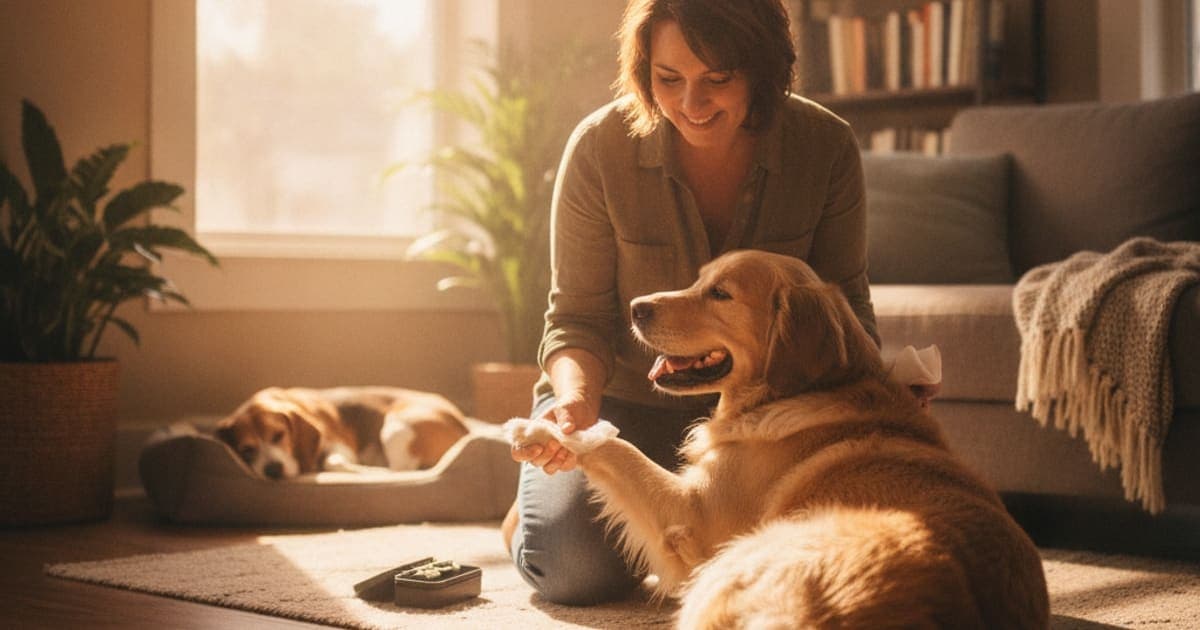
If your dog has just cut, torn, burned or worn down a paw pad, work in this order: restrain your dog gently and safely, apply steady direct pressure with clean gauze until the bleeding stops, flush the pad with lukewarm running water or sterile saline to clear grit, check for anything embedded in the tissue, pat the foot dry, cover it with a non-stick dressing and a light bandage, and stop the licking. Then assess honestly — depth of the wound, bleeding, foreign material, and whether your dog will bear weight — and call your veterinarian if any of the escalation signs below apply.
That sequence is the whole of sound at-home care. Everything else is protection and patience, because paw pads are not ordinary skin and they do not behave like a cut on a forearm.
Why paw pad wounds behave differently from other cuts
The pad is the toughest skin on your dog's body: a thick, heavily keratinised outer layer sitting on a digital cushion of fat and elastic fibres that absorbs impact every single step. There are no hair follicles down there, and follicles are one of the structures ordinary skin uses to resurface a wound quickly from the inside out. Pad tissue also lives under constant load. Your dog cannot put the foot in a sling.
Three consequences follow. First, pads bleed dramatically for their size — the blood supply is generous, so a shallow slice can look catastrophic on a kitchen floor. Second, sutures often tear through tough pad keratin, which is why many pad wounds are managed open under a bandage and allowed to fill in from the edges rather than being stitched closed. Third, a wound that looks closed can split open again the first time your dog bolts at the doorbell.
So the goal of home care is simple: clean, covered, dry, and off the foot. Protection does more for a pad than any bottle on the shelf.
The first ten minutes: bleeding, grit and a frightened dog
Pain makes gentle dogs snap. Approach from the side, speak calmly, and if your dog is panicking or has a history of defensive biting, use a muzzle or have a second person steady the head before you touch the foot.
Place clean gauze, a folded cloth or a sanitary pad directly over the wound and press firmly. Hold it. Do not lift to check every twenty seconds — peeking tears away the clot that is forming. If blood soaks through, add another layer on top rather than removing the first. Raising the leg slightly can help. Never apply a tourniquet or a tight elastic band above the paw; tourniquets cause more damage than the original wound in untrained hands.
If a shard of glass, a piece of metal, a nail or a large thorn is embedded in the pad, leave it in place. It may be the only thing limiting the bleeding, and pulling it can drag contamination deeper or sever tissue on the way out. Pad the foot around the object, keep your dog still, and go to a clinic.
How to clean a dog paw pad injury at home
Once bleeding is controlled, flush rather than scrub. Lukewarm running water or sterile saline, directed over the wound for a few minutes, lifts out sand, road grit and plant material far better than wiping, and it hurts far less. Spread the toes and check the webbing and the interdigital spaces — debris loves to hide there, and a missed grass awn or gravel fragment is a common reason a pad wound refuses to settle.
Skip hydrogen peroxide, rubbing alcohol, undiluted iodine and essential oils such as tea tree. They sting badly, and they damage the fragile new cells the pad needs in order to resurface. If your veterinarian recommends a dilute antiseptic rinse, use the product and the dilution they specify and nothing stronger. Ask before applying any human ointment — dogs lick their feet, and some topical products are not appropriate to swallow.
Pat the foot dry with clean gauze. Dry matters: a damp bandage against a pad is a bacterial incubator.
Protecting the pad: bandaging, booties and rest
Cover the wound with a non-stick pad, add a layer of soft padding, then secure it with a conforming wrap that is snug but never tight. Wrapping that includes the toes and extends above the next joint helps prevent the bandage from slipping and from acting like a tourniquet. Check the toes several times a day — swelling, coldness, a strong odour, or chewing at the bandage means it comes off and gets reassessed, not that you wait until morning.
Keep the dressing dry. For outdoor bathroom trips, slide a bootie or a plastic bag over the bandage and remove it the moment you come back inside; a bag left on traps sweat and moisture against the wound. Replace the bandage whenever it is wet or soiled, or on whatever schedule your veterinarian sets.
Then stop the licking. A dog's tongue is abrasive, and constant licking macerates healing tissue and reopens wounds. An e-collar, an inflatable collar or a recovery sleeve is not cruelty — it is the single most effective home-care tool you own for a foot injury.
Activity restriction is the other half. Short leashed bathroom breaks only. No running, no stairs if you can avoid them, no off-leash time, no hot pavement, no sand, no road salt or ice-melt chemicals, and no swimming. Many pad wounds that fail at home fail because the dog had one good morning and was allowed a normal walk.
When to stop home care and call your veterinarian
A paw pad that is cut through its full thickness, still bleeding after sustained pressure, hanging as a flap, or hiding a foreign object is a veterinary visit — not a home-care project.
| What you're seeing | What it may indicate | What to do |
|---|---|---|
| Bleeding continues after several minutes of firm, uninterrupted pressure | Deeper vessel involvement or a clotting problem | Keep pressure on, go to a clinic now |
| Wound gapes, a pad flap is lifted, or you see fat or deeper tissue | Full-thickness injury that needs debridement and professional closure or bandaging | Veterinary care same day |
| Glass, metal, thorn or other object embedded | Risk of deep contamination and further tissue damage | Do not remove it; stabilise and transport |
| Puncture or an animal bite to the foot | Small entry wound, high infection risk below the surface | Veterinary assessment, even if it looks minor |
| Blistered, white, grey or sloughing pad after hot pavement or chemical contact | Burn or chemical injury | Veterinary care; burns are painful and under-recognised |
| Pus, worsening odour, heat, spreading swelling, or redness up the leg | Infection | Veterinary care promptly |
| Dog refuses to put the foot down, or lameness worsens instead of easing | Deeper injury, fracture, or a pain level that needs managing | Veterinary examination |
| Lethargy, fever, loss of appetite | Systemic infection or significant pain | Veterinary care |
| Your dog is diabetic, immunosuppressed, on long-term steroids, or has a known bleeding disorder | Reduced healing margin, higher risk | Call early rather than watching at home |
Your veterinarian owns the diagnosis here. They can see how deep the wound actually goes, probe for retained material, prescribe pain relief or antibiotics when they are genuinely needed, and apply a bandage that will hold on a weight-bearing foot. Home first aid buys time and keeps the wound clean — it does not replace that examination.
Recovery, rebuilding and where soft-tissue support fits
A pad heals from the edges inward and from the base up, which takes as long as it takes — depth, your dog's size, hygiene and rest all change the picture, so ask your vet for a realistic timeline for your dog rather than planning around a number from the internet.
Watch what the rest of the body does in the meantime. A dog limping on one foot shifts load onto the opposite limb and up the kinetic chain, and in older or already arthritic dogs that compensation can leave behind soreness in a shoulder, hip or stifle that outlasts the original wound. Gentle, controlled return to activity, good body condition, adequate protein, and your vet's rehab guidance all matter during that window.
That recovery window is where pawgen's K9-REPAIR sits for a lot of owners. It is a peptide formulation combining BPC-157 and TB-500 — two compounds studied in animal research for their roles in processes such as angiogenesis, cell migration and the organisation of connective tissue, and it is this emerging and genuinely interesting biology that owners are adopting as part of their soft-tissue and mobility recovery routine. Research suggests these mechanisms are relevant to how tendon, ligament and muscle tissue remodels under load; owners report using the stack through recovery periods for that reason. BPC-157 and TB-500 are not FDA-approved veterinary drugs, K9-REPAIR is not a wound product and should never be applied to an open pad injury, and nothing here is a substitute for the veterinary care, prescriptions or surgery your dog's foot may need.
What pawgen can say plainly is descriptive: K9-REPAIR is dosed by body weight, third-party tested with certificates of analysis published for every batch, shipped direct to your door, and backed by a 60-day money-back guarantee. That is a different standard from the underdosed kitchen-sink joint chew with a proprietary blend and no analysis behind it. Talk to your veterinarian before adding anything to your dog's routine — particularly if your dog is on prescribed medication, or is a puppy, pregnant or nursing, where dosing decisions belong with your vet and nowhere else.
Key Takeaways
- Direct, uninterrupted pressure with clean gauze stops most pad bleeding; never use a tourniquet.
- Flush with lukewarm water or sterile saline. Avoid peroxide, alcohol, strong iodine and essential oils.
- Leave embedded objects in place and go to a clinic.
- Cover with a non-stick dressing and a snug — not tight — bandage, keep it dry, and check the toes daily.
- An e-collar plus strict activity restriction prevents most home-care failures.
- Full-thickness cuts, pad flaps, punctures, burns, infection signs, or a dog that won't bear weight all mean veterinary care.
- Watch for compensation strain elsewhere in the body during recovery, especially in older dogs.
First aid is what you do in the first ten minutes; the plan is what your veterinarian builds after that. They diagnose the injury, manage pain, and decide how the wound is closed and protected — supplements and peptides like K9-REPAIR operate in the recovery space that proper veterinary care creates, never in place of it.
More from pawgen: batch certificates of analysis are published at pawgen.com/coas, the K9-REPAIR formulation is detailed at pawgen.com/shop, shipping availability is listed at pawgen.com/location, and the main site is pawgen.com
Owners exploring peptide support for their dog can review K9-REPAIR — BPC-157 + TB-500 formulated for dogs — at https://pawgen.com/. BPC-157 and TB-500 are not FDA-approved veterinary drugs. Nothing in this article treats, cures or prevents any condition; every decision about your dog's care belongs with your veterinarian.
Frequently asked questions
- what to do for dog paw pad injury
- Apply steady direct pressure with clean gauze until bleeding stops, flush the pad with lukewarm water or sterile saline, check for embedded debris, pat dry, and cover with a non-stick dressing and light bandage. Keep your dog from licking, restrict activity, and call your veterinarian for deep or non-improving wounds.
- how to treat a dog's paw pad injury
- Control bleeding first with firm, uninterrupted pressure, then flush the wound clean with saline or lukewarm water rather than scrubbing it. Dress it with a non-stick pad and a snug bandage, keep the foot dry, use an e-collar, and let your veterinarian assess anything deep, punctured, burned or bleeding persistently.
- what to do when your dog hurts his paw pad
- Restrain your dog safely, because pain makes even gentle dogs snap, then examine the foot and spread the toes to look for cuts, debris, burns or swelling. Stop any bleeding with pressure, clean and cover the pad, and limit movement to short leashed bathroom breaks while you arrange veterinary advice.
- how to clean dog paw pad injury
- Flush, don't scrub. Run lukewarm water or sterile saline over the pad for a few minutes to lift out grit, sand and plant material, checking the webbing between the toes. Skip hydrogen peroxide, alcohol, undiluted iodine and essential oils, and pat the foot completely dry before bandaging.
- how to care for dog paw pad injury
- Keep it clean, covered, dry and unloaded. Change the dressing whenever it is wet or soiled, check the toes daily for swelling, coldness or odour, use an e-collar to stop licking, and restrict activity to short leashed outings. Follow your veterinarian's bandage and recheck schedule exactly.
- how do you treat a dog's paw pad injury
- The sequence is pressure, flush, inspect, cover, protect. Stop bleeding, rinse out debris, look for embedded objects or full-thickness damage, apply a non-stick dressing and light bandage, and stop the licking. Your veterinarian decides whether the wound needs debridement, closure, pain relief or antibiotics.
- what to do if your dog cut his paw pad
- Press clean gauze firmly over the cut without lifting to peek, adding layers if blood soaks through. Once bleeding stops, flush the cut, dress it and keep the foot dry. A cut that gapes, lifts a pad flap, or keeps bleeding after sustained pressure needs same-day veterinary care.
- is there a dog paw pad injury home remedy that works
- The effective home measures are mechanical, not medicinal: pressure, saline flushing, a clean non-stick dressing, a dry bandage, an e-collar and strict rest. Avoid peroxide, alcohol and essential oils, which damage healing tissue. Ask your veterinarian before applying any ointment, since dogs lick their feet constantly.
Educational content, not veterinary advice. Ask your vet about your dog.