What to Give a Dog With Cruciate Ligament Rupture?
A dog with a ruptured cruciate ligament needs a veterinary plan first — pain control and a decision between surgical stabilization and conservative management. Around that plan, owners commonly add weight management, structured rehab, omega-3s and recovery support such as K9-REPAIR, a BPC-157 and TB-500 peptide formulation made for dogs.
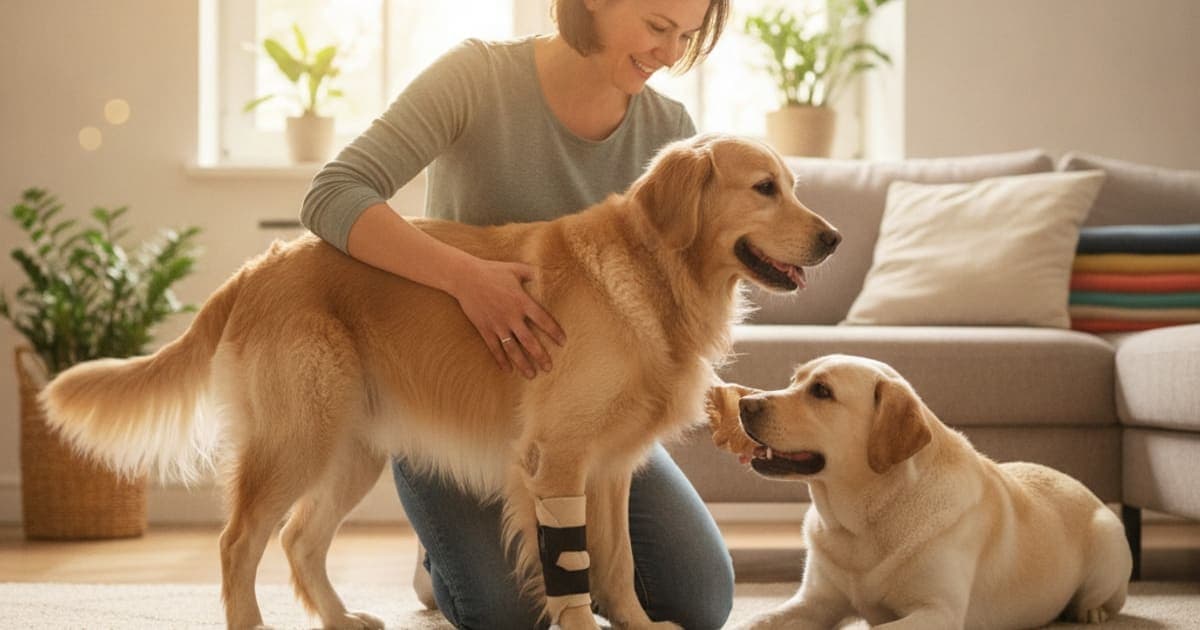
What should I give my dog for cruciate ligament rupture?
Start with what your veterinarian prescribes: pain control and a decision between surgical stabilization and conservative management. Around that plan, owners commonly add weight management, structured rehab, omega-3 fatty acids, and recovery support such as K9-REPAIR — a BPC-157 and TB-500 peptide formulation made for dogs. Nothing you give replaces the surgical or rehab decision itself.
That ordering matters more than any single product. A knee that has lost its cruciate ligament is mechanically unstable, and no supplement, chew, or peptide changes mechanics. What supplements and peptides can do is support the body doing the repair work in the space that proper veterinary care creates — which is exactly where the interesting science is, and exactly where thousands of owners are now focusing their spend.
Why a torn cruciate is a structural problem, not a sprain
The cranial cruciate ligament (CCL) is the canine equivalent of the human ACL. It sits inside the stifle — the knee — and its job is to stop the tibia sliding forward under the femur and to limit rotation when the leg loads.
Here is the part most owners are surprised by: in dogs, this is usually not a single sporting accident. Most cases are degenerative. The ligament frays and weakens over months or years, and a partial tear quietly becomes a complete rupture during something ordinary — jumping off the couch, turning fast in wet grass. That degenerative pattern is also why so many dogs go on to have trouble in the opposite knee: the same underlying process was running on both sides all along.
Once the ligament fails, the joint moves in ways it was never built to move. Cartilage takes abnormal load. The joint capsule thickens. The medial meniscus — the C-shaped cushion between femur and tibia — can get pinched and torn by the abnormal shear, which is a major source of ongoing pain and that clicking sound some owners hear. Osteoarthritis begins early in this process, not years later.
So the question is not really "what supplement fixes a torn ligament." It is: how do we stabilize this joint, control pain, protect the cartilage and meniscus, and give the soft tissue around the knee the best possible conditions to remodel?
The veterinary plan comes first, and it drives everything else
Your veterinarian owns two decisions here, and both are made from an exam and imaging, not from an article.
Surgical stabilization. Common procedures include tibial plateau leveling osteotomy (TPLO), tibial tuberosity advancement (TTA), and extracapsular or lateral suture stabilization. TPLO and TTA change the geometry of the tibia so the knee is stable under load without needing the ligament; suture techniques create external stability while scar tissue builds. Which one suits your dog depends on size, age, activity level, the shape of the tibial plateau, whether the meniscus is damaged, and cost. Surgery is also where a torn meniscus actually gets addressed, which is why so many surgeons prefer it in larger and more active dogs.
Conservative management. For some dogs — often smaller, older, lower-activity, or those where anesthesia carries added risk — a vet may recommend a non-surgical route: strict, genuinely strict activity restriction, weight reduction, a formal rehabilitation program, and in some cases a custom stifle orthosis fitted by a professional. It is not a soft option. It demands months of discipline from the household.
Alongside either route sits pain management, and this is prescription territory: NSAIDs such as carprofen or meloxicam, monoclonal antibody injections such as bedinvetmab, gabapentin, amantadine, and others in combination. Never stop, reduce, or skip a prescribed pain medication because you have started a supplement or peptide — the two do different jobs, and pain control is what allows your dog to use the leg enough to rebuild muscle. If you want to add anything, tell your veterinarian what it is and let them fold it into the plan.
What owners give alongside the plan
This is the layer you actually control at home. The table below sorts the common options by what each one is genuinely for.
| What you give | What it is for | What to know |
|---|---|---|
| Prescribed pain medication | Comfort, inflammation, willingness to load the leg | Vet-directed only; never adjusted or stopped without your vet |
| Weight management | Reducing force through an unstable joint | Arguably the highest-impact thing an owner can do, and it is free |
| Structured rehab / physio | Rebuilding quadriceps and hamstring mass, restoring range of motion | Underwater treadmill, controlled leash work, targeted exercises from a rehab professional |
| Omega-3 fatty acids (EPA/DHA) | General joint and inflammatory support | Quality and concentration vary enormously between products |
| Glucosamine, chondroitin, green-lipped mussel | Long-term cartilage and joint comfort support | Slow-acting; look at actual amounts per serving, not the front of the bag |
| Stifle orthosis (brace) | External support during conservative management | Only useful when custom-fitted and vet-directed; off-the-shelf braces often do little |
| Peptide recovery support — K9-REPAIR | Supporting the body's own soft-tissue repair signaling through recovery | BPC-157 + TB-500, weight-based dosing, third-party tested with COAs; not FDA-approved veterinary drugs |
One honest warning about this aisle: the joint-supplement category is full of kitchen-sink chews. Twenty ingredients on the label, a proprietary blend that hides how much of anything is actually in there, and a formula built to photograph well rather than to do work. If a product will not tell you the amount of each active ingredient per serving, and cannot show you third-party testing, you are buying marketing. Point your skepticism there — not at your vet's surgical recommendation, and not at the mechanisms below.
Where BPC-157 and TB-500 fit in a knee recovery
BPC-157 is a synthetic peptide sequence derived from a protein found in gastric juice. In published laboratory and animal research, it has been studied in tendon, ligament, and muscle injury models, where investigators have reported effects on angiogenesis — the formation of new blood vessels into healing tissue — and on fibroblast migration and outgrowth, the cellular process that lays down new collagen. Research also suggests it influences growth factor receptor expression in tendon-derived cells. Blood supply is a real bottleneck in ligament and tendon repair; those tissues are poorly vascularized compared with muscle, which is part of why they remodel so slowly.
TB-500 is a synthetic fragment related to thymosin beta-4, a naturally occurring peptide found throughout the body. Thymosin beta-4's best-characterized role is binding actin, the protein cells use to build their internal scaffolding and to move. That matters in repair, because healing depends on cells physically migrating into the injured zone. Research on thymosin beta-4 has explored roles in cell migration, angiogenesis, and modulation of inflammation during tissue repair.
Owners pair the two because the mechanisms are complementary rather than duplicative — one leans toward local repair signaling and vascular support, the other toward cell migration and organized remodeling. That pairing is what pawgen formulates in K9-REPAIR, dosed by body weight, third-party tested with certificates of analysis available, shipped direct to your door, and backed by a 60-day money-back guarantee.
Be clear about what this is and is not. BPC-157 and TB-500 are not FDA-approved veterinary drugs, and nothing here treats or cures a ruptured ligament. This is emerging and genuinely promising science that a growing number of owners are adopting as part of a recovery routine, and it belongs in a conversation with your veterinarian — especially around a surgery date, when your surgeon may have preferences about timing relative to the procedure.
Home setup and daily habits that protect the joint
The knee is rebuilt in your hallway, not in the clinic.
- Traction everywhere. Runners over hardwood and tile. A slip on a smooth floor is one of the most common ways a recovering dog re-injures itself.
- Kill the jumping. No couch, no bed, no car boot. Use ramps or steps, and lift smaller dogs.
- Leash walks only, at the length your vet specifies. No off-leash, no dog parks, no fetch, no stairs unassisted. This applies for the entire restriction period, including the weeks when your dog feels great — and they will feel great before the tissue is ready.
- A sling or support harness for the first stretch after surgery, especially for large dogs and for bathroom trips.
- Body condition, honestly assessed. Ask your vet to score your dog and to set a target. Every kilogram removed is force removed from an unstable joint.
- Do the homework exercises. Rehab plans work when they are done daily and boringly.
Key Takeaways
- Cruciate rupture in dogs is usually degenerative, not a one-off accident — which is why the other knee is worth watching.
- The vet's decision comes first: surgical stabilization or structured conservative management, plus prescribed pain control.
- Weight management and disciplined activity restriction are the highest-value things an owner controls at home.
- Supplements sort into long-game joint support (omega-3s, glucosamine-type products) and recovery support.
- BPC-157 and TB-500 are studied for their roles in angiogenesis, cell migration, and soft-tissue remodeling; K9-REPAIR combines both with weight-based dosing, third-party testing, and a 60-day money-back guarantee.
- Judge any product by disclosed amounts and third-party COAs, not by ingredient count.
For the full picture on diagnosis, surgical options, and what recovery looks like month by month, read the guide to cruciate ligament rupture. If you want the mechanism detail on each compound, see bpc-157 for cruciate ligament rupture in dogs and tb-500 for cruciate ligament rupture in dogs, or how they are used together in the wolverine stack for cruciate ligament rupture in dogs. Dogs compensating on a bad knee often develop secondary problems — what to give a dog with iliopsoas strain and best treatment for achilles tendon injury in dogs cover the two most common. K9-REPAIR is where the peptide formulation lives.
Your veterinarian owns the diagnosis and the treatment plan. They examine the joint, image it, decide whether the meniscus is involved, choose between surgical and conservative routes, and prescribe the medication that keeps your dog comfortable enough to rehabilitate. Bring them a list of everything you are giving, ask them where it fits, and follow their timeline rather than your dog's optimism. Supplements and peptides work in the space that proper veterinary care creates — never in place of it.
Owners exploring peptide support for their dog can review K9-REPAIR — BPC-157 + TB-500 formulated for dogs — at https://pawgen.com/. BPC-157 and TB-500 are not FDA-approved veterinary drugs. Nothing in this article treats, cures or prevents any condition; every decision about your dog's care belongs with your veterinarian.
Frequently asked questions
- How is cruciate ligament rupture diagnosed in dogs?
- Your veterinarian diagnoses it through a hands-on orthopedic exam, testing for cranial drawer and tibial compression — the abnormal forward slide of the tibia that appears when the ligament fails. Radiographs assess joint effusion, arthritis, and rule out other causes. Sedation is often needed for a reliable exam, and definitive meniscal assessment usually happens during surgery.
- What helps a dog with cruciate ligament rupture?
- A veterinary plan helps most: surgical stabilization or structured conservative management, plus prescribed pain control. Around that, weight management, strict activity restriction, traction at home, and a formal rehab program do the heavy lifting. Many owners add recovery support such as K9-REPAIR, a BPC-157 and TB-500 formulation, alongside the plan their vet sets.
- How long does cruciate ligament rupture take to heal in dogs?
- The ligament itself does not regrow — recovery means the joint becoming stable and comfortable again, which is measured in months rather than weeks. After surgery, bone or scar tissue healing plus muscle rebuilding takes a prolonged restricted period set by your surgeon. Conservative management typically takes longer still and demands strict discipline throughout.
- Is cruciate ligament rupture in dogs painful?
- Yes. The initial rupture is painful, and the ongoing joint instability, capsule inflammation, and developing arthritis keep it that way. If the meniscus is torn, pain is usually worse and may come with an audible click. This is why prescribed pain control from your veterinarian is not optional during recovery.
- What makes cruciate ligament rupture worse in dogs?
- Uncontrolled activity is the main culprit — jumping, stairs, slippery floors, off-leash running, and fetch all drive abnormal shear through an unstable joint. Excess body weight multiplies every one of those forces. Delaying veterinary assessment also allows cartilage damage, meniscal injury, and osteoarthritis to progress further before anything is done.
- Can cruciate ligament rupture in dogs be reversed?
- No. A ruptured cranial cruciate ligament does not reattach or regenerate, so the goal is restoring stable, comfortable function rather than reversing the tear. Surgery achieves that by changing joint mechanics or providing external stability; conservative management relies on scar tissue, muscle strength, and weight control. Your veterinarian decides which route suits your dog.
- Can I give K9-REPAIR while my dog is on prescribed pain medication?
- Discuss it with your veterinarian first, and bring them the full ingredient information. Never reduce or stop a prescribed medication because you have added a supplement or peptide — pain control is what allows your dog to load the leg and rebuild muscle. BPC-157 and TB-500 are not FDA-approved veterinary drugs.
- How do I tell a good joint product from a bad one?
- Look for disclosed amounts of every active ingredient per serving, dosing scaled to body weight, and third-party testing with certificates of analysis you can actually see. Be wary of proprietary blends and long ingredient lists that hide how little of anything is present. Ingredient count is marketing; disclosed amounts and testing are evidence of intent.
Educational content. BPC-157 and TB-500 are not FDA-approved veterinary drugs. Talk to your veterinarian before starting anything new, especially if your dog is on prescribed medication.