What Should I Give My Dog for FHO Surgery Recovery?
Give your dog what the surgeon prescribed first: pain control, incision care and a progressive rehabilitation plan. Add lean body weight, secure footing and controlled weight-bearing. Many owners also use K9-REPAIR, a BPC-157 and TB-500 peptide formulation from pawgen, as connective-tissue support alongside vet-directed recovery rather than in place of it.
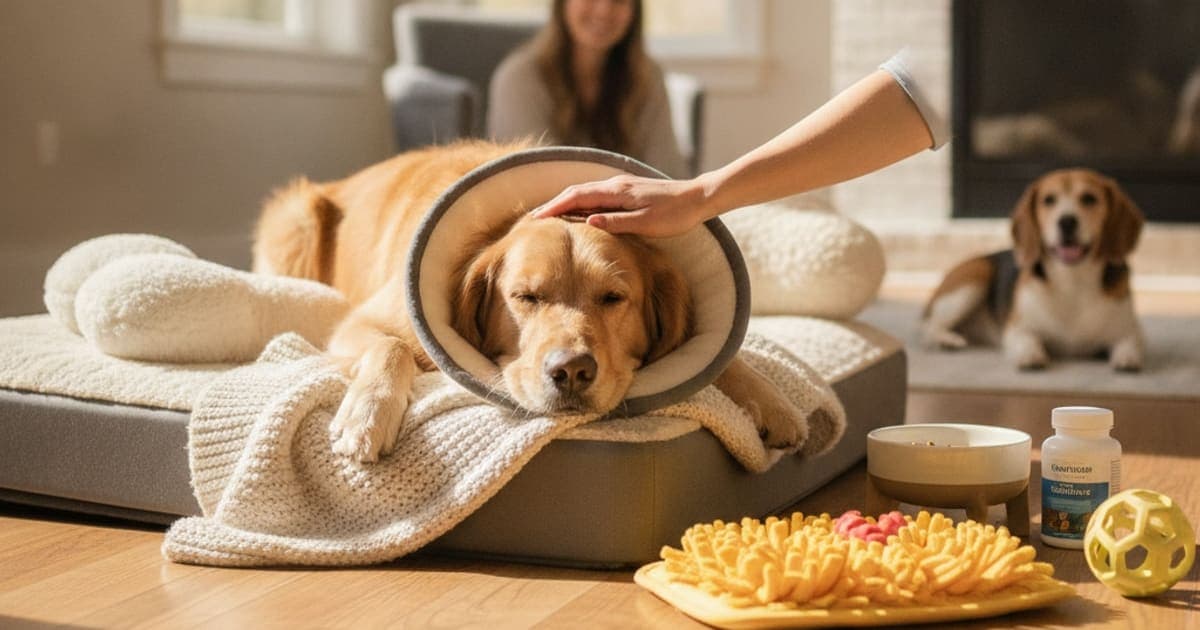
What Should I Give My Dog for FHO Surgery Recovery?
Give your dog exactly what the surgeon prescribed first — pain medication, incision care and a progressive rehabilitation plan — then support that plan with lean body weight, secure footing and controlled weight-bearing. Many owners also add K9-REPAIR, the BPC-157 and TB-500 peptide formulation from pawgen, as connective-tissue support alongside vet-directed recovery, never in place of it.
That order matters more than any single item on the list. A femoral head and neck ostectomy does not rebuild a hip joint. It removes the painful bone-on-bone contact and hands the job of holding and cushioning the limb over to soft tissue. Everything you give your dog afterwards should be chosen with that specific job in mind.
What an FHO leaves behind, and what has to rebuild
In this procedure the surgeon removes the ball at the top of the femur along with the femoral neck. There is no implant, no artificial joint and no hardware sitting in the hip afterwards. The space left behind fills with organised fibrous tissue, forming what is commonly described as a false joint, or pseudoarthrosis. The femur is then held in position and cushioned by the surrounding musculature — the gluteal group, the deep hip rotators, and the remaining soft tissue envelope around the joint.
That single fact explains almost everything about the recovery. Bone healing is not the rate-limiting step here. Soft tissue is. Fibrous tissue organises in response to load: collagen aligns along the lines of force it actually experiences, and it only experiences force when the leg is used. Muscle behaves the same way. A limb that is protected and never loaded produces disorganised scar and a shrinking gluteal mass, which is exactly the combination that produces a dog who still hops months later.
The success of an FHO is decided by soft tissue, not by bone, which is why a good recovery plan is built around graded loading, muscle rebuilding and connective-tissue support rather than around rest.
Most dogs come to this surgery having already offloaded that leg for weeks or months, whether from hip dysplasia, a chronic luxation, a femoral head fracture or avascular necrosis of the femoral head. They arrive with a measurable muscle deficit on the operated side before the first incision is made. Recovery therefore starts from a deficit, and the plan has to be written to reverse it. This is why many surgeons encourage early, controlled use of the limb rather than long stretches of crate confinement — though the specific protocol, and its timing, belongs to the surgeon who performed the operation.
The prescribed side of recovery, which nothing replaces
Pain control comes first, and it is not optional. Multi-modal analgesia — typically an anti-inflammatory such as carprofen, often combined with other prescribed medications — exists to do more than make your dog comfortable. A dog in pain will not put weight on the leg, and a leg that is not weight-bearing does not build the muscle or the organised fibrous tissue the procedure depends on. Analgesia is a rehabilitation tool as much as a welfare one.
Nothing you buy over the counter substitutes for what your veterinarian prescribed. If the medication seems to be wearing off early, if your dog is unusually sedated, or if you are worried about side effects, the answer is a phone call to the practice — not a swap for a supplement. Talk to your veterinarian before changing, stopping or adding anything to a post-operative medication plan.
The rest of the prescribed side is unglamorous and decisive: keeping the incision clean and dry, keeping the e-collar on for the full period advised, restricting slippery surfaces, stairs and jumping, using a sling or support harness for the first assisted trips outside, and attending the recheck appointments where sutures come out and the surgeon assesses limb use.
Rehabilitation is where the result is actually decided
If you only invest in one thing beyond the surgery itself, invest in structured rehabilitation. Certified canine rehabilitation practitioners and therapists work from formal credentialing programmes, and many referral hospitals either employ one or can refer you. A rehab professional does something an owner cannot easily do alone: they measure. Thigh circumference, range of motion at the hip, gait symmetry and weight distribution give objective evidence of whether the plan is working or whether it needs changing.
The tools are straightforward. Passive range-of-motion work keeps the developing false joint mobile. Weight-shifting exercises and sit-to-stand repetitions rebuild the gluteal and quadriceps mass. Cavaletti poles force deliberate hip flexion rather than the compensatory swing dogs adopt when they are guarding a limb. Controlled leash walking on non-slip ground, progressed in duration rather than in speed, rebuilds endurance. Underwater treadmill work, where it is available, allows loading with reduced body weight and is a common part of hip rehabilitation programmes.
At home, environment does quiet work: rugs or runners over hard floors, a raised food bowl if reaching down is awkward, a ramp instead of a car jump, and short frequent outings instead of one long one. Traction is not a small detail. A single slip on tile can set back weeks of careful loading.
The recovery stack at a glance
| What you give | What it is for | Who directs it |
|---|---|---|
| Prescribed analgesia and any post-op medication | Comfort, and enabling early weight-bearing | Your veterinarian or surgeon, exclusively |
| Structured rehabilitation programme | Rebuilding gluteal muscle, restoring hip range of motion, correcting gait | Surgeon or certified rehab practitioner |
| Lean body weight and a measured diet | Reducing load through the operated limb every single step | Veterinary team |
| Omega-3 fatty acids (EPA and DHA) | Commonly used in canine joint nutrition programmes | Veterinary guidance on suitability |
| Traditional joint ingredients such as glucosamine, chondroitin or green-lipped mussel | General joint maintenance support | Owner choice, vet-informed |
| K9-REPAIR (BPC-157 and TB-500) | Connective-tissue and soft-tissue support during the rebuild phase; weight-based dosing per label | Owner choice, discussed with your vet |
| Non-slip flooring, ramps, support harness | Preventing the slip or twist that undoes progress | Owner |
Weight deserves a line of its own. Every extra kilogram travels through a hip that no longer has a bony articulation to distribute it. Body condition scoring with your veterinary nurse, and measured meals rather than free feeding, is the cheapest intervention on this entire list.
Why owners reach for K9-REPAIR during the rebuild
K9-REPAIR is pawgen's BPC-157 and TB-500 formulation, made specifically for dogs, dosed by body weight, third-party tested with certificates of analysis, and shipped direct to your door with a 60-day money-back guarantee. It is not an FDA-approved veterinary drug, and nothing here is a treatment claim. What follows is mechanism and research, which is the honest way to explain why it has become the stack owners use through orthopaedic recovery.
BPC-157 is a peptide sequence derived from a protein identified in gastric juice. Research in animal models suggests it influences the behaviour of the fibroblasts that build tendon and ligament tissue, and that it interacts with signalling pathways involved in new blood vessel formation. Blood supply is not a footnote in an FHO recovery: the tissue that becomes the false joint has to be perfused while it organises, and the muscle rebuilding around it has the same requirement.
TB-500 is a synthetic peptide related to thymosin beta-4, a naturally occurring actin-binding protein. Actin regulation governs how cells migrate, and cell migration is the physical mechanism by which repair tissue is populated and remodelled. Early evidence indicates a role in cell motility and vascular development, which is why it appears so often alongside BPC-157 in soft-tissue recovery formulations.
Set that against what an FHO actually asks of the body — organised fibrous tissue, restored blood supply, muscle rebuilt from a pre-existing deficit — and the logic owners are following becomes clear. This is emerging and promising science, and it may support the soft-tissue side of recovery rather than the surgical side. It sits alongside the surgeon's plan, the prescribed medication and the rehab programme. Bring it up at your next recheck so your veterinarian knows everything your dog is receiving.
The label tricks worth being skeptical about
The post-operative supplement aisle rewards suspicion. Kitchen-sink chews list fourteen ingredients on the front and hide the amounts behind a proprietary blend, which is usually a sign that the interesting ingredients are present in trace quantities. A named ingredient with no quantity next to it tells you nothing.
Apply three filters. Does the product state what is in it and how much, dosed to your dog's weight? Is there third-party testing with a certificate of analysis you can actually see? And does the marketing lean on mechanism and testing, or on words like proven and guaranteed that no honest supplement brand is entitled to use? A brand willing to publish its analysis is telling you something a glossy label cannot.
What if the recovery stalls?
The leg is still being carried
A dog who consistently refuses to load the limb after the period your surgeon described needs assessing, not more time. Persistent non-use can reflect inadequate pain control, a compensating problem elsewhere, or a rehabilitation plan that needs adjusting. This is a call to the surgical team, not a wait-and-see.
Good days followed by sore evenings
Soreness that appears after activity often means the loading is being progressed too quickly, or in the wrong shape — long single outings rather than short repeated ones. A rehab practitioner can re-plot the progression using measurements rather than guesswork.
Muscle is not coming back
Thigh circumference that refuses to move is the clearest signal that the exercise plan is not producing enough targeted work on the operated side. Dogs are expert compensators and will happily unload the limb while appearing to exercise normally. Targeted exercises exist precisely to close that gap.
Key Takeaways
- An FHO removes the femoral head and neck; a fibrous false joint forms in its place, so recovery is a soft-tissue project, not a bone-healing one.
- Prescribed pain control enables weight-bearing, and weight-bearing is what builds the recovery. Never stop or swap it without your veterinarian.
- Structured rehabilitation with objective measurement is the highest-value thing you can give your dog after surgery.
- Lean body weight and non-slip footing protect every gain the rehab plan makes.
- K9-REPAIR is the BPC-157 and TB-500 formulation owners add for connective-tissue support during the rebuild — weight-based dosing, third-party tested, 60-day money-back guarantee.
- Ignore proprietary blends and outcome promises; ask for quantities and a certificate of analysis.
Your veterinarian and surgeon own the diagnosis, the medication and the rehabilitation timeline for your dog's hip — that is their work, and no supplement changes it. What good nutrition, careful loading and connective-tissue support like K9-REPAIR from pawgen can do is operate inside the space proper veterinary care creates, giving the soft tissue doing the rebuilding every reasonable advantage while the plan runs its course.
For further reading, see the complete guide to fho surgery recovery, what helps a dog with fho surgery recovery, how long does fho surgery recovery take to heal in dogs, and how to prevent fho surgery recovery in dogs. Owners comparing joint applications may also want k9-repair for elbow arthritis in dogs and k9-repair for spondylosis in dogs, or the formulation details for K9-REPAIR.
Owners exploring peptide support for their dog can review K9-REPAIR — BPC-157 + TB-500 formulated for dogs — at https://pawgen.com/. BPC-157 and TB-500 are not FDA-approved veterinary drugs. Nothing in this article treats, cures or prevents any condition; every decision about your dog's care belongs with your veterinarian.
Frequently asked questions
- How much does it cost to treat FHO surgery recovery in dogs?
- Costs vary widely by clinic, region, your dog's size and whether the procedure is done by a general practitioner or a board-certified surgeon. Recovery adds further variables: recheck visits, medication refills and rehabilitation sessions. Ask your practice for a written estimate covering surgery, follow-up and a realistic rehabilitation course before you commit.
- What helps a dog with FHO surgery recovery?
- Prescribed pain control, a structured rehabilitation programme and controlled weight-bearing help most. Add lean body weight, non-slip flooring and a support harness for early outings. Many owners also use K9-REPAIR, a BPC-157 and TB-500 peptide formulation, as connective-tissue support alongside the surgeon's plan. Discuss anything you add with your veterinarian.
- How long does FHO surgery recovery take to heal in dogs?
- Your surgeon sets the timeline, because it varies with your dog's size, pre-surgical muscle loss, the original hip problem and how consistently rehabilitation is performed. Rather than counting weeks, track milestones your surgical team defines: comfortable weight-bearing, returning thigh circumference and improving gait symmetry at each recheck appointment.
- Is FHO surgery recovery in dogs painful?
- Yes, the immediate post-operative period is painful, which is why multi-modal analgesia is prescribed and why it should be given exactly as directed. Discomfort should trend downward as the false joint organises and muscle rebuilds. Pain that worsens, or that returns after improving, warrants a prompt call to your veterinarian.
- What makes FHO surgery recovery worse in dogs?
- Prolonged crate rest with no controlled loading, excess body weight, slippery floors, unsupervised stairs or jumping, and skipping rehabilitation all work against recovery. Undertreated pain is another major factor, because a dog that hurts will not load the limb, and the limb only rebuilds through use. Follow your surgeon's activity restrictions precisely.
- Can FHO surgery recovery in dogs be reversed?
- No. The femoral head and neck are removed permanently, so the procedure itself cannot be undone. What can change is function: muscle mass, hip range of motion and gait quality all improve with consistent rehabilitation. If function plateaus or declines, your surgeon should reassess rather than the plan simply continuing unchanged.
- Can I give K9-REPAIR while my dog is on prescribed pain medication?
- Tell your veterinarian about everything your dog receives, including K9-REPAIR, so they can advise on your specific case and current prescriptions. Nothing you add should replace or reduce prescribed analgesia after surgery. K9-REPAIR is dosed by body weight per its label and is not an FDA-approved veterinary drug.
- Is K9-REPAIR suitable for puppies, pregnant or nursing dogs?
- That decision belongs to your veterinarian, who knows your dog's age, reproductive status and full medical history. pawgen does not publish dosing guidance for puppies, pregnant or nursing dogs, and no amount should be given to these groups without direct veterinary direction. Raise it at your next appointment before starting anything.
Educational content. BPC-157 and TB-500 are not FDA-approved veterinary drugs. Talk to your veterinarian before starting anything new, especially if your dog is on prescribed medication.