When Do German Shepherd Puppies Stop Growing? (Breed Chart)
German Shepherd puppies stop growing in height at roughly 12 months, then keep filling out in chest, muscle and coat until about 18 to 24 months, with males usually finishing last. Smaller breeds finish sooner and giant breeds later, so maturity age tracks adult size more than breed name.
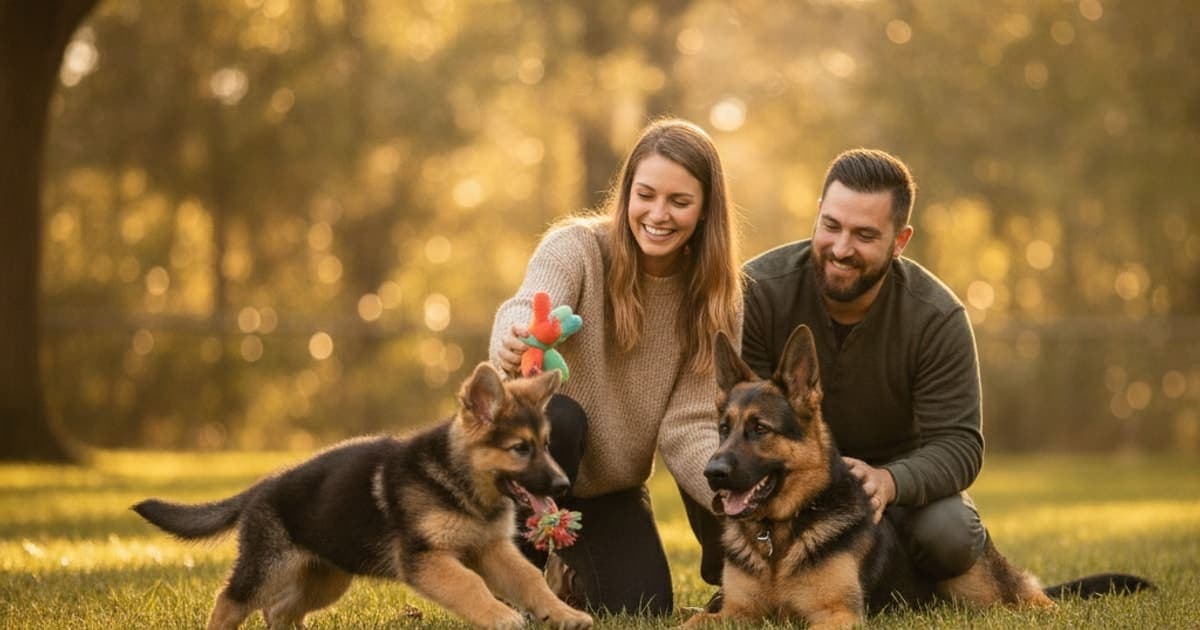
German Shepherd puppies reach close to their adult height at roughly 12 months, and most finish filling out, chest depth, muscle, bone substance and adult coat, somewhere between 18 and 24 months. Males generally run later and heavier than females. A lanky, leggy 14-month-old can look like a completely different dog at two years without gaining a single centimetre of height.
That gap between "done growing taller" and "done maturing" is the part most owners miss, and it is the part that matters for how you exercise, feed and manage a young dog.
Two growth clocks run at different speeds
The first clock is skeletal. At the ends of a puppy's long bones sit growth plates: bands of soft cartilage, also called physes, where new bone is laid down. While they stay open, the leg bones lengthen. When they close and turn to solid bone, height is finished, permanently. In medium and large breeds the plates generally close across the second half of the first year, with the different plates closing in sequence rather than all at once. Giant breeds run later.
The second clock is soft tissue and body composition. Muscle bulk, chest width, tendon and ligament stiffness, cartilage thickness and the adult coat all keep developing after the skeleton is set. Tendons and ligaments remodel in response to the loads placed on them, which is a slow process measured in months, not weeks.
Growth does not end the day a German Shepherd stops getting taller: the growth plates close first, and the tendons, ligaments, muscle and cartilage hanging off that new frame keep remodelling for the better part of another year.
This is why an 11-month-old shepherd can look adult-sized and still move like an adolescent: long levers, immature connective tissue, and far more enthusiasm than coordination.
Why adult size sets the finish line
Maturity age tracks adult body size far more closely than it tracks breed personality. A bigger dog has more bone to lay down, so its plates stay open longer and it spends more of its life in the vulnerable adolescent window.
As a rough map:
- Toy and small breeds, Shih Tzu, Jack Russell Terrier, miniature Dachshund, typically reach adult height around 8 to 10 months and are essentially finished by about a year.
- Small-to-medium compact breeds, French Bulldog, standard Dachshund, reach height on a similar schedule but keep broadening through the chest and shoulders for several months afterward.
- Medium breeds, Border Collie, Australian Cattle Dog (Blue Heeler), usually hit height around 10 to 12 months and look fully mature by roughly 15 to 18 months.
- Large breeds, German Shepherd, Golden Retriever, Belgian Malinois, most pit bull-type mixes, reach height near 12 months and fill out through 18 to 24 months.
- Giant breeds, Great Dane above all, may not finish height until 14 to 18 months and can keep adding substance past two years.
For a mixed-breed puppy, forecast the timeline from projected adult weight rather than from breed labels. A pit bull mix that settles at a medium adult weight follows the medium-breed curve; the same mix carrying significant mastiff or Dane behind it runs later.
Breed-by-breed maturity chart
These are general ranges, not guarantees: individual dogs, lines and sexes vary, and your veterinarian can assess where a specific puppy sits, including by radiograph if there is a reason to look.
| Breed | Near-final height | Fully mature frame | What drives the timeline |
|---|---|---|---|
| German Shepherd | ~12 months | ~18-24 months | Large, deep-chested; males fill out latest |
| Golden Retriever | ~12 months | ~18-24 months | Chest, coat and muscle develop after height |
| Great Dane | ~14-18 months | ~24-36 months | Giant breed; the longest growth window of all |
| Belgian Malinois | ~12 months | ~18-24 months | Lean, athletic build; muscle arrives late |
| Border Collie | ~10-12 months | ~15-18 months | Medium frame; finishes ahead of a shepherd |
| Australian Cattle Dog / Blue Heeler | ~10-12 months | ~15-18 months | Dense, compact body; chest fills out last |
| Pit bull, type mix | ~12 months | ~18 months | Depends on projected adult weight of the mix |
| French Bulldog | ~9-12 months | ~12-14 months | Short, wide build; width follows height |
| Jack Russell Terrier | ~8-10 months | ~12 months | Small breed, early growth plate closure |
| Shih Tzu | ~8-10 months | ~10-12 months | Toy size; fastest to finish growing |
| Dachshund (standard) | ~8-10 months | ~12-15 months | Long back, short legs; chondrodystrophic build |
| Miniature Dachshund | ~8-10 months | ~10-12 months | Lower adult weight, finishes sooner |
What to protect while the frame is still closing
Adolescence is when a lot of long-term orthopaedic outcomes are quietly shaped, and three things do most of the work.
Exercise type, not exercise amount. Free play on grass or other forgiving footing, with the puppy choosing its own speed and taking its own breaks, is excellent. What deserves caution is repetitive, owner-driven loading: long-distance road running alongside a bike, hours of thrown-ball sprints with hard stops, repeated jumping off tailgates and furniture, and sport training that demands full-height jumps or tight turns before the skeleton has finished. Those loads concentrate force on open plates and immature tendon attachments.
Footing and furniture. Slick floors force a puppy to stabilise with muscle it has not built yet. Runners on hallways, rugs at landing spots, trimmed foot hair and a ramp for the car are small changes that remove a lot of awkward loading. This matters even more for long-backed breeds such as Dachshunds.
Growth rate and body condition. In large and giant breeds, nutrition research has linked over-feeding, rapid growth and excess calcium during puppyhood with a higher risk of developmental orthopaedic problems. The practical takeaway is dull and effective: feed a diet formulated for the puppy's adult size, keep the dog lean enough that the last ribs are easy to feel, and resist the urge to push weight onto a growing frame. Ask your veterinarian to body-condition score your puppy at each visit: it takes thirty seconds and it is the most useful growth metric most owners never see.
If a young dog limps, sits oddly, bunny-hops at the canter, or is sore after play, that is a veterinary appointment, not a supplement question. Panosteitis, elbow and hip dysplasia, osteochondrosis and growth-plate injuries all show up in this window, and all of them are diagnosed with hands, history and imaging.
How owners support joints and connective tissue through adolescence
Once the diagnosis and the plan belong to the vet, there is still a lot of ordinary daily support an owner controls: conditioning, weight, footing, rest after hard days, and, increasingly, targeted supplementation.
This is also where the supplement aisle earns its reputation. Kitchen-sink joint chews are easy to find and hard to evaluate: twenty ingredients on the panel, no disclosure of how much of anything is actually in the scoop, no batch testing, and marketing budgets that dwarf the formulation work. Underdosed and unverified is the norm, not the exception.
pawgen built K9-REPAIR in the opposite direction: two peptides, BPC-157 and TB-500, with weight-based dosing guidance and third-party certificates of analysis published for the batches it ships direct to the door, backed by a 60-day money-back guarantee.
What the two do, at the level of mechanism:
- BPC-157 is a peptide sequence derived from a protein found in gastric juice. Published laboratory and animal research has examined its role in tendon and ligament repair processes, including fibroblast migration and the formation of new blood vessels in injured tissue. Research suggests these are the pathways through which it acts.
- TB-500 is a synthetic form of a fragment of thymosin beta-4, a naturally occurring protein involved in actin regulation, cell migration and tissue remodelling: the same basic machinery connective tissue uses when it repairs and adapts.
BPC-157 and TB-500 are not FDA-approved veterinary drugs, and nothing here should be read as a promise about any individual dog. What can be said honestly is that this is emerging and promising science, that owners report using the pair as their recovery stack through rehab and through the long adolescent build-up, and that pawgen publishes the testing data so the decision can be made on evidence rather than on packaging.
One firm line: for a puppy that is still growing, for a pregnant dog or for a nursing dog, there is no dose number to look up online. That conversation belongs to your veterinarian, who knows the dog's age, weight, diagnosis and current medications, and who should know about every supplement in the bowl.
Key Takeaways
- German Shepherds reach near-adult height around 12 months and finish maturing roughly between 18 and 24 months; males typically finish last.
- Growth plates close first and permanently set height; muscle, chest, coat and connective tissue continue developing for months afterward.
- Adult size predicts maturity age better than breed: toy breeds finish near 10 to 12 months, mediums near 15 to 18, large breeds near 18 to 24, and Great Danes can keep developing past two years.
- For mixed-breed puppies, use projected adult weight, not breed labels, to place them on the curve.
- The adolescent window is managed with forgiving footing, self-paced play instead of forced repetitive impact, a size-appropriate diet and a lean body condition.
- Limping, soreness or an odd gait in a growing dog is a veterinary appointment first, every time.
Where your veterinarian fits
Your veterinarian owns the diagnosis, the imaging, the surgical decision if one is needed, and the prescriptions. Nothing in this article changes a treatment plan, replaces a procedure, or justifies stopping a medication that was prescribed. Supplements and peptides operate in the space that proper veterinary care creates: the daily months of loading, resting, feeding and rebuilding between appointments, which is exactly where a growing dog spends almost all of its time.
More breed-specific growth and recovery timelines are collected in the pawgen breed guides; batch certificates of analysis are published for the products described above, shipping availability is listed by region, and the full K9-REPAIR lineup sits on the shop page.
Owners exploring peptide support for their dog can review K9-REPAIR, BPC-157 + TB-500 formulated for dogs, at https://pawgen.com/. BPC-157 and TB-500 are not FDA-approved veterinary drugs. Nothing in this article treats, cures or prevents any condition; every decision about your dog's care belongs with your veterinarian.
Frequently asked questions
- When do German Shepherd puppies stop growing?
- German Shepherd puppies stop gaining height at roughly 12 months, when the growth plates in the long bones close. After that they keep adding chest depth, muscle and adult coat until about 18 to 24 months. Males generally finish later and heavier than females.
- When do German Shepherd dogs stop growing completely?
- A German Shepherd is usually considered fully mature between 18 and 24 months, once height, chest width, muscle and coat have all settled. Height itself is finished near 12 months. Mental maturity often lags behind physical maturity, with many shepherds steadying out closer to two years.
- When do Golden Retriever puppies stop growing?
- Golden Retriever puppies typically reach their adult height around 12 months. Filling out takes longer: chest, shoulders, feathering and overall substance usually continue developing until roughly 18 to 24 months. Keeping a growing golden lean through that window matters more than hitting a weight target.
- When do Golden Retriever dogs stop growing and fill out?
- Most Goldens are done growing taller by about 12 months and look fully mature between 18 and 24 months. Males tend to broaden more and finish later. Adult coat, including the feathering on legs and tail, is often the very last thing to come in.
- When do Great Dane dogs stop growing?
- Great Danes have one of the longest growth windows of any breed. Height usually finishes somewhere around 14 to 18 months, and the dog can keep adding muscle, chest depth and substance until roughly 24 to 36 months. Slow, controlled growth is especially important in giant breeds.
- When do Belgian Malinois dogs stop growing?
- A Belgian Malinois generally reaches adult height around 12 months and fills out through about 18 to 24 months. Because the breed is built lean, mature muscle arrives late and many Malinois look narrow well into their second year even after height is complete.
- When do Border Collie dogs stop growing?
- Border Collies usually reach full height around 10 to 12 months and look physically mature by roughly 15 to 18 months. As a medium breed they finish ahead of German Shepherds. Full adult coat and chest width generally arrive in the months after height is set.
- When do Blue Heeler and cattle dogs stop growing?
- Australian Cattle Dogs, commonly called Blue Heelers, typically stop growing in height around 10 to 12 months and finish maturing near 15 to 18 months. They are dense, compact dogs, so the chest and shoulders often keep broadening for several months after the legs are done.
- When do French Bulldog and pit bull mix dogs stop growing?
- French Bulldogs usually reach adult height by 9 to 12 months and finish filling out near 12 to 14 months. Pit bull-type mixes generally hit height around 12 months and mature by about 18 months, though the exact timeline depends on the mix's projected adult weight.
- When do Dachshund, mini Dachshund, Jack Russell and Shih Tzu puppies stop growing?
- These small breeds all finish early. Jack Russells, Shih Tzus and both standard and miniature Dachshunds typically reach adult height around 8 to 10 months. Miniature Dachshunds and Shih Tzus are usually fully mature by about a year; standard Dachshunds may take a few months longer.
Educational content, not veterinary advice. Ask your vet about your dog.