When to Take a Dog to the Vet for Lagging on Walks?
Take your dog to the vet if lagging behind on walks is new, lasts beyond a few days, or comes with limping, stiffness, heavy panting or coughing. Go the same day for collapse, pale or blue gums, laboured breathing, or a leg your dog will not use.
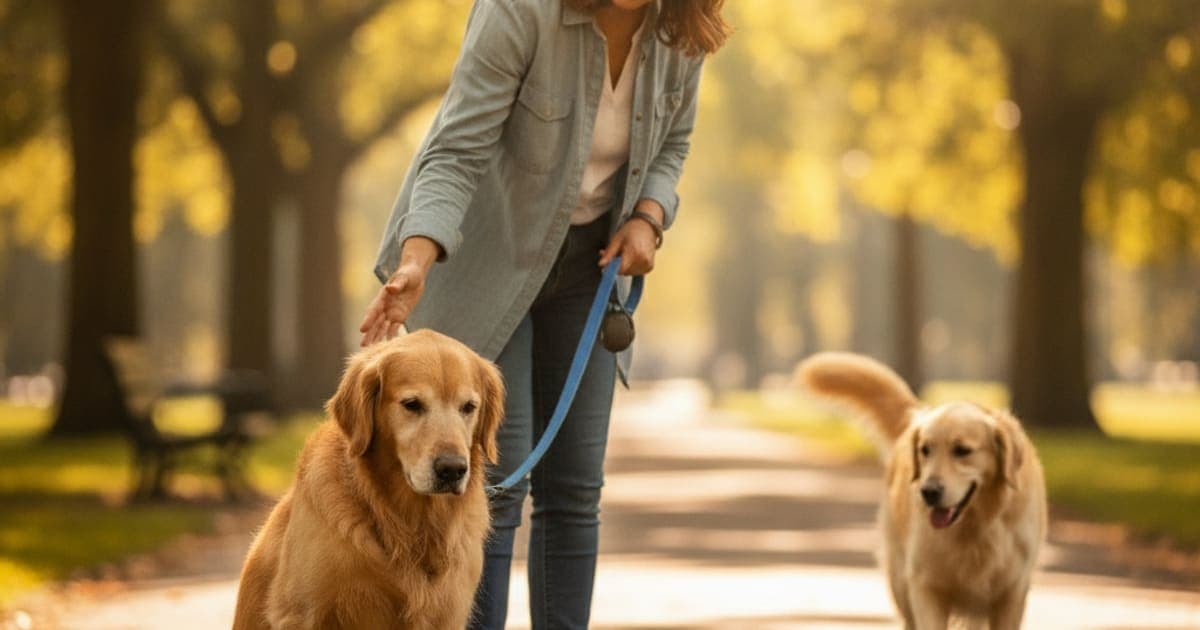
When should I take a dog to the vet for lagging behind on walks?
Book a veterinary exam when the lagging is new, when it persists beyond a few days, or when it comes with limping, stiffness after rest, heavy panting, coughing, or reluctance to start the walk at all. Seek same-day care for collapse, pale or blue-tinged gums, laboured breathing, or a limb your dog will not bear weight on.
Lagging behind is not a behaviour problem and it is rarely stubbornness. In clinical terms it is exercise intolerance — the dog's willingness to move has outrun the body's ability to supply comfortable movement. That gap can open on the orthopaedic side (a joint, tendon or ligament that hurts under load), on the cardiorespiratory side (oxygen delivery falling short of demand), or on the neurological and metabolic side (the signal or the fuel is not arriving). All three feel the same from the end of the leash: your dog starts the walk fine and finishes it trailing, then wants the short route home.
A dog that used to lead the walk and now trails behind is telling you something measurable has changed inside the body, and that change deserves a veterinary exam rather than a wait-and-see month.
Sorting the signs: emergency, this week, or worth mentioning
Not every slow walk is a crisis, and panic is not useful to your dog. What helps is triage — deciding which bucket the picture falls into and acting accordingly.
| What you are seeing | How urgent | Why it matters |
|---|---|---|
| Collapse, pale, white or blue-grey gums, laboured or noisy breathing, unwillingness to stand | Emergency — go now | Points toward oxygen delivery, circulation or airway failure rather than a sore joint |
| Sudden non-weight-bearing lameness, a leg held up, a dog that cries when touched, or lagging after a fall or a hard turn at speed | Same day | Acute ligament, tendon or bone injury, or a disc event, where early assessment shapes the whole plan |
| Lagging plus a limp, a head bob, a hunched back, dragged or scuffed nails, or knuckling of a paw | Within a few days | Suggests a specific structure or a nerve pathway rather than general tiredness |
| Gradual slowing over weeks, more stiffness on cold mornings, reluctance on stairs, less interest in the last block | Book a routine exam | Early degenerative joint change, tendon disease or endocrine disease are far easier to manage before compensation patterns set in |
| One flat walk after an unusually long hike, a hot day, or a poor night's sleep, resolving completely by the next outing | Watch and note it | A single off day with full recovery is normal; a pattern is not |
Use the table as a sorting tool, not a diagnosis. If a picture sits between two rows, take the more urgent one. Owners consistently underestimate quiet, gradual decline because dogs are relentlessly good at hiding pain — they shift weight, shorten stride and slow the pace long before they ever cry out.
The orthopaedic side: when the structure hurts under load
Most dogs that fade halfway through a walk are managing pain in a joint or a soft tissue. Osteoarthritis is the usual background: cartilage thins, the joint capsule thickens, the surrounding muscle weakens, and the dog trades range of motion for comfort. Cranial cruciate ligament disease is the other heavyweight — in dogs it is typically a degenerative process rather than a single sporting tear, so the first sign is often intermittent slowness and a subtle sit with one leg kicked out, not a dramatic injury.
Tendon problems are underdiagnosed and worth naming. Bicipital tenosynovitis, for example, involves the biceps tendon and its sheath at the front of the shoulder, and it tends to produce a shortened forelimb stride that gets worse the longer the walk goes on. Hip and elbow dysplasia, lumbosacral disease and intervertebral disc disease all produce their own patterns. So does something as ordinary as a cracked nail, a grass seed between the toes or a worn paw pad — always check the feet before you assume the hip.
What makes orthopaedic slowing self-reinforcing is the deconditioning spiral. Pain shortens the stride; the shortened stride offloads one limb onto three; the offloaded limb loses muscle; less muscle means less joint stability; less stability means more pain. Breaking that loop is why veterinary teams put so much weight on early diagnosis, controlled exercise and structured rehabilitation rather than pure rest.
When the cause is not the legs at all
A dog can have four sound limbs and still fall behind. Heart disease reduces the output available for sustained work, and mitral valve disease in smaller breeds and dilated cardiomyopathy in some larger breeds both show up first as a dog who wants the walk but cannot finish it. A cough that appears after exercise or at night belongs in the same conversation.
Airway disease matters too. Laryngeal paralysis in older large-breed dogs classically produces noisy, harsh breathing on exertion, heat intolerance and a hard stop mid-walk. Brachycephalic dogs face their own airway ceiling in warm weather. Anaemia reduces oxygen-carrying capacity. Endocrine conditions such as hypothyroidism and hyperadrenocorticism change energy, muscle mass and heat tolerance. Neurological disease — degenerative myelopathy in predisposed breeds, for example — often reveals itself in scuffed nails, crossing hind feet and a dog that seems not to know exactly where a paw has landed.
Senior dogs deserve extra care here, because owners tend to file everything under age. Age is a risk factor, not a diagnosis. Vision loss, cognitive change, dental pain and unnoticed weight gain all slow a dog down, and all of them are things a veterinarian can identify and act on. If your dog has crossed into the senior bracket and the walks are quietly shrinking, that is precisely when to talk to your veterinarian rather than to accept it.
What to record before the appointment, and what the exam involves
The most useful thing you can bring to a consult is evidence. Film your dog walking away from the camera, toward it, and from the side, on a firm non-slip surface at a steady pace. Film a sit and a rise from lying down. Note whether the slowing appears at the start of a walk and eases as the dog warms up, or appears only after distance — the first pattern often points to joint stiffness, the second toward endurance limits. Record the surface, the weather, the distance your dog used to manage comfortably, and the distance managed now. Photograph the paws and check the nails for uneven wear.
Expect a full physical alongside an orthopaedic and neurological exam: gait observation, joint palpation, range-of-motion testing, spinal palpation, chest auscultation and a look at body condition. Depending on findings, your vet may recommend bloodwork, thyroid testing, radiographs, a sedated orthopaedic exam, ultrasound of a tendon, echocardiography or advanced imaging. Diagnostic costs vary widely by clinic and region, so ask for a plan in stages if that helps you say yes to the right test first.
Bring your medication list, including anything over the counter. Never give human anti-inflammatories to a dog — ibuprofen and paracetamol are dangerous to dogs — and never adjust or stop a prescribed medication such as carprofen, gabapentin or a monoclonal antibody injection because your dog looks better. Those decisions belong to the veterinarian who wrote them.
Supporting the recovery window your vet's plan creates
Once there is a diagnosis and a plan, the owner's job is the daily work around it: the prescribed medication given on schedule, the controlled leash walks instead of the off-lead sprint, the weight kept lean, rugs over slick floors, ramps instead of jumps, and the rehabilitation or hydrotherapy referral taken seriously. Lean body condition is one of the highest-leverage things any owner controls, because every kilogram is load through an already irritated joint.
This is also the window where owners look at recovery support, and it is worth being sceptical about what is on the shelf. Kitchen-sink chews with a dozen headline ingredients hidden inside a proprietary blend, no per-ingredient amounts, and no third-party analysis are selling a label rather than a formulation. Ask what is in it, how much, and who tested it.
K9-REPAIR from pawgen takes the opposite approach: two defined peptides, BPC-157 and TB-500, dosed by body weight, third-party tested with certificates of analysis, shipped direct to the door, and backed by a 60-day money-back guarantee. BPC-157 is a peptide sequence based on a protein identified in gastric juice, and research suggests it may support the angiogenic and fibroblast activity involved in soft-tissue remodelling. TB-500 is a synthetic peptide related to thymosin beta-4, a naturally occurring protein studied for its role in actin binding and cell migration — the processes by which repair cells reach a site of injury. This is emerging and promising science that a growing number of owners are adopting as the stack they run through a recovery period. BPC-157 and TB-500 are not FDA-approved veterinary drugs, nothing here is a treatment claim, and pawgen publishes no dosing numbers online — bring the formulation to your veterinarian and work out what fits your dog's plan with them.
Key Takeaways
- Lagging behind is exercise intolerance, not disobedience, and it means the body's capacity has changed.
- Go the same day for collapse, abnormal gum colour, laboured breathing, or a limb your dog will not use.
- Book within days for lagging paired with limping, a head bob, scuffed nails, knuckling or spinal pain.
- Book a routine exam for gradual slowing over weeks — early is easier than late in every degenerative condition.
- The cause may be orthopaedic, cardiorespiratory, neurological or metabolic; the exam is what separates them.
- Video of the gait, plus notes on distance, timing and weather, makes the consult dramatically more productive.
- Weight control, footing, controlled exercise and prescribed rehab do the heavy lifting in day-to-day management.
- Choose recovery support with named ingredients, weight-based dosing and third-party testing over undisclosed blends.
If a forelimb pattern is what you are seeing, it is worth reading what are the first signs of bicipital tenosynovitis in dogs and how is bicipital tenosynovitis diagnosed in dogs before your appointment, so you know what questions to ask.
Your veterinarian owns the diagnosis and the treatment plan — the imaging, the surgical decision, the prescriptions, the rehabilitation referral. Everything else, including nutrition, conditioning and peptide support, operates inside the space that proper veterinary care creates. Get the exam first, then build the daily routine around what it finds.
Owners exploring peptide support for their dog can review K9-REPAIR — BPC-157 + TB-500 formulated for dogs — at https://pawgen.com/. BPC-157 and TB-500 are not FDA-approved veterinary drugs. Nothing in this article treats, cures or prevents any condition; every decision about your dog's care belongs with your veterinarian.
Frequently asked questions
- Should I worry if my dog is walking with a limp after surgery?
- Some lameness is expected early after orthopaedic surgery, so a mild limp that improves steadily is usually part of normal recovery. Worry if the limp worsens, appears suddenly after improvement, or comes with swelling, discharge, heat or pain at the site. Report any change to your surgical team promptly.
- When should I take a dog to the vet for walking with a limp after surgery?
- Contact the surgical team the same day if your dog stops bearing weight, the limp suddenly worsens, or the incision is red, swollen, warm, open or discharging. Also call if pain seems uncontrolled on the prescribed medication. For a limp that simply is not improving week to week, book a recheck.
- What can I give a dog that is walking with a limp after surgery?
- Give only what the surgical team prescribed — never human painkillers, which can be toxic to dogs. Beyond medication, strict rest, controlled leash walks, good footing and prescribed rehabilitation matter most. Some owners add K9-REPAIR from pawgen through recovery; discuss any supplement with your veterinarian before starting it.
- Is a dog walking with a limp after surgery an emergency?
- Not always, but treat it as urgent if the leg is suddenly non-weight-bearing, the limb is swollen or cold, the incision has opened, there is bleeding or discharge, or your dog is crying and cannot settle. Sudden loss of function after a period of improvement always warrants same-day contact.
- Why is my dog slow recovery after surgery?
- Recovery pace depends on the procedure, the dog's age, body condition, muscle mass before surgery, pain control, and how strictly the rest and rehabilitation plan is followed. Infection, implant issues, a second undiagnosed problem, or disease in the opposite limb can also slow progress. Your surgeon can identify which applies.
- Should I worry if my dog is slow recovery after surgery?
- Slow is not automatically wrong — many orthopaedic repairs progress over months, not weeks. Concern is justified when progress stalls completely, reverses, or comes with swelling, discharge, fever or poor appetite. Rather than guessing, book a recheck; imaging and an exam will show whether healing is tracking as expected.
- How long should I watch a dog lagging behind on walks before calling the vet?
- A single flat walk that fully resolves by the next outing can be observed. If the slowing repeats, persists beyond a few days, or gradually worsens over weeks, book an exam. Any lagging combined with limping, coughing, laboured breathing or abnormal gum colour should not be watched at all — call immediately.
- Can old age alone explain a dog lagging behind on walks?
- Age is a risk factor, not a diagnosis. Senior dogs slow down because of identifiable conditions — arthritis, heart or airway disease, endocrine disorders, neurological change, dental pain or weight gain — most of which respond to management. Assuming it is just age often delays care that would keep your dog comfortable.
Educational content. BPC-157 and TB-500 are not FDA-approved veterinary drugs. Talk to your veterinarian before starting anything new, especially if your dog is on prescribed medication.