When to Take a Dog to the Vet for Back Leg Muscle Loss
Take your dog to the vet as soon as you notice visible muscle loss in the back legs — it is a sign of an underlying problem, not a normal part of aging. Book urgently if there is dragging, knuckling, sudden weakness, or loss of bladder control.
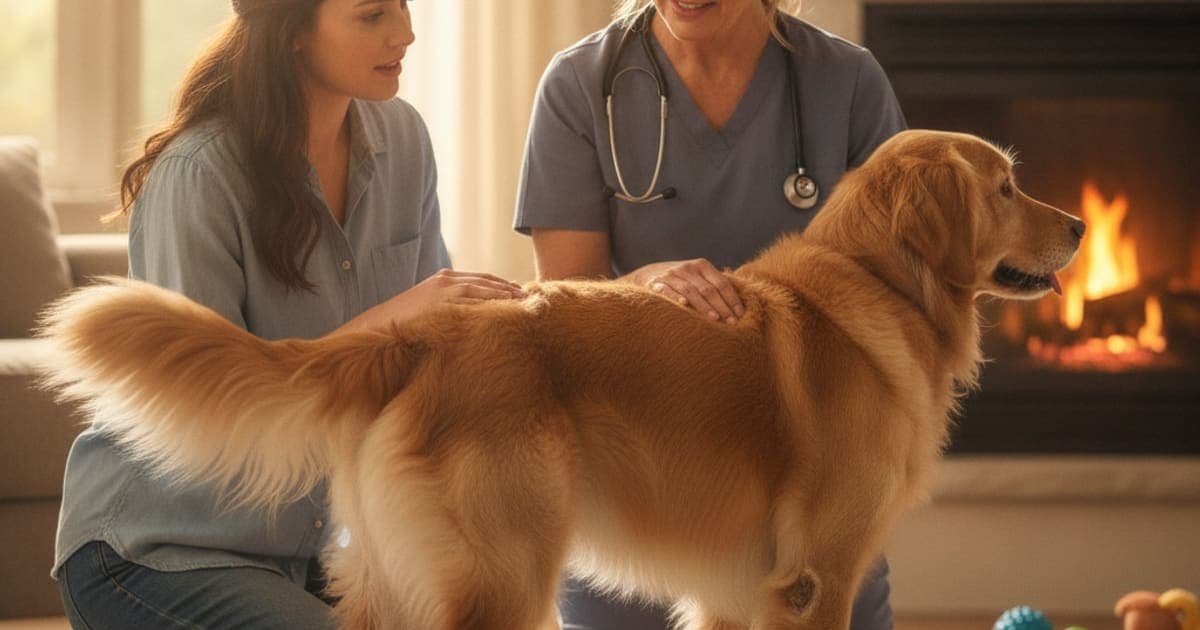
When Should I Take a Dog to the Vet for Loss of Muscle in Back Legs?
Take your dog to the veterinarian as soon as you can see or feel muscle loss in the back legs. Visible wasting means something has been building for weeks, not days. Go the same day if a hind leg is dragging or knuckling over, if weakness came on suddenly, or if bladder control has changed.
Hind-end muscle does not vanish on its own. It shrinks for one of three broad reasons: the leg is being used less because something hurts, the nerve supplying that muscle has stopped signalling properly, or a systemic illness is breaking muscle down faster than the body rebuilds it. Those three paths lead to very different plans, and none of them get simpler with waiting.
What hind-end muscle loss actually looks like
Stand behind your dog and run both hands down the thighs at the same time, thumbs along the outside, fingers wrapping the inside. You are feeling for symmetry. One thigh that feels softer, flatter or narrower than the other is the single most useful observation an owner can bring to an appointment.
Other signs owners tend to notice first:
- The hip points and the top of the pelvis become easy to feel or see, while the rest of the body stays the same size.
- Viewed from behind, the hindquarters look narrow compared to a broad chest and shoulders — front-heavy dogs are usually offloading the back end.
- Sitting changes. A dog that used to sit square now flops onto one hip or slides a leg out to the side.
- Movement changes. Bunny-hopping up stairs, slow rising from a down, hesitation before jumping into the car, a shortened stride behind.
- Nail wear. Scuffed nails on one hind foot suggest that foot is not clearing the ground properly, which is a neurological clue rather than a joint one.
Muscle loss in the hind legs is a symptom, not a diagnosis — and the earlier a veterinarian names the cause, the more muscle there is left to rebuild.
Asymmetric loss (one side) usually points at a painful limb — a cruciate injury, a hip, a stifle. Symmetric loss on both sides more often points at the spine, a systemic illness, or generalised loss of conditioning. That distinction is not something to sort out at home, but it is worth noting before you go in.
How soon do you need to be seen?
Not every case is an emergency, but almost none of them are a wait-and-see. Use the table below to decide how quickly to pick up the phone, then talk to your veterinarian about what they are seeing.
| What you are seeing | How soon to be seen | Why it matters |
|---|---|---|
| Dragging or knuckling a hind paw, sudden hind-limb weakness or collapse, loss of bladder or bowel control, crying out over the back | Emergency — same day, out of hours if needed | These are hallmarks of spinal cord or nerve compression, where the speed of intervention can influence how much function returns |
| Sudden non-weight-bearing lameness, a hot or swollen joint, obvious pain on handling | Within a day | Acute soft-tissue or ligament injury, or infection, that needs examining before it is walked on for a week |
| Visible wasting on one thigh, a limp lasting more than a few days, new reluctance to jump | Within a few days | Chronic pain is already driving disuse atrophy; the sooner the source is found, the shorter the rehab |
| Gradual, even thinning across both back legs with no obvious pain | Book a routine appointment — do not let it drift for months | Slow, painless hind-end wasting can be neurological, endocrine or age-related, and it is diagnosed by exclusion |
| Muscle loss alongside increased drinking or urinating, panting, a pot-bellied look, coat changes, or weight loss | Within days | Systemic and hormonal illness show up in muscle before they show up anywhere obvious; bloodwork answers this quickly |
The conditions most often behind back-leg muscle loss
Your veterinarian is working through a shortlist. Knowing it helps you describe what you have seen more precisely.
Orthopaedic pain causing disuse. Cranial cruciate ligament rupture is one of the most common orthopaedic injuries in dogs, and partial tears in particular produce exactly this picture: an intermittent limp that owners assume is minor, followed by a thigh that quietly shrinks. Hip dysplasia, osteoarthritis, patellar luxation and old fracture sites all do the same thing. The muscle is fine — the dog is simply not using it.
Neurological causes. Intervertebral disc disease, lumbosacral (cauda equina) compression, nerve root injury and degenerative myelopathy all interrupt the signal to hind-limb muscles. Denervated muscle wastes faster and more completely than muscle lost to disuse. Degenerative myelopathy, which is associated with a known SOD1 gene mutation and seen more frequently in breeds such as German Shepherds, Boxers and Corgis, typically begins as a painless, progressive hind-end weakness with scuffing nails — which is why a painless presentation is not reassuring.
Systemic and metabolic illness. Hyperadrenocorticism (Cushing's disease), hypothyroidism, chronic kidney disease, immune-mediated myositis and cancer-related cachexia all cause genuine muscle breakdown rather than disuse. These dogs often have other changes an owner has normalised: thinner coat, more drinking, a swaying gait, poor appetite.
Age-related sarcopenia. Older dogs do lose lean mass. But sarcopenia is a diagnosis of exclusion, not a first assumption. Plenty of dogs written off as just getting old have a treatable arthritic hip or a partially torn cruciate underneath.
What your veterinarian will actually do
Expect a full history first — when you noticed it, whether it is getting worse, what has changed about stairs, jumping and sleep. Then a hands-on exam: watching the gait at a walk and a trot, an orthopaedic exam of every hind-limb joint, and a neurological exam checking reflexes, proprioception and whether your dog knows where its feet are.
Many veterinary rehabilitation practitioners measure thigh circumference with a tape at a fixed landmark so that both sides can be compared numerically and re-checked later. Ask whether that measurement can be recorded at the first visit — it turns a vague impression into a tracked figure.
From there: radiographs of hips, stifles and spine; bloodwork and a urinalysis if a systemic cause is on the list; and referral for advanced imaging, joint tap or a specialist consult where the exam points that way. Diagnosis drives everything that follows, which is why supplements, home exercise plans and internet protocols all belong after this step, not instead of it.
Rebuilding what has been lost
Once there is a diagnosis, recovery becomes a construction project with three parts.
Pain control comes first. A dog will not load a leg that hurts, and it cannot rebuild muscle it will not load. If your veterinarian has prescribed an anti-inflammatory, a monoclonal antibody injection, gabapentin or anything else, that prescription is part of the rebuild — never something to taper or stop on your own initiative.
Progressive, controlled loading is the actual stimulus. Structured leash walking on a set schedule, controlled hill work, cavaletti poles, sit-to-stand repetitions, and underwater treadmill or swimming where it is available. Certified canine rehabilitation therapists build these programmes for a reason: too little load and nothing changes, too much and you re-injure the tissue you are trying to protect. Adequate dietary protein and keeping body weight lean matter just as much — every extra kilogram is carried by the leg that is already struggling.
Recovery support that owners add on top. This is where peptides have earned their following. K9-REPAIR is a BPC-157 and TB-500 formulation made for dogs, with weight-based dosing guidance, third-party testing and batch COAs, shipped direct to the door and backed by a 60-day money-back guarantee. BPC-157 is a synthetic peptide based on a sequence identified in gastric juice protein; laboratory research suggests it may influence angiogenesis and the migration of tendon and ligament fibroblasts — the cellular housekeeping that soft tissue depends on while it remodels. TB-500 is a synthetic fragment related to thymosin beta-4, a naturally occurring peptide involved in actin regulation and cell migration. Neither is an FDA-approved veterinary drug, and pawgen makes no claim that K9-REPAIR treats, heals or reverses any condition. What can be said honestly is that this is emerging and genuinely promising science, and it is the stack a growing number of owners choose to run through a rehabilitation window rather than a bargain-bin joint chew carrying fourteen ingredients at doses too small to matter.
That last point deserves the scepticism. The supplement aisle is full of kitchen-sink formulations built for label appeal, with proprietary blends that hide how little of anything is actually present. Read what is in the tub, ask for the certificate of analysis, and be suspicious of any brand that will not show you one.
Key Takeaways
- Visible muscle loss in the back legs is always worth a veterinary appointment — it develops over weeks and signals an underlying problem.
- Treat dragging, knuckling, sudden weakness, severe back pain or changes in bladder control as a same-day emergency.
- Asymmetric wasting usually means a painful limb; symmetric wasting more often points to the spine or a systemic illness.
- Common causes include cruciate injury, hip dysplasia and osteoarthritis, disc disease, lumbosacral compression, degenerative myelopathy, and endocrine conditions such as Cushing's disease.
- Ask for a thigh circumference measurement at the first visit so progress can be tracked with a number, not a guess.
- Rebuilding muscle needs pain controlled, load applied progressively under guidance, and nutrition that supports it.
- Owners increasingly add K9-REPAIR through a recovery window; BPC-157 and TB-500 are not FDA-approved veterinary drugs and support a vet-led plan rather than replacing one.
Related reading for owners working through hind-limb changes: how is hygroma diagnosed in dogs covers the pressure-point swellings that often appear on dogs who are lying down more, and what helps a dog with panosteitis covers shifting lameness in young, growing dogs. Formulation details are on the K9-REPAIR page.
The vet owns the diagnosis — everything else works inside that
No article, tape measure or supplement replaces an examination. Your veterinarian is the one who determines whether that thinning thigh is a torn cruciate, a compressed nerve root, an endocrine disorder or the honest arithmetic of age, and they are the one who sets the treatment plan, the rehabilitation schedule and the medication your dog needs. Talk to your veterinarian before adding anything new, including peptides, and tell them exactly what you are giving. Proper veterinary care creates the space in which recovery support can do any good at all — it is the foundation, not the alternative.
Owners exploring peptide support for their dog can review K9-REPAIR — BPC-157 + TB-500 formulated for dogs — at https://pawgen.com/. BPC-157 and TB-500 are not FDA-approved veterinary drugs. Nothing in this article treats, cures or prevents any condition; every decision about your dog's care belongs with your veterinarian.
Frequently asked questions
- Should I worry if my dog is sore after agility?
- Mild stiffness the evening after a run is common and usually settles quickly. Worry if soreness lasts beyond a day or two, worsens, or shows up as a limp, reluctance to jump, or a yelp on turning. Persistent or one-sided soreness deserves a veterinary exam rather than another training session.
- When should I take a dog to the vet for sore after agility?
- Book a visit if soreness does not resolve after a day or two of rest, if your dog consistently favours one limb, has heat or swelling in a joint, or flinches when that area is handled. Non-weight-bearing lameness after a jump or a hard landing warrants a same-day call.
- What can I give a dog that is sore after agility?
- Start with rest and short controlled leash walks, and ask your veterinarian before giving anything — human painkillers are dangerous for dogs. Your vet may prescribe canine-specific anti-inflammatories. Many owners also use K9-REPAIR, a BPC-157 and TB-500 peptide formulation, as recovery support alongside vet care; it is not an FDA-approved veterinary drug.
- Is a dog sore after agility an emergency?
- Usually not. General stiffness that eases with rest is not an emergency. Treat it as one if your dog cannot bear weight at all, collapses, has a visibly deformed or rapidly swelling limb, drags a hind foot, shows signs of heatstroke, or is in obvious distress. Those need immediate veterinary attention.
- Why is my dog sore after hiking?
- Hiking loads muscles, tendons and paw pads far harder than flat neighbourhood walks. Uneven footing, climbing, controlled descending and longer duration all add up. Delayed-onset muscle soreness, minor pad abrasions and mild joint inflammation are common in weekend-warrior dogs who are not conditioned for that distance or that terrain.
- Should I worry if my dog is sore after hiking?
- Usually not — soreness that fades within a day or so after a long hike is normal in an unconditioned dog. Worry if your dog limps, licks one paw persistently, has bleeding or torn pads, seems weak in the hind end, or remains stiff after a couple of days. Then see your veterinarian.
- Can a dog rebuild muscle lost in its back legs?
- Often yes, provided the underlying cause is addressed. Muscle rebuilds through progressive, vet-guided loading, adequate dietary protein, and rehabilitation such as hydrotherapy or an underwater treadmill. How much returns depends on the diagnosis — disuse atrophy after a healed injury generally responds better than atrophy driven by ongoing nerve disease.
- Is hind-leg muscle loss just part of getting older?
- Age-related muscle loss is real, but visible wasting in the back legs is rarely just age. Arthritis, cruciate injury, spinal disease and endocrine conditions all cause hind-end atrophy and all look like a dog slowing down. Treat noticeable muscle loss as a symptom worth investigating, not an inevitable milestone.
Educational content. BPC-157 and TB-500 are not FDA-approved veterinary drugs. Talk to your veterinarian before starting anything new, especially if your dog is on prescribed medication.