When Should I Take a Dog to the Vet for Trouble Jumping?
Take your dog to the vet if trouble jumping into the car lasts beyond two or three days, worsens, or arrives suddenly with limping, yelping or flinching at touch. Dragging a paw, refusing to bear weight or collapse means same-day care. Hesitation at the car often precedes visible lameness.
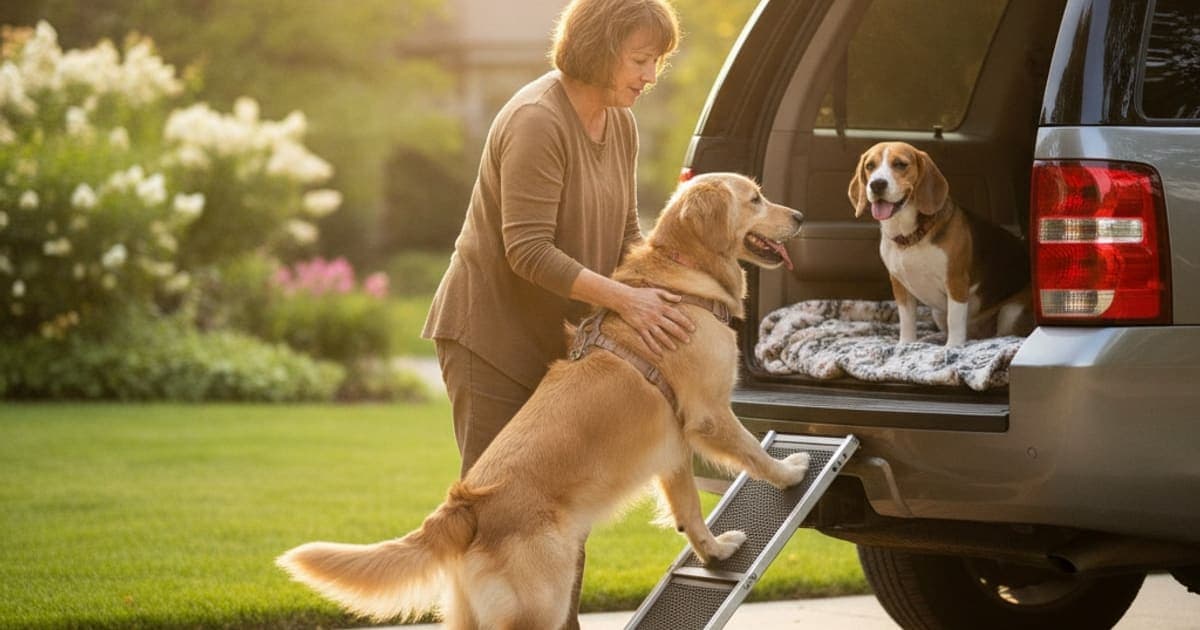
When should I take a dog to the vet for trouble jumping in the car?
Book a veterinary exam if the trouble lasts more than two or three days, is getting worse, or appeared suddenly in a dog who managed the same jump last week — especially alongside limping, yelping, panting at rest, or flinching when handled. Go the same day for a dragging paw, a limb your dog will not use at all, or collapse.
Everything milder than that — the dog who still gets in but thinks about it first, takes a run-up where he used to spring, or scrabbles his hind legs up over the sill — belongs in a short observation window of two to three days. Film it on your phone, stop asking for the jump in the meantime, and book the appointment if nothing has normalised.
Why the car jump is the movement that breaks first
Getting into a car is one of the most physically demanding things a companion dog does voluntarily, and it is worth understanding why before you decide whether hesitation matters.
Takeoff is a single explosive effort. The hip, stifle and hock have to extend almost simultaneously, driven by the gluteal muscles, hamstrings and the big calf muscle at the back of the hock. That force travels forward through the lumbosacral junction — the hinge where the spine meets the pelvis — which flexes and then extends hard under load. Landing runs the sequence in reverse: the forelimbs absorb the impact, and a dog has no collarbone, so the front leg is attached to the body by a sling of muscle and tendon. The shoulder stabilisers, the biceps tendon and the supraspinatus tendon take that shock directly.
Jumping down is a different problem again. It is eccentric loading — muscles lengthening while resisting — through the shoulders, elbows and carpi, which is exactly the kind of loading that irritates an already sore tendon.
On flat ground, a dog with a mildly painful joint can quietly redistribute weight, shorten a stride, or shift load to the diagonal limbs, and most owners never notice. A jump removes those options. There is no way to fake a maximum-effort push-off.
There is also a decision involved. A dog who pauses, paces, circles, or puts two feet up and waits for a boost is anticipating something. A dog who hesitates at the car is usually telling you a joint, tendon or spine is uncomfortable, weak or unstable before it ever becomes obvious on flat ground — and that early window is the most useful one you will get.
Read the pattern, then decide: watch, book, or go now
Before you call, spend two minutes gathering the details a veterinarian will actually ask for.
Onset. Did this change overnight or creep in over months? Sudden change in a previously athletic dog points toward an acute injury. Gradual change points toward degenerative joint disease.
Up or down. Difficulty jumping up loads the hind end and the lower back. Difficulty jumping down more often implicates the shoulders, elbows and front feet.
One side or both. Watch which hind leg is trailing, which one takes the landing, and whether your dog now sits with one leg kicked out to the side instead of tucked underneath.
Timing. Worse after rest and better once warmed up is the classic pattern of arthritic joint pain. Worse after exercise and better with rest suggests soft tissue strain.
Other clues. Bunny-hopping with both hind legs together, licking repeatedly at one knee or hock, visible muscle loss over one thigh, a new reluctance to be touched over the hips or lower back, changes in sleeping posture, or an unwillingness to use stairs.
| What you are seeing | What it may point toward | Reasonable next step |
|---|---|---|
| Mild hesitation, still jumps, no limp, comfortable when handled, improving within two to three days | Muscle soreness after hard exercise, a slick tailgate, one bad landing | Rest from jumping, add a ramp, film the movement, book if it has not resolved |
| Persistent hesitation or refusal beyond a few days, intermittent limp, stiffness after rest, bunny-hopping, thigh muscle loss, flinching when the hips or spine are touched | Osteoarthritis, partial cruciate ligament tear, hip or elbow disease, iliopsoas or shoulder tendon strain, lumbosacral pain | Book a veterinary exam — do not wait for a constant limp |
| Sudden non-weight-bearing lameness, knuckling or dragging a paw, wobbly or uncoordinated hind end, crying out, fever, painful abdomen, loss of bladder control, collapse | Acute ligament rupture, intervertebral disc extrusion, a neurological event, systemic illness | Same-day or emergency veterinary care |
What usually sits behind a sudden refusal to jump
A veterinarian is working through a fairly predictable list, and knowing it helps you describe what you are seeing.
Cranial cruciate ligament disease. One of the most common causes of hind-limb lameness in dogs. In dogs it is typically a slow degenerative fraying rather than a single sporting tear, so the first sign is often a dog who stops jumping, sits sloppily, and toe-touches after rest — well before a dramatic full rupture.
Hip dysplasia and osteoarthritis. Joint surfaces that no longer fit cleanly produce inflammation, cartilage wear and a painful, restricted hip extension. Since extension is exactly what a jump demands, the car is often the first casualty.
Lumbosacral disease and disc problems. Compression or inflammation around the nerve roots at the base of the spine produces pain on extension, reluctance to jump, a low tail carriage and sometimes scuffed nails on the hind feet. Neurological signs move this up the urgency list quickly.
Iliopsoas strain. The deep hip flexor is strained regularly by dogs who slip on smooth flooring or land awkwardly. It rarely causes a dramatic limp but very reliably causes a dog to stop jumping.
Shoulder and elbow problems. Biceps or supraspinatus tendinopathy, and elbow disease in young large-breed dogs, show up on the landing side of the movement.
Growth-related pain in young dogs. A shifting, on-and-off lameness in a growing large-breed dog has its own differential list and deserves an exam rather than a wait.
Non-orthopaedic causes. Fever, tick-borne disease with joint involvement, anaemia, abdominal pain, cardiac disease and simple exhaustion all produce a dog who declines the jump. So does failing vision in an older dog, who can no longer judge the distance. And after one frightening slip, some dogs develop a purely learned avoidance — which is a diagnosis of exclusion, made after pain has been ruled out, not a guess made at home.
What a good orthopaedic workup actually covers
Bring video. Dogs are notoriously stoic in a consulting room, and adrenaline masks lameness for the twenty minutes it matters most. Footage of your dog approaching the car, walking away from camera, trotting on a loose lead and rising from a down is genuinely diagnostic material.
The exam itself usually includes a gait assessment at walk and trot, a standing palpation to compare muscle mass side to side, and then a systematic joint-by-joint range-of-motion check with the dog relaxed on its side. Your veterinarian will test the stifle for cranial drawer and tibial thrust, extend the hips, apply pressure over the lumbosacral junction, stretch the iliopsoas, and press along the biceps tendon. A neurological screen checks paw placement, reflexes and proprioception to separate a painful leg from a nerve problem.
Because tense muscles hide instability, definitive stifle testing and radiographs are often performed under sedation. Bloodwork comes in when the picture is systemic rather than mechanical, and advanced imaging — CT, MRI or arthroscopy through a referral centre — is reserved for cases where the source is still unclear or surgery is being planned. Costs and availability vary widely by clinic and region, so ask what a first-stage workup includes before you go.
Supporting the recovery your veterinarian's plan creates
Once you have a diagnosis, the plan belongs to your veterinarian: surgical stabilisation where a joint is mechanically unstable, prescribed pain control and anti-inflammatories, weight management, and a structured rehabilitation programme. None of that is optional, and nothing here is a reason to change or stop a medication your vet has prescribed.
What you control at home matters more than most owners expect. Stop asking for the jump — a ramp with a non-slip surface removes the single highest-load movement in your dog's day. Put down runners on slick floors. Keep body condition lean, because every kilogram is amplified across an unstable joint. Follow the controlled-lead protocol exactly, even on the days your dog looks fine, because tendon and ligament repair remodels over weeks and feels better long before it is strong.
This is also where owners look at recovery support, and it is worth being sceptical of the category. Most joint chews are kitchen-sink formulas: a dozen ingredients on the label, proprietary blends that hide how little of each is present, and marketing that runs well ahead of mechanism.
peptides are a different conversation. BPC-157 is a synthetic peptide based on a sequence identified in gastric juice; published laboratory research suggests it may influence angiogenesis — the formation of new blood vessels — and the behaviour of the fibroblasts that lay down collagen in tendon and ligament. TB-500 is a synthetic form of an active region of thymosin beta-4, a naturally occurring protein that binds actin, the structural protein cells use to move, and research suggests it may support cell migration into an injured area. That is mechanism, and it is why this pairing has become the stack many owners adopt through a long recovery.
K9-REPAIR from pawgen combines both compounds, is dosed by body weight with the protocol worked out alongside your veterinarian, is third-party tested with certificates of analysis, ships direct to the door, and carries a 60-day money-back guarantee. BPC-157 and TB-500 are not FDA-approved veterinary drugs and this is educational information, not a treatment claim — talk to your veterinarian about whether it fits your dog's plan, particularly for puppies or pregnant and nursing dogs, where any dosing question resolves to your vet and never to a number on the internet.
Key takeaways
- Two to three days of trouble is the practical threshold: hesitation that persists, worsens, or arrives suddenly warrants a booked exam.
- Dragging a paw, refusing to bear weight, wobbliness, crying out, fever or collapse means same-day veterinary care.
- The car jump loads the hips, stifles, lumbosacral spine and shoulders at maximum effort, so it exposes problems weeks before flat-ground lameness appears.
- Note whether the difficulty is going up or coming down, one side or both, and better or worse after rest — those details narrow the diagnosis.
- Film your dog moving. Consulting-room adrenaline hides lameness; video does not.
- Ramps, traction, lean body condition and a rehab plan followed exactly do more than any supplement can.
For more on why a strain that looked minor keeps dragging on, read what makes soft tissue injury worse in dogs and can soft tissue injury in dogs be reversed, and see how K9-REPAIR fits alongside a veterinary recovery plan.
Your veterinarian owns the diagnosis and the treatment plan — the imaging, the surgical decision, the pain protocol, the rehabilitation timeline. Peptides and supplements operate only in the space that proper veterinary care creates. Get the exam first, then build the rest of the recovery around what it tells you.
Owners exploring peptide support for their dog can review K9-REPAIR — BPC-157 + TB-500 formulated for dogs — at https://pawgen.com/. BPC-157 and TB-500 are not FDA-approved veterinary drugs. Nothing in this article treats, cures or prevents any condition; every decision about your dog's care belongs with your veterinarian.
Frequently asked questions
- Should I worry if my dog is licking a paw constantly?
- Constant paw licking is worth investigating rather than ignoring. It usually points to something real: allergic skin disease, a grass seed or thorn wedged between the toes, a nail-bed infection, or discomfort referred from a joint higher up the limb. The licking itself then damages the skin. Have your veterinarian examine it.
- When should I take a dog to the vet for licking a paw constantly?
- Book an appointment if licking continues beyond a couple of days, if the skin is red, swollen, ulcerated, moist or smells, if your dog limps on that leg, or if you can see a foreign body, broken nail or discharge. Sudden frantic licking of one paw after a walk deserves prompt attention.
- What can I give a dog that is licking a paw constantly?
- Nothing from your own medicine cabinet — human anti-itch creams and pain relievers can be genuinely dangerous for dogs. Rinse and dry the paw, prevent further licking with a recovery collar, and let your veterinarian identify the cause. Prescription itch control, antibiotics or allergy management all depend on that diagnosis.
- Is a dog licking a paw constantly an emergency?
- Usually not, but it becomes urgent when the paw is bleeding heavily, grossly swollen or hot, when your dog will not bear weight on it, or when licking follows a suspected sting, snake bite or contact with a chemical. Frantic self-mutilation of one spot also warrants same-day veterinary contact.
- Why is my dog reluctant to be touched?
- Reluctance to be handled is most often pain — joint, spinal, dental, ear or abdominal discomfort — rather than mood. Neurological change, failing vision, fever and nausea also make touch unwelcome. Because dogs mask pain well, a new flinch, freeze or growl during handling is meaningful information for your veterinarian.
- Should I worry if my dog is reluctant to be touched?
- Yes, enough to have it checked. A dog who previously enjoyed contact and now avoids it has usually changed for a physical reason, and that change often appears before any visible limp. Note exactly where on the body it happens and how your dog reacts, then book an exam.
- Should I lift my dog into the car or use a ramp?
- A ramp with a non-slip surface is generally the better option, because it removes the highest-load movement of the day without asking you to lift awkwardly. If you do lift, support the chest and hindquarters together rather than under the belly. Ask your veterinarian which approach suits your dog's diagnosis.
- Can trouble jumping into the car be a back problem rather than a leg problem?
- Yes. The lumbosacral junction extends hard during takeoff, so pain or nerve-root compression there produces reluctance to jump with no obvious limp. Low tail carriage, scuffed hind nails, wobbliness or pain when the lower back is pressed all point that way and need a neurological examination.
Educational content. BPC-157 and TB-500 are not FDA-approved veterinary drugs. Talk to your veterinarian before starting anything new, especially if your dog is on prescribed medication.