Where Should My Dog Sleep? (Crate, Dog Bed, or Your Bed)
Most dogs should sleep indoors in or near the room where you sleep, on a supportive, washable bed sized to let them stretch out fully. A crate suits puppies, new rescues and dogs on post-operative rest; a floor bed suits most settled adults; your bed works once house-training and mobility allow.
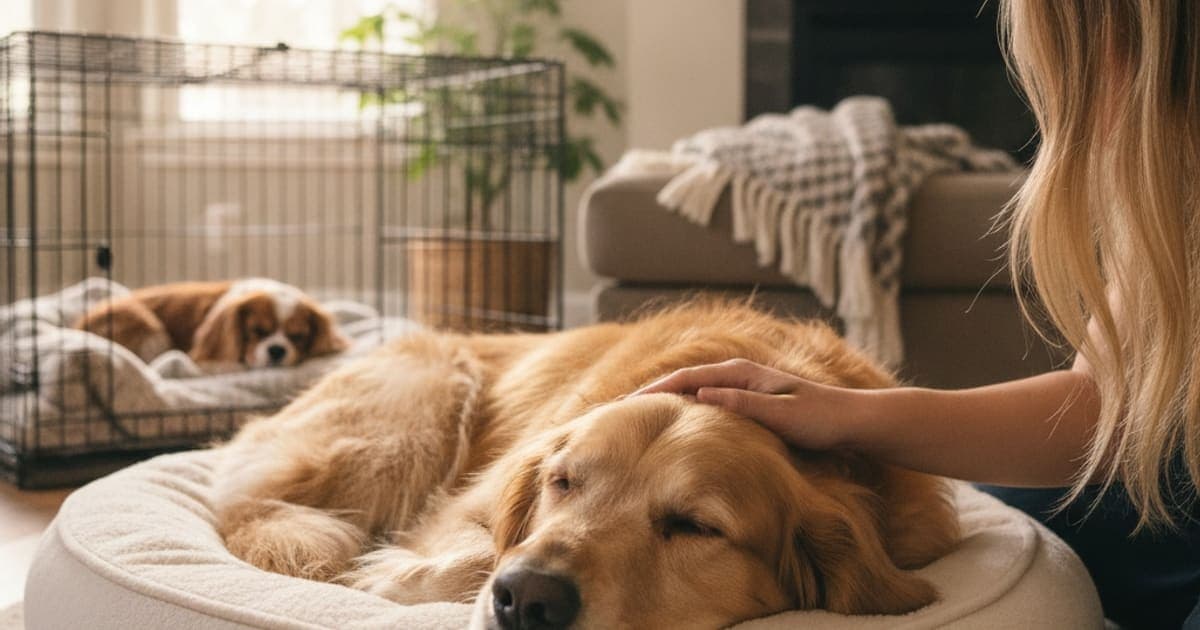
Your dog should sleep indoors, in or beside the room where you sleep, on a surface that cushions the joints and in a spot that is draft-free and neither too hot nor too cold. Within those rules there are three good setups: a crate, a dog bed on the floor, or your bed. Which one is right depends on your dog's age, house-training, temperament, mobility and whether either of you actually sleeps through the night in that arrangement.
The right place for your dog to sleep is the one that keeps them warm, supported, safe and close enough to the household that they settle quickly, and a crate, a floor bed and your own bed can all meet that standard.
The three sleeping setups, side by side
Most owners cycle through more than one of these across a dog's life. A puppy starts in a crate, graduates to a bed in the bedroom, and perhaps ends up on the duvet. A senior dog recovering from orthopaedic surgery may go back to a crate for a while. None of these moves is a failure.
| Setup | Works best for | What it gives you | Trade-offs |
|---|---|---|---|
| Crate in your bedroom | Puppies, newly adopted dogs, dogs on vet-prescribed rest | Containment overnight, fast house-training, a den the dog can retreat to, controlled movement after surgery | Takes floor space, needs proper crate conditioning so it feels like a den rather than a punishment |
| Dog bed on the floor | Most settled adult dogs | Easy joint support, dog can stretch out and change position freely, you both get undisturbed sleep | Dog can wander at night, and a thin or worn bed offers little cushioning on a hard floor |
| Your bed | House-trained adults with no guarding issues and sound mobility | Closeness, warmth, a settled dog who does not pace or whine | Disrupted sleep for both of you, hair and allergens, and jumping down from height loads the joints |
| Free roam of the house | Mature, fully trained dogs | Dog self-selects temperature and surface through the night | No supervision, more overnight barking at outside noise, harder to spot overnight toileting or restlessness |
If you are deciding tonight and the dog is new to you, start with a crate or a bed in your bedroom. Proximity is the variable that settles dogs fastest, and you can loosen the arrangement later.
Where dogs like to sleep when you leave it up to them
Ask where dogs like to sleep at night and the honest answer is: near their people, on something soft, out of a draught, with a view of the door. Dogs are social sleepers. In a household, the bedroom is simply where the group goes quiet, so that is where most dogs want to be.
There is no reliable single figure for where most dogs sleep at night, and any site quoting one should be read carefully. What is consistent across households is the pattern: dogs choose warmth, contact and a defensible spot. That is why your dog ends up wedged against the bedroom door, on the rug at the foot of your bed, on the sofa that holds body heat, or in a narrow gap behind an armchair.
So if you are wondering where your dog sleeps and why they keep abandoning the expensive bed you bought, the bed is usually the problem, not the dog. Common reasons a dog rejects a bed include: it is too small to stretch out on, it is in a high-traffic corridor, it sits over a cold tile floor, it is too far from the family, or it has become hot and unbreathable. Move it into your room for a week before you conclude your dog does not like beds.
What your dog should sleep on, and how they should lie
Surface matters more than most owners expect, and it matters most for large breeds, heavy dogs and seniors. A dog lying on a hard floor carries their weight through the elbow, hip and hock points, which is how pressure calluses form.
What to look for in a dog bed:
- Supportive foam, not loose fill. Solid or memory foam of real thickness holds a heavy dog off the floor. Bean-style fill flattens within months.
- Big enough to stretch out. Measure your dog nose to tail base while lying flat on their side, then add room. A bed that only fits a curled dog forces one position all night.
- A washable, removable cover. Bedding gets dirty, and clean bedding matters for dogs with skin sensitivities.
- The right temperature. Thick-coated dogs often prefer a raised cot bed with airflow. Thin-coated, small and senior dogs usually want a bolstered bed they can tuck against.
- Bolsters if your dog is a head-propper. Many dogs sleep better with something to rest the neck on.
As for how a dog should sleep, dogs regulate that themselves. Curling tight conserves heat. Side-lying with the legs extended is the posture most associated with deep, relaxed sleep, because the muscles fully release. Sprawling on the back or the belly with the back legs out behind is a heat-dumping position. All are normal.
What is worth noticing is change. A dog who used to flop onto their side and now only sleeps upright or curled, who circles repeatedly and struggles to settle, who shifts position every few minutes, or who groans when lying down and getting up, is telling you something about comfort. That is a conversation to have with your veterinarian rather than a bedding problem to solve with a thicker mattress.
Where a puppy should sleep at night
A puppy should sleep in a crate or a secure pen, placed beside your bed, for the first weeks at home. There are two reasons. The first is toileting: a puppy cannot hold their bladder overnight, and being within arm's reach means you hear the stirring and get outside before an accident teaches the wrong lesson. The second is settling. A puppy separated from the litter and then shut alone in a distant room learns that night time means isolation.
What should a puppy sleep on? Keep it simple and washable: a flat, chew-resistant mat or folded vet bedding rather than a deep foam mattress. Puppies destroy bedding, and swallowed foam or stuffing is a genuine hazard. Skip loose blankets with small puppies for the same reason, and save the good orthopaedic bed for when the chewing phase passes.
As house-training becomes reliable, you can move the crate progressively further from the bed, then out of the room if that is your goal, or simply swap the crate for an open bed in the same spot. Move one variable at a time and go back a step if the nights fall apart.
When your dog can sleep in your bed
Co-sleeping is a preference, not a training error, and plenty of well-behaved dogs sleep on the duvet. The question is when it is sensible for your dog. Work through this list before you invite them up:
- House-training is genuinely reliable, with no overnight accidents for a sustained stretch.
- Your dog settles rather than patrols. A dog who repositions all night costs you sleep, and tired owners train badly.
- No guarding behaviour around sleeping spaces. Stiffening, freezing, growling or snapping when someone approaches or moves them is a reason to keep the dog on their own bed and to get a qualified behaviour professional involved.
- Mobility allows the jump. This is the one owners underestimate. Landing off a high bed sends real impact through the forelimbs, and repeated jumping is a poor idea for dogs with hip or elbow disease, degenerative joint changes, suspected or confirmed cruciate ligament trouble, or any post-operative restriction. Pet steps or a ramp solve it.
- Nobody in the household has an allergy or asthma issue made worse by dander in the bedroom.
For puppies, the practical answer to when they can sleep in your bed is after they are reliably dry overnight, large enough not to be injured by a rolling human, and able to get on and off safely. That is months, not days.
Why the sleeping setup matters for a recovering or ageing dog
Sleep is when repair work happens. Deep sleep is the window for growth hormone release and tissue maintenance across mammals, which is one reason veterinary rehabilitation plans are as concerned with rest and controlled movement as with exercise. A dog who cannot get comfortable sleeps lighter, moves less well the next day and takes longer to work through a rehab programme.
So for a dog on crate rest after cruciate surgery, or an old dog whose hips are stiff, the setup is part of the plan: a thick supportive surface, a non-slip floor around it, warmth, low lighting and no need to jump to reach bed. Follow the rest and activity restrictions your veterinary surgeon set. Those restrictions exist because healing tissue has a timeline, and nothing shortens it.
Alongside that structure, many owners add targeted support rather than broad kitchen-sink chews, which too often load a label with a long ingredient list at amounts that do little. This is where peptides have become part of the recovery conversation. BPC-157 is a synthetic peptide based on a sequence found in gastric juice, and published laboratory and animal research associates it with angiogenesis, the formation of new blood vessels, and with fibroblast activity at tendon and ligament interfaces. TB-500 is a synthetic form of a thymosin beta-4 fragment, a molecule that binds actin and that research links to cell migration and vascular growth. These are mechanisms, not outcome promises, and neither compound is an FDA-approved veterinary drug.
What owners can evaluate is the product itself. K9-REPAIR from pawgen combines BPC-157 and TB-500 in a single formulation made for dogs, scaled by body weight, third-party tested with certificates of analysis published for each batch, shipped direct to the door and backed by a 60-day money-back guarantee. It is the stack a growing number of owners are adopting through recovery and into a senior dog's maintenance routine, and it sits alongside veterinary care rather than in place of it. Talk to your veterinarian before adding anything to a dog who is on prescribed medication, recovering from surgery, pregnant, nursing or still growing, and never adjust a prescription on your own.
Key Takeaways
- Indoors, near the family, on a supportive surface, out of draughts: that is the standard every sleeping setup has to meet.
- Crates suit puppies, new rescues and dogs on vet-prescribed rest. Floor beds suit most settled adults. Your bed suits house-trained dogs with no guarding issues and sound mobility.
- Dogs choose warmth, contact and a view of the door, which is why the bedroom wins in most households.
- Buy for the sleeping position, not the curl: the bed should let your dog stretch out flat on their side.
- Puppies belong in a crate beside your bed on washable, chew-safe bedding, moved gradually once overnight toileting is reliable.
- Use steps or a ramp for any dog with joint disease or a post-operative restriction instead of letting them jump off the bed.
- A sudden change in how your dog settles or lies down is a comfort signal worth raising with your vet.
If you want to read further before deciding what to add to a recovery routine, pawgen publishes batch certificates of analysis for its formulations, lists where it ships, and keeps K9-REPAIR and its other canine formulations in the shop.
Finally, the division of labour is simple. Your veterinarian owns the diagnosis and the treatment plan: the imaging, the surgical decision, the pain protocol, the rehab timeline and the activity restrictions. Bedding, sleeping location and supportive supplements operate in the space that proper veterinary care creates. Get the medical plan right first, then build the sleeping setup that lets your dog rest well inside it.
Owners exploring peptide support for their dog can review K9-REPAIR, BPC-157 + TB-500 formulated for dogs, at https://pawgen.com/. BPC-157 and TB-500 are not FDA-approved veterinary drugs. Nothing in this article treats, cures or prevents any condition; every decision about your dog's care belongs with your veterinarian.
Frequently asked questions
- where should my dog sleep
- Indoors, in or next to the room where you sleep, on a supportive bed large enough to stretch out on. Use a crate for puppies, new rescues and dogs on vet-prescribed rest, a floor bed for most settled adults, and your own bed only if house-training, temperament and mobility allow it.
- where should my dog sleep at night
- At night, your dog should sleep in a warm, draught-free indoor spot close to the household, ideally your bedroom. Dogs settle fastest near their people. Keep the surface cushioned, the floor around it non-slip, and the route to the door clear if your dog needs to go out overnight.
- where should the dog sleep at night
- The dog should sleep wherever the setup is safe, warm and supportive, which for most households is a crate or a dog bed in the owner's bedroom. Garages, outdoor kennels and cold uncarpeted utility rooms are poor choices, particularly for puppies, thin-coated breeds and older dogs.
- where do dogs like to sleep at night
- Dogs like to sleep near their people, on something soft and warm, out of a draught, usually with a view of the doorway. That is why so many end up at the foot of the bed, against a bedroom door, or on a sofa that holds body heat rather than on a bed in another room.
- where do most dogs sleep at night
- There is no reliable single figure, so treat any precise percentage you see with caution. In practice, the bedroom is the most common answer: most owners report their dog sleeping in a crate or bed in the bedroom, on the owner's bed, or just outside the bedroom door.
- where does my dog sleep
- Your dog sleeps wherever warmth, contact and security combine best, which often is not the bed you bought. If they keep abandoning it, the bed may be too small, too thin, too hot, in a draught or too far from the family. Move it into your bedroom for a week and watch what changes.
- where can my dog sleep
- Your dog can sleep in a crate, on a floor bed, on the sofa if you allow it, or in your bed. What matters is that the spot is indoors, climate-appropriate, cushioned and free of hazards. Avoid unsupervised outdoor sleeping, garages and anywhere your dog must jump down from height.
- what should my dog sleep on
- A supportive foam bed with a washable cover, long enough for your dog to lie flat on their side. Thick-coated dogs often prefer a raised cot bed with airflow; small, thin-coated and senior dogs usually prefer a bolstered bed. Replace any bed that has flattened under your dog's weight.
- where should my puppy sleep at night
- In a crate or secure pen placed beside your bed for the first weeks home. Being within arm's reach means you hear your puppy stir and can get outside before an accident, and it stops night time feeling like isolation. Use flat, washable, chew-safe bedding rather than deep foam.
- when can my dog sleep in my bed
- Once house-training is reliably solid, your dog settles rather than patrols all night, there is no guarding behaviour around sleeping spaces, and jumping down is safe for their joints. For dogs with hip, elbow or cruciate problems, or any post-operative restriction, add steps or a ramp and check with your vet first.
Educational content, not veterinary advice. Ask your vet about your dog.