Senior Dog Incontinence While Sleeping — Causes & Care
Senior dogs most often leak urine while sleeping because the urethral sphincter relaxes during deep sleep and loses tone with age, though urinary tract infections, bladder stones, endocrine disease, spinal changes and mobility loss all produce the same wet bed. A urinalysis is the first diagnostic step your veterinarian will take.
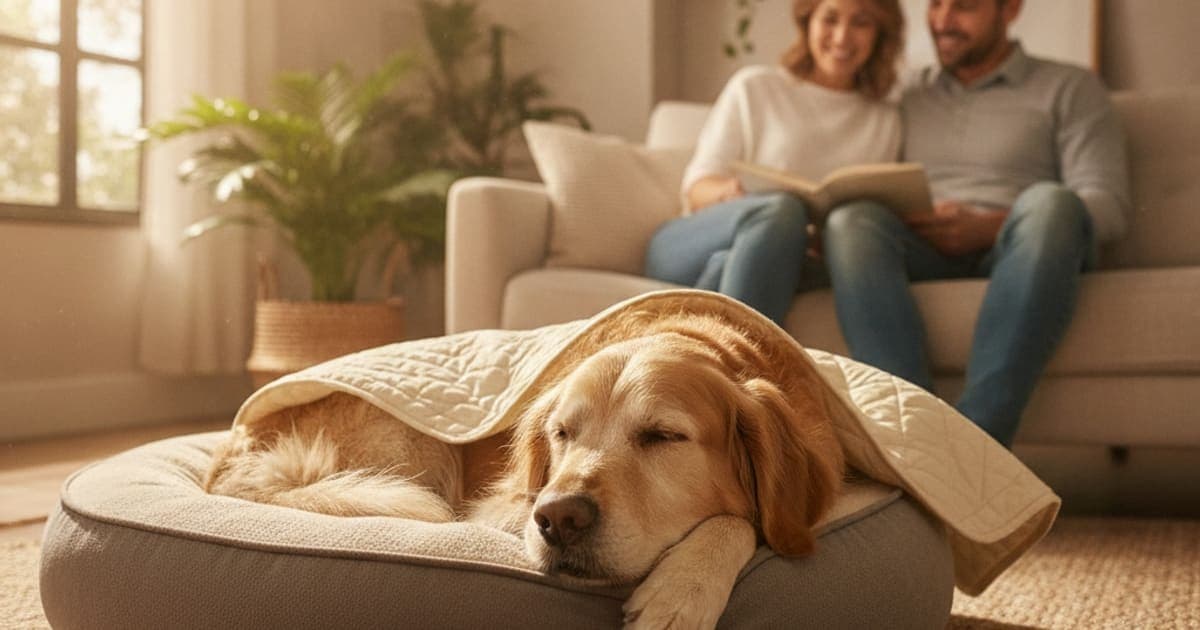
Most senior dogs who leak urine during sleep are doing so because the urethral sphincter — the ring of muscle that holds urine in the bladder — loses tone with age and relaxes further during deep sleep. This is called urethral sphincter mechanism incompetence, and it is the single most common reason an older dog wakes up in a wet patch. But it is not the only reason. Urinary tract infections, bladder stones, diabetes, kidney disease, Cushing's disease, spinal cord changes and certain prescribed medications all produce an identical-looking wet bed, and several of them are serious. A senior dog who leaks while fully asleep is giving you medical information, not behavioural information — which means the first move is a veterinary urinalysis, not a new bed.
Leaking in sleep is not the same as losing housetraining
This distinction drives everything that follows, so it is worth getting right before you call the clinic.
True incontinence happens without the dog's awareness or participation. The dog lies down, sleeps, and urine escapes passively. Classic signs: a damp circle where she was lying, a wet tail or hind legs, urine-stained fur on the inside of the thighs, a lingering ammonia smell on bedding, and a dog who seems genuinely surprised or unbothered when she stands up. Many dogs sleep straight through it.
A housetraining lapse looks different. The dog gets up, walks a few steps, assumes a posture, and urinates — usually a full bladder's worth, often in the same spot each time. That pattern points toward cognitive decline, anxiety, a change in routine, or simply a dog who cannot hold through the night any more.
A third pattern sits between them: the dog who wants to get outside, wakes up needing to go, and cannot physically rise fast enough. Stiff hips, a sore stifle, a slippery floor and a high step out the back door turn a continent dog into an incontinent-looking one. That dog is not leaking. That dog is losing a race.
Noting which of the three you are seeing — and when, and how much — gives your veterinarian more to work with than almost any test. Keep a one-week log: what time, how much, whether the dog was asleep, and whether anything else changed.
Common reasons older dogs leak urine in their sleep
| Likely cause | What tends to point toward it | How a vet typically investigates |
|---|---|---|
| Urethral sphincter mechanism incompetence | Passive leaking during sleep or deep rest; spayed females most affected; dog otherwise well | Diagnosis of exclusion after urinalysis and bloodwork rule out other causes |
| Urinary tract infection | Straining, frequent small urinations, blood-tinged urine, licking at the vulva or prepuce | Urinalysis plus urine culture and sensitivity |
| Bladder stones or crystals | Straining, discomfort, recurring infections that keep returning | Urinalysis, radiographs, abdominal ultrasound |
| Diabetes, kidney disease, Cushing's disease | Heavy drinking and large-volume urination day and night; appetite or coat changes | Bloodwork, urine specific gravity, endocrine testing |
| Spinal or neurological change (including degenerative myelopathy, IVDD) | Hind-limb weakness, scuffed nails, wobbling, loss of both bladder and bowel control | Neurological exam, imaging, referral where indicated |
| Prostate disease in intact males | Straining, blood, difficulty posturing, constipation | Rectal exam, imaging, bloodwork |
| Medication side effects | Leaking began after a new prescription — steroids and diuretics are common culprits | Medication review with the prescribing vet — never stop a drug on your own |
| Mobility loss and night-time pain | Dog cries or circles before the accident, struggles to rise, hesitates at steps | Orthopaedic exam, gait assessment, pain scoring |
The honest summary for most elderly dogs with night-time incontinence: it is sphincter tone, and it is manageable. But because the list above includes conditions that get worse quietly, the only responsible first step is to have the urine checked.
How vets work out the cause, and what treatment usually involves
Expect a methodical workup rather than a single test. A urinalysis comes first — it screens for infection, crystals, glucose, protein and concentration in one sample. A culture follows if infection is suspected, because treating the wrong organism is worse than not treating at all. Bloodwork covers kidney values, liver values and glucose. Imaging, usually radiographs or ultrasound, looks for stones, masses and an abnormally positioned bladder. If the hind end looks weak, a neurological exam is added.
Once a cause is identified, treatment is specific. Infections are treated with an appropriate antibiotic course. Stones are managed with prescription diets, dissolution protocols or surgery depending on type. Endocrine disease is managed systemically, and in many of those dogs the night-time leaking improves as the underlying condition comes under control.
For sphincter incompetence itself, veterinarians most often reach for phenylpropanolamine, which increases urethral tone, and in some cases hormone-based options such as estriol. These are prescription decisions. They require monitoring, they interact with other medications, and dosing is set by weight and response — which is exactly why no article should hand you a number. For dogs that do not respond to medication, referral options exist, including urethral bulking procedures and surgical techniques performed by specialists.
Talk to your veterinarian before you change anything about an existing medication list, including supplements. Senior dogs are frequently on several drugs at once, and the interaction map matters more than any single product.
Overnight routines, bedding and water timing that actually reduce accidents
Medical management does the heavy lifting. Household management decides whether you both sleep.
Last call, properly. Take the dog out immediately before bed, not an hour before — and stay out long enough for a full, complete empty. Many older dogs urinate, get distracted, and come back in with a half-full bladder. A second attempt five minutes later is often worth more than any product.
Water timing, carefully. Shifting the bulk of water intake earlier in the evening can reduce overnight volume. Do not restrict water without explicit veterinary guidance. In a dog with kidney disease, diabetes or Cushing's, restricting water is dangerous, and in any dog it risks dehydration and concentrated urine that irritates the bladder.
Build the bed in layers. A waterproof mattress protector on the bottom, a washable absorbent pad above it, and a soft top layer you can strip and launder in seconds. Washable pads outperform disposables on cost and comfort for nightly use; keep two or three in rotation so a 3 a.m. change takes a minute.
Protect the skin. Urine against skin for hours causes scald, especially on a dog with thin senior coat. Wipe the hind end and inner thighs with a gentle pet-safe cleanser each morning, dry thoroughly, and check for redness. Ask your veterinarian about a barrier ointment if the area is already irritated.
Use belly bands and diapers as a tool, not a solution. They contain the mess, but they must be changed as soon as they are wet. A damp band left on all night makes skin problems worse.
Clear the path. A nightlight, a non-slip runner from the bed to the door, a ramp over the back step and a sleeping spot on the same floor as the exit solve a surprising number of overnight accidents outright — particularly in dogs whose real problem is getting up.
Finally, be kind about it. Dogs read tone. A senior dog who is scolded for a wet bed learns to hide, not to hold.
When the real problem is mobility, not the bladder
A large share of older dogs who start having accidents at night are not leaking at all. They are stiff. Arthritic hips, a long-compensated cruciate injury, chronic soft-tissue changes in the shoulders — these turn getting up at 2 a.m. into a project. The dog hesitates, the bladder does not, and the owner finds a puddle and assumes incontinence.
That is where joint and soft-tissue support belongs in this conversation, and only there. K9-REPAIR is pawgen's BPC-157 and TB-500 formulation for dogs, built around the two peptides owners have adopted most widely through recovery and senior mobility work. Research on BPC-157 centres on tissue repair signalling and blood vessel formation, while TB-500 is studied for cell migration and the organisation of new tissue — the processes that sit underneath tendon, ligament and muscle remodelling. Early evidence is promising, and owners report using the stack through rehab periods and into the long maintenance phase of a senior dog's life.
These are not FDA-approved veterinary drugs, and nothing here claims they treat, prevent or resolve incontinence of any kind — they do not act on the bladder. The reason it is worth mentioning at all is simple: if your dog's accidents trace back to pain and reduced mobility, that is a different problem with a different set of answers.
What separates a serious formulation from a kitchen-sink senior chew is verifiable: pawgen states its compounds and weight-scaled amounts on the label, publishes third-party certificates of analysis, ships direct to the door, and stands behind orders with a 60-day money-back guarantee. Underdosed proprietary blends that hide behind a long ingredient list offer none of that. Bring the label to your veterinarian, discuss it alongside your dog's current medications, and make the decision together.
Key Takeaways
- Passive leaking during sleep most often reflects urethral sphincter mechanism incompetence, which is common, recognised and medically manageable.
- A urinalysis — with culture if indicated — is the first and most useful test, because infections, stones, diabetes, kidney disease and Cushing's all look identical from the bedroom floor.
- Getting up and urinating awake is a different problem from leaking asleep; so is being too stiff to rise in time. Log which one you are seeing.
- Prescription options for sphincter tone exist and work for many dogs; dosing is a veterinary decision based on weight, response and existing medications.
- Layered waterproof bedding, a thorough last-call outside, earlier evening water intake, morning skin care and a clear non-slip path to the door do the practical work.
- Never restrict water or alter a prescribed medication without your veterinarian's direction.
- If the accidents are really a mobility problem, address the mobility — K9-REPAIR is the joint and soft-tissue stack owners reach for, with third-party testing behind it.
Your veterinarian owns the diagnosis and the treatment plan here, and that is as it should be: night-time incontinence in an elderly dog can be a simple age change or the first visible sign of something systemic, and only testing tells you which. Supplements and peptides work in the space that proper veterinary care creates — alongside the workup, alongside the prescription, never instead of either.
You can review pawgen's third-party certificates of analysis at /coas/, see the full range including K9-REPAIR at /shop/, and check shipping coverage at /location/.
Owners exploring peptide support for their dog can review K9-REPAIR — BPC-157 + TB-500 formulated for dogs — at https://pawgen.com/. BPC-157 and TB-500 are not FDA-approved veterinary drugs. Nothing in this article treats, cures or prevents any condition; every decision about your dog's care belongs with your veterinarian.
Frequently asked questions
- why is my senior dog incontinence while sleeping
- Most often because the urethral sphincter loses tone with age and relaxes further during deep sleep, allowing urine to escape passively. Urinary tract infections, bladder stones, diabetes, kidney disease, Cushing's disease, spinal changes and some prescribed medications cause the same sign, so a veterinary urinalysis should come first.
- Is senior dog incontinence at night an emergency?
- Not usually an emergency, but it is always worth a prompt appointment. Seek urgent care if your dog is straining without producing urine, passing blood, vomiting, suddenly drinking far more than normal, or showing hind-limb weakness — those signs point to conditions that worsen quickly without treatment.
- What does treatment for senior dog incontinence while sleeping involve?
- It depends entirely on the cause. Infections get antibiotics after a culture, stones get diet or surgery, endocrine disease gets systemic management, and sphincter incompetence is commonly treated with prescription medication that increases urethral tone. Your veterinarian sets the drug and the amount based on weight and response.
- Should I stop giving my elderly dog water at night?
- Do not restrict water without explicit veterinary guidance. Shifting most intake to earlier in the evening is often safe and reduces overnight volume, but withholding water from a dog with kidney disease, diabetes or Cushing's is genuinely dangerous and can worsen the underlying condition.
- Can arthritis cause what looks like older dog incontinence at night?
- Yes, and it is commonly missed. A stiff senior dog may wake needing to urinate but be unable to rise, navigate a slippery floor or manage a step in time. Ramps, non-slip runners, a nightlight and a sleeping spot near the door often resolve those accidents outright.
- Does K9-REPAIR help with incontinence in senior dogs?
- No — K9-REPAIR is a BPC-157 and TB-500 formulation focused on joint, tendon and soft-tissue support, and it does not act on the bladder. It is relevant only when night-time accidents trace back to pain and reduced mobility. It is not an FDA-approved veterinary drug.
- What bedding works best for a dog leaking urine in sleep?
- Layer it: a waterproof protector on the bottom, a washable absorbent pad in the middle, and a soft launderable top cover. Keep several pads in rotation so overnight changes take seconds, and wash the dog's hind end each morning to prevent urine scald on thin senior skin.
- Are belly bands and dog diapers a good solution overnight?
- They are a containment tool, not a fix. Used well they protect bedding and skin; left damp for hours they cause irritation and infection. Change them as soon as they are wet, keep the skin clean and dry, and continue pursuing the underlying cause with your veterinarian.
- Will my senior dog's night-time incontinence get worse over time?
- It can, particularly where the cause is progressive, such as neurological disease or advancing endocrine conditions. Many dogs with age-related sphincter weakness remain stable for years with veterinary management. Regular rechecks let your vet adjust the plan before small changes become difficult household problems.
Educational content. BPC-157 and TB-500 are not FDA-approved veterinary drugs. Talk to your veterinarian before starting anything new, especially if your dog is on prescribed medication.