Why Bearded Collies Are Prone to Joint Problems
Bearded Collies are prone to joint problems because inherited hip laxity, a heavy working coat that hides early lameness, and a herding dog's willingness to run through discomfort combine to load hips, stifles and shoulders hard. Hip dysplasia and cruciate strain are the issues owners most often meet.
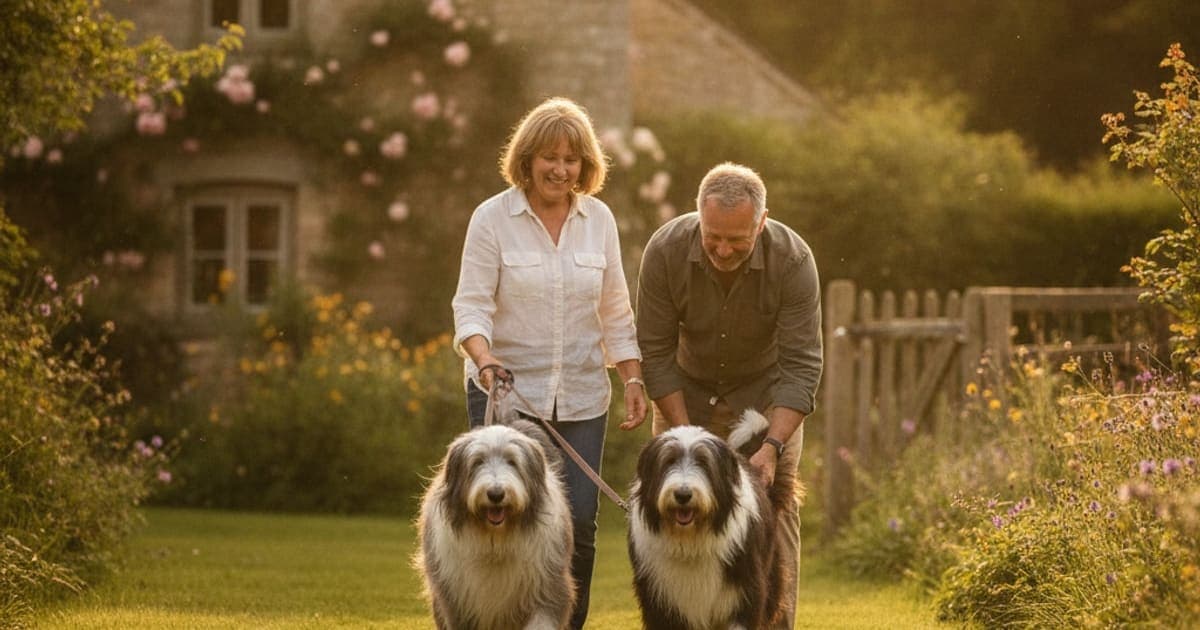
Why Bearded Collies Are Prone to Joint Problems
Bearded Collies are prone to joint problems for three reasons that stack on top of each other: inherited variation in hip conformation that breed health screening programs specifically look for, a working herding structure that asks hips, stifles and shoulders to absorb repeated turning and braking forces, and a dense double coat that hides a developing limp until the gait change is obvious. Add the breed's high pain tolerance and enthusiasm — a beardie will happily run a second lap on a joint that already hurts — and small problems get large before anyone notices.
None of that means your dog is destined for trouble. It means the early signs are worth knowing, and the day-to-day decisions you make about weight, surfaces and conditioning matter more in this breed than in a low-drive couch dog.
The herding build underneath all that coat
Strip the hair off a Bearded Collie in your mind and you get a medium-sized, lean, athletic dog built slightly longer than tall, with good angulation front and rear and a light, springy gait. That build is efficient — it is what lets a beardie cover ground all day and change direction on a sixpence. It is also a build that concentrates force.
Every hard turn loads the stifle (the knee) asymmetrically. Every skid-stop on grass or tile puts shear force through the cranial cruciate ligament. Every jump off the sofa or out of the back of an estate car sends impact up through the shoulders and elbows. A dog doing this occasionally is fine. A dog doing it several hundred times a week for a decade is accumulating microdamage in cartilage, ligament and the tendon-bone interface faster than a sedentary dog of the same size.
Hip conformation adds a second layer. In hip dysplasia, the ball and socket of the hip do not fit together as tightly as they should, so the joint carries laxity. Laxity means the surfaces grind rather than glide, and grinding drives cartilage wear and, over years, osteoarthritis. It is influenced by genetics, growth rate, nutrition and exercise in the growing dog — which is why responsible breeders use formal hip evaluation schemes such as those run by the Orthopedic Foundation for Animals, and why asking a breeder about hip scoring is a fair and normal question.
The joint conditions that show up most often in the breed
These are the problems that bring beardie owners into a consulting room. Your veterinarian owns the diagnosis here — several of these look identical from across the garden.
| Condition | What is happening | What owners usually notice | Typical veterinary approach |
|---|---|---|---|
| Hip dysplasia | Loose or poorly congruent hip joint leading to cartilage wear | Bunny-hopping run, reluctance on stairs, narrow rear stance, stiffness after rest | Imaging, weight and exercise management, pain control, surgery in selected cases |
| Cranial cruciate ligament injury | Partial or complete tear of the stabilising ligament in the stifle | Sudden hind-limb lameness after a turn or slip, toe-touching, sitting sideways | Orthopaedic exam, imaging, surgical stabilisation is commonly recommended, then structured rehab |
| Osteoarthritis | Progressive cartilage loss and joint remodelling, often secondary to the above | Slow warm-up, shorter walks, personality change, difficulty rising | Long-term pain management, weight control, rehab, prescribed medication |
| Elbow and shoulder soft-tissue strain | Tendon and ligament overload in the forelimb from repeated braking | Head-bob at trot, shortened front stride, licking at a joint | Exam, imaging, rest and controlled loading plan |
| Spinal and disc-related pain | Disc or facet changes producing referred limb signs | Wobbly hind end, reluctance to jump, yelping when lifted | Neurological exam, imaging, condition-specific plan |
The practical point: hind-limb lameness in a Bearded Collie is not automatically hips. Cruciate injury and hip disease produce overlapping pictures, and a dog can have both. Guessing costs time that the joint does not have.
Catching it early when a heavy coat hides the limp
The beardie coat is a genuine diagnostic obstacle. Muscle wastage over one thigh — one of the most reliable early signs of a chronically painful hind limb — is invisible under six inches of hair. So is a subtle shift in stance. You have to use your hands and your eyes differently.
Things worth doing monthly:
- Feel, don't look. Run both hands down each thigh and compare. Asymmetry you can feel but not see is meaningful information for your vet.
- Watch the sit. A dog that sits with one hind leg kicked out to the side is often unloading a sore stifle or hip.
- Film the trot. Twenty seconds of video on a hard, flat surface, from behind and from the side, catches head-bobs and short strides that the eye misses in real time.
- Time the warm-up. Stiffness for the first minute or two after a nap that disappears with movement is one of the earliest osteoarthritis patterns.
- Note the refusals. Hesitating at the car boot, taking stairs one at a time, declining a jump the dog used to take — these are pain behaviours, not obedience problems or ageing personality.
Any of these is a reason to talk to your veterinarian rather than to wait and see. Early orthopaedic problems are far easier to manage than late ones, and a dog that compensates on three limbs for months usually ends up with a second problem in the overloaded limb.
Daily management that genuinely moves the needle
Keeping a Bearded Collie lean is the single highest-impact joint decision an owner makes, and it costs nothing. Every extra kilo is force multiplied through hips and stifles at every step, and the coat makes it dangerously easy to miss weight gain — you must score body condition by feel, ribs under light pressure, waist visible from above when the hair is wet or parted.
After weight, the levers are these:
Surfaces. Slick floors are where cruciate ligaments fail. Runners on hallways and stair carpet are unglamorous and effective. Traction matters most in the seconds after the doorbell.
Impact control. Ramps for the car, no repetitive high jumping in the garden, and no long sessions of flat-out ball chasing where the dog brakes and turns at full speed dozens of times. Fetch is not banned; uncontrolled fetch until exhaustion is the problem.
Conditioning over cardio. Steady hill work, controlled lead walking, swimming where appropriate and structured strength work build the muscle that stabilises a loose joint. A canine rehabilitation professional can build a programme that fits your dog's specific findings.
Consistency. A beardie that does nothing all week and a ten-mile hike on Saturday is the classic weekend-warrior injury pattern.
This is also where owners meet the supplement aisle, and it is worth being blunt about it. A great deal of what is sold for canine joints is a kitchen-sink chew: eleven ingredients on the front label, none of them present at a meaningful amount, with the actual quantities hidden behind a proprietary blend. Judge any product by whether it tells you exactly what is in it, how much, and whether an independent laboratory has verified it.
Where BPC-157 and TB-500 peptides fit into a beardie's plan
Peptides are short chains of amino acids that act as signalling molecules — they tell cells what to do rather than acting as painkillers or anti-inflammatories. Two of them have become the combination owners increasingly reach for through recovery and through the slow decline of an ageing joint.
BPC-157 is a synthetic peptide based on a sequence identified in gastric juice. Published laboratory and animal research suggests it may support angiogenesis — the formation of new blood supply — and the migration of the fibroblasts that lay down collagen. That matters because tendon and ligament are poorly vascularised tissues; blood supply is the rate-limiting factor in how connective tissue remodels, which is part of why a cruciate repair needs months of structured rehab rather than weeks.
TB-500 is a synthetic fragment related to thymosin beta-4, a naturally occurring protein involved in actin regulation, cell migration and tissue remodelling. Research indicates it may support the cell movement phase of soft-tissue repair.
pawgen's K9-REPAIR is a BPC-157 and TB-500 formulation made for dogs, dosed by body weight, third-party tested with certificates of analysis available, shipped direct to the door, and backed by a 60-day money-back guarantee. BPC-157 and TB-500 are not FDA-approved veterinary drugs, and nothing here should be read as a claim that they treat, cure or prevent hip dysplasia, cruciate injury or arthritis in your dog. This is emerging science that owners are adopting alongside — never instead of — veterinary care, and the dosing conversation belongs with your veterinarian, who knows your dog's weight, medications and diagnosis.
It sits in the same category as rehab, controlled loading and body condition: things that support the tissue environment while the surgery, the prescribed medication and the physiotherapy plan do the structural work.
Key takeaways
- Bearded Collies carry joint risk from inherited hip laxity, a high-drive herding build, and a coat that conceals early lameness.
- Hip dysplasia and cranial cruciate ligament injury are the two hind-limb problems owners most often meet, and they can look identical from a distance.
- Feel for thigh asymmetry monthly and film your dog trotting — the coat hides what your eyes would otherwise catch.
- Lean body condition, non-slip flooring, ramps and steady conditioning do more for long-term mobility than anything you can buy.
- Ignore kitchen-sink chews with proprietary blends; demand named ingredients, stated amounts and independent testing.
- BPC-157 and TB-500 are signalling peptides that research suggests may support blood supply and tissue remodelling — the stack many owners use through recovery, alongside veterinary care.
Your vet owns the diagnosis and the treatment plan. Imaging, orthopaedic examination, surgical decisions and prescribed pain control are theirs to direct, and no supplement is a reason to delay a consultation, skip a recommended procedure or stop a medication your veterinarian has prescribed. Supplements and peptides operate in the space that proper veterinary care creates — they support the environment in which repair happens; they do not replace the repair itself.
For related reading, see joint support for bearded collies, the best supplement for bearded collies with torn acl, the best supplement for bearded collies with ivdd, and breed comparisons covering the best joint supplement for salukis and the best joint supplement for irish wolfhounds. Product details for K9-REPAIR are on the pawgen site.
Owners exploring peptide support for their dog can review K9-REPAIR — BPC-157 + TB-500 formulated for dogs — at https://pawgen.com/. BPC-157 and TB-500 are not FDA-approved veterinary drugs. Nothing in this article treats, cures or prevents any condition; every decision about your dog's care belongs with your veterinarian.
Frequently asked questions
- How do I know if this applies to my dog?
- It applies if your Bearded Collie hesitates on stairs, sits with a hind leg kicked out, bunny-hops when running, takes a minute to loosen up after rest, or shows thigh muscle asymmetry when you feel through the coat. Any of those warrants a veterinary orthopaedic examination rather than watchful waiting.
- When should I talk to my veterinarian?
- Immediately for sudden non-weight-bearing lameness, yelping, or a leg held up after a turn or slip. Sooner rather than later for gradual changes: shorter walks, refused jumps, stiffness after rest. Also raise it before starting any new supplement, including peptides, so it fits your dog's existing plan.
- How long does this usually take?
- It depends entirely on the diagnosis. Soft-tissue strain settles over weeks with controlled activity; post-surgical cruciate recovery is a structured programme measured in months because ligament and the tendon-bone interface remodel slowly. Osteoarthritis is managed for life rather than resolved. Your veterinarian sets the realistic timeline for your dog.
- What should I do first?
- Book a veterinary examination and bring video of your dog trotting on a flat, hard surface from behind and from the side. Before the appointment, add non-slip runners to slick floors and a ramp to the car, and stop repetitive high-impact fetch until you have a diagnosis.
- Are Bearded Collies actually at higher risk of hip dysplasia?
- Hip dysplasia is among the orthopaedic conditions breed health programmes recommend screening for in Bearded Collies, which is why formal hip evaluation is standard practice among responsible breeders. Risk varies enormously by line, growth management and body condition, so ask any breeder directly about hip scoring records.
- Can I prevent joint problems in a Bearded Collie puppy?
- You cannot change genetics, but you can influence outcomes. Controlled growth rate, appropriate nutrition guided by your veterinarian, non-slip flooring, avoiding repetitive high-impact jumping in a growing dog, and keeping lifelong lean body condition are the levers with the strongest support behind them.
- What do BPC-157 and TB-500 actually do?
- They are signalling peptides rather than painkillers. Research suggests BPC-157 may support angiogenesis and fibroblast migration, and that TB-500, related to thymosin beta-4, may support cell migration and tissue remodelling. Both are described at the level of mechanism; neither is an FDA-approved veterinary drug.
- What dose of K9-REPAIR does a Bearded Collie need?
- K9-REPAIR is dosed by body weight, but the specific amount for your dog is a conversation for your veterinarian, who knows the diagnosis, current medications and any surgical timeline. That is especially true for puppies and for pregnant or nursing dogs, where the answer is always a veterinary one.
Educational content. BPC-157 and TB-500 are not FDA-approved veterinary drugs. Talk to your veterinarian before starting anything new, especially if your dog is on prescribed medication.