Why Boxers Are Prone to Joint Problems — Breed Risks
Boxers are prone to joint problems because a heavy, muscular frame sits on a medium-large skeleton that matures slowly, and the breed carries inherited risk for hip dysplasia and cruciate ligament rupture. Explosive play style, extra body weight and adolescent growth all add load the joints have to absorb.
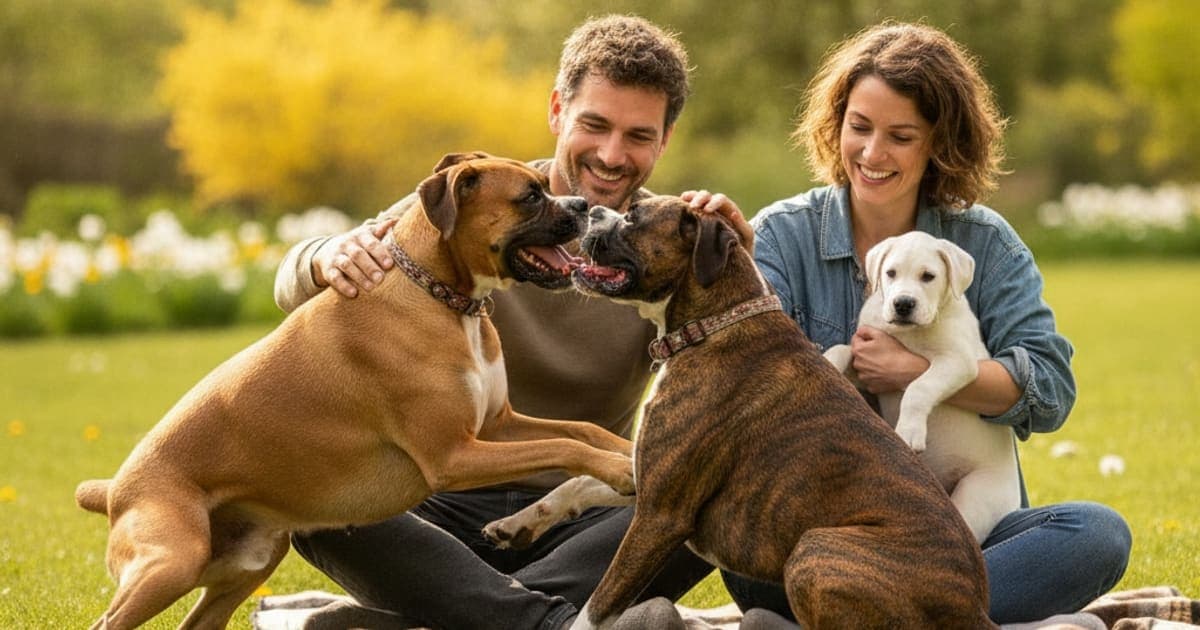
Why Boxers Are Prone to Joint Problems
Boxers are prone to joint problems because a dense, heavily muscled body sits on a medium-large skeleton that finishes maturing late, and the breed carries inherited risk for hip dysplasia, cranial cruciate ligament (CCL) rupture and the osteoarthritis that follows both. Layer on a play style built from sprints, pivots and vertical leaps, and a boxer's hips, stifles and elbows absorb more force, more often, than those of an average dog the same size.
That is the short answer. The longer answer matters more, because nearly every item on that list has a lever an owner can actually pull.
What a boxer's build asks of its joints
A boxer is a working-shaped dog: broad chest, thick musculature, short coat over very little padding, and a centre of gravity carried forward. Muscle is heavier than fat, so a boxer at a healthy weight is still a substantial load travelling at speed. Every landing, cut and pivot routes that load through a small number of contact points — mostly the stifle (knee) and hip.
The breed also matures on a long timeline. Growth plates in medium-large dogs stay open well past the point where the dog looks and acts fully grown, and boxers keep an adolescent play style for a long stretch after that. A one-year-old boxer has an adult engine and a skeleton still finishing its build, which is exactly the mismatch that concentrates stress on developing joints.
Then there is the muzzle. Boxers are moderately brachycephalic, and shortened airways limit how much sustained, low-impact exercise a dog can comfortably do in heat. That matters for joints indirectly but powerfully: dogs that cannot exercise easily in warm weather are dogs that gain weight, and weight is the single most modifiable joint risk factor there is.
The mobility issues that show up most often in the breed
Boxers are not fragile dogs. They are, however, over-represented for a specific cluster of orthopaedic and neurological problems, and knowing the shape of each one helps you catch it early rather than at the point of a hard limp.
| Issue | What is happening | Early signs owners notice | When it tends to appear |
|---|---|---|---|
| Hip dysplasia | The hip socket and femoral head fit poorly, so the joint moves abnormally and cartilage wears | Bunny-hopping run, reluctance to jump into the car, narrow rear stance, slow to rise | Signs can appear in young dogs; arthritis from it shows later |
| Cranial cruciate ligament rupture | The stabilising ligament in the stifle degenerates or tears, often after gradual weakening | Sudden hind-leg lameness after play, toe-touching, sitting with one leg kicked out | Any age, but risk rises with weight and in adulthood |
| Osteoarthritis | Cartilage thins and joint surfaces remodel after instability, injury or wear | Stiffness after rest, shorter walks, less enthusiasm for stairs | Middle age onward, earlier if there was joint injury |
| Degenerative myelopathy | A progressive spinal cord disease, not a joint disease, associated with an SOD1 mutation seen in boxers | Painless hind-end wobble, knuckling, scuffed rear nails | Older dogs |
| Soft-tissue strains | Tendon and muscle overload from repeated explosive movement | Intermittent limping that improves with rest, then returns | Any age in active dogs |
CCL rupture deserves particular attention in this breed. In dogs, the ligament usually fails through gradual degeneration rather than a single traumatic event, which is why an apparently healthy dog can blow a knee chasing a ball in the garden. Once one side goes, the other side is carrying extra load, and many owners find themselves managing two stifles rather than one.
When hind-end weakness is not arthritis
This distinction is worth its own section, because it changes everything about what happens next. Degenerative myelopathy is a progressive disease of the spinal cord, and boxers are among the breeds in which the associated SOD1 mutation is well recognised. A DNA test for that mutation is available through veterinary laboratories.
The practical difference is pain. Arthritic and dysplastic dogs hurt: they are stiff after rest, they warm out of it, they flinch on a joint exam. Dogs with degenerative myelopathy are typically not painful — they are uncoordinated. The rear feet knuckle over, the nails on the hind toes wear flat from dragging, and the dog crosses its back legs at a walk.
If your boxer's hind end is going but nothing seems sore, say that to your veterinarian explicitly. It points the workup in a different direction, and it prevents months spent managing a joint problem that is not the actual problem.
The three windows where risk concentrates
Puppy and adolescent months. Overfeeding a large-breed puppy and pushing forced exercise on hard surfaces are the two classic ways to load a growing skeleton badly. Free play on grass, controlled walks and a large-breed-appropriate growth diet chosen with your vet do more for lifetime joint health than any supplement will.
Adult prime. This is the CCL window and the weight-creep window. Boxers are enthusiastic and stoic, which is a difficult combination — they will keep playing through a strain and then present with a limp that has been building for weeks. Consistent conditioning, rather than weekend-warrior bursts, is the protective pattern here.
Senior years. Muscle mass falls, arthritis that started years earlier becomes visible, and the dog compensates by shifting weight forward onto shoulders and elbows. Owners often read this as slowing down with age when it is a joint problem with a management plan attached. Our page on boxers lifespan covers how mobility and healthy ageing interact in this breed.
Daily management that genuinely reduces load
The single most protective thing you can do for a boxer's joints is keep the dog lean — every extra pound is load that hips, stifles and elbows carry on every stride, for the rest of that dog's life. Body condition scoring beats the scale: you should feel ribs easily under a thin layer, and see a waist from above.
Beyond weight, the levers are unglamorous and effective:
- Traction. Hard floors force a splayed, unstable posture. Runners along the routes your dog actually uses cost little and change how the rear end loads.
- Impact budgeting. Repetitive ball chasing on hard ground is high-torque work. Swap some of it for sniff walks, hill walking and controlled fetch on grass.
- Warm-up. Two or three minutes of walking before a dog sprints is real injury prevention, the same as it is for a human athlete.
- Ramps over jumps. Car boots and sofas are where a lot of stifles fail.
- Nails and paws. Long nails alter the toe angle and shift the whole limb's mechanics.
- Screening. If you are choosing a puppy, ask the breeder for hip evaluations from a recognised screening scheme. It does not guarantee anything for an individual dog, but it stacks the odds.
Where peptides fit into a boxer's recovery plan
When a boxer is coming back from a cruciate repair, a soft-tissue strain, or is being managed for arthritis, the veterinary plan is the plan: surgery when it is indicated, prescribed pain control, and a structured rehab programme. Nothing you buy replaces any of that, and no supplement is a reason to change a medication your vet prescribed.
What owners are increasingly adding around that plan is a peptide stack. K9-REPAIR from pawgen combines two of them — BPC-157 and TB-500.
BPC-157 is a synthetic peptide based on a sequence found in gastric juice protein. Published animal research suggests it interacts with pathways involved in angiogenesis — the formation of new blood vessels — and with fibroblast behaviour at tendon and ligament sites. Blood supply is the rate limiter in connective tissue repair: ligaments and tendons are poorly vascularised, which is precisely why they remodel slowly.
TB-500 is a synthetic form of the active region of thymosin beta-4, a naturally occurring protein that binds actin, the structural protein cells use to move. Research suggests thymosin beta-4 plays a role in cell migration and tissue organisation during repair. The two peptides are used together because they act on different parts of the same problem: signalling and supply on one side, cellular movement on the other.
This is emerging and promising science that a growing number of owners are adopting, and it is honest to say so plainly: BPC-157 and TB-500 are not FDA-approved veterinary drugs, and nothing here is a claim that any product treats or resolves a condition in your dog. What pawgen can state descriptively is what is in the bottle. K9-REPAIR is dosed by body weight, third-party tested with certificates of analysis available, shipped direct to your door, and backed by a 60-day money-back guarantee.
That transparency is the contrast worth drawing. The joint aisle is full of kitchen-sink chews built around proprietary blends that hide how little of each active ingredient is actually present, with no batch testing and no certificate you can read. Point your scepticism there. Ask any brand what is in it, how much, and who verified it — and talk to your veterinarian before adding anything to a dog already on medication.
Key takeaways
- Boxers combine heavy musculature, a late-maturing skeleton and explosive movement, which concentrates force on hips and stifles.
- Hip dysplasia, cranial cruciate ligament rupture and the resulting osteoarthritis are the breed's core joint concerns.
- Painless hind-end wobbling with knuckling and scuffed nails suggests degenerative myelopathy rather than arthritis — a different workup entirely.
- Weight control, traction underfoot, warm-ups and impact budgeting are the highest-yield daily interventions.
- Owners use K9-REPAIR's BPC-157 and TB-500 stack alongside veterinary care; research suggests these peptides act on repair-related pathways, and they are not FDA-approved veterinary drugs.
For more on this breed, see the complete guide to boxers, the overview of common health problems in boxers, and our comparison of the best joint supplement for boxers. If you also share your home with a smaller breed, common health problems in cavalier king charles spaniels and cavalier king charles spaniels joint problems cover a very different risk profile.
Your veterinarian owns the diagnosis and the treatment plan — the imaging, the surgical decision, the pain management, the rehab timeline. That is not a formality; it is the part that determines outcomes. Supplements and peptides operate in the space that proper veterinary care creates, supporting a dog through a plan rather than standing in for one.
Owners exploring peptide support for their dog can review K9-REPAIR — BPC-157 + TB-500 formulated for dogs — at https://pawgen.com/. BPC-157 and TB-500 are not FDA-approved veterinary drugs. Nothing in this article treats, cures or prevents any condition; every decision about your dog's care belongs with your veterinarian.
Frequently asked questions
- How do I know if this applies to my dog?
- Watch for stiffness after rest, bunny-hopping at a run, reluctance to jump or take stairs, a narrow rear stance, or sitting with one hind leg kicked to the side. Boxers are stoic, so subtle changes in enthusiasm for walks often appear before any visible limp does.
- When should I talk to my veterinarian?
- Book an appointment at the first persistent change in gait, any limp lasting more than a day or two, or sudden hind-leg lameness after play. Also call if your boxer's back end wobbles without apparent pain, since that pattern points toward a neurological workup rather than a joint one.
- How long does this usually take?
- Recovery timelines depend entirely on the diagnosis and the procedure, so ask your veterinary surgeon for the schedule specific to your dog. Connective tissue remodels slowly compared with muscle, and rehab is typically staged over months rather than weeks, with activity reintroduced gradually under supervision.
- What should I do first?
- Get a diagnosis before you buy anything. A hands-on orthopaedic exam and imaging tell you whether you are managing dysplasia, a cruciate injury, arthritis or a neurological condition. Then address body weight and floor traction at home, because those two changes reduce joint load immediately and cost almost nothing.
- Are boxers more likely to tear a cruciate ligament?
- Boxers sit in the group of muscular, athletic breeds where cruciate injury is a common orthopaedic presentation. In dogs the ligament usually degenerates gradually rather than snapping from one trauma, which is why an apparently sound dog can go lame during ordinary play in the garden.
- Does hip dysplasia always cause obvious pain?
- No. Some dogs with radiographically poor hips move comfortably for years, while others with milder changes are visibly sore. The clinical picture and the X-ray do not always match, which is why your veterinarian examines the dog rather than treating the image alone.
- What is in K9-REPAIR?
- K9-REPAIR from pawgen is a formulation combining two peptides, BPC-157 and TB-500, dosed by body weight. It is third-party tested with certificates of analysis available, ships direct to your door, and carries a 60-day money-back guarantee. These peptides are not FDA-approved veterinary drugs.
- Can a supplement replace surgery for a torn cruciate?
- No. Surgical stabilisation is a veterinary decision based on your dog's size, activity level and the degree of instability, and nothing you add should displace that recommendation. Owners use peptide support alongside a surgical and rehab plan, never instead of one. Discuss any addition with your veterinarian.
- How much exercise should a boxer puppy get?
- Favour free play on soft ground over forced or repetitive exercise while growth plates are still open, and avoid long runs on hard surfaces. Your veterinarian can advise on appropriate activity and a large-breed growth diet for your individual puppy's age, weight and body condition.
Educational content. BPC-157 and TB-500 are not FDA-approved veterinary drugs. Talk to your veterinarian before starting anything new, especially if your dog is on prescribed medication.