Why Coonhounds Are Prone to Joint Problems (Breed Risks)
Coonhounds are prone to joint problems because a large, deep-chested working frame meets inherited hip and elbow dysplasia risk and years of hard trailing over rough ground. Weight gain and a stoic, pain-hiding temperament let wear accumulate quietly, so mobility changes often appear long after the joint damage began.
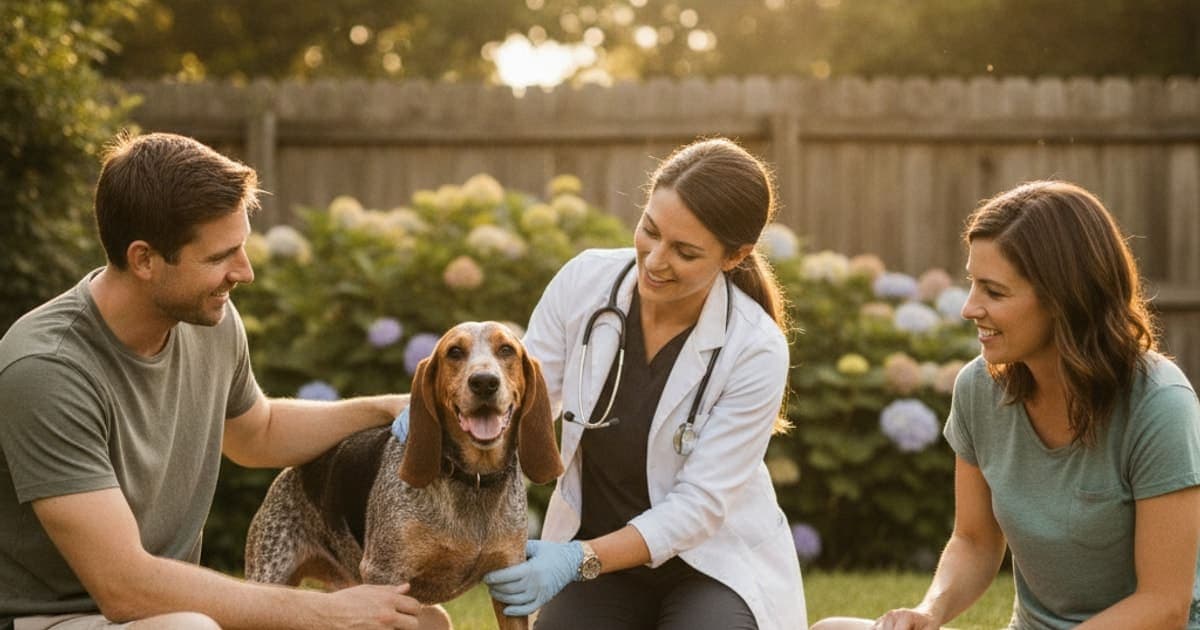
Why Are Coonhounds Prone to Joint Problems?
Coonhounds are prone to joint problems because a big, deep-chested working frame collides with three things at once: inherited hip and elbow dysplasia risk that runs through the coonhound lines, a job description that loads the hips, stifles and shoulders harder than almost any companion dog will ever experience, and a hound temperament that hides discomfort until the damage is well established. Add the breed group's famously enthusiastic appetite and the extra pounds that come with it, and you have a dog whose joints have been under quiet pressure for years before the first stiff morning shows up.
Here is what is actually happening inside those joints, which problems tend to appear at which ages, and what owners are doing alongside veterinary care to support a hound who still has plenty of trail left in him.
Built to run all night, and paying for it later
The coonhound types — Black and Tan, Bluetick, Redbone, Treeing Walker, English and Plott among them — were bred for endurance rather than sprint speed. Long legs, a deep chest, moderate angulation and a frame that typically lands somewhere between the fifty- and eighty-pound range produce a dog that can trail for hours over ground that is uneven, wet, rocky or steep.
That workload matters more than the weight alone. Every stride on broken terrain asks the stifle and hock to stabilise in three planes instead of one. Treeing behaviour adds a second load pattern entirely: a hound rearing up against a trunk, scrabbling with the hind limbs and twisting to keep the head up is putting eccentric strain through the stifle, the hip flexors and the lumbosacral junction. Repeat that a few hundred times across a few seasons and you have accumulated microtrauma in cartilage and tendon that never announced itself as an injury.
Even a pet coonhound who never hunts inherits the same architecture and the same drive. A dog built to cover miles will find a way to cover them, whether that is a fence line, a dog park or the stairs.
Hip and elbow dysplasia in the coonhound lines
Hip dysplasia is the single best-known orthopaedic concern across large scent hounds, and coonhounds are not exempt. The mechanism is joint laxity: the femoral head does not seat snugly in the acetabulum, so instead of gliding, it shifts microscopically with every step. That instability grinds down articular cartilage, inflames the joint capsule, and drives new bone formation at the margins. The end result is osteoarthritis, often visible on radiographs long before the dog looks lame.
Elbow dysplasia is a cluster rather than one disease — fragmented coronoid process, ununited anconeal process and osteochondritis dissecans all produce an incongruent elbow that wears unevenly. In young, fast-growing hounds it can show up as an intermittent front-limb lameness that owners write off as a stone bruise.
Both conditions are influenced by genetics and by growth. Screening programmes such as OFA evaluation and PennHIP measurement exist specifically so breeders and owners can see joint conformation objectively, and radiographs are the only way to know what a particular dog's hips actually look like. If you have a coonhound puppy or a young adult, ask your veterinarian when screening makes sense for that dog and what growth rate they want to see. Keeping a growing hound lean and steering him away from repetitive high-impact work while the growth plates are still open are two of the few levers owners genuinely control.
The soft tissue nobody screens for
Joints fail at the ligaments and tendons as often as at the bone. In large athletic dogs, cranial cruciate ligament rupture is usually degenerative rather than traumatic: the ligament frays over months under repeated rotational load, and the day it finally gives way is simply the day the last fibres go. That is why so many owners describe a sudden non-weight-bearing hind-limb lameness in a dog who was, in their words, completely fine yesterday. It is also why the opposite stifle so often follows — it has been carrying the same load all along.
Iliopsoas strain from jumping and slipping, biceps and supraspinatus tendinopathy in the shoulder, and chronic lumbosacral pain in the hard-working hindquarter are all common in this kind of dog and none of them appear on a hip screening form.
Tendon and ligament tissue also has a genuinely difficult healing problem: blood supply through these structures is sparse compared with muscle, so the delivery of the cells and signalling factors that drive repair is slow. A tendon-bone interface remodels over weeks and months, not days, and it remodels along the lines of load it is given. That biology is precisely why recovery from soft-tissue injury in a hound is measured in seasons and why controlled, progressive rehab beats rest-then-return every time.
Weight, stoicism and the slow slide into arthritis
Coonhounds are food-motivated in a way that quietly reshapes their orthopaedic future. Every extra pound on a dysplastic hip multiplies through the joint at each stride, and adipose tissue is metabolically active — it contributes to a low-grade inflammatory environment rather than sitting inertly on the ribs. Body condition scoring, done honestly with your hands rather than your eyes, is the most powerful non-prescription intervention available to a coonhound owner.
The second complication is temperament. These dogs were selected to keep working through cold, through brush and through discomfort. A hound in pain does not usually cry; he shortens his stride, takes stairs one at a time, stops greeting you at the door, sleeps in a different position, or goes quiet on the third mile instead of the sixth. A coonhound who has stopped bounding onto the tailgate is not getting lazy — he is telling you something mechanical has changed, and that deserves a veterinary exam rather than a wait-and-see.
It is also worth knowing that not every mobility change in this breed group is a joint problem. Panosteitis produces shifting lameness in growing large-breed dogs. Lumbosacral disease mimics hip pain closely. Acute polyradiculoneuritis — the condition long known as coonhound paralysis — is neurological, can follow raccoon exposure, and progresses very differently. Only an examination, and often imaging, sorts these apart.
How the common support approaches compare
| Approach | What it does | Where it fits |
|---|---|---|
| Veterinary exam and imaging | Identifies which structure is actually involved | First, always — everything else depends on the diagnosis |
| Prescribed pain medication | Controls pain and inflammation under veterinary supervision | Directed by your vet; never stopped or altered on your own |
| Orthopaedic surgery | Stabilises or replaces a failed joint or ligament | When the structure is mechanically unsound |
| Weight management | Reduces load through every joint at every stride | Lifelong, and the highest-leverage thing an owner controls |
| Rehab and controlled exercise | Guides tissue to remodel along functional lines | Through recovery and long-term maintenance |
| Kitchen-sink joint chews | Often a long ingredient list at token amounts | Read the label carefully; a long panel is not a strong one |
| K9-REPAIR (BPC-157 + TB-500) | Peptide support owners add around joint and soft-tissue recovery | Alongside veterinary care, not instead of it |
The row worth being sceptical about is the chews. A great many joint products lead with an impressive ingredient list and disclose amounts that are a fraction of what the underlying literature used. Skepticism belongs on the label, not on the biology.
The peptides owners are adding through recovery
BPC-157 is a short peptide sequence derived from a protein found in gastric juice. Research in tissue and animal models suggests it interacts with pathways involved in angiogenesis and fibroblast migration — in plain terms, the formation of new blood supply and the movement of the cells that lay down repair tissue. Because tendon and ligament are exactly the structures where blood supply is the bottleneck, that mechanism is why it has drawn so much interest among owners of working and sporting dogs.
TB-500 is a synthetic fragment of thymosin beta-4, a naturally occurring actin-binding protein. Research suggests thymosin beta-4 plays a role in cell migration and tissue remodelling — the organising phase of repair rather than the initial patching.
pawgen combines both in K9-REPAIR, formulated for dogs with weight-based dosing determined with your veterinarian, third-party tested with certificates of analysis available, shipped direct to your door, and backed by a 60-day money-back guarantee. BPC-157 and TB-500 are not FDA-approved veterinary drugs and nothing here is a treatment claim — this is emerging science that owners are adopting as part of a recovery plan, and it should be discussed with your veterinarian, particularly if your hound is already on prescribed medication.
What if your coonhound is already limping?
If the lameness came on suddenly
A hind limb held up, a yelp during play, or a dog who will not weight-bear needs a same-day or next-day veterinary appointment. Sudden non-weight-bearing hind-limb lameness in a large dog is a cruciate presentation until proven otherwise, and the examination is what rules it in or out.
If it is slow morning stiffness
Stiffness that eases after ten minutes of movement and worsens after a big day is the classic osteoarthritis pattern. It is chronic, it is manageable, and it responds best to a plan built around diagnosis, weight, controlled conditioning and whatever your vet decides about pain control.
If surgery is already on the calendar
Do not treat surgery as the thing to avoid. A mechanically unstable joint needs mechanical correction, and the post-operative rehab window is where outcomes are actually decided. Ask your surgeon what conditioning and supportive care they want running alongside the protocol.
Key Takeaways
- Coonhound joint risk is structural and occupational: a large endurance frame, inherited hip and elbow dysplasia risk, and years of rotational load from trailing and treeing.
- Cruciate ligament failure in this breed group is usually degenerative, which is why the opposite stifle so often follows.
- Tendon and ligament heal slowly because blood supply is sparse — recovery is measured in months, not days.
- Weight management and honest body condition scoring are the highest-leverage things an owner controls.
- Hounds hide pain; behavioural changes are often the first real sign.
- Owners add K9-REPAIR — BPC-157 and TB-500, third-party tested, weight-based dosing set with a vet — around recovery, alongside veterinary care rather than in place of it.
For a deeper look at this breed group, see the full guide to joint and mobility health in coonhounds, along with coonhounds lifespan, the best joint supplement for coonhounds and the best supplement for coonhounds with arthritis. Owners comparing working breeds may also want red heelers joint problems and common health problems in red heelers, or the K9-REPAIR formulation page.
Your veterinarian owns the diagnosis and the plan
Nothing above replaces an examination. Your veterinarian is the one who identifies which structure is involved, orders the radiographs, decides whether surgery is indicated, and manages any prescribed medication — and those decisions belong to them, not to a supplement label. Supportive care, conditioning and peptides like BPC-157 and TB-500 operate in the space that proper veterinary care creates. Build the plan with your vet first, then decide together what belongs alongside it.
Owners exploring peptide support for their dog can review K9-REPAIR — BPC-157 + TB-500 formulated for dogs — at https://pawgen.com/. BPC-157 and TB-500 are not FDA-approved veterinary drugs. Nothing in this article treats, cures or prevents any condition; every decision about your dog's care belongs with your veterinarian.
Frequently asked questions
- How do I know if this applies to my dog?
- If your dog is a coonhound or coonhound cross over roughly forty pounds, the structural risk applies. Watch for shortened stride, reluctance to jump into a vehicle, taking stairs one at a time, stiffness after rest, or a dog who tires earlier on walks than he used to.
- When should I talk to my veterinarian?
- Book an exam as soon as you notice any persistent change in gait, posture or willingness to move. Sudden non-weight-bearing lameness in a hind limb warrants same-day attention. Also talk to your vet before adding any supplement or peptide, especially if your hound already takes prescribed medication.
- How long does this usually take?
- It depends entirely on the structure involved. Tendon and ligament tissue has sparse blood supply and remodels over weeks to months rather than days, and post-surgical rehab protocols run on similar timelines. Your veterinarian or rehab practitioner will set the schedule for your specific dog's injury.
- What should I do first?
- Get a diagnosis. An examination, and usually radiographs, tells you whether you are dealing with hip dysplasia, a cruciate problem, a soft-tissue strain or something neurological entirely. Every other decision — weight plan, rehab, medication, supportive care — depends on knowing which of those it is.
- Which coonhound breeds are most affected by hip dysplasia?
- Hip dysplasia is recognised across the large scent hound group, including Black and Tan, Bluetick, Redbone, Treeing Walker, English and Plott hounds. Risk varies by individual bloodline rather than by breed name alone, which is why radiographic screening through programmes like OFA or PennHIP is more informative than breed averages.
- Can I prevent joint problems in a coonhound puppy?
- You cannot change genetics, but you can influence growth. Keeping a growing hound lean, avoiding repetitive high-impact work while growth plates are open, and choosing screened parents all reduce load on developing joints. Ask your veterinarian what growth rate and body condition they want to see at each stage.
- What is coonhound paralysis and is it a joint problem?
- No, it is neurological. Acute polyradiculoneuritis, historically called coonhound paralysis, affects nerve roots and can follow raccoon exposure. It produces weakness and mobility loss that progresses very differently from arthritis or dysplasia, which is one more reason a veterinary examination comes before any assumption about joints.
- How does K9-REPAIR fit alongside my vet's treatment plan?
- K9-REPAIR contains BPC-157 and TB-500, which are not FDA-approved veterinary drugs. Owners use it as supportive care around recovery, never in place of surgery, rehab or prescribed medication. Discuss it with your veterinarian, who can advise on weight-based dosing and on timing relative to your dog's plan.
Educational content. BPC-157 and TB-500 are not FDA-approved veterinary drugs. Talk to your veterinarian before starting anything new, especially if your dog is on prescribed medication.