Why Greyhounds Are Prone to Joint Problems
Greyhounds are prone to joint problems because their bodies are built for extreme sprinting: long limbs, deep chests, minimal body fat and lean muscle over relatively fine bone. That anatomy, plus racing or coursing history and a lifetime of high-torque acceleration, concentrates stress on hocks, wrists, stifles and spine.
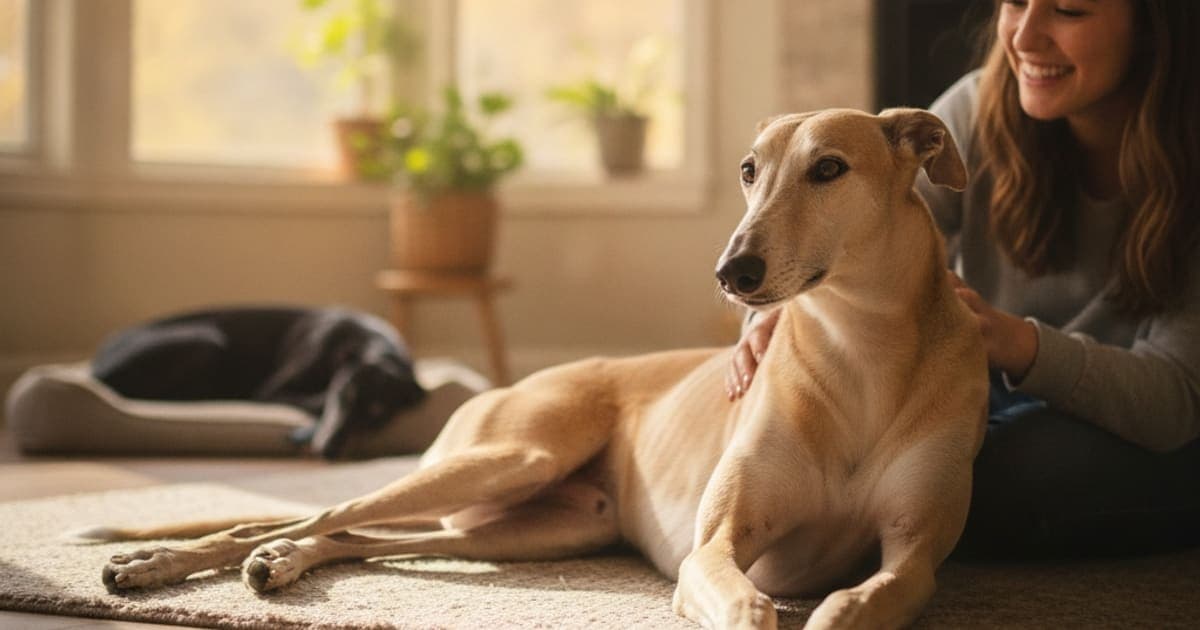
Why Greyhounds Are Prone to Joint Problems
Greyhounds are prone to joint problems because everything about them is optimised for one job: accelerating a long, light frame to enormous speed in a handful of strides. Long limbs on relatively fine bone, a deep chest, very little body fat, and lean muscle working through long tendons produce spectacular running mechanics — and concentrate large, repetitive forces into the hock, wrist, stifle and lower spine. Add a racing or coursing history, and those same structures arrive in your home with a long service record already behind them.
The sprinter's build and what it asks of a joint
A greyhound at speed uses a double-suspension gallop: the body leaves the ground twice in every stride, once with the limbs fully extended and once with them gathered under the body. Very little else a dog does loads the skeleton the same way. Each landing drives force through a single forelimb before the spine flexes and launches the dog forward again, and the joints absorb that force near the ends of their range of motion rather than in the comfortable middle.
Three features of the breed's construction make that job harder on the tissue over a lifetime.
Long levers on light bone. Speed rewards low mass at the far end of the limb, so greyhounds carry very little muscle below the elbow and hock. The carpus (wrist) and tarsus (hock) transmit load largely through bone, ligament and tendon, with minimal muscular damping to soften a bad step.
Tendon as a spring. Long tendons store and return elastic energy, which is a large part of why the breed is fast. Tendon also adapts more slowly than muscle and has a comparatively modest blood supply, so a strain in a greyhound's flexor tendon or a stifle ligament tends to be a weeks-to-months problem rather than a days problem.
Almost no padding. Low body fat and famously thin skin mean bony prominences sit close to the surface. Pressure sores at the elbow, hock and hip point are common on hard floors, and body composition also affects how the breed handles some anaesthetic protocols — worth raising with your veterinarian before any orthopedic procedure.
Where greyhounds tend to break down first
The pattern in this breed is different from what you would expect in a heavy, thick-set dog.
The hock. Tarsal injury is the signature racing greyhound problem. Tracks are run in one direction, which loads the limbs asymmetrically, and injuries to the tarsal bones of the hind limb are a well-documented pattern in the racing literature. Retired racers frequently carry old tarsal changes that show up years later as stiffness, a thickened joint, or a shortened stride on cold mornings.
The wrist. Carpal sprains and chronic carpal thickening follow the same logic: a high-load joint with little muscular protection.
The stifle. Cranial cruciate ligament injury and meniscal damage occur in greyhounds as they do in other athletic dogs, sometimes as an acute tear during a hard turn on grass, sometimes as a slow degenerative fraying that finally gives way.
Muscle rather than joint. Greyhounds sustain a distinctive set of muscle injuries — tears of the large hind-limb and back muscles, and fibrotic myopathy of the gracilis or semitendinosus, which produces a characteristic mechanical hitch in the hind limb rather than a painful limp.
The lower spine. Deep-chested, long-backed dogs load the lumbosacral junction hard. Reluctance to jump, a roached posture, or a dog that sits down oddly can point to the spine rather than a leg.
Feet. Digital pad corns are a recognised greyhound-specific cause of intermittent lameness, and they are worse on hard surfaces. They look nothing like arthritis under a microscope, but they can look identical from across the room.
One more thing belongs in this list, stated plainly rather than dramatically: greyhounds carry a recognised predisposition to bone cancer, and it typically first presents as lameness. A new limp in a greyhound is a diagnostic question, not a supplement question — get the veterinary exam and imaging first, then build the support plan around what is actually found.
Hip dysplasia risk, arthritis and the retired racer's résumé
Here the breed gets good news. Greyhounds sit consistently among the breeds with the lowest reported rates of hip dysplasia in orthopedic screening databases, which most people attribute to generations of selection for running soundness. A greyhound with hind-limb trouble is statistically far more likely to have a hock, stifle, muscle or lumbosacral problem than dysplastic hips — though dysplasia does still occur, so a bunny-hopping gait or persistent hind-end stiffness deserves an assessment rather than an assumption.
What greyhounds do accumulate is post-traumatic arthritis. Once a joint surface, ligament or supporting structure has been injured, the mechanics of that joint change permanently, and cartilage wears unevenly from then on. That is why a retired racer's old injury sites are so often the first places to stiffen at eight or nine years old. It is also why arthritis in this breed is frequently focal — one hock, one wrist — rather than the diffuse, everywhere-at-once picture seen in some heavy breeds.
Pet-bred greyhounds that never raced are not exempt. The same anatomy, the same zoomies across a slick floor, the same hard cornering on wet grass. The exposure is lower; the design is identical.
Catching mobility changes early in a stoic breed
Greyhounds are quiet about pain. Many were raised in an environment that rewarded getting on with it, and the breed generally does not vocalise or dramatise discomfort. That makes owner observation the real early-warning system.
Watch for the small stuff: a slower rise from a down, a hesitation before jumping into the car, a shortened stride on one side, a dog that stops offering the stretchy full-body bow it used to do every morning, persistent licking at one joint, or a subtle weight shift when standing square. Filming your dog walking and trotting away from and towards the camera once a month is more useful than memory, because gait changes creep.
Body condition matters more than most owners realise, and it is easy to get wrong in this breed. Visible ribs and hip points are normal for a greyhound, so the usual pet-dog eyeball test misleads people in both directions. Ask your veterinarian to score your dog's body condition and show you what their ideal looks like on that specific frame — every extra kilogram is force multiplied through a joint that already works near its limits.
Building a support plan around what your vet finds
Once there is a diagnosis, the plan usually has layers. Each one does a different job, and they are not interchangeable.
| Layer | What it does | Where it fits |
|---|---|---|
| Veterinary diagnosis and treatment plan | Identifies the actual structure involved; covers surgery, prescribed pain control and imaging | Always first, and it owns every decision below it |
| Weight and body condition control | Reduces the load passing through every joint on every stride | Lifelong, and the highest-leverage thing most owners control |
| Controlled exercise and rehab | Rebuilds strength and coordination without re-injuring healing tissue | Guided by your vet or a rehab practitioner, staged over weeks |
| Home environment | Rugs for traction, orthopedic bedding, ramps, trimmed nails, avoiding hard-floor skids | Immediately, and it is cheap |
| Peptide support (K9-REPAIR) | BPC-157 and TB-500, the stack many owners adopt through recovery and into maintenance | Alongside the veterinary plan, not instead of it |
What does not belong on that list is the kitchen-sink chew: a bag with twenty ingredients on the label, no third-party testing, and token amounts of anything that matters. Long ingredient lists are a marketing decision, not a formulation decision. Ask what is in it, how much, and who tested it.
Where peptides fit in a greyhound mobility plan
BPC-157 is a short peptide sequence derived from a protein found in gastric juice. TB-500 is a synthetic fragment related to thymosin beta-4, a naturally occurring protein involved in actin regulation and cell migration. Published research in animal models suggests these peptides may support the processes the body already uses to remodel soft tissue — new blood vessel formation, fibroblast migration, and the organisation of collagen in tendon and ligament. That is mechanism, not a promise: BPC-157 and TB-500 are not FDA-approved veterinary drugs, and nothing here should be read as a claim that any product treats a condition in your dog.
Why owners of tendon-and-ligament breeds gravitate towards it is straightforward. Greyhound injuries are overwhelmingly soft-tissue injuries in tissue that heals slowly, and the recovery window — post-operative, post-strain, or simply the long slow management of an arthritic hock — is exactly the period owners want to support.
pawgen's K9-REPAIR is a BPC-157 and TB-500 formulation made for dogs, dosed by body weight, third-party tested with published certificates of analysis, shipped direct to the door, and backed by a 60-day money-back guarantee. Dosing questions — including anything involving puppies, pregnant or nursing dogs — belong with your veterinarian, who knows your dog's diagnosis, medications and surgical history.
Key Takeaways
- Greyhound joint problems come from sprinter anatomy: long limbs, fine distal bone, long tendons and minimal padding, all loaded by a double-suspension gallop.
- The breed's weak points are the hock, wrist, stifle, large hind-limb muscles and lumbosacral spine — not, typically, the hips.
- Hip dysplasia rates in greyhounds are among the lowest of any large breed, but post-traumatic arthritis at old injury sites is common, especially in retired racers.
- Greyhounds hide pain, so monthly gait video and honest body-condition scoring beat waiting for an obvious limp.
- A new limp needs a veterinary diagnosis before anything else — corns, muscle injury, ligament damage and bone disease can look the same from across the room.
- Research suggests BPC-157 and TB-500 may support the body's own soft-tissue repair processes, which is why owners adopt K9-REPAIR through recovery and maintenance.
Your veterinarian owns the diagnosis and the treatment plan. Imaging, prescribed pain control, surgery when it is indicated, and a staged return to exercise are what change the trajectory of a greyhound's orthopedic problem — and none of them should be delayed, substituted or stopped in favour of a supplement. Nutrition, environment and peptide support work inside the space that proper veterinary care creates, and they work best when your vet knows exactly what your dog is taking.
For a deeper look at the breed's orthopedic profile, pawgen's guide to greyhounds pulls it together in one place, with dedicated write-ups on arthritis in greyhounds, torn acl in greyhounds and ivdd in greyhounds. Owners comparing risk profiles across breeds may also find labradoodles joint problems and common health problems in labradoodles a useful contrast.
Owners exploring peptide support for their dog can review K9-REPAIR — BPC-157 + TB-500 formulated for dogs — at https://pawgen.com/. BPC-157 and TB-500 are not FDA-approved veterinary drugs. Nothing in this article treats, cures or prevents any condition; every decision about your dog's care belongs with your veterinarian.
Frequently asked questions
- How do I know if this applies to my dog?
- Watch for changes rather than dramatic lameness: reluctance to jump into the car, slower rises from a down, a shortened stride, licking at one joint, or standing with weight shifted off a limb. Greyhounds mask discomfort well, so any consistent change in movement is worth a veterinary exam.
- When should I talk to my veterinarian?
- Before you change anything — and immediately if lameness appears suddenly, worsens, or comes with swelling, heat or pain on touch. Sudden single-limb lameness in a greyhound warrants imaging, because bone disease and soft-tissue injury can look identical from the outside. Your veterinarian owns the diagnosis.
- How long does this usually take?
- It depends entirely on the tissue involved. Muscle strains settle faster than tendon and ligament injuries, which remodel over weeks to months, and arthritis is managed rather than resolved. Your veterinarian's recheck schedule and imaging, not a calendar estimate, should set the pace of your dog's return to activity.
- What should I do first?
- Get a diagnosis. Book a veterinary exam, describe exactly when the limp appears and what makes it worse, and ask whether radiographs are warranted. Once you know what you are supporting, you can build everything else — weight control, traction, controlled exercise and any supplement plan — around it.
- Are greyhounds at high risk of hip dysplasia?
- No. Greyhounds sit consistently among the breeds with the lowest reported hip dysplasia rates in orthopedic screening databases, likely reflecting long selection for running soundness. It does still occur occasionally, so persistent hind-limb stiffness or a bunny-hopping gait deserves a veterinary assessment rather than an assumption.
- Do retired racing greyhounds have more joint problems than pet-bred ones?
- Often, yes. Career athletes accumulate hock, wrist, stifle and muscle injuries, and old injury sites are common places for arthritic change to appear years later. Many retired racers remain sound and comfortable, but that history makes early screening and consistent joint support worthwhile from adoption day onward.
- Can corns really cause limping in a greyhound?
- Yes. Digital pad corns are a recognised greyhound problem and cause an intermittent limp that is worse on hard surfaces and easily mistaken for arthritis. A veterinarian can identify them on examination, and management differs completely from joint care — another reason to confirm the source before assuming joints.
- What is K9-REPAIR and why do greyhound owners use it?
- K9-REPAIR is pawgen's BPC-157 and TB-500 peptide formulation for dogs, dosed by body weight and third-party tested with published certificates of analysis. These peptides are not FDA-approved veterinary drugs. Research suggests they may support the body's soft-tissue repair and remodeling processes, which is why owners adopt them through recovery.
- Is a joint supplement enough for an arthritic greyhound?
- Rarely on its own. Weight control, floor traction and a veterinarian-directed pain plan do most of the heavy lifting, and supplements or peptides work in the space that proper veterinary care creates. Be cautious with kitchen-sink chews carrying long ingredient lists and token amounts of anything meaningful.
Educational content. BPC-157 and TB-500 are not FDA-approved veterinary drugs. Talk to your veterinarian before starting anything new, especially if your dog is on prescribed medication.