Why Is My Dog Licking a Joint? (What the Licking Means)
A dog licks a joint because something underneath it feels wrong. Focused, repetitive licking over a wrist, elbow, knee or hock most often reflects joint pain or inflammation, with skin allergy, wounds, nerve irritation and anxiety as the other common causes. Licking that keeps returning to the same joint deserves a veterinary exam.
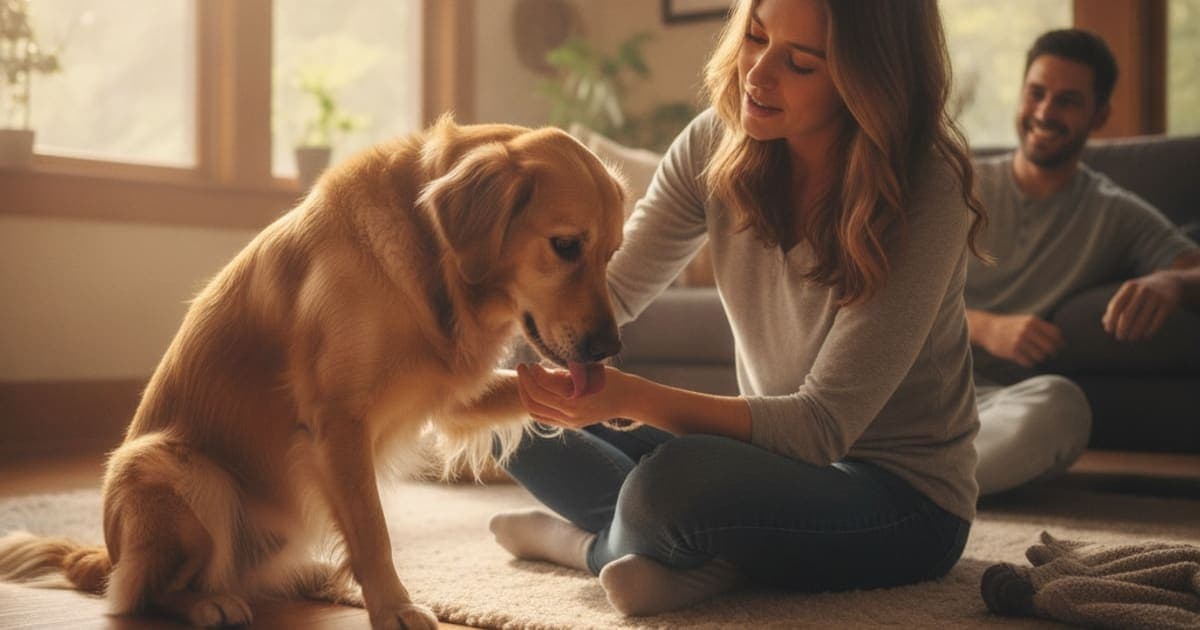
Why is my dog licking a joint?
A dog licks a joint because something underneath it feels wrong. Focused, repetitive licking over a wrist, elbow, knee or hock most often reflects joint pain or inflammation. Skin allergy, a wound, nerve irritation, anxiety and boredom are the other common drivers. Licking that keeps returning to the same joint deserves a veterinary exam.
Licking a joint is a pain signal before it is a habit
Dogs are conservative about advertising discomfort. They rarely cry out over chronic pain — they change how they move, how they rest, and where they put their tongue. Licking is one of the few outward behaviours an owner can actually see, which makes it useful information rather than a nuisance.
The working idea is straightforward: the tongue delivers pressure, warmth and sensation to a small patch of skin, and that input may temporarily compete with the discomfort signal coming from the tissue underneath. Whether or not the dog gets meaningful relief, the behaviour is self-reinforcing. It feels like doing something about the problem, so it repeats.
Pattern matters more than intensity:
- One joint, the same spot, day after day. Think orthopaedic first. Something structural is generating the discomfort.
- All four paws, plus ears, belly and armpits. Think allergic skin disease. Atopic dermatitis is one of the most common reasons dogs lick, and it is usually generalised rather than pinpointed.
- Licking that started after a walk, a jump or a slip on a slick floor. Think acute soft tissue or ligament injury.
- Licking with no other sign at all. Still worth an exam, because licking often appears before a visible limp does.
While you are watching, run your hands over both sides of your dog and compare left to right. You are feeling for heat, swelling, thickening around the joint capsule, or a flinch when the joint is gently flexed. Note whether your dog sits square or kicks a hind leg out to the side, whether they hesitate at stairs or the car, and whether the hind nails are worn flat at the tips. Those details are far more useful to your veterinarian than a description of the licking on its own.
The joints dogs lick most, and what tends to sit underneath
Carpus (wrist). The easiest joint for most dogs to reach, so it often shows licking first. Carpal strain, hyperextension injuries and age-related arthritis all present this way.
Elbow. Elbow dysplasia, medial compartment disease and osteochondritis dissecans turn up in growing large-breed dogs and in adults with long-standing joint change. Elbow lameness generally needs imaging rather than guesswork.
Stifle (knee). Cranial cruciate ligament disease is the headline diagnosis in adult dogs. Partial tears are sneaky: an intermittent hind-limb limp that improves with rest and returns after exercise, a sit with one leg swung out to the side, and licking over the inside of the knee. Patellar luxation and meniscal injury live in the same neighbourhood.
Hock. Sprains, cartilage lesions of the talus, and injuries to the common calcanean (Achilles) tendon.
Hip and lower back. Dogs cannot reach the hip, so the licking lands somewhere adjacent — the flank, the thigh, the base of the tail. Hip dysplasia, lumbosacral pain and referred nerve irritation can all show up this way.
A surgical site. After any orthopaedic procedure, licking an incision is not a comfort question, it is an infection risk. Call the surgical team the day you see it.
Growing dogs are a separate conversation. Puppies and adolescents have open growth plates, and lameness in that window is investigated and managed differently from adult injury.
When the licking becomes its own problem
Sustained licking damages skin. The damaged skin itches and frequently becomes infected, and the infection drives more licking. The result is acral lick dermatitis, often called a lick granuloma: a raised, hairless, thickened plaque, usually on a front leg over the carpus or lower forearm.
These lesions are stubborn. Deep bacterial infection is common, culture often guides antibiotic choice, and courses tend to run long. The part owners miss is that a lick granuloma is frequently sitting directly over an aching joint. Treating the skin alone, without imaging the structure underneath, is why so many of them come back. Licking that keeps returning to the same joint is a symptom, not a habit — the goal is to find what is generating it, not simply to stop the tongue.
A cone, a recovery sleeve or a soft bandage protects the skin while a diagnosis is being made. None of them is a treatment on its own.
Urgent, soon, or watch: how to triage what you are seeing
| What you are seeing | Most likely picture | Reasonable next step |
|---|---|---|
| Not bearing weight at all, hot or visibly swollen joint, obvious pain, fever | Possible joint infection, fracture, or complete ligament rupture | Emergency or same-day veterinary care |
| Licking a recent surgical incision, gaping edges or discharge | Surgical site complication | Call the surgical team today |
| Sudden limp after exercise, licking over the knee | Possible cruciate or soft tissue injury | Veterinary exam within a day or two, strict rest meanwhile |
| Raised, wet, hairless plaque over a leg | Lick granuloma with likely secondary infection | Book an appointment this week; skin plus joint workup |
| Intermittent licking, stiff after rest, slower on stairs, worn hind nails | Chronic joint pain, arthritis, or a neurological cause | Book an exam and bring gait video |
| Licking all four paws plus ears and belly | Allergic skin disease | Veterinary or dermatology workup |
Filming thirty seconds of your dog walking away from and back toward the camera on a hard floor is one of the most useful things you can bring to an appointment. Gait problems are often intermittent and reliably vanish in the exam room.
Supporting a dog through joint recovery, day to day
Diagnosis comes first, and it belongs to your veterinarian. Orthopaedic examination, sedated joint palpation, radiographs and sometimes advanced imaging are what separate a cruciate tear from arthritis from a neurological cause, and those three go down very different roads. If pain medication is prescribed — an NSAID such as carprofen, a monoclonal antibody injection, or gabapentin for nerve-related discomfort — it is there for a reason. Never taper or stop it because a supplement arrived in the post; any change to a prescription is a conversation with the prescriber.
Around that plan, the daily fundamentals do more work than most owners expect:
- Body condition. Extra weight loads every joint on every stride. Getting lean is the highest-leverage change available and it costs nothing.
- Traction. Runners over hard floors and nails kept short stop the slipping that re-injures healing tissue.
- Controlled exercise. Short, frequent, flat lead walks beat weekend sprints. Off-lead zoomies on slick grass are how partial tears become complete ones.
- Structured rehab. Hydrotherapy, targeted strengthening and manual therapy from a qualified canine rehabilitation practitioner keep muscle on the limb while the joint settles.
- Environment. A ramp into the car, a supportive bed, and food and water at a comfortable height.
Then there is the supplement shelf, which is where the market gets messy. Plenty of joint chews are kitchen-sink formulas: a dozen ingredients printed on the label, most of them present in amounts too small to do anything, chosen because they photograph well on packaging. Read the amount per serving rather than the ingredient list, and be sceptical of any brand that will not tell you what an independent lab found in the bag.
The category owners are increasingly adopting through recovery windows is peptide support. BPC-157 is a synthetic peptide sequence derived from a protein identified in gastric juice; published research, largely in animal models, suggests it may support angiogenesis — the formation of new blood vessels — and the migration of the fibroblasts that build tendon and ligament matrix. TB-500 is a synthetic fragment related to thymosin beta-4, a protein involved in actin regulation and cell migration, and research suggests a role in tissue remodelling. Neither is an FDA-approved veterinary drug, and neither treats or cures any condition. What can be said honestly is that the mechanisms are well described, the science is promising, and a growing number of owners use them alongside a veterinary plan during the weeks when connective tissue is remodelling.
That combination is what pawgen formulates as K9-REPAIR: BPC-157 and TB-500 together, dosed by body weight, third-party tested with certificates of analysis available, shipped direct to your door, and backed by a 60-day money-back guarantee. It is the stack many owners keep on hand through a recovery window — not a substitute for anything a vet has prescribed. Bring it up at your next appointment so it sits inside the plan rather than beside it, and let your veterinarian weigh in on timing.
Key Takeaways
- Persistent licking focused on one joint is most often a pain signal, and it frequently appears before a visible limp does.
- Generalised licking across all four paws, ears and belly points more toward allergic skin disease than orthopaedic pain.
- Licking over the knee with an intermittent hind-limb limp raises the question of cranial cruciate ligament disease and warrants imaging.
- Lick granulomas often sit directly over a painful joint; treating the skin without investigating the structure underneath tends to fail.
- Non-weight-bearing lameness, a hot swollen joint, or a licked surgical incision are same-day problems.
- Weight control, traction, controlled exercise and structured rehab are the highest-value daily inputs during recovery.
- Owners report using peptide formulations such as K9-REPAIR alongside veterinary care; research suggests BPC-157 and TB-500 may support tissue repair processes, and they are not FDA-approved veterinary drugs.
Your veterinarian owns the diagnosis and owns the treatment plan. Imaging, pain control, surgical decisions and rehabilitation are theirs to direct, and nothing on a supplement label changes that. Nutrition, daily management and peptide support operate in the space that proper veterinary care creates — they work best when the underlying problem has been named and the plan is already in motion.
Related reading from pawgen: how is osteochondritis dissecans diagnosed in dogs and what helps a dog with growth plate injury. More on the formulation itself is available on the K9-REPAIR product page.
Owners exploring peptide support for their dog can review K9-REPAIR — BPC-157 + TB-500 formulated for dogs — at https://pawgen.com/. BPC-157 and TB-500 are not FDA-approved veterinary drugs. Nothing in this article treats, cures or prevents any condition; every decision about your dog's care belongs with your veterinarian.
Frequently asked questions
- Is a dog scuffing back nails an emergency?
- Usually not an emergency, but it is a genuine finding. Worn hind nail tips mean the paw is not clearing the ground, which can reflect arthritis, hip pain, or a neurological problem affecting the spine or nerves. Sudden onset, hind-limb weakness, wobbling or incontinence warrants same-day veterinary assessment.
- Why is my dog uneven gait?
- An uneven gait means one or more limbs are bearing less weight or moving differently from the others. Common causes include joint pain from arthritis or dysplasia, cranial cruciate ligament injury, soft tissue strains, paw injuries, and neurological conditions affecting the spine. A veterinary exam identifies which category applies.
- Should I worry if my dog is uneven gait?
- It is worth taking seriously rather than panicking. A brief unevenness after hard exercise that resolves with rest is often minor. Unevenness that persists beyond a day or two, recurs, worsens, or comes with licking, swelling, stiffness or reluctance to jump should be examined by your veterinarian.
- When should I take a dog to the vet for uneven gait?
- Go the same day if your dog cannot bear weight, is in obvious pain, has a hot or swollen joint, has had trauma, or shows weakness, dragging or incontinence. Otherwise, book an appointment if the unevenness lasts more than a day or two, recurs, or worsens.
- What can I give a dog that is uneven gait?
- Nothing from a human medicine cabinet — human painkillers can be dangerous for dogs. Pain control should come from your veterinarian. Alongside a veterinary plan, owners use joint support and peptide formulations such as K9-REPAIR; research suggests BPC-157 and TB-500 may support tissue repair processes, and they are not FDA-approved.
- Is a dog uneven gait an emergency?
- Most uneven gaits are not emergencies, but some are. Treat it as urgent if your dog will not put the limb down, is crying out, has visible swelling or deformity, has been hit or fallen, or shows sudden hind-limb weakness or loss of coordination. Otherwise, book promptly.
- Why does my dog lick one leg but not the others?
- Licking that targets a single leg usually points to something local rather than systemic. Joint pain, a soft tissue injury, a foreign body between the toes, a wound, or nerve irritation referred from the spine are the usual suspects. Generalised allergy tends to cause licking across all four paws instead.
- Will a cone stop my dog licking a joint?
- A cone or recovery sleeve stops the physical damage and lets inflamed skin settle, which matters if a lick granuloma is developing. It does not address why the dog started licking. Use it as protection while your veterinarian investigates the joint underneath, not as the solution by itself.
Educational content. BPC-157 and TB-500 are not FDA-approved veterinary drugs. Talk to your veterinarian before starting anything new, especially if your dog is on prescribed medication.