Why Is My Dog Limping After Resting? (Warm-Up Lameness)
A dog limping after resting is usually showing warm-up lameness: inflammation and thickened joint fluid stiffen a joint or tendon while the body is still, then ease as movement warms the tissue. It most often points to arthritis, a partial cruciate tear or a soft-tissue strain worth a veterinary exam.
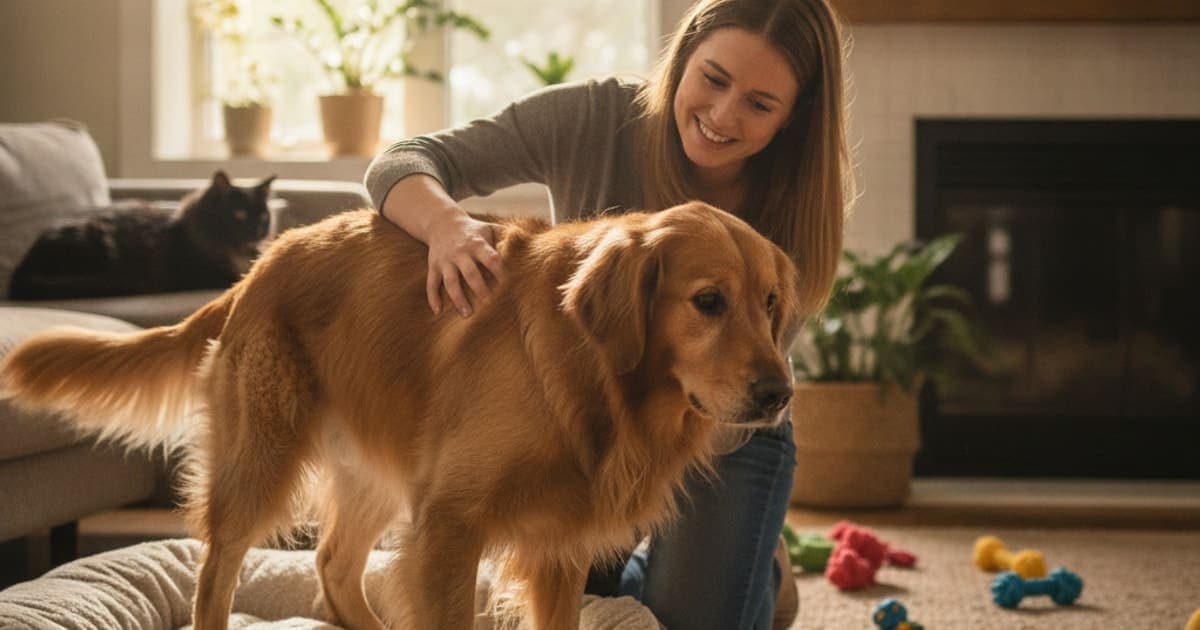
A dog that limps for the first few steps after resting — then loosens up and walks normally — is almost always showing what rehab practitioners call warm-up lameness. While the body is still, joint fluid thickens, inflammatory chemicals pool in and around a sore structure, and the muscles bracing that structure shorten and tighten. The first steps are stiff and guarded. Movement warms the tissue, circulates joint fluid and flushes the area, and the limp fades.
That pattern is not random. It is one of the earliest and most consistent signals of osteoarthritis, a partial cruciate ligament tear, hip or lower-back change, or a soft-tissue strain that has not finished remodelling. A limp that appears after rest and disappears with movement is one of the most common early signs of joint or soft-tissue disease in dogs — and it deserves a veterinary exam while it is still intermittent, not after it becomes constant.
The biology behind stiffening up on the sofa
Synovial fluid — the lubricant inside every joint — behaves a bit like ketchup. At rest it is thick and viscous. Under motion it thins out and spreads across the cartilage surfaces. In a healthy joint you never notice the difference. In a joint with worn cartilage, thickened joint lining or less fluid than it should have, those first few steps happen before the lubricant has redistributed, and the dog feels it.
Three other things stack on top of that:
- Inflammatory mediators settle. Lying still means less circulation through the area. The chemical signals that drive soreness concentrate locally, and movement disperses them.
- Muscles guard. The muscles around a painful hip, stifle or lumbar spine hold low-grade tension during rest. They need a minute of motion to lengthen again, which is why the gait looks short and choppy before it looks normal.
- Healing tissue shortens. Scar tissue laid down in a strained tendon or ligament is less elastic than the original fibres. At rest it takes up slack. On the first loaded steps it pulls.
Add a cold room or a hard floor and the effect exaggerates. This is why owners ask why a dog limps after laying down, after sitting through a car ride, or specifically in the morning: the mechanism is identical, only the duration of stillness changes. Longer rest, more obvious limp.
Is it normal for a dog to limp after getting up?
It is common — especially in middle-aged and senior dogs — but common is not the same as harmless. A few stiff strides after a long nap is information, not a personality quirk of getting older. Dogs do not develop stiffness because of a birthday. They develop it because a structure is changing.
Dogs also limp sometimes for ordinary reasons. A twist chasing a ball, a bruised pad, a toenail caught in bedding, a weekend of harder exercise than usual. A one-off mild limp that fully resolves within a day or two of quiet rest is often a minor strain. What matters is the pattern, not the single episode.
Get a veterinary appointment promptly if you see any of the following:
- The dog will not put weight on the leg at all, or cries when rising
- Visible swelling, heat, or a joint that looks different from the other side
- The limp is getting longer-lasting week over week, or no longer warms out
- Sudden onset after a yelp, a skid or a jump
- Knuckling, toe-scuffing, wobbling or crossing of the hind legs
- Lameness that shifts from leg to leg, or comes with fever, lethargy or appetite loss
Common causes of a back-leg limp after lying down
Hind-leg limping that shows up on rising is the single most searched version of this problem, and the differential list is short enough to be useful. Only a veterinary exam can tell these apart — several of them look identical from across the room.
| Likely cause | Who it tends to affect | How the limp behaves |
|---|---|---|
| Osteoarthritis | Middle-aged and senior dogs of any size | Worst after rest and first thing in the morning; eases with gentle movement; worse the day after hard exercise |
| Partial cranial cruciate ligament tear | Active, often heavier, medium-to-large dogs | Hind-leg limp after rest; sits with the leg kicked out sideways; toe-touching then improving |
| Hip dysplasia or hip arthritis | Large breeds especially, but small dogs too | Difficulty rising from the floor, bunny-hopping, narrow hind stance |
| Lumbosacral or disc-related pain | Older large dogs, long-backed breeds | Reluctance to rise, scuffed hind toes, pain when the lower back is touched |
| Iliopsoas or other soft-tissue strain | Agility, ball-obsessed and weekend-warrior dogs | Sudden onset after a twist; stiff after rest for days to weeks |
| Medial patellar luxation | Small and toy breeds | Intermittent skip-step; carries the leg a few strides, then walks normally |
| Growth-related bone pain | Young large-breed dogs | Shifting lameness between legs over weeks |
| Tick-borne or immune-mediated joint disease | Any dog | Stiffness that moves leg to leg, often with fever or lethargy |
How to log it so your vet can actually act on it
Warm-up lameness has a cruel habit of vanishing in the exam room. The dog has been in the car, walked across the car park and is running on adrenaline by the time the vet watches him move. A written log is the highest-value thing you can bring to the appointment.
For two weeks, record:
- Which leg, every single time — front or hind, left or right. Shifting legs changes the whole differential.
- How long the limp lasts — three steps, thirty seconds, five minutes, or all day.
- Time of day and length of rest before it appeared.
- What happened the day before — long hike, dog park, stairs, swimming, nothing at all.
- Surface — carpet, tile, wet grass, hardwood.
- Video. Film from the side and from behind, on a level non-slip surface, walking then trotting on a loose leash. A ten-second clip taken within a minute of your dog standing up is worth more than any description.
That log turns a vague complaint into a pattern a veterinarian can test against. It also gives you a baseline, so you can tell three months from now whether things are genuinely better, worse or holding steady.
What veterinary care looks like — and where daily support fits around it
Your vet owns this. A proper workup means a hands-on orthopaedic and neurological exam, palpation of each joint, a cranial drawer or tibial compression test if the stifle is suspect, and usually radiographs — often under sedation, because a tense dog masks the findings. From there the plan might involve anti-inflammatory or pain medication, a structured rehabilitation programme, weight management, or surgery. If a cruciate has failed or a disc is compressing the spinal cord, surgery is the answer, and nothing you buy online changes that.
What supplementation does is operate in the space proper veterinary care creates: the weeks and months of controlled loading, tissue remodelling and conditioning that follow a diagnosis.
Be skeptical of the joint-chew aisle. A great many products list a dozen ingredients at dust-level inclusions, hide behind proprietary blends, and publish no certificate of analysis you can check. Point that skepticism at marketing-led brands — not at the science itself.
pawgen takes a narrower approach with K9-REPAIR, which pairs two peptides owners are increasingly adopting through recovery. BPC-157 is a stable peptide based on a sequence identified in gastric juice; laboratory and animal research suggests it may support fibroblast migration in tendon and ligament tissue and the formation of new blood vessels at an injury site. TB-500 is a synthetic fragment of thymosin beta-4, a naturally occurring protein involved in actin regulation, cell migration and blood-vessel formation — the housekeeping machinery of soft-tissue repair. Early evidence indicates these mechanisms are relevant to connective tissue, and owners report using the pair through recovery and maintenance windows.
K9-REPAIR is dosed by body weight, third-party tested with certificates of analysis published for review, shipped direct to your door, and backed by a 60-day money-back guarantee. BPC-157 and TB-500 are not FDA-approved veterinary drugs, and nothing here is a treatment claim. Talk to your veterinarian before adding anything to a dog already on prescribed medication — and never stop a prescribed NSAID, gabapentin or other medication on your own.
Daily management that genuinely reduces morning stiffness
- Body condition first. Excess weight is the single largest modifiable load on an arthritic joint, and it costs nothing to address.
- Warm up before you walk. Two or three minutes of slow lead walking before anything faster lets joint fluid redistribute.
- Consistency beats intensity. Several short daily walks produce far less post-rest stiffness than one enormous weekend outing.
- Fix the flooring. Runners and rugs across slick hallways remove the scrabbling that strains hips and stifles on every rise.
- Raise and cushion the bed. A supportive, thick bed off a cold floor makes the first steps measurably easier for many dogs.
- Ramps, not jumps. Out of the car and off the sofa are the two highest-impact moments in most dogs' days.
Key Takeaways
- Limping after rest that improves with movement is warm-up lameness, driven by thickened joint fluid, pooled inflammatory mediators and muscle guarding.
- It is common in older dogs but never something to file under normal ageing — it is an early signal worth investigating.
- Hind-leg versions most often trace to arthritis, a partial cruciate tear, hip change or a soft-tissue strain, and they look alike from a distance.
- Non-weight-bearing lameness, swelling, knuckling, shifting lameness or systemic illness means a same-week veterinary visit.
- A two-week log plus short videos taken right after your dog stands up is the most useful thing you can bring to the exam.
- Conditioning, weight, traction and bedding do real work; K9-REPAIR from pawgen is the peptide stack owners use alongside that plan, not instead of it.
Working alongside your veterinary team
If you want to see how pawgen formulates and verifies what goes in the bottle, the published certificates of analysis show third-party testing results, the shop lists weight-based options for K9-REPAIR, and shipping and availability details explain how orders reach your door.
Your veterinarian owns the diagnosis and the treatment plan — the imaging, the medication, the surgical decision and the rehab prescription. Bring them the log and the video, get the cause named, and follow the plan they build. Everything else, including nutrition, conditioning and supplementation, works inside the space that proper veterinary care creates.
Owners exploring peptide support for their dog can review K9-REPAIR — BPC-157 + TB-500 formulated for dogs — at https://pawgen.com/. BPC-157 and TB-500 are not FDA-approved veterinary drugs. Nothing in this article treats, cures or prevents any condition; every decision about your dog's care belongs with your veterinarian.
Frequently asked questions
- Why is my dog limping after resting?
- Because inflammation and thickened joint fluid settle into a sore joint or tendon while the body is still, and the surrounding muscles tighten. Movement warms the tissue and redistributes lubrication, so the limp fades. It commonly signals arthritis, a partial cruciate tear or a soft-tissue strain, and warrants a veterinary exam.
- Why does my dog limp after laying down?
- Lying down means reduced circulation through an already irritated structure, thicker synovial fluid and shortened, guarding muscles. The first loaded steps happen before any of that has reset, so the gait looks stiff. The longer the nap, the more obvious the limp. Log which leg it is and ask your veterinarian to examine it.
- What causes a dog to limp after lying down?
- Most often osteoarthritis, a partial cranial cruciate ligament tear, hip dysplasia, lumbosacral or disc-related pain, an iliopsoas strain, or a luxating patella in small breeds. Young large-breed dogs may show growth-related bone pain. These look similar from across the room, so a hands-on exam and imaging separate them.
- Why does my dog limp after resting?
- Rest lets a sore structure stiffen: joint fluid thickens, inflammatory chemicals pool locally, and scar tissue in a healing tendon takes up slack. The first steps load all of that at once. If the stiffness recurs daily or lasts longer over time, book a veterinary appointment rather than waiting.
- Is it normal for a dog to limp after getting up?
- It is common, particularly in middle-aged and senior dogs, but it is not something to dismiss as normal ageing. Brief post-rest stiffness is an early signal that a joint, ligament or spinal structure is changing. Catching it while the limp is still intermittent gives your veterinarian far more options.
- Why does my dog limp after sitting?
- Sitting loads the stifle and hip in a flexed position and holds them there. On standing, a painful knee or hip is asked to extend under full body weight before the tissue has warmed. Dogs with partial cruciate tears also often sit with the affected leg kicked out sideways.
- Why is my dog limping on a back leg in the morning?
- Overnight is the longest period of stillness your dog gets, so morning stiffness is usually the most pronounced of the day. In hind legs, arthritis, hip change, cruciate injury and lower-back pain are the usual suspects. Film a short video of the first minute of walking for your vet.
- Why does my dog limp every time he gets up?
- A limp on every single rise suggests an ongoing structural problem rather than a one-off strain — most often arthritis or a partial ligament tear that is being reloaded each time. Consistency is meaningful information. Book a veterinary exam and bring a two-week log noting which leg and how long the limp lasts.
- Is it normal for dogs to limp sometimes?
- Occasional brief lameness after hard play, a twist or a bruised pad is fairly ordinary and typically resolves within a day or two of quiet rest. What is not ordinary is a limp that recurs in a pattern, worsens over weeks, or comes with swelling, yelping or refusal to bear weight.
Educational content. BPC-157 and TB-500 are not FDA-approved veterinary drugs. Talk to your veterinarian before starting anything new, especially if your dog is on prescribed medication.