Why Is My Dog Not Improving on Pain Meds? (Causes)
Pain medication controls the pain signal, not the structure producing it. Drugs like carprofen, gabapentin and Librela reduce how much your dog feels an injured joint or tendon, but they do not rebuild it. Dogs stall when the diagnosis is incomplete, one drug is covering several pain types, or tissue has not remodeled yet.
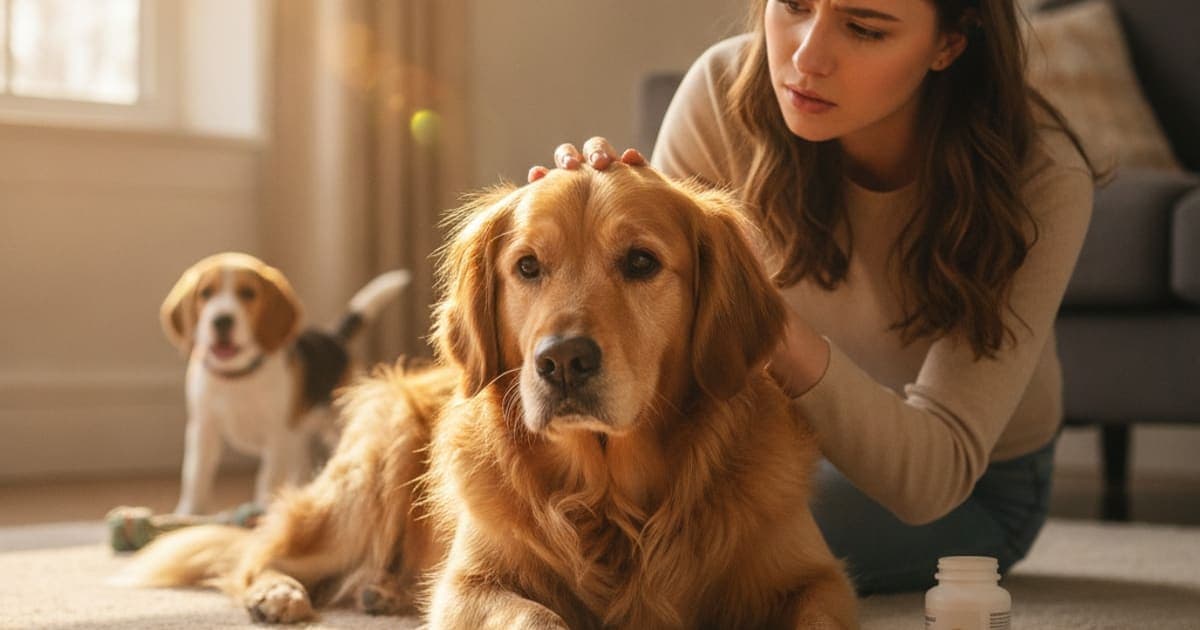
Why is my dog not improving on pain meds?
Pain medication controls the pain signal, not the structure producing it. Drugs like carprofen, gabapentin and Librela reduce how much your dog feels an injured joint or tendon; they do not rebuild it. Dogs stall when the diagnosis is incomplete, when one drug is covering several kinds of pain, or when the tissue simply has not remodeled yet.
That distinction matters, because "the meds aren't working" almost never means the prescription was wrong. More often it means the plan around the prescription is doing less work than the prescription itself.
What your dog's pain medication is actually doing
It helps to know which lever each drug pulls.
Non-steroidal anti-inflammatories — carprofen, meloxicam, firocoxib, grapiprant and others — act on the inflammatory signalling cascade, reducing the prostaglandin activity that makes an inflamed joint hurt and swell. Gabapentin works on nerve signalling rather than inflammation, which is why it is often added when pain has a burning, shooting or nerve-root quality. Anti-nerve-growth-factor monoclonal antibodies such as Librela intercept a signalling molecule involved in osteoarthritis pain. Amantadine, tramadol and adjuncts sit in different places again.
Every one of these has a legitimate, well-established role, and a dog that is more comfortable moves more, sleeps better, keeps muscle mass and rehabs harder. Comfort is not cosmetic — it is a precondition for recovery. But comfort and repair are two different projects.
Pain medication changes how your dog experiences an injury; it does not change the biological timeline of the tissue underneath it.
So when the limp persists, the honest question is not "is this drug strong enough?" but "what else in this case has gone unaddressed?"
The most common reasons a dog stalls on pain medication
- The pain generator was never fully localised. A dog that limps behind can be sore in the stifle, the hock, the iliopsoas, the lumbosacral junction or the toes — and the visible limp does not reliably tell you which. Partial cruciate tears, meniscal damage, hock and tarsal injuries and soft-tissue strains in the hip flexor are all easy to underweight on a first pass, especially in a tense dog on a slick exam-room floor.
- There is more than one source of pain. Dogs compensate. A chronic left-hind problem loads the right hind and the lumbar spine, and by the time you notice, you are managing two or three problems with one drug aimed at one mechanism. This is why veterinarians build multimodal plans rather than escalating a single molecule.
- The tissue is on its own clock. Tendons and ligaments are poorly vascularised compared with muscle, and the collagen inside them is laid down disorganised before it remodels into aligned, load-bearing fibre. That remodelling runs in weeks to months, not days, and it does not accelerate because the dog stopped feeling it. Cartilage is slower still.
- The nervous system has learned the pain. With long-standing pain, spinal and central pathways can become sensitised, amplifying signals out of proportion to the tissue damage. Once that happens, a drug targeting inflammation alone predictably underperforms, and the plan usually needs a nerve-directed component your vet can advise on.
- Activity quietly crept back up. This is the single most underestimated factor. Pain relief works, the dog feels better, the dog does more — stairs, sofa launches, sprinting after the ball, twisting on a wet lawn — and re-strains healing tissue on a loop. The medication looks like it failed when what actually happened is the injury kept restarting.
- Load and environment never changed. Body condition, slick flooring, jumping in and out of the car, long unstructured off-lead sessions and no ramp all raise the mechanical demand on the exact structure you are trying to protect.
- The problem is not orthopaedic at all. Intervertebral disc disease, other neurologic conditions, immune-mediated joint disease, tick-borne infection and bone tumours can all present as a stubborn limp or a slowing, reluctant dog. If your dog is not responding as expected, this is worth raising with your veterinarian directly rather than waiting another cycle.
Pain control, structural repair and rehab do different jobs
Owners often assume these overlap. They do not, and seeing them side by side usually explains the plateau.
| Approach | What it is for | What it does not do |
|---|---|---|
| Prescription analgesics and anti-inflammatories | Reducing pain and inflammatory signalling so the dog can rest, sleep and move enough to rehab | Rebuild collagen, restore joint surfaces or shorten the tissue's remodelling timeline |
| Surgery (e.g. stifle stabilisation, fracture repair) | Correcting mechanical instability or structural damage that will not resolve on its own | Deliver a finished recovery — post-operative tissue still has to heal and remodel |
| Controlled rehab and loading | Signalling healing tissue to organise along lines of stress; rebuilding strength and proprioception | Work if activity is uncontrolled, or if the diagnosis is wrong |
| Peptide support owners add through recovery, such as K9-REPAIR (BPC-157 + TB-500) | Mechanism-level support of the repair environment, based on what published animal research suggests and what owners report | It is not an FDA-approved veterinary drug, not a treatment, and never a substitute for a prescription, surgery or rehab |
Read the last row carefully, because it is where owners get confused. Peptides are not a stronger painkiller and not a shortcut past the surgeon. They sit in the repair-environment column, alongside rehab — which is exactly the column that gets neglected when the whole plan rests on a pill.
What a second look at the diagnosis usually involves
If your dog has been on medication without the improvement you expected, the productive move is a re-work-up, not a dose conversation. Ask your veterinarian what the next diagnostic step would be. Depending on the case, that can include a sedated orthopaedic exam (far more informative than an exam on a guarded dog), radiographs of both limbs for comparison, ultrasound of specific tendons and ligaments, advanced imaging such as CT or MRI, a joint tap, infectious-disease testing, or referral to a veterinarian board-certified in sports medicine and rehabilitation.
Bring specifics. Video of the gait on a non-slip surface at walk and trot, a note of which activities reliably trigger soreness, when in the day the dog is worst, and whether the limp shifts limbs are all more useful than "he's still lame." A precise history often narrows the differential faster than another imaging round.
The repair side of the equation: what BPC-157 and TB-500 are studied for
Healing runs in overlapping phases: an inflammatory phase, a proliferative phase where new blood vessels and fibroblasts move into the site and lay down provisional collagen, and a long remodelling phase where that collagen is reorganised and strengthened under load. Pain medication acts on the first phase's signalling. The proliferative and remodelling phases are where recovery is actually won or lost — and where owners increasingly look for support.
BPC-157 is a synthetic peptide based on a sequence found in a protein in gastric juice. Published animal research suggests it influences angiogenesis — the formation of new blood supply — and the migration of fibroblasts and tendon cells into injured tissue, with reported effects on tendon, ligament, muscle and gut healing in laboratory models. TB-500 is a synthetic fragment of thymosin beta-4, a naturally occurring actin-binding peptide. Because actin governs how cells change shape and move, thymosin beta-4 has been studied for its role in cell migration and new vessel formation — in plain terms, getting repair cells to the site and keeping them supplied.
That is the mechanism, and it is genuinely promising science that a growing number of owners are adopting through recovery periods. It is also the correct level to describe it at. BPC-157 and TB-500 are not FDA-approved veterinary drugs, no product can be said to heal or treat anything, and nothing here predicts what will happen with your dog. What can be said plainly is descriptive: K9-REPAIR combines BPC-157 and TB-500 in one formulation, is dosed by body weight, is third-party tested with certificates of analysis available, ships direct to your door, and is backed by a 60-day money-back guarantee.
On dosing, there is one answer and it is not a number: work it out with your veterinarian, who knows your dog's weight, bloodwork, diagnosis and every other medication in play. That is especially true for puppies and for pregnant or nursing dogs, where the conversation belongs with your vet and nowhere else.
Rehab and load management earn the comfort back
Whatever else changes, this part is non-negotiable. Controlled, progressive loading is the strongest known signal telling healing collagen how to organise. Underwater treadmill or swimming work, structured lead walks instead of free running, ramps instead of jumps, non-slip runners on hard floors, and honest attention to body condition all reduce the mechanical demand on the structure you are trying to protect while still stimulating it.
And keep taking the medication as prescribed. Pain relief is what makes controlled loading possible; stopping it because "it isn't working" usually removes the one thing letting your dog move at all. Changes to a prescription are your veterinarian's call, never a decision to make from a blog post.
Key Takeaways
- Pain medication reduces the pain signal; it does not rebuild ligament, tendon or cartilage, so comfort and repair progress on separate timelines.
- The most common causes of a plateau are an incompletely localised pain source, several pain types treated with one drug, uncontrolled activity, unchanged mechanical load, and tissue that has not finished remodelling.
- Persistent lameness deserves a re-work-up — sedated exam, targeted imaging, or referral — not a self-directed dose change.
- Central sensitisation can make inflammation-focused drugs underperform, which is why multimodal plans exist.
- Repair-environment support, including peptides like BPC-157 and TB-500, sits alongside rehab, never in place of surgery, prescriptions or veterinary care.
- Every dosing question, for any peptide, resolves with your veterinarian.
Where to go from here
If the limp traces to the back leg's lower joint, what helps a dog with hock injury and how long does hock injury take to heal in dogs go deeper on that structure specifically, including why those injuries so often outlast an owner's expectations.
Your veterinarian owns the diagnosis and the treatment plan — the imaging, the prescriptions, the surgical decision, the rehab prescription and the timeline. That is not a formality; it is the part that determines the outcome. Supplements and peptides operate only in the space that proper veterinary care creates, supporting the environment in which healing tissue does its own slow, structural work.
Owners exploring peptide support for their dog can review K9-REPAIR — BPC-157 + TB-500 formulated for dogs — at https://pawgen.com/. BPC-157 and TB-500 are not FDA-approved veterinary drugs. Nothing in this article treats, cures or prevents any condition; every decision about your dog's care belongs with your veterinarian.
Frequently asked questions
- How much TB-500 should I give my dog?
- That number should come from your veterinarian, not from an article. TB-500 dosing depends on your dog's body weight, diagnosis, bloodwork and every other medication in play, so pawgen does not publish protocols. Bring the product details to your vet and decide together — particularly for puppies, pregnant or nursing dogs.
- Is TB-500 legal for dogs?
- TB-500 is not a controlled substance, and it is also not an FDA-approved veterinary drug, so it is sold and discussed in an educational context rather than as an approved medicine. If your dog competes in organised sport or working trials, check your governing body's rules, since many prohibit peptides.
- Do vets recommend TB-500 for dogs?
- Because TB-500 is not FDA-approved for animals, it sits outside standard-of-care prescribing, so it is not something most vets initiate by default. That said, interest among integrative and sports-medicine veterinarians is growing, and owners increasingly raise it in the consult room. Ask your veterinarian directly — that conversation is the right starting point.
- Does TB-500 actually work for dogs?
- No large controlled canine trials have been published, so honest hedging is required. What research suggests is mechanism: TB-500 is a synthetic fragment of thymosin beta-4, an actin-binding peptide studied for its role in cell migration and new blood vessel formation. Owners report using it through recovery periods for that reason.
- Is TB-500 worth the money for dogs?
- That depends on what you are comparing it against. Many recovery chews are underdosed kitchen-sink blends with vague labels. K9-REPAIR is a defined BPC-157 and TB-500 formulation, dosed by body weight, third-party tested with certificates of analysis available, shipped direct, and backed by a 60-day money-back guarantee.
- What are the side effects of TB-500 in dogs?
- There is no large controlled canine safety dataset, so no one can responsibly claim it is side-effect free. Owners generally report it being well tolerated, and typical things to watch for include injection-site reaction, appetite or stool changes, and lethargy. Report anything unusual to your veterinarian promptly.
- How long should it take before pain medication helps my dog?
- It varies by drug class and by dog, so ask your vet what window to expect for the specific prescription. Anti-inflammatories often act faster than nerve-directed drugs, which may need time to build effect. If you see no change within the window your vet describes, book a recheck rather than adjusting doses.
- Should I stop my dog's pain meds if they aren't working?
- No — not without your veterinarian's direction. Pain relief is often the only reason your dog can move enough to rehab, and stopping abruptly can worsen both comfort and mobility. Report the lack of progress instead, so your vet can reassess the diagnosis or add a second mechanism to the plan.
Educational content. BPC-157 and TB-500 are not FDA-approved veterinary drugs. Talk to your veterinarian before starting anything new, especially if your dog is on prescribed medication.