How Long Does a Hock Injury Take to Heal in Dogs? (Timeline)
Most hock injuries in dogs need weeks to months to heal, depending on which structure is damaged: soft-tissue sprains recover fastest, while fractures, luxations and Achilles tendon injuries take considerably longer and usually require surgery. Your veterinarian's examination and imaging set the realistic timeline for your dog.
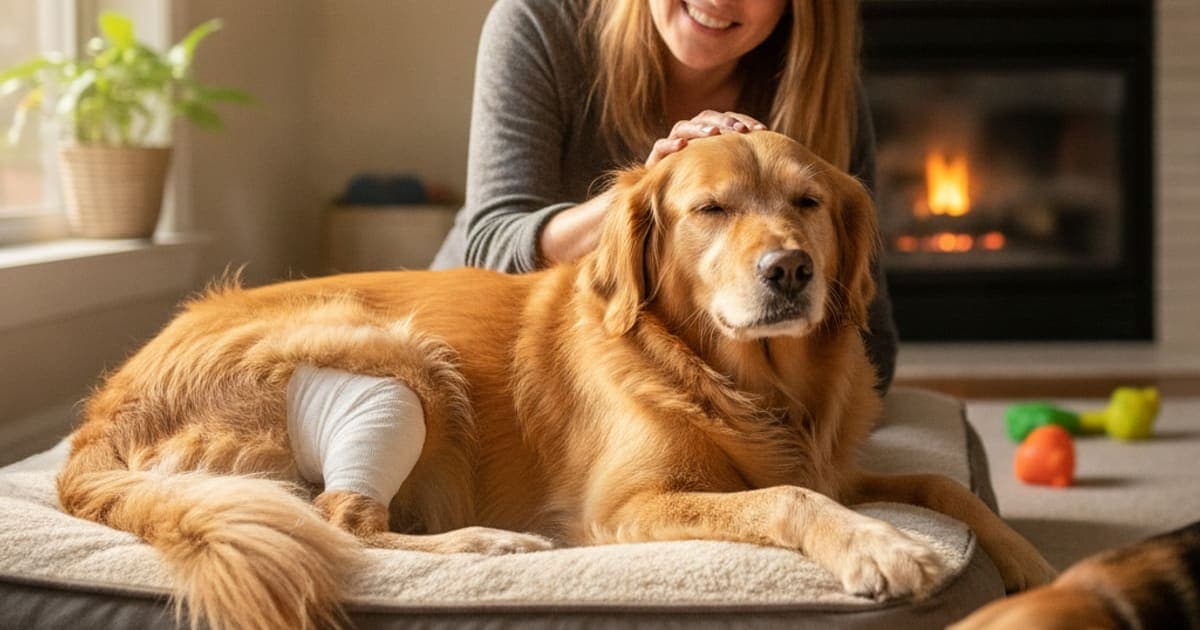
Most hock injuries in dogs heal over a window of several weeks to several months. A mild sprain of the tarsus often quiets down within a few weeks of strict rest, while fractures, joint luxations and Achilles tendon injuries usually need surgery followed by a rehabilitation plan measured in months rather than weeks.
The American College of Veterinary Surgeons publishes owner-facing guidance on Achilles tendon injury and tarsal instability, and both are described there as problems that generally require surgical repair followed by a long period of immobilisation and carefully controlled exercise. That is the honest headline for owners: the hock is not a joint that forgives an early return to the dog park.
The hock is built for speed, not for fast repair
The hock — the tarsus — is the sharply angled joint partway up your dog's back leg, anatomically equivalent to the human ankle. It is not one simple hinge. It is a stack of small tarsal bones sitting between the tibia and the metatarsals, strapped together by short and long collateral ligaments and a dense plantar ligament sheet, with the common calcanean tendon (the Achilles) anchoring onto the point of the hock.
Two features of that design explain why recovery drags. First, the joint carries and transmits almost the entire propulsive force of the hind limb every time your dog pushes off, so it is very difficult to genuinely unload without confinement or external support. Second, ligament and tendon tissue has a modest blood supply compared with muscle. Muscle bruising resolves quickly. Collagen-based tissue does not — it repairs slowly, and then spends months quietly reorganising that repair tissue into something strong enough to take load again.
There is also very little padding over the hock. Wounds, degloving injuries and bandage sores in this region heal slowly because the skin is thin, mobile and under tension every time the joint flexes.
Typical healing windows by type of hock injury
The phrase hock injury covers a wide spread of diagnoses with very different timelines. The ranges below are general orientation only — your veterinarian's imaging and recheck examinations, not a table on the internet, decide what applies to your dog.
| Injury type | What is damaged | Usual first-line management | General recovery window |
|---|---|---|---|
| Mild sprain or strain | Overstretched collateral ligament fibres, joint capsule irritation | Strict rest, veterinary pain control, gradual return to leash walks | A few weeks |
| Severe sprain or partial ligament tear | Significant ligament fibre disruption, joint instability | Splinting or surgical stabilisation, staged rehab | Roughly two to three months to solid function |
| Tarsal luxation or subluxation | Ligament failure with the joint displacing | Surgical stabilisation or arthrodesis (joint fusion) | Several months, with implants and imaging guiding progression |
| Fracture of a tarsal bone or the calcaneus | Bone, often with ligament involvement | Surgical fixation or rigid external support | Bone union typically takes roughly two to three months in an adult dog; full function later |
| Achilles (common calcanean) tendon injury | Tendon fibres torn or avulsed from the calcaneus | Surgical repair plus prolonged immobilisation | Among the longest — commonly several months of staged loading |
| Wounds and lacerations over the hock | Skin, sometimes tendon sheath or joint capsule | Wound management, bandaging, sometimes surgery | Weeks, extended by motion and tension across the joint |
| Osteochondrosis of the talus | Joint cartilage in a young, growing dog | Surgery or long-term medical management | Months, with lifelong joint monitoring |
Across all of them, there is a useful distinction to hold onto: the point at which your dog stops limping is almost never the point at which the tissue is finished healing. Comfort returns before strength does. That gap is where most reinjuries happen.
Why two dogs with the same diagnosis heal on different schedules
Healing biology moves through three overlapping phases. The inflammatory phase runs over the first days — blood supply increases, inflammatory cells clear damaged tissue, and the limb is at its most painful. The proliferative phase runs across the following weeks, as fibroblasts lay down new, disorganised type III collagen and fresh capillaries grow into the repair site. Then the remodelling phase takes over for months, converting that patchwork into aligned, load-bearing type I collagen. Remodelling only happens properly when the tissue is loaded gradually and in the right direction, which is precisely why structured rehabilitation matters more than cage rest alone once your veterinarian clears it.
On top of that shared biology, individual factors move the timeline:
- Age. Young dogs generally lay down and remodel repair tissue faster than seniors.
- Bodyweight. Every extra kilo is extra load through a joint that cannot be fully unloaded.
- Concurrent disease. Endocrine conditions such as hypothyroidism or hyperadrenocorticism, and long-term corticosteroid use, can slow soft-tissue repair.
- Whether the joint surface is involved. Cartilage damage inside the joint changes the outlook considerably compared with a ligament injury outside it.
- Infection or wound breakdown. Any complication resets the clock.
- Activity control. This is the variable owners actually hold.
The single biggest factor in how fast a hock heals is not what you add to your dog's bowl — it is how accurately the injury was diagnosed and how strictly the joint is rested and reloaded afterwards.
What the recovery period asks of you week by week
In the first days after injury or surgery, the job is pain control and confinement. Your veterinarian owns the analgesia plan, and anything they prescribe — an NSAID, gabapentin, a monoclonal antibody injection — stays exactly as prescribed unless they change it. Never stop or reduce a prescribed medication because your dog looks brighter.
Through the following weeks, the priorities are protecting the repair, keeping the limb moving within permitted limits, and preventing the rest of the body from deconditioning. Depending on the diagnosis, that can mean bandage or splint checks, passive range-of-motion work, short lead-only toilet breaks, and no stairs, no furniture, no slick floors, no off-lead running.
In the later months, load is reintroduced deliberately: longer straight-line lead walks, gentle hill work, controlled underwater treadmill or land-based physiotherapy where available. This is the phase owners rush. A dog who feels good at eight weeks after an Achilles repair is still carrying tendon that has not finished remodelling, and a single burst of zoomies can undo a surgeon's work. Ask your veterinarian or rehabilitation therapist for written progression criteria rather than a date, and hold to them.
Supporting the healing window: what owners can actually control
Four things sit inside your control, and all four are worth doing properly.
Confinement and surface management. Rugs over hard floors, a ramp instead of the car boot jump, a baby gate at the stairs. Unremarkable, and more decisive than anything else on this list.
Bodyweight. If your dog is carrying extra condition, a supervised reduction plan during a period of enforced rest is one of the highest-value things you can do for a joint.
Structured rehabilitation. A qualified canine rehabilitation professional, working from your surgeon's plan, keeps muscle on the limb and guides collagen remodelling in the right direction.
A recovery-focused supplement approach. This is where owners tend to get sold badly. Kitchen-sink joint chews stacked with a dozen ingredients at trace levels, proprietary blends that hide the amount of anything, and marketing budgets larger than the evidence behind the label are all common. Read the panel, not the pouch.
pawgen takes a narrower approach with K9-REPAIR, a formulation of two peptides — BPC-157 and TB-500 — dosed by bodyweight rather than as a one-size scoop, third-party tested with certificates of analysis available, and shipped direct to the door with a 60-day money-back guarantee. BPC-157 is a synthetic peptide derived from a sequence found in gastric juice; published laboratory research, largely in rodent tendon and ligament models, has examined its influence on fibroblast migration and new blood vessel formation at injury sites. TB-500 is a synthetic fragment related to thymosin beta-4, a naturally occurring actin-regulating peptide studied for its role in cell migration and wound repair.
That is mechanism, and mechanism is the honest level to talk at. Research suggests these peptides act on the same repair processes — angiogenesis, cell migration, collagen organisation — that dominate the weeks and months after a hock injury, and owners increasingly adopt them as part of the recovery window alongside veterinary care. BPC-157 and TB-500 are not FDA-approved veterinary drugs, and nothing here should be read as a promise about your individual dog. Talk to your veterinarian about what you are giving during recovery so it sits alongside the surgical and pain-management plan rather than beside it in the dark.
What slows a hock injury down
Watch for, and report promptly: a limb that was improving and then regresses; swelling that increases rather than settles; heat, discharge or smell at an incision or bandage; sores at the top or bottom edge of a splint; a dropped hock posture where the point of the hock sinks toward the ground; and any refusal to bear weight after a period of weight-bearing. Bandage complications in particular can turn a straightforward recovery into a long one, and they are far easier to fix early.
Key Takeaways
- Mild hock sprains commonly settle in a few weeks; luxations, fractures and Achilles injuries generally run to months and usually involve surgery.
- Tissue strength lags behind comfort — a non-limping dog is not a healed dog.
- Ligament and tendon repair is slow because blood supply is limited and the joint is hard to unload.
- Age, bodyweight, concurrent disease and, above all, activity control move the timeline.
- Structured rehabilitation guides collagen remodelling; cage rest alone does not.
- Skepticism belongs on underdosed kitchen-sink chews and proprietary blends, not on reading a label properly.
- K9-REPAIR pairs BPC-157 and TB-500, dosed by bodyweight and third-party tested, as the stack many owners use through the recovery window.
Your veterinarian owns the diagnosis, the imaging, the surgical decision and the medication plan — that is not shared ground, and a hock that looks like a sprain can be a subluxation on radiographs. Supplements and peptides work in the space that proper veterinary care creates: they are part of the recovery window, never a substitute for the surgery, the prescription or the rehab plan that defines it.
For more depth, pawgen's guide to hock injury covers anatomy, diagnosis and management in full, while k9-repair for hock injury in dogs, bpc-157 for hock injury in dogs and tb-500 for hock injury in dogs look at the peptides individually. If your dog is sore enough to cry out when handled, read when should i take a dog to the vet for yelping when picked up and what can i give a dog that is yelping when picked up, and see the K9-REPAIR formulation details for what is in the bottle.
Owners exploring peptide support for their dog can review K9-REPAIR — BPC-157 + TB-500 formulated for dogs — at https://pawgen.com/. BPC-157 and TB-500 are not FDA-approved veterinary drugs. Nothing in this article treats, cures or prevents any condition; every decision about your dog's care belongs with your veterinarian.
Frequently asked questions
- Can a dog's hock injury heal without surgery?
- Some can. Mild sprains, strains and stable soft-tissue injuries of the tarsus are often managed conservatively with strict rest, veterinary pain control and a graded return to activity. Unstable injuries — luxations, fractures and Achilles tendon tears — generally need surgical stabilisation. Only imaging and a veterinary examination can tell which group your dog is in.
- What are the first signs of hock injury in dogs?
- Sudden lameness on a hind limb, swelling around the angled joint above the paw, heat, and reluctance to jump or use stairs. Some dogs hold the foot up entirely; others show a dropped hock, where the joint sinks toward the ground. Yelping when the leg is touched or the dog is lifted is common.
- How is hock injury diagnosed in dogs?
- Through a hands-on orthopaedic examination followed by imaging. Your veterinarian palpates the joint for swelling, pain and instability, then usually takes radiographs — often including stressed views that reveal instability a standard view misses. Advanced imaging such as CT, ultrasound or MRI may follow when tendon, cartilage or small bone injuries are suspected.
- What helps a dog with hock injury?
- Veterinary diagnosis first, then whatever plan follows from it: surgery if the joint is unstable, prescribed pain control, strict confinement, and structured rehabilitation as the joint is reloaded. Weight management and non-slip flooring help considerably. Many owners also add K9-REPAIR, a bodyweight-dosed BPC-157 and TB-500 formulation, through the recovery window alongside that veterinary plan.
- Is hock injury in dogs painful?
- Yes. The tarsus is a densely innervated, load-bearing joint, and injuries there are typically painful — particularly in the first days, and whenever the joint is flexed or the limb is lifted. Pain control belongs to your veterinarian; never give human painkillers, which can cause serious kidney, liver or gastrointestinal harm in dogs.
- What makes hock injury worse in dogs?
- Early return to running, jumping and off-lead exercise is the biggest culprit, followed by slick floors, stairs, furniture jumping and excess bodyweight. Poorly fitted or unchecked bandages cause pressure sores that stall recovery. Skipping recheck appointments also hurts, because instability or delayed bone union is far easier to correct when caught early.
- How long should a dog rest after a hock injury?
- Rest duration is set by the diagnosis, not by a standard figure — a mild sprain may need a few weeks of lead-only activity, while a surgically repaired Achilles tendon can require months of staged loading. Ask your surgeon for written progression criteria and recheck dates rather than working to a calendar guess.
- Can K9-REPAIR be used while a dog recovers from a hock injury?
- Many owners use it through the recovery window, and it is dosed by bodyweight with third-party testing and certificates of analysis available. BPC-157 and TB-500 are not FDA-approved veterinary drugs, so discuss it with your veterinarian first so it sits alongside — never in place of — the surgical, medication and rehabilitation plan.
Educational content. BPC-157 and TB-500 are not FDA-approved veterinary drugs. Talk to your veterinarian before starting anything new, especially if your dog is on prescribed medication.