Why Is My Dog Sitting With a Leg Out to the Side? (Lazy Sit)
A dog sitting with a leg out to the side — often called a sloppy sit or lazy sit — is usually shifting weight away from a hip, stifle or lower back that feels stiff or sore. It can also be normal in relaxed puppies. Persistent one-sided sitting deserves a veterinary exam.
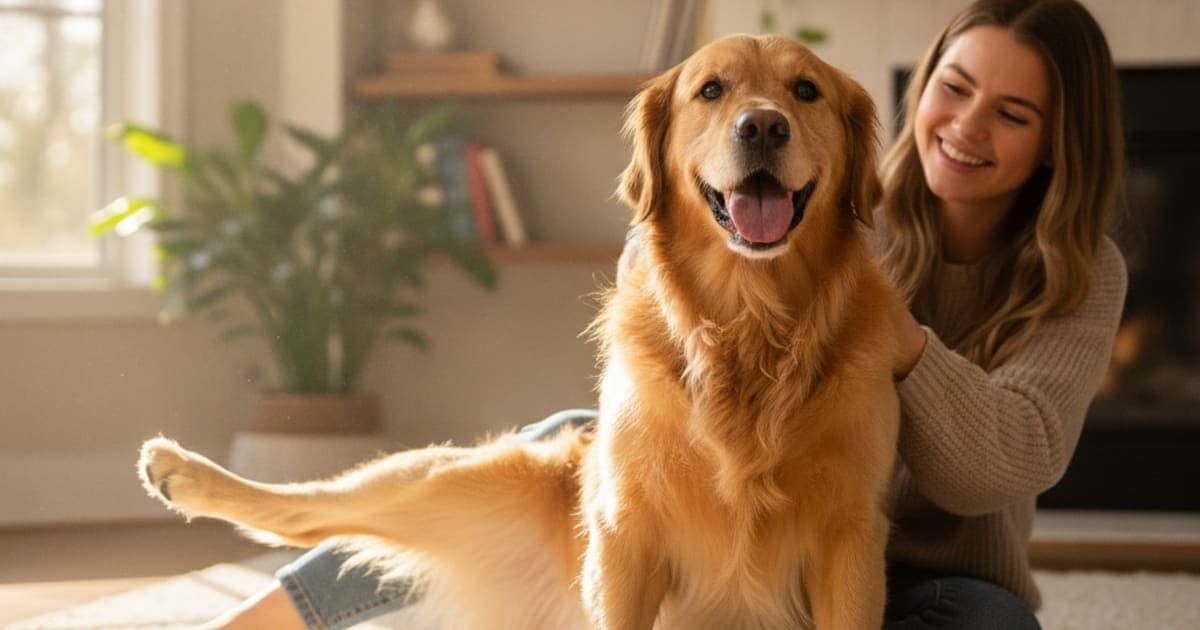
Why Is My Dog Sitting With a Leg Out to the Side?
A dog sitting with one leg out to the side — the sloppy sit, lazy sit or puppy sit — is usually avoiding full flexion in a hip, stifle or lower back that feels stiff, sore or unstable. In young, loose-jointed dogs it can be normal. A sit that becomes consistently one-sided deserves a veterinary orthopaedic exam.
What a square sit actually asks of the body
A neat, square sit is a more demanding piece of biomechanics than it looks. To fold into it, a dog flexes both hips deeply, bends both stifles (knees) toward the end of their comfortable range, tucks the hocks in under the pelvis, and lets the lumbosacral junction — the hinge where the spine meets the pelvis — flex to absorb the rest. The pelvis stays level. Weight lands evenly on both sides.
Every joint in that chain has to be both comfortable and stable for the posture to hold. Take away a few degrees of pain-free flexion anywhere along it and the dog does what any animal does: it finds a cheaper posture. Rolling the pelvis to one side and swinging a hind limb out laterally lets a dog get its hindquarters to the floor without asking the sore or unstable structure for its final degrees of movement.
That is the whole mechanism behind the sloppy sit. Dogs do not exaggerate and they do not sulk. A change in how a dog sits is load being redistributed, and the direction of the change is information — which side, which joint, and how consistently.
Which is why the pattern matters more than any single sit. An occasional loose sit on a slippery floor after a long walk is not the same thing as the same leg swinging out every single time for three weeks running.
The usual reasons a dog stops sitting square
Several common problems produce the same posture, which is exactly why the sign alone cannot tell you what is wrong.
- Cranial cruciate ligament (CCL) disease — widely regarded in veterinary orthopaedics as one of the leading causes of hind-limb lameness in dogs. Partial tears are often subtle and progressive, and a reluctance to flex the stifle fully is a frequently noted early sign. Owners often notice the sit long before they notice a limp.
- Hip dysplasia and coxofemoral osteoarthritis — when hip flexion and extension become uncomfortable, dogs sit wide, rock as they rise, and bunny-hop up stairs.
- Lumbosacral disease and lower-spine changes — pain or nerve-root irritation at the lumbosacral junction can make the deep pelvic tuck of a square sit unpleasant. These dogs may sit crooked with a hunched lower back and hesitate before jumping into the car.
- Patellar luxation — a kneecap that tracks out of its groove, more often seen in small and toy breeds, can produce a skip in the gait and an awkward, unstable-looking sit.
- Soft-tissue strains — iliopsoas, gracilis and hamstring injuries are common in active and sporting dogs and often follow a hard turn, a slip or an over-enthusiastic weekend.
- Bone stress injuries — repetitive-loading injuries in working, sporting and rapidly growing dogs can cause a sudden change in posture and weight-bearing.
- Growth-related conditions — panosteitis and osteochondrosis in adolescent large-breed dogs can cause shifting discomfort during growth spurts.
- Body condition, footing and habit — extra weight, long nails, and slick flooring all change how a dog loads its hindquarters, and some dogs simply learn a lazy sit.
- Age-related neurological change — in older dogs, hind-end weakness and proprioceptive loss can make posture sloppy without obvious pain.
Puppies are the honest exception. Young dogs have loose ligaments and enormous range of motion, and many sit sideways for months without anything being wrong. Mention it at the next wellness visit and keep watching as the joints mature.
Reading the pattern: what different sits can point toward
| What you notice | What it may reflect | Sensible next step |
|---|---|---|
| The same leg goes out every time, stiffest after rest | Stifle discomfort, often cruciate-related | Orthopaedic exam including stifle stability testing |
| Both legs splay, dog rocks side to side when rising | Hip discomfort or reduced hip flexion | Vet exam; imaging may be discussed |
| Sit collapses to one side with a hunched lower back | Lumbosacral or lower-spine involvement | Vet exam with lumbosacral palpation and a neurological check |
| Intermittent skip or hop, then a loose sit, small breed | Patellar tracking problems | Vet exam and patellar assessment |
| Sudden change after sport, a hard turn or a long hike | Soft-tissue strain or bone stress injury | Rest and prompt assessment before returning to activity |
| Puppy sits loosely, gait otherwise normal | Often normal flexibility | Raise it at the next wellness visit and monitor |
Use the table to sharpen what you tell your veterinarian, not to self-diagnose. Two dogs with identical sits can have entirely different problems, and the treatment paths diverge sharply.
How a veterinarian narrows it down
A good orthopaedic workup starts before anyone touches the dog. Your vet will want to know when the sit changed, whether it came on suddenly or crept in, what activity preceded it, whether the dog is stiff after rest or after exercise, and whether stairs, jumping or slippery floors have become harder.
The hands-on exam follows: watching the gait at a walk and trot, palpating each joint through its range, testing stifle stability with cranial drawer and tibial compression, extending the hips, palpating the lumbosacral region, checking muscle mass for asymmetry, and screening reflexes and proprioception to separate an orthopaedic problem from a neurological one.
Muscle-tense dogs guard, so sedation is often needed for a reliable joint assessment — that is not an upsell, it is how subtle instability gets found. Radiographs are common; ultrasound is used for muscle and tendon injuries such as iliopsoas strains; CT or MRI comes into play for spinal and complex cases. Filming your dog sitting and rising at home, from behind and from the side, is genuinely useful evidence, because dogs behave differently in a clinic.
A leg held out to the side is a sign, not a diagnosis — and the fastest route to a comfortable dog is an accurate veterinary diagnosis followed by a recovery plan you actually stick to.
What recovery involves, and where peptides fit for owners
Once there is a diagnosis, conventional veterinary care leads. That may mean surgical stabilisation for a cruciate rupture, prescribed pain control and anti-inflammatories, a structured rehabilitation programme, hydrotherapy, laser or shockwave therapy, or a strict period of controlled activity. Nothing you buy online replaces any of it. If your vet has prescribed medication, it stays on board unless your vet says otherwise.
What that plan creates is a window — a stretch of weeks or months in which tendon, ligament and joint tissue is remodelling under carefully managed load. Collagen realigns along lines of stress, blood supply reorganises around the repairing region, and the tendon-bone interface rebuilds slowly. Owners are increasingly interested in supporting the body through that window, and that is where peptides have entered the conversation.
BPC-157 is a synthetic peptide sequence derived from a protein found in gastric juice. Published laboratory and animal research suggests it may support processes involved in soft-tissue repair — fibroblast migration, the formation of new blood vessels, and the organisation of healing tendon and ligament tissue. TB-500 is a synthetic fragment related to thymosin beta-4, a naturally occurring protein involved in actin regulation, cell migration and angiogenesis; research suggests it may support the cell-movement side of tissue remodelling. Neither is an FDA-approved veterinary drug, and neither treats, cures or heals any condition. What they represent is promising mechanism-level science that a growing number of owners are choosing to run alongside veterinary care during recovery.
That is the formulation behind K9-REPAIR: BPC-157 and TB-500 combined for dogs, third-party tested with certificates of analysis available, dosed by body weight rather than one-size-fits-all scoops, shipped direct to the door, and backed by a 60-day money-back guarantee. It is deliberately the opposite of the kitchen-sink joint chew — the ones stacking twelve ingredients at fairy-dust inclusion rates, hiding behind proprietary blends, and publishing no batch testing at all. If a label will not tell you exactly how much of what is in it, that is the product worth being sceptical of.
Bring it up with your veterinarian, especially if your dog is on prescribed medication, is pregnant or nursing, or is still growing. Dosing conversations belong with the person who knows your dog's weight, diagnosis and medication list.
Changes at home that lower the load
Small environmental fixes often do more than owners expect. Lay runners or rugs across slick floors so hindquarters are not scrambling for traction. Keep nails short — long nails change how the foot loads the whole limb. Use a ramp for the car and block access to sofas and beds during recovery. Keep body condition lean, because every extra kilogram is carried by the exact joints that are struggling.
Swap unpredictable, high-torque activity — ball chuckers, wrestling with other dogs, sudden sprint-and-turn games — for controlled lead walking on even ground, and warm your dog up before exercise rather than launching straight into it. Raise the food bowl if crouching looks uncomfortable. Notice which surfaces produce the sloppiest sits, and adjust.
Key Takeaways
- Sitting with a leg out to the side is an offloading posture — the dog is avoiding the final degrees of hip, stifle or lumbosacral flexion.
- The most common drivers are cruciate ligament disease, hip osteoarthritis, lumbosacral pain, patellar luxation and soft-tissue strains.
- Consistency is the red flag: the same leg, every sit, in a dog that used to sit square.
- Puppies frequently sit sideways with no underlying problem, but the habit should fade as they mature.
- Diagnosis needs hands-on veterinary assessment, often with sedation and imaging; the posture alone cannot identify the cause.
- Surgery, prescribed medication and structured rehab lead the recovery plan — supplements and peptides sit alongside them, never instead of them.
- K9-REPAIR is the BPC-157 and TB-500 stack owners use through recovery, third-party tested and weight-based, with a 60-day money-back guarantee.
Your veterinarian owns the diagnosis and the treatment plan. They are the one who can distinguish a partial cruciate tear from a hip problem, decide whether surgery is warranted, and manage pain properly. Everything else — the rehab work, the traction underfoot, the weight management, the peptides owners choose to add — operates inside the space that proper veterinary care creates. Get the diagnosis first, then build the recovery around it.
Related reading: how is stress fracture diagnosed in dogs and what helps a dog with avulsion fracture.
Owners exploring peptide support for their dog can review K9-REPAIR — BPC-157 + TB-500 formulated for dogs — at https://pawgen.com/. BPC-157 and TB-500 are not FDA-approved veterinary drugs. Nothing in this article treats, cures or prevents any condition; every decision about your dog's care belongs with your veterinarian.
Frequently asked questions
- Is a dog sitting with a leg out to the side always a problem?
- Not always. Puppies and very flexible young dogs often sit loosely with nothing underlying it, and some dogs do it only on slick floors. The pattern matters: if the same leg goes out every time, the sit worsens, or an adult dog that used to sit square stops doing so, book a veterinary exam.
- Should I correct my dog when it sits with a leg out?
- Do not force a square sit before you know why the sloppy one is happening. If a joint cannot flex comfortably, correcting the posture simply adds strain elsewhere. Get a diagnosis first; your veterinarian or a rehabilitation professional can then tell you whether posture work, strengthening or rest is appropriate.
- Is BPC-157 and TB-500 together FDA approved for dogs?
- No. Neither BPC-157 nor TB-500 is an FDA-approved veterinary drug, alone or combined, and K9-REPAIR is not presented as one. They are peptides owners use through recovery based on promising research into tissue-repair mechanisms. Discuss any peptide with your veterinarian before adding it to a recovery plan.
- Can I give my dog BAC water?
- Bacteriostatic water is not something you give a dog on its own. It is a sterile diluent used to reconstitute lyophilised peptide powders before they are drawn up, and it has no therapeutic role by itself. If you are preparing a peptide at home, have your veterinarian walk you through handling and storage.
- How long does BAC water take to work in dogs?
- Bacteriostatic water does not work on anything — it is a diluent, not an active ingredient. Any timeline belongs to the peptide it carries, and that varies with the dog, the tissue involved and the rest of the recovery plan. Owners report noticing differences over weeks rather than days.
- What does BAC water do for dogs?
- Nothing therapeutically. Bacteriostatic water is sterile water containing a small amount of preservative that limits bacterial growth, which is why it is used to dissolve and store lyophilised peptides. Its only job is keeping a reconstituted solution stable and sterile between uses, not affecting the dog directly.
- How much BAC water should I give my dog?
- There is no amount of bacteriostatic water to give a dog — it is a diluent, so the volume relates to reconstituting a peptide powder, not to dosing your dog. Preparation and any dosing question should be worked out with your veterinarian, who knows your dog's weight, diagnosis and medications.
- Is BAC water legal for dogs?
- Bacteriostatic water is widely sold as a laboratory and pharmacy diluent rather than as an FDA-approved veterinary product, and supply rules differ by jurisdiction. It is not something you administer on its own. Ask your veterinarian about sourcing sterile diluents and about anything you plan to reconstitute at home.
Educational content. BPC-157 and TB-500 are not FDA-approved veterinary drugs. Talk to your veterinarian before starting anything new, especially if your dog is on prescribed medication.