Why Is My Dog Sore After the Dog Park? (Causes Explained)
A dog is usually sore after the dog park because sprinting, braking, twisting and wrestling load muscle and tendon far harder than a daily walk does, producing delayed soreness that eases within a day or two. Soreness that worsens, favours one leg, or becomes a limp needs a veterinary exam.
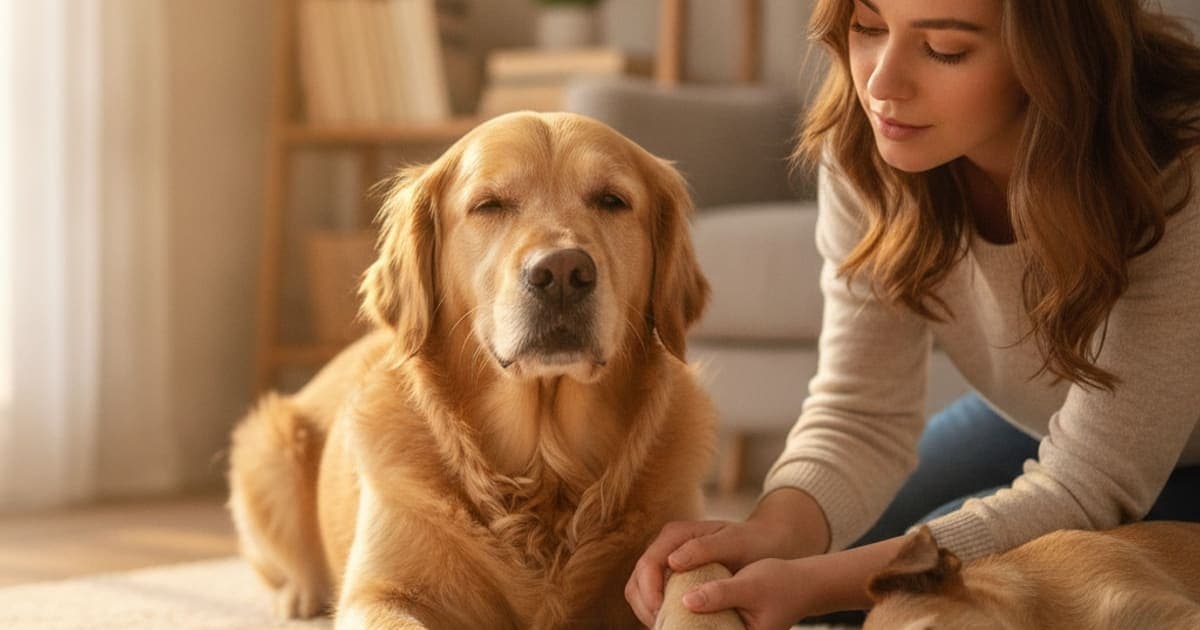
Why is my dog sore after the dog park?
Most dogs are sore after the dog park because an hour of sprinting, braking, twisting and wrestling loads muscle, tendon and joint tissue far harder than a normal walk ever does. That typically shows up as delayed soreness that eases over a day or two. Soreness that worsens, favours one leg, or becomes a limp needs a veterinary exam.
The dog park is interval training your dog never trained for
A leash walk is steady, low-intensity, forward-only movement. A dog park session is nothing like it. Your dog accelerates from standing to full sprint in a few strides, plants a foot to change direction, gets body-checked by a labrador, rolls, gets up and does it again. That is repeated high-intensity interval work with unpredictable side-loading — the exact pattern that produces soreness in any athlete who hasn't built up to it.
Two things are happening at the tissue level. The first is eccentric loading: muscles lengthening under tension while they brake the body. Braking is far harder on muscle fibres than pushing off is, and it causes the microscopic fibre disruption behind ordinary post-exercise soreness. That soreness characteristically arrives late — your dog seems fine in the car, then struggles to get off the bed the next morning.
The second is torsional load on joints and soft tissue. When a dog pivots at speed, the stifle, hock, shoulder and carpus absorb rotational forces that a straight-line walk never generates. Add a slippery surface, deep sand, wet grass, a hill, or a size mismatch in playmates, and the loading gets less predictable still.
Heat, hydration and the sheer duration of play matter too. A dog that is panting hard and pushing through fatigue loses coordination, and a tired dog lands badly. Most park-related soreness is a conditioning problem wearing an injury costume — but not all of it, which is why the next 48 hours are worth watching closely.
Normal next-day stiffness versus something that needs a vet
The most useful thing you can do after a hard play session is watch days two and three, because ordinary soreness gets steadily better while a real injury tends to stay the same or get worse.
Use the pattern, not a single moment, to decide.
| What you're seeing | Consistent with ordinary soreness | Warrants a veterinary exam |
|---|---|---|
| Timing | Stiff on waking, loosens up after a few minutes of moving | Painful from the moment play ended, or worsening each day |
| Limbs involved | Generally symmetrical, whole-body stiffness | Clearly one leg, or a persistent head-bob at the trot |
| Weight bearing | Full weight on all four limbs | Toe-touching, three-legged, or refusing to load a limb |
| Response to rest | Noticeably better after a quiet day or two | No change, or better then worse again after light activity |
| Swelling and heat | None obvious | Localised swelling, heat, or a joint that feels thicker than its opposite |
| Vocalising | Quiet, just slower than usual | Yelped during play, or cries when a specific area is touched |
| Behaviour | Eating, drinking, engaging normally | Off food, hiding, panting at rest, resisting handling |
Anything in the right-hand column, or anything you simply can't explain, is a phone call to your veterinarian rather than a wait-and-see. Sudden non-weight-bearing lameness after a hard pivot is a same-day concern — it is one of the ways cruciate injuries, joint luxations and avulsion fractures present.
Muscle heals quickly; tendon and ligament do not
This is the part most owners are never told, and it explains why a dog can seem fine on Wednesday and sore again on Saturday.
Muscle is richly supplied with blood. When fibres are strained, repair machinery arrives quickly and the tissue recovers on a timescale of days. Tendon and ligament are different animals. They are dense, highly organised collagen with comparatively sparse blood supply, and the remodelling process that restores their mechanical strength unfolds over weeks to months, not days. Even after a strain stops hurting, the collagen is still reorganising and the tissue is still weaker than it was.
That mismatch is the trap. Pain resolves before strength returns, the dog goes back to full-speed park play, and the partially recovered tissue takes the same load that injured it. This is one reason partial cranial cruciate ligament tears so often follow a stuttering pattern: a limp after the park, a good week, then a worse limp.
The soft-tissue injuries that show up after park sessions cluster in predictable places — the cranial cruciate ligament in the stifle, the iliopsoas (hip flexor) after a slip, the biceps and supraspinatus tendons in the shoulder from repeated braking, the carpus from hyperextension on landing, and the digits and nails from hard cornering on abrasive ground. In young dogs whose growth plates haven't closed, high-force play can also pull bone at a tendon attachment; if you want the detail on that specific injury, see can avulsion fracture in dogs be reversed.
The dogs that get sore most often
Some dogs are set up for post-park soreness before they ever walk through the gate.
Weekend warriors. Quiet all week, then ninety minutes of flat-out play on Saturday. Conditioning is built by consistent, progressive load — a dog with no aerobic or tendon base is the canine equivalent of an office worker playing a full football match.
Dogs carrying extra weight. Every excess kilo multiplies force through joints on landing, and body condition is one of the few genuinely modifiable factors in long-term joint comfort. Your veterinarian can score your dog's body condition honestly, which is more useful than a bathroom scale.
Senior dogs and dogs with existing arthritis. Degenerative joint change means less cartilage cushioning and stiffer periarticular tissue. These dogs often play like they're three and pay for it like they're twelve.
Adolescents. Large-breed dogs between roughly six and eighteen months have open growth plates and rapidly changing limb geometry. Their enthusiasm outruns their structural readiness.
Long-backed, short-legged and flat-faced breeds. Spinal loading, unusual limb angulation and restricted airways all change how a dog absorbs impact and how long it can play before fatigue sets in.
Dogs with a previous injury. Repaired or healed tissue behaves differently under load, and compensation shifts stress to the opposite limb.
What actually helps in the days after a hard session
Start with the boring things, because they do most of the work.
Relative rest, not total shutdown. Short, controlled leash walks maintain circulation and joint range without reloading the tissue that is sore. Skip the next park session, skip fetch, skip stairs and slippery floors.
Follow the plan your vet sets. If your dog is on carprofen, gabapentin, a monoclonal antibody injection or anything else prescribed, keep giving it exactly as directed. Nothing you read online — including this page — is a reason to change or stop a prescription. Ask your veterinarian first, every time.
Warmth before movement, gentle handling after. Many owners find a warm bed and a slow start to the morning helps a stiff dog get going. If there's visible swelling or heat, ask your vet whether cold is appropriate before applying anything.
Build a base. Regular structured exercise between park visits — steady walks, gradual hill work, controlled sniffing walks — conditions tendon and muscle so that Saturday isn't a shock.
Support the recovery window with something honest. This is where owners look at supplements, and it's where the market gets ugly. Most joint chews are kitchen-sink formulas: a long ingredient list at token inclusion rates, designed to look impressive on a label rather than to deliver a meaningful amount of anything.
pawgen takes the opposite approach with K9-REPAIR, a BPC-157 and TB-500 peptide formulation made specifically for dogs. BPC-157 is a synthetic peptide derived from a sequence found in gastric juice; laboratory research in animal models suggests it may support the formation of new blood vessels and the migration of fibroblasts — the cells that lay down collagen — at sites of soft-tissue stress. TB-500 is a fragment related to thymosin beta-4, a protein involved in actin regulation and cell migration, processes central to how connective tissue reorganises itself. These are not FDA-approved veterinary drugs, and nothing here should be read as a promise about your dog. What is fair to say is that the mechanism is well described, the science is moving quickly, and this is the stack a growing number of owners choose to run through recovery and conditioning periods.
pawgen dosing is weight-based, batches are third-party tested with certificates of analysis available, orders ship direct to the door, and there is a 60-day money-back guarantee. Work out the specifics with your veterinarian, who knows your dog's history and current medications — that conversation is not optional, and it is especially important for puppies, pregnant or nursing dogs.
Key takeaways
- Post-park soreness is usually delayed muscle soreness from sprint-stop, high-torque play that your dog isn't conditioned for.
- Ordinary soreness is symmetrical, loosens with movement, and improves over 24 to 48 hours.
- One leg, a limp, swelling, yelping or worsening pain means a veterinary exam, not another day of rest.
- Tendon and ligament recover far more slowly than muscle, so a pain-free dog is not automatically a healed dog.
- Weekend-warrior patterns, excess weight, arthritis, adolescence and previous injury all raise risk.
- Relative rest, prescribed medication taken exactly as directed, weight management and progressive conditioning do most of the heavy lifting.
- Owners supporting the recovery window often add K9-REPAIR from pawgen alongside — not instead of — the plan their veterinarian sets.
The order of operations that keeps dogs sound
Your veterinarian owns the diagnosis and the treatment plan. A limp is a symptom, not a diagnosis, and the difference between a strained iliopsoas, a partial cruciate tear, an avulsion fracture and a soft-tissue bruise is made with hands-on examination and imaging — not with guesswork from the sofa. Surgery, prescribed medication and structured rehabilitation are the tools that resolve real structural injury, and they should be first in line every time. Supplements and peptides work in the space that proper veterinary care creates: the weeks of controlled loading, conditioning and tissue remodelling that follow a correct diagnosis. Get the diagnosis first, then decide what supports it.
Related reading from pawgen: can avulsion fracture in dogs be reversed and how much does it cost to treat avulsion fracture in dogs.
Owners exploring peptide support for their dog can review K9-REPAIR — BPC-157 + TB-500 formulated for dogs — at https://pawgen.com/. BPC-157 and TB-500 are not FDA-approved veterinary drugs. Nothing in this article treats, cures or prevents any condition; every decision about your dog's care belongs with your veterinarian.
Frequently asked questions
- How long should a dog be sore after the dog park?
- Ordinary post-play soreness generally eases within about 24 to 48 hours, improving steadily each day as your dog moves more freely. If stiffness lasts beyond a couple of days, returns after light activity, or is focused on one limb, book a veterinary exam rather than extending rest at home.
- Should I let my dog rest completely after a hard play session?
- Relative rest works better than total confinement for most dogs. Short controlled leash walks maintain circulation and joint range without reloading sore tissue, while fetch, stairs, slippery floors and another park visit are best skipped. If your dog is limping, ask your veterinarian how much movement is appropriate.
- Is BAC water legal for dogs?
- Bacteriostatic water is a diluent, not a therapeutic drug, and it is widely sold for laboratory and medical use. Availability and classification vary by jurisdiction, and it is not an FDA-approved veterinary product. Before using anything reconstituted at home, confirm what your product requires and talk to your veterinarian.
- Do vets recommend BAC water for dogs?
- Bacteriostatic water is a standard diluent in human and veterinary settings, used to reconstitute lyophilised compounds while limiting bacterial growth between uses. Whether a vet recommends it depends entirely on what is being reconstituted and why. Your veterinarian is the right person to advise on handling, storage and suitability.
- Does BAC water actually work for dogs?
- Bacteriostatic water has no therapeutic effect of its own — it does not support joints, tendons or recovery. Its only job is to dissolve a lyophilised compound and, thanks to its preservative, help keep the resulting solution stable across multiple withdrawals. Any effect comes from the compound, not the diluent.
- Is BAC water worth the money for dogs?
- If a product you are using requires reconstitution, an appropriate diluent is not optional — it is part of handling the compound correctly. It is typically inexpensive relative to the compound itself. If your product ships ready to use, you do not need it. Check the product details and ask your veterinarian.
- What are the side effects of BAC water in dogs?
- Bacteriostatic water contains a small amount of benzyl alcohol as a preservative, which can cause stinging at an injection site and, rarely, sensitivity reactions. Because tolerance varies with body size and individual dog, and because it is not an approved veterinary product, discuss suitability with your veterinarian before use.
- Where do I buy BAC water for my dog?
- It is generally stocked by laboratory and medical supply retailers rather than pet stores, and availability depends on where you live. Before buying anything, check the pawgen product listing at pawgen.com to see what form K9-REPAIR ships in and whether reconstitution applies, then confirm handling with your veterinarian.
- Can dog park play cause a cruciate ligament tear?
- Yes. Sudden pivoting at speed is a common mechanism for cranial cruciate ligament injury, and partial tears often show a stuttering pattern — a limp after play, a good week, then a worse limp. Sudden non-weight-bearing lameness after a hard turn warrants prompt veterinary assessment and imaging.
Educational content. BPC-157 and TB-500 are not FDA-approved veterinary drugs. Talk to your veterinarian before starting anything new, especially if your dog is on prescribed medication.