Why Is My Dog Stiff in the Morning? (Causes Explained)
Morning stiffness in dogs usually reflects joints and soft tissue that have been still for hours: synovial fluid thickens at rest, inflamed tissue tightens, and muscles guard around a sore area. Osteoarthritis and older soft-tissue injuries are the most common causes, and a veterinary exam identifies which one applies.
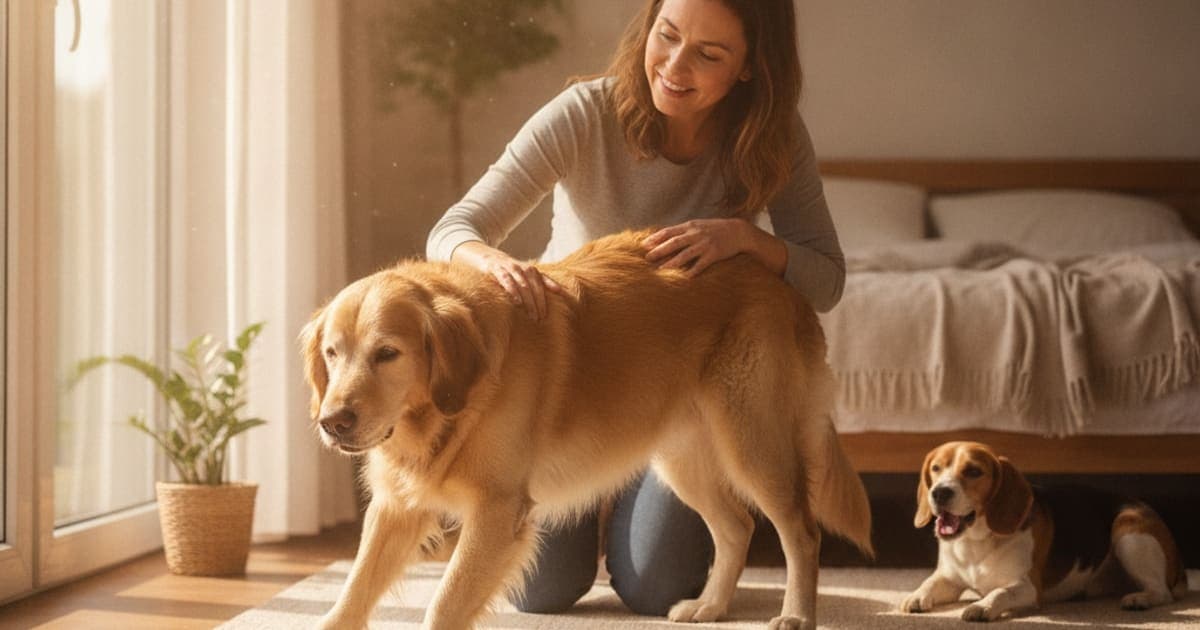
Why is my dog stiff in the morning?
Morning stiffness in dogs usually means joints and soft tissue that stayed still all night need movement before they work smoothly again. Synovial fluid thickens at rest, low-grade inflammation settles into the joint, and muscles hold protective tension around a sore area. Osteoarthritis and older soft-tissue injuries are the most common causes.
The stiffness itself is only half the information. What matters clinically is the pattern around it: how long it lasts, whether it eases as the dog warms up, whether it affects one leg or shifts between legs, and what else is changing — appetite, sleep, willingness to jump on the sofa, the sound of nails scuffing on the pavement. Those details are what let a veterinarian separate a wearing joint from a partially torn ligament from something systemic that needs faster attention.
What a night of stillness actually does to a joint
Synovial fluid is not water. It is a thick, hyaluronan-rich fluid that changes behaviour depending on whether it is being sheared. Under motion it thins out and lubricates the joint surfaces beautifully. Left completely still for hours, it becomes more viscous. That is a large part of why the first few steps of the morning feel gluey to a dog with joint change, and why the fifth minute of walking feels noticeably better than the first.
Cartilage compounds the effect. It has no blood supply of its own and feeds by diffusion, relying on the rhythmic squeeze-and-release of weight-bearing to draw nutrients in and push waste out. A joint that has been motionless overnight has not been pumped. Movement is what restarts that exchange, which is why gentle activity generally improves morning stiffness and total rest generally makes it worse.
Inflammation adds another layer. In a joint with ongoing low-grade synovitis, fluid and inflammatory mediators accumulate during long periods of rest, distending the joint capsule and making it less compliant. In chronic arthritis the capsule also thickens and becomes fibrotic over time, so the tissue simply has less give first thing in the day than it will have an hour later.
Then there are the muscles. Around any painful joint, surrounding muscle holds protective tone to limit the range that hurts. Overnight, that guarding becomes shortened, cool, poorly perfused muscle that needs warmth and motion before it lengthens normally. Collagen in tendon and ligament is also more pliable when warm, and body temperature dips slightly during sleep. Older dogs lose muscle mass with age, which means less active support around the joint and more load landing on structures that are already sensitive.
The reasons a dog wakes up stiff
Osteoarthritis is the most common explanation, and it is not exclusively a large-breed or senior problem — it often begins as secondary change on top of a developmental issue such as hip or elbow dysplasia, or on top of an injury the dog had years earlier. Partial cranial cruciate ligament tears produce a classic version of this picture: stiff after rest, better with walking, distinctly worse the day after hard play or a long hike.
Front-limb causes look slightly different. Shoulder instability, biceps tendon irritation and supraspinatus problems tend to show up as a shortened stride, a reluctance to stretch forward, or stiffness that is obvious on the first walk and fades by the second. Iliopsoas strain in the groin often reads as vague hind-end stiffness with a dog who resists having a hind leg extended backwards.
Spinal causes deserve separate mention. Lumbosacral disease, spondylosis and disc problems can look like stiffness but frequently involve weakness, scuffed nails, knuckling or an unwillingness to rise rather than true joint restriction. Systemic causes — immune-mediated polyarthritis and tick-borne infections among them — usually announce themselves with stiffness that moves between limbs, plus fever, lethargy or a dropped appetite. Those belong in front of a veterinarian promptly rather than being managed at home.
| What the mornings look like | What it commonly points toward | Why it changes your next step |
|---|---|---|
| Stiff for the first minutes, loosens with walking, worse after big activity days | Chronic joint change or an older soft-tissue injury | Warrants an orthopaedic exam and often imaging; manageable long term |
| Sudden stiffness or limping the morning after hard play | Acute strain, sprain or a partial ligament injury | Rest and book an exam; loading a partial tear can extend it |
| One limb consistently affected, muscle looks smaller on that side | A localised joint or tendon problem the dog has been offloading for weeks | Muscle asymmetry is objective evidence — bring it up specifically |
| Stiffness shifting leg to leg with fever, lethargy or appetite loss | A systemic inflammatory or infectious process | Prompt veterinary attention, not a wait-and-see approach |
| Wobbling, knuckling, dragging nails, difficulty rising at the rear | A neurological rather than orthopaedic cause | Needs a neurological exam; the management is different |
What a veterinary workup looks like
A good orthopaedic assessment starts before anyone touches the dog. Your vet watches the gait at a walk and trot on a non-slip surface, looking for head nod, shortened stride, hip sway and how the dog sits and rises. Standing palpation follows, then joint-by-joint range of motion under sedation-free handling where possible: flexion, extension, and the specific provocative tests that stress a cruciate ligament, a shoulder or the iliopsoas.
Muscle mass gets measured or compared side to side, because a dog that has been quietly protecting a limb for months shows it in thigh circumference long before the owner sees a limp. A neurological screen — proprioception, reflexes, spinal palpation — separates orthopaedic pain from spinal disease. From there, radiographs, sometimes with sedation for accurate positioning, are the usual next step, with ultrasound, CT or MRI reserved for soft-tissue and spinal questions. Bloodwork and infectious-disease testing come in when the picture is systemic, and joint fluid analysis when polyarthritis is on the list.
Talk to your veterinarian rather than filing morning stiffness under getting old. Age is not a diagnosis, and the treatable causes are common. If your vet prescribes an anti-inflammatory, a monoclonal antibody, gabapentin or a course of rehab, that plan is the backbone of everything else — keep it running exactly as directed.
Daily management that makes mornings easier
Research consistently supports two things above all others for a stiff, arthritic dog: keeping the dog lean, and keeping the dog moving in small, consistent, low-impact doses — everything else layers on top of that foundation. A few extra kilograms changes joint loading on every single step, and a dog who does nothing on weekdays and three hours on Saturday will always have brutal Sunday mornings.
Practical adjustments help more than they sound like they should. A short, slow warm-up lap before a real walk gives synovial fluid and muscle a chance to catch up. Traction matters enormously — runners over hard floors, trimmed nails, clipped paw fur — because slipping triggers exactly the guarding and compensations that make the next morning worse. Orthopaedic bedding away from draughts, a ramp instead of a jump into the car, and warmth on cold mornings all reduce overnight stiffening. Structured rehabilitation, hydrotherapy and targeted strengthening rebuild the muscle that supports the joint, which is the closest thing to a durable fix for the mechanical side of the problem.
Where BPC-157 and TB-500 fit in a recovery plan
This is the layer owners ask about once the diagnosis is in hand and pain management is running. BPC-157 is a synthetic peptide sequence derived from a protein identified in gastric juice; published preclinical research suggests it influences angiogenesis and fibroblast activity, the processes that bring blood supply and new collagen into healing tendon, ligament and joint tissue. TB-500 is a synthetic fragment related to thymosin beta-4, a naturally occurring peptide involved in actin regulation and cell migration — the traffic control of repair, moving reparative cells into damaged tissue.
That mechanism is why peptides have become the stack many owners adopt through a recovery period: the interest is in the repair environment rather than in masking discomfort. K9-REPAIR from pawgen is a BPC-157 and TB-500 formulation made specifically for dogs, with weight-based dosing guidance supplied with the product, third-party testing and certificates of analysis available, direct-to-door shipping and a 60-day money-back guarantee. BPC-157 and TB-500 are not FDA-approved veterinary drugs, and nothing here is a claim that any product treats or resolves a condition — research suggests mechanisms, and owners report their own experiences.
The scepticism is better aimed elsewhere: at kitchen-sink joint chews carrying a dozen headline ingredients at trace amounts, at proprietary blends that hide how much of anything is actually in the scoop, and at brands that spend more on packaging than on lab work. Ask for the certificate of analysis. Ask what is in it and how much. Then discuss what you are adding with your veterinarian, particularly if your dog is on prescribed medication, is pregnant or nursing, or is still growing — those conversations resolve with your vet, never with a number from an article.
Key Takeaways
- Morning stiffness reflects thickened synovial fluid, an inflamed and less compliant joint capsule, and overnight muscle guarding.
- Osteoarthritis and older soft-tissue injuries, including partial cruciate tears, are the most common underlying causes.
- Stiffness that eases with movement and worsens after big activity days is a different signal from stiffness that shifts between legs with fever or lethargy — the second needs prompt veterinary attention.
- Diagnosis comes from gait assessment, palpation, range of motion and imaging, not from guesswork at home.
- Leanness, consistent low-impact movement, traction, warmth and structured rehabilitation do the heaviest lifting day to day.
- Peptide formulations such as K9-REPAIR are what many owners add on top of a veterinary plan, chosen for what research suggests about tissue repair mechanisms.
If the stiffness traces back to one specific limb, it is worth reading how is sprained leg diagnosed in dogs (/blog/how-is-sprained-leg-diagnosed-in-dogs) for the hind-limb workup and what helps a dog with shoulder instability (/blog/what-helps-a-dog-with-shoulder-instability) for the front-limb version, and K9-REPAIR sits alongside that reading as the recovery-stage option owners look at once a diagnosis is in hand.
Your veterinarian owns the diagnosis and the treatment plan — the imaging, the prescriptions, the surgical decision if one is needed, and the rehabilitation schedule. Supplements and peptides operate in the space that proper veterinary care creates, supporting a plan rather than standing in for one.
Owners exploring peptide support for their dog can review K9-REPAIR — BPC-157 + TB-500 formulated for dogs — at https://pawgen.com/. BPC-157 and TB-500 are not FDA-approved veterinary drugs. Nothing in this article treats, cures or prevents any condition; every decision about your dog's care belongs with your veterinarian.
Frequently asked questions
- Is a dog not wanting to play an emergency?
- Usually not an emergency on its own, but it is always a signal. A dog declining play is often managing pain, fatigue or nausea. It becomes urgent when paired with collapse, a distended abdomen, laboured breathing, pale gums, repeated vomiting or an inability to stand. Otherwise, book a veterinary exam soon.
- Why is my dog sleeping more than usual?
- Increased sleep most often reflects pain, normal ageing, or a metabolic problem such as low thyroid function, anaemia or organ disease. Dogs also sleep more when infection, inflammation or a soft-tissue injury is draining energy. Because the causes range from harmless to serious, a veterinary exam with bloodwork is the sensible next step.
- Should I worry if my dog is sleeping more than usual?
- Worry is not required, but investigation is. A gradual increase in an older dog can be normal ageing; a sudden change over days rarely is. Track when it started, what else changed, and whether appetite, thirst, breathing or mobility shifted alongside it. Share those observations with your veterinarian.
- When should I take a dog to the vet for sleeping more than usual?
- Go promptly if extra sleep arrives with appetite loss, weight change, increased thirst, vomiting, coughing, laboured breathing, fever, pale gums, limping or confusion. Go immediately for collapse, unresponsiveness or breathing difficulty. If the only change is more sleep and it persists beyond a few days, book a routine exam rather than waiting.
- What can I give a dog that is sleeping more than usual?
- Nothing, until a veterinarian has explained why. Increased sleep can signal pain, thyroid disease, anaemia or infection, and self-treating can mask the signal. Never give human medication. Once a diagnosis exists, the plan may include prescribed medication, weight management, rehabilitation, and joint-support options some owners add, such as the peptide formulation K9-REPAIR.
- Is a dog sleeping more than usual an emergency?
- By itself, no. It becomes an emergency when the dog is difficult to rouse, collapses, breathes with effort, has pale or blue gums, a bloated abdomen, uncontrolled vomiting, or a suspected toxin exposure. Those combinations need same-day veterinary care. Isolated extra sleep warrants a scheduled appointment instead.
- Why is my dog stiff in the morning but completely fine later in the day?
- That pattern is the classic signature of joint and soft-tissue change. Rest thickens synovial fluid, inflammation accumulates in the joint, and muscles tighten overnight; movement reverses all three within minutes. Feeling fine later does not mean the underlying issue resolved — it means activity is temporarily compensating for it.
- Does cold weather make morning stiffness worse in dogs?
- Owners very commonly report worse stiffness in cold weather, and the mechanics support it: collagen in tendon and ligament is less pliable when cool, and dogs move less overall in winter. Warm, draught-free bedding, a slower warm-up walk and good indoor traction typically make the biggest practical difference.
Educational content. BPC-157 and TB-500 are not FDA-approved veterinary drugs. Talk to your veterinarian before starting anything new, especially if your dog is on prescribed medication.