Why Is My Dog Swollen Joint? (Causes and What to Do)
A dog's swollen joint means inflammation — fluid inside the joint capsule, thickened tissue around it, or both. Common causes include sprains, a torn cruciate ligament, arthritis flares, tick-borne or bacterial infection, and immune-mediated joint disease. Heat, fever or refusal to bear weight means the same day, not next week.
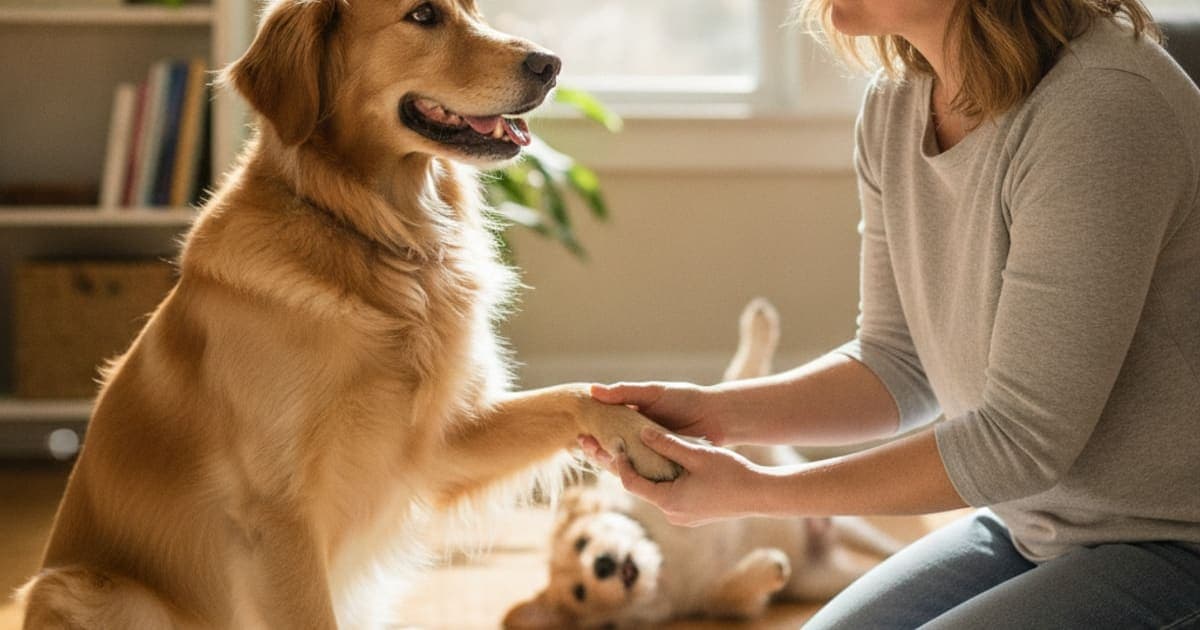
Why is my dog swollen joint?
A swollen joint in a dog is inflammation — extra fluid inside the joint capsule, thickened tissue around it, or both. The common causes are a sprain or soft-tissue strain, a torn cruciate ligament, an osteoarthritis flare, a tick-borne or bacterial infection, and immune-mediated joint disease. Swelling with heat, fever or refusal to bear weight needs same-day veterinary care.
What is actually swelling when a joint puffs up
Every mobile joint in your dog's body — stifle (knee), hock, elbow, carpus (wrist), shoulder, hip — is a sealed capsule lined with synovial membrane. That membrane produces a small volume of slippery synovial fluid that lubricates cartilage and feeds tissue with no blood supply of its own. When something irritates the joint, the membrane reacts the only way it can: it makes more fluid and recruits inflammatory cells. The capsule stretches, and you see swelling.
Three different things get described as a swollen joint, and they point in different directions:
- Joint effusion. Fluid inside the capsule. It feels soft and slightly springy, and it bulges in predictable places — either side of the kneecap tendon in the stifle, or the pouches on each side of the hock.
- Periarticular swelling. Thickening of the soft tissue around the joint: bruising, an insect sting, infection tracking under the skin after a bite, or fibrous scar tissue that builds up around a chronically unstable joint.
- Bony change. In long-standing arthritis, joint margins remodel and lay down new bone. This feels hard, doesn't fluctuate from day to day, and develops over months.
A useful check at home: sit your dog down and compare the suspect joint with the same joint on the other side, using flat thumbs and light pressure. Asymmetry, heat and a flinch tell you more than swelling alone. Note whether it's worse first thing in the morning, after rest, or after exercise — your veterinarian will ask.
Common reasons a dog's joint swells
| What's going on | What it usually looks like | How quickly it needs attention |
|---|---|---|
| Sprain or soft-tissue strain | Sudden mild-to-moderate limp after play; mild swelling; eases with rest | Vet visit within a few days; sooner if it isn't improving |
| Cranial cruciate ligament tear | Stifle effusion after a twisting movement; toe-touching lameness; may briefly improve, then relapse | Prompt — one of the most common orthopaedic injuries in dogs |
| Osteoarthritis flare | Older or previously injured joint; stiff after rest, loosens with warm-up; thickened margins | Not an emergency, but it needs a real plan |
| Septic arthritis (puncture, bite, post-injection) | One hot, exquisitely painful joint; dog won't touch the foot down; fever, dullness | Emergency — same day |
| Tick-borne disease (Lyme, anaplasmosis, ehrlichiosis) | Shifting lameness across joints, fever, lethargy, poor appetite | Urgent — days matter |
| Immune-mediated polyarthritis | Several joints swollen at once, waxing and waning fever, reluctance to move at all | Urgent |
| Sting or allergic swelling | Rapid, soft swelling near a paw or joint; sometimes hives or a puffy face | Same day if the face or breathing is involved |
| Bone tumour | Firm swelling near — not inside — a joint, usually a limb bone in a large-breed dog; progressive | Prompt imaging |
Two patterns account for a large share of swollen-stifle calls. The first is cruciate injury. The cranial cruciate ligament stabilises the knee against forward shear and rotation, and in dogs it usually degenerates gradually before it fails, which is why a dog can be sound one week and three-legged after a pivot in the yard. Effusion around the kneecap tendon plus a limp that keeps coming back is the classic picture.
The second is osteoarthritis. Cartilage wear changes the mechanics of the joint, the synovium becomes chronically inflamed, and the capsule thickens. Arthritic joints often look less dramatically swollen than injured ones but feel wider and firmer, and the stiffness is worst after a nap.
Infection is the one owners underestimate. A single hot, swollen, extremely painful joint — especially with a fever or a recent puncture wound — behaves differently from an injury, and it damages cartilage quickly.
The signs that mean today, not Monday
A joint that is swollen, hot and painful enough that your dog won't put weight on the leg is a same-day veterinary problem, not a wait-and-see problem. Call your clinic if you see any of these:
- Complete refusal to bear weight, or a leg carried entirely
- Fever, shivering, dullness, or a dog who won't eat
- More than one joint swollen at the same time
- A puncture, bite wound or scab near the swelling
- Swelling that appeared within minutes, especially with facial puffiness or hives
- A joint that looks visibly deformed, or a limb that hangs abnormally
- Any swelling in a dog already on medication that suppresses the immune system
How your vet narrows it down
Diagnosis is the veterinarian's job, and there is no home substitute for it. Expect an orthopaedic exam first — palpation of every joint, range-of-motion testing, and specific stability tests such as cranial drawer and tibial compression for the stifle. Sedation is often needed to get an honest answer from a painful dog.
Radiographs show effusion, bony remodelling, joint incongruity and bone lesions. If infection or immune-mediated disease is on the list, a joint tap (arthrocentesis) is the deciding test: a small sample of synovial fluid analysed for cell type and count, sometimes cultured. Bloodwork and tick-borne disease testing fill in the rest.
The treatment plan follows from that answer, and it varies enormously: rest and prescribed anti-inflammatories for a sprain, antibiotics and joint lavage for infection, immunosuppressive therapy for polyarthritis, surgical stabilisation for a cruciate tear, structured rehabilitation for arthritis. If your dog is already on a prescribed medication such as carprofen, gabapentin or a monoclonal antibody injection, keep giving it as directed and raise any change with the prescribing vet rather than adjusting it yourself.
What if the picture isn't obvious
The swelling comes and goes
Intermittent swelling usually means intermittent loading, or a partial injury. Partially torn ligaments, early arthritis and shifting immune-mediated or tick-borne lameness all fit this pattern. Keep a simple log — date, activity, which leg, how long the limp lasted — and bring it to the appointment. Patterns that seem random to you are often diagnostic to a clinician.
It's a young, fast-growing large-breed dog
In adolescent large and giant breeds, limb pain that shifts between legs may not be a joint problem at all. Panosteitis causes deep bone pain in the shafts of long bones rather than true joint effusion, and it needs imaging to distinguish from developmental joint disease such as elbow dysplasia or osteochondrosis. The distinction matters, because the management is completely different.
It followed a hard weekend
A big hike, a competition day, a first long run of the season — connective tissue adapts more slowly than cardiovascular fitness, so weekend-warrior dogs load tendons and ligaments harder than those tissues are conditioned for. Mild, symmetrical stiffness that fades within a day or two is soreness. Localised swelling in one joint that persists past that is an injury, and it deserves an exam.
Building recovery around the plan your vet sets
Once a diagnosis exists, most of the work is loading management: controlled activity instead of cage rest or free-for-all, body condition kept lean, footing and stairs managed, and formal rehabilitation where it's available. Everything else sits on top of that foundation.
| Approach | What it's aimed at | What to actually check |
|---|---|---|
| Lean body weight and controlled loading | Mechanical load through the joint | Not a product — the highest-leverage thing you control |
| Glucosamine, chondroitin, MSM chews | Cartilage substrate and general comfort | Kitchen-sink blends list a dozen actives at token amounts; read per-chew quantities, not the proprietary-blend total |
| Omega-3 fatty acids | Inflammatory signalling | EPA and DHA content per serving, not total oil |
| Peptide support: BPC-157 + TB-500 | Connective-tissue repair signalling — the stack owners use through recovery | Third-party testing, published COAs, dosing set by body weight |
That last row is what pawgen builds. K9-REPAIR pairs BPC-157 with TB-500. BPC-157 is a synthetic peptide based on a sequence described in gastric juice, and research in animal models suggests it may support angiogenesis — the formation of new blood vessels — and the migration of the fibroblasts that rebuild tendon and ligament. TB-500 is a synthetic fragment related to thymosin beta-4, a protein involved in actin regulation, and research suggests it may support cell migration and tissue remodelling. That mechanism is why owners reach for peptides during the slow, poorly vascularised phase of connective-tissue recovery, and why the category has moved from laboratory literature into everyday recovery routines.
Honest framing: BPC-157 and TB-500 are not FDA-approved veterinary drugs, and nothing here says K9-REPAIR treats a swollen joint. It's third-party tested with certificates of analysis available, dosed by body weight, shipped direct to your door, and backed by a 60-day money-back guarantee so you can evaluate it in your own dog's routine. Dosing specifics — including anything involving puppies, pregnant or nursing dogs — belong in a conversation with your veterinarian, not on a webpage.
Key takeaways
- Swelling is a symptom, not a diagnosis: fluid in the capsule, soft tissue around it, and bony remodelling all feel different and mean different things.
- Sprains, cruciate tears and arthritis are the most common causes; infection, tick-borne disease and immune-mediated polyarthritis are the ones that need speed.
- Heat, fever, multiple swollen joints, a wound near the swelling, or a leg your dog won't use at all mean same-day veterinary care.
- Diagnosis usually needs an orthopaedic exam, radiographs, and sometimes a joint tap — no home test replaces it.
- Recovery is built on controlled loading, lean body weight and rehab, with supplements and peptides layered on top of a veterinary plan.
Your veterinarian owns the diagnosis and the treatment plan — the imaging, the medication, the surgical decision, the rehab prescription. Supplements and peptides operate in the space that proper veterinary care creates, supporting the recovery window rather than substituting for it. Get the joint looked at, get the answer, then build around it.
Related reading from pawgen: is panosteitis in dogs painful and what makes panosteitis worse in dogs.
Owners exploring peptide support for their dog can review K9-REPAIR — BPC-157 + TB-500 formulated for dogs — at https://pawgen.com/. BPC-157 and TB-500 are not FDA-approved veterinary drugs. Nothing in this article treats, cures or prevents any condition; every decision about your dog's care belongs with your veterinarian.
Frequently asked questions
- Is a dog sore after agility an emergency?
- Usually not. Mild stiffness that eases within a day or two after an agility session is ordinary post-exercise soreness. It becomes urgent when your dog refuses to bear weight, a joint is hot and swollen, there was a yelp and sudden collapse, or the soreness worsens instead of settling. Call your veterinarian then.
- Why is my dog sore after hiking?
- Hiking loads muscles and connective tissue in ways flat-yard exercise does not — long descents create heavy eccentric loading, uneven ground demands constant stabilising work, and distance outpaces conditioning. Pads abrade on rock, and existing arthritis is often unmasked by sustained effort. Soreness the next day usually reflects that unaccustomed workload.
- Should I worry if my dog is sore after hiking?
- Mild, symmetrical stiffness that improves over one to two days is normal and not a cause for worry. Be concerned if one leg is clearly worse, a joint is swollen or hot, your dog won't rise or eat, or the soreness lasts beyond a couple of days. Those warrant a veterinary exam.
- When should I take a dog to the vet for sore after hiking?
- Go promptly if your dog won't bear weight, a single joint is swollen, hot or painful, there is a cut, puncture or torn pad, soreness persists beyond two days, or there is fever, dullness or loss of appetite. Recurring soreness after every outing also deserves an orthopaedic assessment.
- What can I give a dog that is sore after hiking?
- Rest, fresh water and short controlled leash walks rather than another big outing. Never give human painkillers — ibuprofen and paracetamol are toxic to dogs. Pain relief must be prescribed by your veterinarian. For connective-tissue support through recovery, many owners use K9-REPAIR, a BPC-157 and TB-500 formulation dosed by body weight.
- Is a dog sore after hiking an emergency?
- Generally no. Post-hike soreness that fades within a day or two is not an emergency. Treat it as one if your dog collapses, cannot stand, has a hot swollen joint, shows heatstroke signs such as heavy distress and bright red gums, or carries a leg completely. Those need immediate veterinary care.
- How can I tell if my dog's joint is swollen or just the muscle?
- Compare the same joint on both sides with flat thumbs and light pressure. Joint effusion feels soft and springy and bulges in specific spots, such as beside the kneecap tendon. Muscle swelling sits along the limb between joints. If you are unsure, let your veterinarian palpate it — asymmetry is the key clue.
- Can a swollen joint in a dog go away on its own?
- Mild swelling from a minor sprain often settles with rest, but swelling that resolves is not proof the underlying problem is gone. Partial cruciate tears, early arthritis and tick-borne disease all improve temporarily before returning. Any swelling that recurs, or that lasts more than a couple of days, needs a veterinary exam.
Educational content. BPC-157 and TB-500 are not FDA-approved veterinary drugs. Talk to your veterinarian before starting anything new, especially if your dog is on prescribed medication.