Peruvian Inca Orchids Joint Problems — Why They Happen
Peruvian Inca Orchids are prone to joint problems because a sighthound's long limbs, fine bone and low body fat sit on top of an explosive running style, leaving knees, hips and soft tissue with little natural padding. Age, cold-driven stiffness and growth-stage loading all compound that baseline risk.
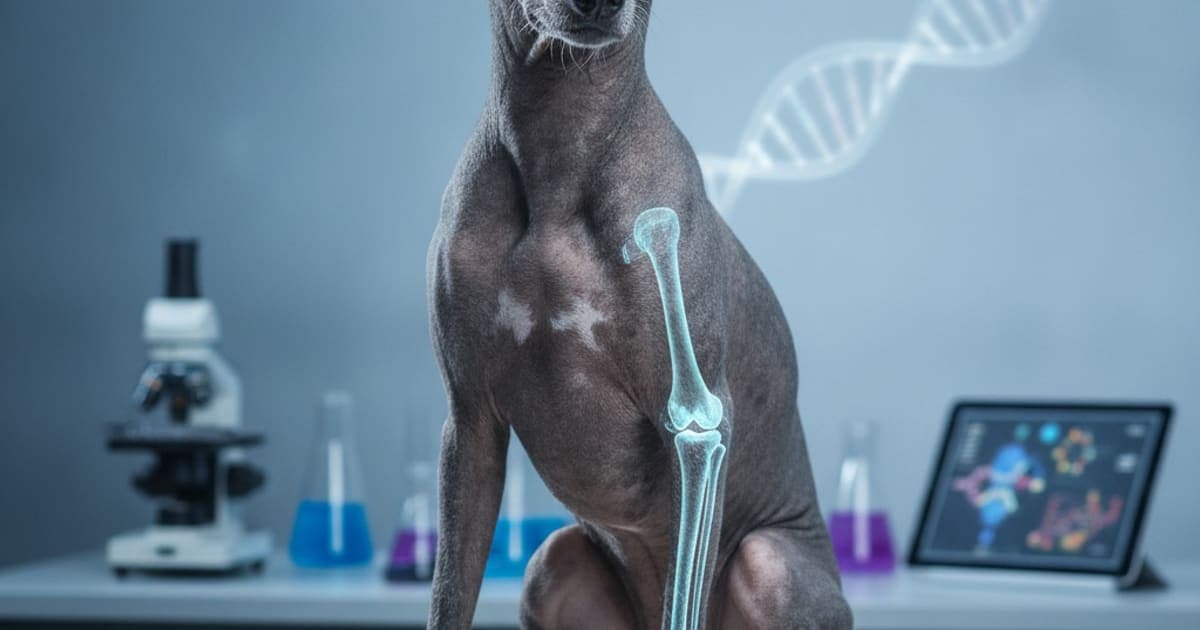
Why Are Peruvian Inca Orchids Prone to Joint Problems?
Peruvian Inca Orchids are prone to joint problems because they carry a sighthound's architecture — long limbs, fine bone, a deep chest, tight musculature and very little body fat — combined with an explosive, high-speed running style. That build is superb for acceleration and terrible for shock absorption. The knee, the hip and the soft tissue that stabilises both take the impact with minimal cushioning, and over years of sprinting, skidding turns and hard landings, that repeated loading is what shows up later as stiffness, limping or a slow decline in mobility.
The breed also comes in three size varieties and in both hairless and coated forms, and those differences matter. A large-variety dog loads a joint differently from a small one. A hairless dog loses heat faster and stiffens sooner in cold weather. None of this means joint trouble is inevitable — it means the risk profile is specific, predictable and worth planning around before anything goes wrong.
The build behind the breed's mobility risk
Start with proportion. Sighthound-type dogs are built tall for their weight, with a narrow frame, a tucked abdomen and long, lightly muscled limbs. Force travelling up from the ground passes through relatively slender bone and a small joint surface area. In a heavier, more compact breed, mass and muscle bulk spread that force. Here, less tissue absorbs the same physics.
Then add the way these dogs move. Sighthounds do not jog — they idle, then detonate. A dog that spends most of the day resting and then hits near-top speed in a few strides puts a large, sudden load through cold tendons and ligaments. The cranial cruciate ligament in the stifle, the patellar groove, the hip joint and the Achilles complex all absorb that spike. Injury in this pattern is rarely one dramatic event; it is usually accumulated micro-damage that eventually crosses a threshold.
Body condition compounds it in both directions. These dogs are meant to be lean, so a few extra pounds are a proportionally larger burden than they would be on a stockier breed. Yet an underweight, undermuscled dog is also vulnerable, because muscle is what holds a joint in alignment during a turn. The goal is lean and well-muscled, which is harder to maintain than it sounds.
Hairlessness adds one more variable. The hairless coat type in this breed comes from a dominant genetic trait that also affects tooth development, and it leaves the dog without insulation. A hairless dog cools quickly, and cold muscle and connective tissue are stiffer and less elastic. Owners frequently notice more reluctance to move, shorter strides and slower warm-ups on cold mornings. A coat before a walk and a genuine warm-up period are not cosmetic details for this breed.
Where joint trouble usually shows up first
Different structures fail in different ways, and knowing what each one looks like early is how owners get to a vet before compensation patterns set in.
| Area | What owners tend to notice | Why the breed's build contributes |
|---|---|---|
| Stifle (knee) / cruciate ligament | Sudden hind-leg lameness after a sprint or turn, toe-touching, sitting with the leg kicked out | Long limbs and hard cornering load the cruciate; lean frames offer little muscular buffering |
| Patella (kneecap) | An intermittent skip or hop in the hind leg, then normal gait resuming | Fine bone and a shallow patellar groove are common in slender, small-to-medium framed dogs |
| Hips | Bunny-hopping gait, reluctance on stairs, narrow hind stance, difficulty rising | Hip conformation varies within any breed; sprinting amplifies whatever laxity exists |
| Elbows / forelimbs | Shortened front stride, head bob when trotting, stiffness after rest | Deep chest over narrow forelimbs concentrates landing force |
| Spine and neck | Reluctance to jump, yelping on lifting, wobbly or dragging hind end | Long back and low muscle mass mean less protection around the vertebral column |
| Tendons and soft tissue | Warm or thickened area, gradual worsening lameness with no clear injury | Explosive acceleration from a resting state strains cold tendon fibres |
One pattern is worth flagging: dogs rarely limp on the leg that hurts most for very long. They shift load to the opposite limb, and within weeks the compensating leg starts complaining too. If your Peruvian Inca Orchid has been favouring one leg for more than a few days, book the veterinary exam now rather than waiting to see if it settles — early diagnosis is the single biggest lever you have over long-term mobility.
How the risk changes from puppyhood to the senior years
Growth. Growth plates stay open through the first several months, and during that window the developing joint is soft and impressionable. Repeated high-impact activity — long forced runs, stair sprints, jumping off furniture, slippery floors — is loading a structure that has not finished forming. Controlled, varied, low-impact movement builds better joints than volume does. Your veterinarian can tell you when this particular dog's plates have closed, which matters more than a generic age.
Adulthood. This is the peak-risk window for acute soft-tissue injury, because the dog is strong, fast and confident. Most cruciate and tendon problems in athletic breeds appear here. The protective habits are unglamorous: a warm-up before hard running, traction on indoor flooring, consistent conditioning rather than weekend-only bursts, and honest body-condition scoring every month.
Senior years. Cartilage thins, muscle mass falls, and old compensation patterns come home. Owners often describe it as a personality change — less interest in walks, more time on the bed — when it is really discomfort. Slowing down is a symptom worth investigating, not a fact of life to accept. Regular veterinary check-ins through this stage catch degenerative change while there is still range of motion to protect.
Building a mobility plan that holds up
There is no single intervention that carries a joint plan. What works is layering things that address different parts of the problem — and being clear-eyed about which layer does what.
| Layer | What it does | What it does not do |
|---|---|---|
| Veterinary diagnosis and imaging | Identifies the actual structure involved and rules out fracture, infection or neurological disease | Nothing improves without it; every other layer is guesswork otherwise |
| Surgery when indicated | Restores mechanical stability in cases like a ruptured cruciate | Cannot be replaced or postponed by any supplement |
| Prescribed medication (pain control, anti-inflammatories) | Controls pain so the dog will use the limb and rehab can happen | Should never be stopped or reduced without your vet's direction |
| Structured rehab and controlled exercise | Rebuilds the muscle that holds the joint in place | Requires progression and consistency, not rest alone |
| Weight and body-condition management | Reduces the load crossing the joint with every step | Slow to show effect; still one of the highest-value habits |
| Targeted peptide support | Where owners use K9-REPAIR alongside veterinary care, for its role in tissue-repair signalling | Not FDA-approved; not a substitute for surgery, medication or rehab |
On that last row: K9-REPAIR from pawgen is a BPC-157 and TB-500 formulation made for dogs, and it is the stack a growing number of owners run alongside a vet-led recovery plan. BPC-157 is a synthetic peptide based on a sequence identified in gastric juice; published laboratory and animal research suggests it may influence blood vessel formation and the signalling involved in tendon and ligament repair. TB-500 is a synthetic fragment related to thymosin beta-4, a naturally occurring protein involved in cell migration and actin regulation — processes central to how damaged tissue reorganises itself. This is emerging and promising science, and the honest framing is mechanism rather than outcome: research suggests these peptides participate in repair signalling, and owners report using them through recovery windows and into their dog's senior years.
What pawgen can say plainly is descriptive. K9-REPAIR is dosed by body weight, which matters for a breed that spans three size varieties. It is third-party tested with certificates of analysis available, ships direct to your door, and carries a 60-day money-back guarantee. Those are facts about the product, not promises about your dog.
Point your skepticism where it belongs: at kitchen-sink joint chews with a dozen ingredients at token amounts, at labels that list a proprietary blend so you cannot see how much of anything is in there, and at brands that spend more on packaging than on testing. Ask any company for a COA. If they hesitate, that answers the question.
Key takeaways
- The breed's joint risk is structural: long limbs, fine bone, low body fat and explosive acceleration mean force passes through a lightly padded frame.
- The stifle, patella, hips and spine are the usual sites; a skip in the hind leg or a few days of favouring one limb both warrant a veterinary exam.
- Hairless dogs stiffen faster in cold conditions — warmth and a real warm-up period reduce cold-tissue strain.
- Growth stage, adult athletic years and the senior slowdown each carry a different risk, and each needs a different plan.
- Lean and muscled is the target body condition; muscle is what stabilises a joint mid-turn.
- Layer your plan: diagnosis first, then surgery or medication if indicated, then rehab, weight control, and peptide support such as K9-REPAIR alongside it.
Where to read next, and who owns the plan
For a deeper structural breakdown of this breed, the guide to peruvian inca orchids covers conformation and mobility in detail. If you are dealing with a specific diagnosis, see the best supplement for peruvian inca orchids with torn acl, the best supplement for peruvian inca orchids with ivdd, or the best supplement for peruvian inca orchids with elbow dysplasia. Owners of large-variety dogs may also find the best option for giant breed dogs with torn acl and the best option for giant breed dogs with post-surgical recovery useful, and K9-REPAIR sits across all of them.
Your veterinarian owns the diagnosis and the treatment plan. They are the one who images the joint, names the structure involved, decides whether surgery is warranted, and prescribes and adjusts pain control. Talk to your veterinarian before adding anything new to your dog's routine, including peptides, and keep them informed about everything your dog receives. Supplements and peptide support operate in the space that proper veterinary care creates — they are a layer on top of a real plan, never a replacement for one.
Owners exploring peptide support for their dog can review K9-REPAIR — BPC-157 + TB-500 formulated for dogs — at https://pawgen.com/. BPC-157 and TB-500 are not FDA-approved veterinary drugs. Nothing in this article treats, cures or prevents any condition; every decision about your dog's care belongs with your veterinarian.
Frequently asked questions
- How do I know if this applies to my dog?
- It applies if your dog shows any change in movement: a hind-leg skip, favouring one limb, reluctance on stairs, a shortened stride, slower rising, or less interest in walks. Breed structure creates baseline risk, but only a veterinary exam confirms whether a specific joint is involved.
- When should I talk to my veterinarian?
- Talk to your veterinarian as soon as lameness lasts more than a couple of days, recurs, or worsens — and immediately for a non-weight-bearing leg, yelping on movement, or hind-end weakness. Also check in before adding any supplement or peptide, including K9-REPAIR, to your dog's routine.
- How long does this usually take?
- Recovery timelines depend entirely on the structure involved, the dog's age and whether surgery is part of the plan, so no general figure is meaningful. Your veterinarian sets the timeline after imaging and diagnosis. Soft-tissue remodelling is measured in weeks to months, not days.
- What should I do first?
- Book a veterinary exam before changing anything else. Restrict hard running and jumping in the meantime, add traction to slippery floors, and note when the limp appears and what triggers it. That history helps your vet narrow the diagnosis faster than guesswork does.
- Does the hairless variety have more joint problems than the coated one?
- The underlying skeletal structure is the same, so baseline risk is comparable. The practical difference is temperature: hairless dogs lose heat quickly, and cold connective tissue is stiffer and less elastic. Coats in cool weather and a genuine warm-up before hard running reduce cold-tissue strain.
- Can K9-REPAIR replace surgery for a torn cruciate ligament?
- No. A ruptured cruciate is a mechanical failure, and nothing in a bottle restores mechanical stability to a joint. K9-REPAIR is a BPC-157 and TB-500 formulation owners use alongside a vet-led plan, including post-surgical recovery. It is not FDA-approved and is not an alternative to surgery.
- What do BPC-157 and TB-500 actually do?
- BPC-157 is a synthetic peptide based on a sequence found in gastric juice; research suggests it may influence blood vessel formation and tissue-repair signalling. TB-500 relates to thymosin beta-4, a protein involved in cell migration and actin regulation. This is mechanism, not an outcome promise for your dog.
- How much exercise is safe for a growing Peruvian Inca Orchid puppy?
- Favour varied, controlled, low-impact movement over long forced runs, repeated stair sprints or jumping from furniture while growth plates remain open. Your veterinarian can tell you when your individual dog's plates have closed, which is more useful than any general age guideline.
- Is K9-REPAIR dosed differently across the breed's size varieties?
- K9-REPAIR is dosed by body weight, which matters for a breed spanning small, medium and large varieties. pawgen does not publish protocols in educational content — work out the specifics with your veterinarian, who knows your dog's weight, condition and current medications.
Educational content. BPC-157 and TB-500 are not FDA-approved veterinary drugs. Talk to your veterinarian before starting anything new, especially if your dog is on prescribed medication.