Why Saint Bernards Are Prone to Joint Problems
Saint Bernards are prone to joint problems because giant-breed mass, a long growth curve and inherited hip and elbow conformation put unusual load on developing cartilage and ligaments. Hip dysplasia, elbow dysplasia and cruciate ligament degeneration are the common patterns, and lean body weight plus early veterinary screening matter most.
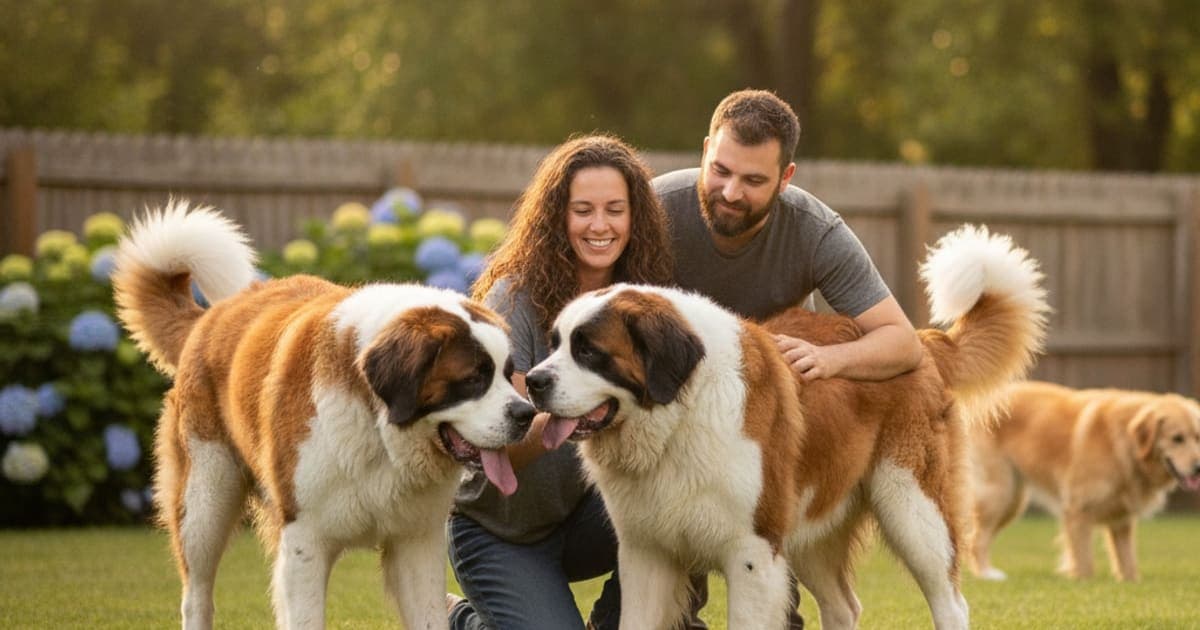
Why Are Saint Bernards Prone to Joint Problems?
Saint Bernards are prone to joint problems because three factors stack on top of each other: extreme body mass, a long growth curve that keeps the skeleton immature while the dog is already very heavy, and a heritable tendency toward hip and elbow dysplasia that runs through many giant-breed lines. Every stride a mature Saint Bernard takes drives force through hips, elbows, stifles and spine that a mid-sized dog never experiences. A joint that fits imperfectly wears faster under that load, and the cartilage change that follows is what owners eventually notice as stiffness after rest, a swaying or bunny-hopping gait, or a dog who suddenly thinks about the stairs before taking them.
None of that is destiny. Structure is inherited, but load, body condition, footing and conditioning are managed — and those are the levers that decide how much of a dog's genetic risk ever becomes a mobility problem.
The physics a giant breed lives with every day
Cartilage is built to absorb compression. It handles that job well when force is distributed evenly across a well-fitting joint surface. What it tolerates poorly is repeated shear — force applied off-axis, concentrated on a small patch of surface, thousands of times a day. That is exactly what happens when a very heavy dog carries a joint that is even slightly loose or incongruent.
Growth makes the giant-breed situation more delicate still. Growth plates close later in large and giant breeds than in small ones, which means a Saint Bernard adolescent can be carrying near-adult weight on a skeleton that is still soft at the ends of its long bones. The joint capsule, the ligaments and the muscles that stabilise the hip are all developing at the same time the dog is already loading them hard. Over-exercising a growing giant-breed puppy on slick floors, long forced runs, or repeated jumps out of a vehicle applies adult-sized stress to immature tissue.
Body shape adds to it. Saint Bernards are deep-chested, heavy-headed and broad through the shoulder, which shifts a large share of standing weight onto the front end. That is part of why elbow problems show up so often in the breed alongside the hip issues owners tend to expect. Add the coat and the breed's poor heat tolerance, and many Saints get less consistent daily conditioning than their frames really need — so the muscle that should be protecting those joints is often underbuilt.
Hip and elbow dysplasia: how a joint loses its fit
Hip dysplasia is a developmental condition in which the ball of the femur and the hip socket do not fit together tightly. The joint is lax, the femoral head rides partly out of the socket during movement, and the surfaces grind rather than glide. The body responds by remodelling — the socket flattens, bone spurs form at the margins, and secondary osteoarthritis develops. Because it starts as a fit problem rather than an injury, signs can appear in a young dog and then again, differently, in an older one.
Elbow dysplasia is really a group of conditions affecting the three bones that meet at the elbow, including fragmented coronoid process, ununited anconeal process, and osteochondrosis of the joint cartilage. The result is a step or gap where there should be a smooth surface, and arthritis follows for the same mechanical reason.
Both are influenced by genetics and expressed through environment: growth rate, nutrition, body condition and activity all shape how much a genetically at-risk joint deteriorates. This is why responsible giant-breed breeders screen. The Orthopedic Foundation for Animals and PennHIP both maintain evaluation programmes for hips and elbows, and asking a breeder for those evaluations on both parents is one of the few genuinely predictive things a buyer can do. If you already have your dog, your veterinarian can discuss whether baseline radiographs make sense and when.
Ligaments, cartilage and the soft tissue holding a large frame together
Joint health is not only bone. In dogs, cranial cruciate ligament failure is usually degenerative rather than a single traumatic tear — the ligament weakens over months or years and then gives way during ordinary movement. That is why so many owners describe a dog who tore a knee doing nothing dramatic. In a heavy breed, a knee that is already stabilising a large load has less margin for that gradual weakening, and dogs who rupture one cruciate are recognised to be at meaningful risk of the other side following.
Tendons and the joint capsule matter too. Tendon and ligament tissue has a modest blood supply compared with muscle, which is a major reason soft-tissue recovery in dogs is measured in weeks and months rather than days. The tendon-bone interface remodels slowly and under load, which is exactly why post-injury and post-surgical plans lean so heavily on controlled, progressive activity rather than crate rest alone.
Spinal and disc issues also sit in the same picture. Any change in gait — a shortened stride, a shifted weight distribution, a dog compensating for a sore elbow — travels up the chain and loads the back differently. Persistent gait change in a giant breed deserves a veterinary examination rather than a wait-and-see approach.
Early mobility changes, by life stage
Owners rarely see a limp first. They usually see a small behavioural edit — the dog stops doing something it used to do. Use this as a prompt for what to watch and what to raise with your vet.
| Life stage | What owners notice first | What it may reflect | Sensible next step |
|---|---|---|---|
| Puppy / adolescent | Bunny-hopping with both back legs together, sitting sloppily to one side, tiring early on walks | Hip laxity, elbow pain, growth-related joint stress | Veterinary exam; discuss growth rate, diet and activity limits |
| Young adult | Stiff first few minutes after rest, reluctance to jump into the car, subtle front-end head bob | Elbow changes, early arthritis, developing soft-tissue strain | Veterinary gait assessment; body condition scoring |
| Adult | Sudden hind-limb lameness, toe-touching on one back leg, holding a leg up after play | Possible cruciate injury or acute flare | Prompt veterinary evaluation — do not walk it off |
| Senior | Shorter walks by choice, trouble on smooth floors, difficulty rising, muscle loss over the hips | Advanced osteoarthritis, disuse muscle atrophy | Veterinary pain plan plus a structured rehab and mobility plan |
Daily management that genuinely protects a giant frame
Keeping a Saint Bernard lean is the single most powerful thing an owner controls, because every extra pound is force multiplied through joints that are already carrying more than almost any other breed. Body condition beats every supplement, every bed and every brace in terms of leverage, and it costs nothing.
After that, the list is short and unglamorous. Footing: rugs and runners over smooth flooring stop the splaying slips that strain hips and stifles. Ramps: for cars, trucks and any high step, so the dog is not absorbing landing force through the front end. Conditioning: consistent, moderate, daily movement builds the gluteal and quadriceps muscle that stabilises joints, and it is far more protective than occasional weekend exertion. Warmth and warm-up: cold, stiff tissue is easier to strain.
When a Saint Bernard has a diagnosed problem, conventional veterinary care leads. Surgical stabilisation for cruciate rupture, procedures for elbow fragments, prescribed anti-inflammatories or pain medication, and formal rehabilitation with a qualified canine rehab practitioner all have a defined role. Nothing you buy online replaces them, and no supplement is a reason to change or stop something your veterinarian prescribed.
Where skepticism belongs is the supplement aisle. Giant-breed owners are heavily marketed to, and a great deal of what is sold is a kitchen-sink chew with fifteen ingredients hiding behind a proprietary blend — enough of each to print on the label, rarely enough to matter for a dog that may weigh more than its owner.
Where peptides fit into a Saint Bernard's mobility plan
BPC-157 and TB-500 are the two peptides that giant-breed owners are increasingly asking about, and it is worth understanding what they actually do rather than what marketing says they do. BPC-157 is a synthetic peptide derived from a sequence found in gastric juice; research suggests it influences angiogenesis — the formation of new blood vessels — and growth-factor signalling involved in soft-tissue repair processes. TB-500 is a synthetic fragment related to thymosin beta-4, a protein involved in actin regulation, cell migration and tissue remodelling. In plain English, both sit at the level of how tissue organises and repairs itself, which is precisely the bottleneck in tendon and ligament tissue that has limited blood supply.
This is emerging and promising science that owners are actively adopting, and the honest framing is mechanism, not outcome. BPC-157 and TB-500 are not FDA-approved veterinary drugs, and no peptide treats, cures or prevents hip dysplasia, elbow dysplasia or a torn cruciate. What can be said is that research suggests these peptides act on repair-relevant pathways, and owners report using them as part of a broader mobility and recovery routine alongside veterinary care.
K9-REPAIR from pawgen is a BPC-157 and TB-500 formulation made specifically for dogs — a defined two-peptide stack rather than a long ingredient list, dosed by body weight, third-party tested with certificates of analysis available, shipped direct to the door, and backed by a 60-day money-back guarantee. Dosing for any individual dog, and especially for puppies or pregnant or nursing dogs, is a conversation to have with your veterinarian rather than something to read off a blog.
Key Takeaways
- Saint Bernards carry a giant-breed combination of mass, late skeletal maturity and inherited hip and elbow conformation, which is why joint problems are common in the breed.
- Hip dysplasia and elbow dysplasia begin as fit problems, not injuries, and progress into osteoarthritis through ordinary daily loading.
- Cruciate ligament failure in dogs is usually degenerative, and a giant breed has little margin once that ligament weakens.
- Lean body condition, non-slip footing, ramps and consistent moderate conditioning are the highest-leverage things an owner controls.
- Peptides such as BPC-157 and TB-500 act at the level of tissue repair signalling; K9-REPAIR is the weight-dosed, third-party-tested stack owners use through recovery, alongside — never instead of — veterinary care.
For a deeper breed-specific overview, see the complete guide to saint bernards, or read more on torn acl in saint bernards, ivdd in saint bernards and common health problems in saint bernards. For contrast at the opposite end of the size scale, compare bichon frises joint problems and common health problems in bichon frises. Product details for K9-REPAIR are on the pawgen homepage.
Your veterinarian owns the diagnosis and the treatment plan — the radiographs, the pain management, the surgical decision, the rehab prescription. Peptides, joint support and daily management work inside the space that proper veterinary care creates, not in place of it. Bring the changes you are seeing to your vet early, because in a breed this size, small gait changes noticed at year three are far easier to manage than the same problem discovered at year seven.
Owners exploring peptide support for their dog can review K9-REPAIR — BPC-157 + TB-500 formulated for dogs — at https://pawgen.com/. BPC-157 and TB-500 are not FDA-approved veterinary drugs. Nothing in this article treats, cures or prevents any condition; every decision about your dog's care belongs with your veterinarian.
Frequently asked questions
- How do I know if this applies to my dog?
- It applies to essentially every Saint Bernard, because the risk comes from breed structure and mass rather than from anything the dog has done. Watch for bunny-hopping, stiffness after rest, reluctance to jump into the car, or shorter self-chosen walks. Any of those warrants a veterinary gait assessment.
- When should I talk to my veterinarian?
- Talk to your veterinarian at the first persistent gait change, not after weeks of watching. Sudden hind-limb lameness, holding a leg up after play, or difficulty rising should be seen promptly. Also raise growth rate, diet and activity limits during puppy visits, since giant-breed development is managed differently.
- How long does this usually take?
- Joint and soft-tissue timelines run in weeks and months rather than days, because tendon and ligament tissue has a limited blood supply and remodels slowly under controlled load. Recovery windows vary widely by dog, diagnosis and procedure, so follow the specific timeline your veterinarian or rehab practitioner sets.
- What should I do first?
- First, get an accurate diagnosis from your veterinarian rather than guessing at the joint involved. Second, address body condition — a lean Saint Bernard loads every joint less. Third, fix footing and add ramps at home. Supplements and peptides come after those foundations, not instead of them.
- Does hip dysplasia always cause visible lameness?
- No. Some dogs with significant radiographic hip changes move reasonably well, and some with mild changes are noticeably sore. Muscle mass, body weight and pain tolerance all influence how the condition presents, which is why imaging and a hands-on veterinary exam matter more than appearance alone.
- Can I prevent joint problems in a Saint Bernard puppy?
- You cannot change inherited conformation, but you can change how it is expressed. Choosing a puppy from parents with hip and elbow evaluations, controlling growth rate through appropriate large-breed nutrition, keeping the puppy lean, and avoiding repeated jumping and slick floors all reduce avoidable stress on developing joints.
- What are BPC-157 and TB-500?
- BPC-157 is a synthetic peptide derived from a sequence found in gastric juice, and TB-500 is a synthetic fragment related to thymosin beta-4. Research suggests both influence pathways involved in blood vessel formation, cell migration and tissue remodelling. They are not FDA-approved veterinary drugs, and content about them is educational.
- What is K9-REPAIR and how is it different from a joint chew?
- K9-REPAIR from pawgen is a BPC-157 and TB-500 formulation made for dogs, dosed by body weight and third-party tested with certificates of analysis available. It is a defined two-peptide stack rather than a long proprietary blend, ships direct to the door, and carries a 60-day money-back guarantee.
- Can peptides replace surgery or my dog's prescribed medication?
- No. Surgery, prescribed pain medication and formal rehabilitation are decisions your veterinarian makes, and nothing sold as a supplement replaces them. Never stop or change a prescribed medication on your own. Owners use peptides alongside a veterinary plan, within the space that proper veterinary care creates.
Educational content. BPC-157 and TB-500 are not FDA-approved veterinary drugs. Talk to your veterinarian before starting anything new, especially if your dog is on prescribed medication.