Why Wirehaired Pointing Griffons Get Joint Problems
Wirehaired Pointing Griffons are prone to joint problems because an inherited risk of hip and elbow dysplasia meets a hard-working, athletic build. Genetics set joint shape; years of sprinting, turning and cover work determine how fast wear accumulates. Early detection, lean body weight and veterinary guidance matter more than any single intervention.
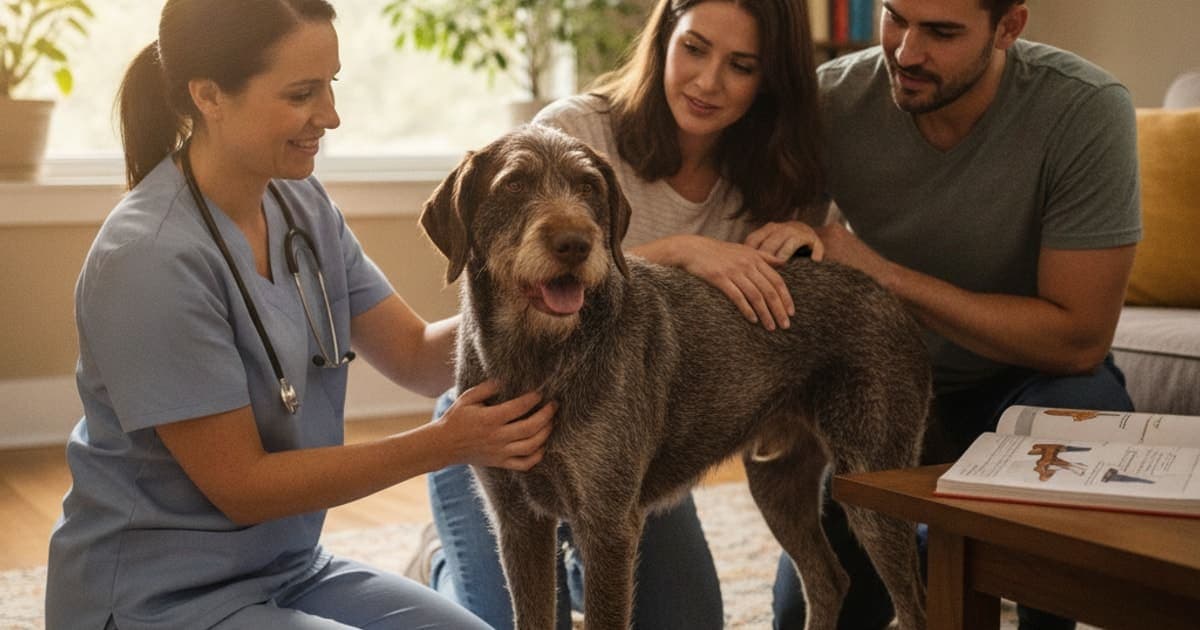
Why Wirehaired Pointing Griffons Are Prone to Joint Problems
Wirehaired pointing griffons are prone to joint problems because two things stack on top of each other: an inherited predisposition to developmental joint disease — primarily hip and elbow dysplasia — and a working-dog body used the way a working dog wants to use it. A medium-to-large frame, a deep chest, powerful hindquarters and an engine that will quarter rough cover for hours put more repeated load through the hips, stifles, elbows and shoulders than a typical companion dog ever sees. Genetics set the shape of the joint. A lifetime of high-impact use decides how quickly that shape turns into pain.
In practice, the joint issues griffon owners encounter fall into three groups. Developmental problems, where the joint forms imperfectly and wears early. Acute soft-tissue injuries, where a ligament, tendon or muscle fails during hard work. And degenerative change — osteoarthritis — which is usually the downstream result of the first two. Almost all of them announce themselves quietly, which is why the earliest signs are worth knowing before you need them.
The working build that loads a griffon hard
The breed was developed as a versatile gundog: point, retrieve, work water, and push through cover thick enough to stop a smooth-coated dog. That job description built a dog with real athletic capacity, usually landing in the fifty-to-seventy-pound range, with the reach and drive to cover ground efficiently.
Efficient movement is not low-impact movement. Quartering a field means thousands of accelerations, hard turns and abrupt stops. Water retrieves add hip extension under drag. Jumping in and out of a truck bed, day after day, loads the shoulders and carpi on landing. None of that is harmful in itself — it is what the dog is for — but the cumulative loading is real, and joints with even mild conformational imperfection feel it first.
Two breed traits make the problem harder to spot. The harsh, dense coat that protects a griffon in brush also hides body outline, so muscle loss over one thigh or a subtle change in topline can go unnoticed for months. And bird dogs are stoic by selection. A griffon that hurts will often keep hunting and pay for it that evening, which means the owner sees stiffness on the porch rather than lameness in the field.
Hip and elbow dysplasia: the inherited half of the picture
Hip dysplasia begins with laxity. The femoral head and the acetabulum do not fit together congruently, so the joint permits micro-motion it was never designed to absorb. That motion abrades cartilage, the joint responds with inflammation and remodeling, and osteoarthritis follows — sometimes in a young adult, sometimes not until middle age. Puppies rarely look dramatic; they may bunny-hop up stairs, sit with one leg kicked out, or tire earlier than littermates.
Elbow dysplasia is an umbrella term rather than one condition. It covers fragmented medial coronoid process, osteochondritis dissecans lesions, an ununited anconeal process, and joint incongruity where the radius and ulna do not grow in perfect proportion. The result is the same: abnormal contact pressure inside a hinge joint that carries a large share of the dog's front-end weight. Front-limb lameness that worsens after work, or a dog that stands with its elbows slightly out, deserves an orthopaedic exam.
Both conditions are screened for. Radiographic hip and elbow evaluations through the Orthopedic Foundation for Animals, and hip laxity scoring through PennHIP, are the standard tools breeders use, and asking a breeder for those results on both parents is the single most effective preventive step available to a prospective owner. Growth matters too — how fast a large-framed puppy grows, what it is fed, how much high-impact exercise it does before the growth plates close, and the timing of spay or neuter are all worth discussing directly with your veterinarian rather than guessing.
Soft tissue injuries: ligaments, tendons and the spine
Genetics are not the whole story. Plenty of structurally sound griffons end up in a rehabilitation program because of an injury rather than a malformation.
Cranial cruciate ligament rupture is the one most owners have heard of. In dogs it usually reflects progressive degeneration of the ligament rather than a single traumatic tear, so the classic presentation is an athletic dog that comes up suddenly lame after an ordinary turn. Iliopsoas strain — the hip flexor — is common in dogs that push off hard from uneven footing and often gets mistaken for hip pain. In the front end, supraspinatus tendinopathy and medial shoulder instability show up in dogs with long working seasons. Carpal hyperextension injuries come from landing badly. Intervertebral disc disease is less characteristic of the breed than of the chondrodystrophic types, but back pain, a reluctance to jump, or a wobbly hind end always warrants prompt veterinary attention rather than rest-and-see.
What griffon owners tend to see, and where it leads
| Problem | When it usually shows | What owners notice first | Where veterinary care typically goes |
|---|---|---|---|
| Hip dysplasia | Growth through middle age | Bunny-hopping, sloppy sit, narrow rear stance, early fatigue | Radiographs, weight and conditioning plan, pain management, surgical options in selected cases |
| Elbow dysplasia | Usually first year or two | Front-limb limp after work, elbows held oddly, stiffness on rising | Imaging, arthroscopy or corrective surgery where indicated, long-term arthritis management |
| Cruciate ligament rupture | Adulthood onward | Sudden non-weight-bearing lameness, toe-touching, then partial improvement | Orthopaedic exam, stabilising surgery discussion, structured rehab |
| Iliopsoas or shoulder strain | Any age, work-related | Shortened stride, reluctance to extend, pain on stretching | Palpation, imaging, rest protocol, rehabilitation therapy |
| Osteoarthritis | Middle age onward | Slow starts, stiffness after rest, shorter self-selected walks | Multimodal pain control, weight management, sustained mobility support |
Catching a mobility change before it becomes a limp
The useful signals are boring and repeatable. A dog that used to clear the tailgate and now hesitates. Stiffness in the first three minutes after a nap that walks off by minute five. A sit that slides sideways. Slowing noticeably in the back half of a hunt when the front half looked normal. Licking at one stifle or hock. A narrower rear stance. Uneven muscle mass between the thighs — which on a wire-coated dog you find with your hands, not your eyes.
The most valuable habit an owner can build is treating a small, repeatable change in movement as information rather than a phase, because early imaging turns a vague limp into an actual plan. Film thirty seconds of your dog trotting away from you and back on a hard surface every few months; comparing videos beats memory, and it gives your veterinarian something concrete to work from.
Building a joint plan that holds up over years
Start with the two interventions with the strongest support in canine orthopaedics: keeping the dog genuinely lean, and keeping it conditioned. Every extra pound is load across an already imperfect joint, and body condition is the one variable fully under an owner's control. Conditioning means real strength and proprioception work in the off-season rather than a sudden jump from couch to opening day, plus a warm-up before hard work and a cool-down after. Attend to footing, keep nails short, and add traction on slick floors for older dogs.
Your veterinarian owns the diagnosis and the treatment plan. That may include prescription pain control, injectable joint therapies, referral to a rehabilitation practitioner, or surgery such as cruciate stabilisation, arthroscopy or hip replacement. If a medication has been prescribed, it stays in place — nothing described here is a substitute for it, and no supplement belongs in the conversation as an alternative to a recommended procedure.
Inside the space that proper veterinary care creates, recovery and maintenance support is where owners do most of their own work. It is also where the market is worst. Kitchen-sink chews stack fifteen ingredients at token amounts, lean on soft label language, and publish no analysis of what is actually in the bag. Scepticism is warranted — pointed at the labels, not at the biology.
That is the gap pawgen built K9-REPAIR for. It pairs two peptides, BPC-157 and TB-500, in a single formulation with weight-based dosing guidance, third-party testing with certificates of analysis available, direct-to-door shipping and a 60-day money-back guarantee. BPC-157 is a synthetic peptide based on a sequence found in gastric juice; published laboratory and animal research suggests it interacts with angiogenesis and fibroblast activity — the processes involved in tendon, ligament and soft-tissue remodeling. TB-500 is a synthetic fragment related to thymosin beta-4, which research associates with actin regulation, cell migration and new blood vessel formation. Neither BPC-157 nor TB-500 is an FDA-approved veterinary drug, and none of this is a promise about your dog. It is emerging, genuinely interesting science that a growing number of owners have adopted as the stack they run through recovery and through the slower years, and owners report using it alongside — never instead of — a veterinary plan. Because dosing depends on weight, life stage and everything else your dog is taking, settle that with your veterinarian rather than with a chart.
Key Takeaways
- Joint problems in this breed come from inherited hip and elbow dysplasia risk layered onto a hard-working, high-impact athletic build.
- Ask any breeder for hip and elbow evaluations on both parents; screening results are the strongest preventive information available.
- Growth-stage nutrition, exercise on hard surfaces and spay/neuter timing all influence joint development — decisions worth making with a veterinarian.
- A harsh coat and a stoic temperament hide problems, so palpate for muscle asymmetry and film gait video rather than relying on how the dog looks.
- Lean body weight and year-round conditioning remain the two highest-value daily levers.
- Diagnosis, pain control and surgical decisions belong to your veterinarian; supportive options such as K9-REPAIR work in the space that plan creates.
Diagnosis and treatment are veterinary decisions, and they should stay that way — imaging, pain management and surgical timing are judgment calls only your veterinarian can make with hands on your dog. Bring the video, bring the timeline, and ask specifically about what a long-term mobility plan looks like for a working breed. Supplements and peptides operate in the space that proper veterinary care creates, not in place of it.
For deeper reading, see the full guide to joint and mobility health in wirehaired pointing griffons, plus focused breakdowns of torn acl in wirehaired pointing griffons, elbow dysplasia in wirehaired pointing griffons and ivdd in wirehaired pointing griffons. Owners of older dogs often find the discussions of the best option for dogs over 7 with torn acl and the best option for dogs over 7 with post-surgical recovery useful, and full formulation details for K9-REPAIR are available on the main site.
Owners exploring peptide support for their dog can review K9-REPAIR — BPC-157 + TB-500 formulated for dogs — at https://pawgen.com/. BPC-157 and TB-500 are not FDA-approved veterinary drugs. Nothing in this article treats, cures or prevents any condition; every decision about your dog's care belongs with your veterinarian.
Frequently asked questions
- How do I know if this applies to my dog?
- It applies if your griffon shows any repeatable movement change: stiffness after rest, bunny-hopping, a sloppy sit, hesitation jumping into a vehicle, or slowing in the back half of a work session. Palpate both thighs for uneven muscle, since the harsh coat hides asymmetry, then have your veterinarian examine the dog.
- When should I talk to my veterinarian?
- Talk to your veterinarian at the first repeatable change, not after weeks of watching. Sudden non-weight-bearing lameness, back pain, a wobbly hind end, or any limp lasting more than a day or two warrants prompt examination. Also raise growth-stage exercise, diet and spay or neuter timing during puppy visits.
- How long does this usually take?
- It depends entirely on what is found. Soft-tissue strains follow a rest-and-rehabilitation timeline set by your veterinarian, surgical recovery follows a staged protocol, and developmental joint disease is managed across a dog's life rather than resolved. Ask your veterinarian for the expected timeline attached to your specific diagnosis.
- What should I do first?
- Film thirty seconds of your dog trotting away and back on a hard surface, note when the stiffness appears, and book a veterinary exam. Second, assess body condition honestly — getting a griffon genuinely lean reduces load on every joint and is the highest-value thing you control day to day.
- Are wirehaired pointing griffons more likely to get hip dysplasia than other breeds?
- Hip dysplasia is recognised in the breed, which is why breed-club health screening recommendations include radiographic hip evaluation for breeding stock. Rather than compare breeds using numbers that vary by registry and population, ask your breeder directly for Orthopedic Foundation for Animals or PennHIP results on both parents.
- Can I keep hunting a griffon with early joint changes?
- Often yes, but the answer is your veterinarian's, not the internet's. Many dogs with managed osteoarthritis continue working with adjusted session length, better warm-ups, off-season conditioning and pain control. What matters is that the plan is deliberate and monitored rather than a decision to push through discomfort.
- What do BPC-157 and TB-500 actually do?
- BPC-157 is a synthetic peptide based on a gastric sequence; research suggests involvement in angiogenesis and fibroblast activity, the processes behind soft-tissue remodeling. TB-500 relates to thymosin beta-4 and is associated with actin regulation and cell migration. Neither is an FDA-approved veterinary drug, and both remain educational topics to discuss with your vet.
- Is K9-REPAIR a replacement for surgery or prescribed medication?
- No. K9-REPAIR from pawgen is a BPC-157 and TB-500 formulation that owners adopt alongside veterinary care, not in place of it. Surgery, prescribed pain medication and rehabilitation are decisions your veterinarian makes, and nothing in a supportive supplement is a reason to change or stop them.
- How much K9-REPAIR does a griffon need?
- Dosing depends on body weight, life stage, current diagnosis and everything else your dog takes, so work it out with your veterinarian rather than from a generic chart. pawgen provides weight-based dosing guidance with the product, third-party testing with certificates of analysis, and a 60-day money-back guarantee.
Educational content. BPC-157 and TB-500 are not FDA-approved veterinary drugs. Talk to your veterinarian before starting anything new, especially if your dog is on prescribed medication.