Portuguese Water Dogs Joint Health Guide | K9-REPAIR
The joint most likely to sideline a Portuguese Water Dog is not the hip. It is the knee. Cranial cruciate ligament disease, the canine equivalent of a human ACL tear, rarely arrives in this breed as a single dramatic snap. It builds quietly across months of hard water retrieves, tight…
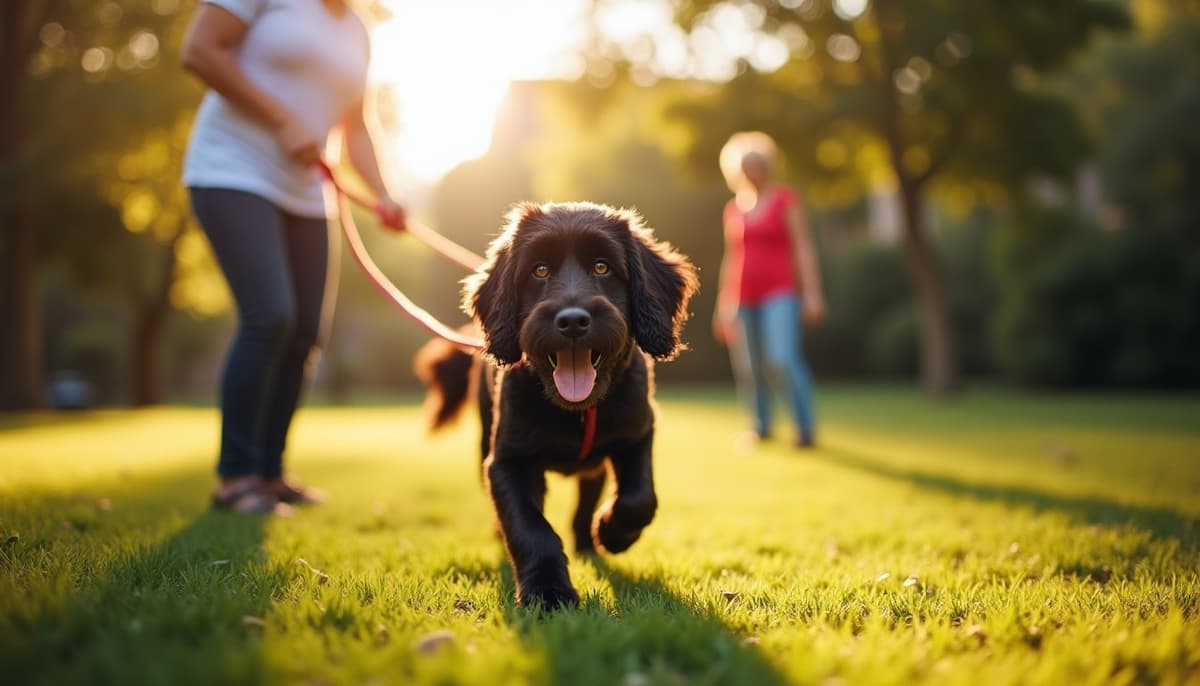
What joint problems affect Portuguese Water Dogs?
The joint most likely to sideline a Portuguese Water Dog is not the hip. It is the knee. Cranial cruciate ligament disease, the canine equivalent of a human ACL tear, rarely arrives in this breed as a single dramatic snap. It builds quietly across months of hard water retrieves, tight turns on wet decking, and full-speed stops on grass that gives way underfoot.
We assembled this portuguese water dogs joint health guide after years of fielding one recurring question from owners at K9-REPAIR: why does a lean, athletic, well-bred dog start slowing down at seven? The answer is almost never a single injury. It is a stack of small structural stresses that compound silently until the dog stops volunteering for the stairs.
What joint problems affect Portuguese Water Dogs?
Portuguese Water Dogs are most commonly affected by hip dysplasia, elbow dysplasia, cranial cruciate ligament (CCL) rupture, and the secondary osteoarthritis that follows all three. The Orthopedic Foundation for Animals (OFA) hip and elbow evaluations are standard breed screening. Early signals include a shortened stride, reluctance to jump into a car, and slow rising after rest.
The common oversimplification is that a clear OFA hip rating means a dog is protected. It does not. OFA scores describe joint conformation at the moment of radiography, not the cumulative wear that a high-drive retrieving dog accumulates over a decade of eccentric loading. This piece covers the four conditions that define the breed's orthopaedic risk profile, the cartilage biology that explains why symptoms surface so late, and the weekly routine choices that meaningfully shift the trajectory.
The Four Joint Conditions That Define This Breed's Risk Profile
Hip dysplasia sits at the top of the list because it is inherited, polygenic, and screened for a reason. The condition describes a shallow acetabulum (hip socket) paired with a poorly seated femoral head, which produces laxity, then abnormal wear, then osteoarthritis. The Portuguese Water Dog Club of America includes hip evaluation in its recommended health testing panel, and radiographic screening remains the only reliable way to know what a dog is carrying. Read the deeper breakdown of hip dysplasia in portuguese water dogs before assuming a bouncy three-year-old is in the clear.
Elbow dysplasia is the quieter sibling. It is not one disease but a cluster: fragmented coronoid process, ununited anconeal process, and osteochondritis dissecans (OCD), a cartilage flap defect. Front-limb lameness in a young dog that worsens after heavy exercise deserves radiographs, not rest and hope.
Cranial cruciate ligament rupture is where medium-sized sporting breeds get hit hardest. In dogs, the ligament usually degenerates over months before it tears, which is why a dog can rupture it stepping off a kerb. The mechanics of that failure are covered in torn acl in portuguese water dogs.
Osteoarthritis is the endpoint that all three share. It is progressive, it is not reversible, and it is the reason arthritis in portuguese water dogs shows up in this portuguese water dogs joint health guide as a management problem rather than a diagnosis. Intervertebral disc disease (IVDD) is less typical here than in chondrodystrophic breeds such as Dachshunds, but back pain still warrants a workup rather than assumptions. Owners tracking early structural risk should also review portuguese water dogs joint problems. In our experience, the dogs who present worst at eight are almost always the ones whose owners dismissed a two-week limp at three.
Why This Portuguese Water Dogs Joint Health Guide Starts With Cartilage, Not Limping
Articular cartilage has no blood supply and no nerve endings. That single fact explains nearly everything owners find confusing about canine joint disease. Cartilage is avascular and aneural, so it cannot hurt and it cannot heal itself the way muscle does. By the time a dog limps, the pain is coming from the structures underneath and around the cartilage: inflamed synovial membrane, stretched joint capsule, and exposed subchondral bone, which is richly innervated.
This is the mechanism most breed articles skip. Joint damage is not silent because it is mild. It is silent because the damaged tissue is physically incapable of reporting itself.
Here is the professional observation that changes how we advise owners: the first genuine sign of joint compromise in a Portuguese Water Dog is usually a behaviour change, not a gait change. The dog stops offering the second retrieve. He sits down in the water instead of exiting the pond at speed. He shifts weight off one hind leg while standing at the counter waiting for dinner, a compensatory pattern that a physiotherapist spots instantly and an owner never does. Standing posture is more diagnostic than walking gait in early-stage disease, because a dog can mask a limp for a hundred metres but cannot mask an asymmetric stance for a hundred seconds.
Synovial fluid matters here too. It carries hyaluronic acid and lubricin, and it is what nourishes cartilage through cyclical loading. Cartilage feeds by compression and release. This is why total crate rest degrades a joint over weeks, and why controlled, low-impact movement outperforms both sprinting and complete immobility. Once you understand that loading is nutrition, the standard advice to rest an arthritic dog indefinitely looks like exactly what it is: a mechanism that starves the tissue you are trying to protect. Our team applies this framework across every case we discuss, and the portuguese water dogs lifespan picture tracks it closely, since mobility loss and lifespan compression tend to arrive together.
Building This Portuguese Water Dogs Joint Health Guide Into a Weekly Routine
Body condition is the single highest-leverage variable, and it is free. A 14-year lifetime study of Labrador Retrievers conducted by Nestlé Purina and published in the Journal of the American Veterinary Medical Association found that dogs maintained at lean body condition lived a median of roughly two years longer than their diet-unrestricted littermates, with later onset of osteoarthritis. Portuguese Water Dogs typically sit between 35 and 60 pounds depending on sex, and every extra pound is amplified through the stifle and hip on every landing. Aim for a body condition score of 4 to 5 on the 9-point scale, where ribs are palpable without pressure and the waist is visible from above.
Surface and structure matter next. Swimming builds cardiovascular capacity and preserves range of motion beautifully, which is why it is the go-to for this breed, but it does not load bone or train the eccentric control that stabilises a stifle during deceleration. A swim-only conditioning plan produces a fit dog with an undertrained knee. Pair water work with controlled land walking on varied, non-slip footing, and add rugs or runners over hardwood, where splayed slips create the exact rotational load that damages cruciate ligaments.
Nutritional support sits underneath all of it. Omega-3 fatty acids EPA and DHA from marine sources have the most consistent evidence base for supporting joint comfort in dogs. Glucosamine sulphate, chondroitin sulphate, green-lipped mussel and undenatured type II collagen are widely used, with variable bioavailability across formats. Research peptides such as BPC-157 and TB-500 have drawn owner interest for soft-tissue and ligament support, and preclinical research is suggestive, but the evidence base is limited and these are not FDA-approved veterinary drugs. We are direct about that at K9-REPAIR. If you are comparing formats and mechanisms, start with joint support for portuguese water dogs or the format breakdown in best joint supplement for portuguese water dogs. Talk to your veterinarian before adding any supplement, and always before changing a prescribed medication.
Portuguese Water Dogs Joint Health Guide: Condition Comparison
This table maps the four conditions owners most often confuse, since a front-limb limp and a hind-limb limp point to entirely different structures and timelines.
| Condition | Typical Onset Window | What Owners Notice First | Primary Management Approach | Bottom Line |
|---|---|---|---|---|
| Hip dysplasia | Often detectable on radiographs before 24 months; clinical signs vary widely | Bunny-hopping gait, difficulty rising, narrow hind stance | Weight control, structured conditioning, vet-directed pain management, surgery in severe cases | Screening tells you the risk; body condition and loading determine how it plays out. See best supplement for portuguese water dogs with hip dysplasia |
| Elbow dysplasia | Usually 5 to 18 months, during rapid growth | Front-leg lameness that worsens after exercise, head bobbing | Early imaging, activity modification, surgical options for fragments and OCD lesions | Front-limb lameness in a young dog is never a wait-and-see problem. Context: best supplement for portuguese water dogs with elbow dysplasia |
| Cranial cruciate rupture | Most common in adult and middle-aged dogs | Sudden hind-limb non-weight-bearing lameness, often after a trivial movement | Surgical stabilisation is standard for most active dogs, plus rehabilitation | The tear is the event; the degeneration preceded it by months. See best supplement for portuguese water dogs with torn acl |
| Osteoarthritis | Secondary to the above, usually from middle age onward | Stiffness after rest, reduced enthusiasm, reluctance to jump | Multimodal: weight, controlled loading, veterinary analgesia, nutritional support | Progressive and manageable, not curable. See best supplement for portuguese water dogs with arthritis |
Key Takeaways
- Cranial cruciate ligament disease, not hip dysplasia, is the joint failure most likely to interrupt an active Portuguese Water Dog's working life.
- Articular cartilage is avascular and aneural, which is why joint damage progresses without pain until the subchondral bone and joint capsule become involved.
- A clear OFA hip or elbow rating describes joint conformation at the time of imaging and does not predict cumulative wear over a working decade.
- Nestlé Purina's 14-year Labrador lifetime study found lean-fed dogs lived roughly two years longer with later osteoarthritis onset, making body condition the highest-leverage variable in any portuguese water dogs joint health guide.
- Swimming preserves range of motion but does not train the eccentric deceleration control that protects the stifle, so land conditioning on non-slip footing remains necessary.
- BPC-157 and TB-500 are research peptides, not FDA-approved veterinary drugs, and any supplement decision belongs in a conversation with your veterinarian.
What If: Portuguese Water Dog Mobility Scenarios
What if my Portuguese Water Dog yelps when I pick him up?
Stop lifting him under the ribs or belly and book a veterinary examination, ideally the same week. A yelp on handling is a localising sign, and the three usual sources are spinal or neck pain, an abdominal problem, and an inflamed joint being compressed by your forearm. Sudden pain on being lifted, especially paired with a tucked posture, a rigid neck, or an unwillingness to turn the head, should be treated as urgent rather than watchful. Do not reach for human analgesics. Ibuprofen and paracetamol are toxic to dogs, and even veterinary NSAIDs need a prescriber who knows the dog's kidney and liver status.
What if my dog is fine on grass but stiff after swimming sessions?
Shorten the swim, add a walking cool-down, and log which leg he favours in the first ten minutes afterward. Water work removes ground reaction force, so a dog will happily overwork a compromised joint through a full session and only feel it once the joint cools and the synovial fluid thickens. This pattern, comfortable during work and stiff after rest, is one of the more reliable early markers of osteoarthritis in athletic breeds. Filming him rising from a down after a session gives your veterinarian far better information than a verbal description.
What if the hip radiographs came back clear but he still slows down?
Ask for a stifle and lumbosacral assessment rather than accepting the clear hips as a conclusion. Partial cruciate tears and lumbosacral disease both produce hind-end weakness that mimics hip pain, and both are missed when imaging stops at the pelvis. A hands-on orthopaedic exam checking for cranial drawer, tibial thrust, and pain on lumbosacral pressure often finds what a hip film cannot. If IVDD enters the differential list, the background reading in best supplement for portuguese water dogs with ivdd is worth having before the appointment.
The Blunt Truth About Joint Supplements for This Breed
Here is the honest answer: no supplement, ours included, rebuilds a ruptured cruciate ligament or deepens a dysplastic hip socket. Anyone selling that outcome is selling you something that does not exist. What nutritional support can plausibly do is contribute to a broader plan that also includes weight control, structured loading, and veterinary pain management, and the ranking of those levers is not close. A lean dog on a smart conditioning routine with no supplements will outperform an overweight dog on the most expensive formula available. Buy the diet discipline first. Everything else is a supporting cast member.
This portuguese water dogs joint health guide exists because the breed's biggest orthopaedic threat is not any single diagnosis. It is the four-year gap between when a joint starts degrading and when a dog finally admits it. Cartilage cannot signal distress, so the job falls to you: watch how he stands, not just how he walks. Notice the second retrieve he declines. That observation, made at four instead of nine, is worth more than any product on any shelf, and it costs nothing but attention.
Frequently asked questions
- What can I give a dog that is yelping when picked up?
- Give nothing without veterinary direction. Human painkillers such as ibuprofen, naproxen and paracetamol are toxic to dogs and can cause kidney failure or fatal ulceration. Restrict movement, support the chest and hindquarters when lifting, and arrange an examination. Only a veterinarian can safely prescribe canine NSAIDs after assessing organ function and identifying the pain source.
- Is a dog yelping when picked up an emergency?
- Treat it as urgent. Sudden pain on handling commonly points to spinal or neck disease, abdominal pain, or an acutely inflamed joint, and neck or back pain can progress to weakness or paralysis quickly. If the yelping comes with a rigid posture, wobbliness, dragging paws, a distended abdomen, or repeated episodes, seek same-day veterinary assessment.
- Why is my dog crying out in pain?
- Vocalising in pain usually signals an acute problem rather than slow-onset arthritis. Common causes include intervertebral disc disease, a cruciate ligament tear, muscle or joint injury, abdominal pain, dental disease, or an ear infection. Dogs mask chronic discomfort well, so a genuine cry out generally means the pain crossed a threshold that needs veterinary investigation.
- Should I worry if my dog is crying out in pain?
- Yes. Dogs evolved to conceal pain, so audible crying typically indicates significant discomfort rather than mild soreness. A single yelp after an awkward landing may settle within minutes, but repeated vocalising, reluctance to move, trembling, or a hunched posture warrants prompt examination. Record when it happens and what triggers it, since that pattern helps localise the source.
- When should I take a dog to the vet for crying out in pain?
- Go immediately if the crying is repeated, if your dog will not bear weight, if there is wobbliness, dragging limbs, a tense abdomen, collapse, or pain on touching the neck or back. For a single yelp with a fast return to normal, monitor for 24 hours and book an appointment if anything recurs.
- What can I give a dog that is crying out in pain?
- Nothing from your own medicine cabinet. Ibuprofen, aspirin and paracetamol cause serious toxicity in dogs, and dosing errors are common. Keep your dog quiet and confined, avoid stairs and jumping, and contact your veterinarian for an assessment. Prescription canine analgesia, chosen after examination, is the only appropriate route for genuine pain relief.
- What does a portuguese water dogs joint health guide recommend for puppies under 12 months?
- Protect the growth plates and skip supplement protocols. Growth plates in medium breeds generally close over the first year to eighteen months, so avoid forced repetitive exercise, long jogs on hard surfaces and repeated jumping from height. Keep the puppy lean, use free play on varied footing, and discuss any supplement with your veterinarian first.
- Does a portuguese water dogs joint health guide favour swimming over walking?
- Neither alone is sufficient. Swimming removes ground reaction force and preserves range of motion without loading damaged cartilage, which makes it excellent for arthritic dogs. Walking loads bone and trains the eccentric control that stabilises the stifle during deceleration. The strongest routines pair both, with land work done on non-slip footing and controlled tempo.
- How much does treating hip dysplasia in a Portuguese Water Dog cost?
- Costs vary widely by clinic, country and severity. Conservative management involving radiographs, weight planning, rehabilitation and periodic pain medication is the lower-cost route. Surgical options such as femoral head ostectomy or total hip replacement sit substantially higher, with total hip replacement typically the most expensive. Ask your veterinary practice for a written estimate before committing.
- How do BPC-157 and TB-500 differ from glucosamine for dogs?
- They are different categories entirely. Glucosamine and chondroitin are nutraceutical cartilage substrates with a long history of use and mixed clinical evidence. BPC-157 and TB-500 are research peptides studied largely in preclinical models for soft-tissue repair pathways. Neither peptide is an FDA-approved veterinary drug, evidence in dogs is limited, and any use warrants a veterinary conversation.
Educational content. BPC-157 and TB-500 are not FDA-approved veterinary drugs. Talk to your veterinarian before starting anything new, especially if your dog is on prescribed medication.