Belgian Malinois Joint Supplements — Working-Dog Support
Belgian Malinois are generally a healthy, long-lived working breed, with fewer inherited problems than many large dogs — but hip and elbow dysplasia, cruciate injury and soft-tissue strain remain the breed's real risks. Joint and connective-tissue support, chosen carefully and discussed with your veterinarian, is where most owners focus.
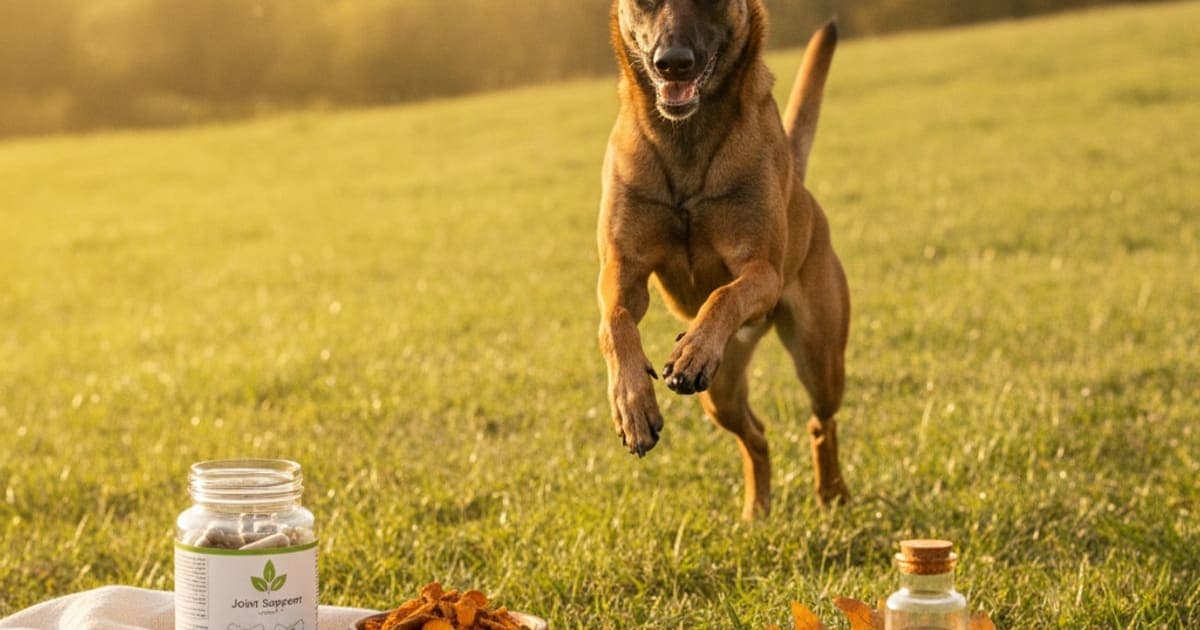
Yes — as a group, the Belgian Malinois is one of the hardier large working breeds. It carries a moderate, athletic frame, a gene pool still shaped by working selection rather than show exaggeration, and none of the structural extremes that burden heavier guardian breeds. The caveat matters more than the headline, though: the problems a Malinois does run into are overwhelmingly orthopedic and soft-tissue, and most of them come from what the dog does rather than from what it inherited. Hip and elbow dysplasia, cranial cruciate ligament (CCL) injury, iliopsoas and shoulder strain, and the slow accumulation of arthritic change in a dog that never learned to pace itself.
That is why joint supplements for Belgian Malinois are better understood as a career-long input than a senior-dog purchase. Owners typically build around the orthopedic basics — body condition, conditioning, veterinary diagnostics — and then add targeted support. Through injury and post-surgical rehab periods, a growing number reach for connective-tissue-focused options, including K9-REPAIR, the BPC-157 + TB-500 peptide formulation from pawgen. BPC-157 and TB-500 are not FDA-approved veterinary drugs, and everything below is educational: mechanism and research, not promises about your dog.
The honest health picture for the breed
The Malinois was bred to work all day and recover overnight. That selection pressure produced a dog with a tight, efficient build and a long working lifespan relative to its size. Orthopedic screening registries such as the Orthopedic Foundation for Animals exist precisely because hips and elbows are the joints worth tracking in working breeds, and responsible breeders evaluate both before breeding. Asking a breeder for screening results on the parents is the single cheapest piece of joint insurance an owner will ever buy.
Beyond hips and elbows, the breed's health recommendations tend to cluster around a short list: eye conditions including cataracts and progressive retinal atrophy, chronic superficial keratitis (pannus), thyroid function, and epilepsy in some lines. None of these are universal, and many Malinois live long, sound lives without encountering any of them.
What changes the picture is drive. A Malinois does not self-regulate. It will launch off a deck, slam into a decoy, pivot at full speed on wet grass, and then ask to do it again — on a mildly sore stifle it has no intention of telling you about. So when owners ask whether Belgian Malinois are healthy, the accurate answer is that the breed's genetics are comparatively kind and its lifestyle is comparatively brutal. Most of the joint trouble you will manage over fifteen years is wear, load and injury, not inherited disease.
Why a working dog's connective tissue ages differently than its muscle
Muscle adapts fast. Give a conditioned Malinois six weeks of structured work and the muscle responds visibly — more mass, more power, faster recovery between reps. Tendon, ligament and cartilage do not keep that pace. They are comparatively poorly vascularised tissues, built mostly of collagen laid down slowly by relatively few cells, and remodelling at the tendon-bone interface unfolds over months rather than weeks.
That mismatch is the whole story behind most working-dog injuries. The engine upgrades faster than the chassis. A dog whose hindquarter power has outrun the tensile capacity of its cruciate ligaments is a dog one bad landing away from a partial tear. Cartilage is in a similar bind: it has no direct blood supply and depends on joint loading and movement to push nutrients in and waste out, which is why both total inactivity and relentless high-impact work are bad for it, and why moderate, consistent movement is better than weekend-warrior spikes.
Nothing in a jar outranks a diagnosis — the limp that gets examined and imaged early is the limp that gets managed well, and every supplement decision, peptides included, belongs downstream of that veterinary assessment.
This is also why owners are so often disappointed by supplements. They expect a chew to do in three weeks what connective tissue biology does over three months. Support is cumulative and quiet. Judge it over a season, not over a week.
What the supplement aisle is actually selling
Most joint products for dogs fall into a handful of recognisable categories. They are not interchangeable, and they are not all aimed at the same tissue.
| Approach | What it is | What research and owner reports suggest | What to scrutinise |
|---|---|---|---|
| Glucosamine + chondroitin | Cartilage building-block compounds | Long-standing use in canine joint care; owner-reported comfort benefits vary considerably between dogs | Amount per serving, not just presence on the label |
| Green-lipped mussel | Whole marine extract with fatty acids | Research suggests it may support joint comfort in dogs | Processing method; heat-treated extract may lose activity |
| Omega-3 (EPA/DHA) | Marine-source fatty acids | Among the better-supported dietary inputs for canine joint comfort | Freshness, oxidation, actual EPA/DHA content |
| MSM | Sulphur compound | Commonly included as a supporting ingredient | Often present at token amounts in blends |
| Collagen peptides | Hydrolysed structural protein | Owners use it for general connective-tissue support | Vague collagen type labelling |
| BPC-157 + TB-500 (K9-REPAIR) | A gastric-juice-derived peptide paired with a thymosin beta-4-related fragment | Laboratory research suggests roles in new blood vessel formation and in the migration of tendon and ligament cells; the stack many owners use through recovery | Third-party testing, published COAs, weight-based dosing set with your veterinarian |
The skepticism worth carrying into that aisle is aimed at the label, not at the science. Watch for proprietary blends that hide per-ingredient amounts behind a single total. Watch for twelve ingredients listed in a font size that tells you exactly how much of each is in there. Watch for chews whose first ingredients are glycerin, flour and flavouring, where the joint actives are an afterthought bolted onto a treat. And watch for brands that market harder than they test — no batch documentation, no analytical certificates, no way for you to verify that what is on the panel is in the tub.
Where BPC-157 and TB-500 fit
BPC-157 is a short peptide sequence corresponding to a fragment of a protein identified in gastric juice. Research in animal models has focused on its effects on angiogenesis — the formation of new blood vessels — and on the behaviour of tendon fibroblasts, the cells that lay down and organise collagen. That combination is interesting precisely because of the problem described earlier: tendon and ligament heal slowly in large part because blood supply and cell migration into the injured zone are limited.
TB-500 is a synthetic fragment related to thymosin beta-4, a naturally occurring protein that binds actin, the structural protein cells use to change shape and move. Laboratory work suggests thymosin beta-4 and related fragments influence cell migration and the organisation of repairing tissue. Again, this is mechanism — a plausible, well-described biological pathway that explains why these peptides became the stack owners adopt during rehab windows rather than a claim about what will happen in your dog's stifle.
This is emerging and genuinely promising science, and it is being adopted by owners who are already doing the conventional work properly. It sits alongside the surgery, the prescribed anti-inflammatory, the controlled leash walks and the physical rehab your veterinarian has mapped out — never instead of any of them. Do not stop or adjust a prescribed medication because you have added a supplement, and tell your veterinarian everything your dog is receiving so the whole plan can be evaluated as one picture.
What pawgen can state plainly is descriptive: what K9-REPAIR contains, that dosing is weight-based and belongs in a conversation with your veterinarian rather than in a blog post, that batches are third-party tested with certificates available, that it ships direct to the door, and that it is backed by a 60-day money-back guarantee.
Building a routine around the dog in front of you
Start with the two inputs that outperform every product ever sold. Keep the dog lean — a Malinois carrying extra weight is loading every joint surface on every repetition, and lean body condition is the most reliable orthopedic intervention available to an owner. Then condition deliberately: structured warm-ups before hard work, cool-downs after, hill and cavaletti work to build the stabilising musculature around hips and stifles, and non-slip surfaces at home, because the kitchen floor has ruined more cruciates than any training field.
Adjust the work to the life stage. Growing dogs need their high-impact repetitions capped while growth plates are open. Adult working dogs need recovery days built in rather than earned through injury. Older dogs need the work shortened and made more frequent, not eliminated — cartilage wants motion.
And learn the early tells, because this breed hides them: a shortened stride on the first few steps out of the crate, sitting with one hind leg kicked out to the side, a reluctance to launch into the car, a dropped head on the rebound from a jump. Those are veterinary appointments, not wait-and-see moments. A partial cruciate tear caught early is a very different conversation from a full rupture with meniscal damage.
Key Takeaways
- Belgian Malinois are a broadly healthy working breed; their main risks are orthopedic and load-driven rather than inherited disease.
- Hip and elbow screening in breeding stock, plus lean body condition, are the highest-value joint decisions an owner makes.
- Connective tissue remodels over months, not weeks — evaluate any joint support across a season.
- Supplement categories differ in target and quality; underdosed blends and proprietary-blend labels are the real risk, not the science.
- BPC-157 and TB-500 are not FDA-approved veterinary drugs; research describes mechanisms involving blood vessel formation and cell migration, and owners adopt them through recovery periods.
- Dosing is weight-based and belongs in a conversation with your veterinarian — never a number from the internet.
For owners evaluating K9-REPAIR, pawgen publishes batch certificates of analysis so the panel can be verified rather than trusted, lists formulation and weight-based options in the shop, and sets out direct-to-door shipping availability.
Finally, the ordering never changes. Your veterinarian owns the diagnosis and the treatment plan — the imaging, the surgical decision, the prescriptions, the rehab protocol and the follow-up. That is the structure everything else hangs on. Supplements and peptides, chosen carefully and discussed openly with your vet, operate in the space that proper veterinary care creates. For a dog built to work as hard as a Malinois, that space is worth getting right early.
Owners exploring peptide support for their dog can review K9-REPAIR — BPC-157 + TB-500 formulated for dogs — at https://pawgen.com/. BPC-157 and TB-500 are not FDA-approved veterinary drugs. Nothing in this article treats, cures or prevents any condition; every decision about your dog's care belongs with your veterinarian.
Frequently asked questions
- Are Belgian Malinois healthy?
- Broadly yes. The breed is considered one of the hardier large working dogs, with a moderate structure and fewer exaggerated features than many giant breeds. Its real risks are orthopedic: hip and elbow dysplasia, cruciate tears and soft-tissue strain from high-drive work. Screening breeding stock and managing workload matter enormously.
- What joint supplements do Belgian Malinois owners use?
- Common categories include glucosamine and chondroitin, green-lipped mussel, omega-3 fatty acids, MSM and collagen peptides. Through injury and rehab windows, many owners also use K9-REPAIR, the BPC-157 and TB-500 peptide formulation from pawgen. These peptides are not FDA-approved veterinary drugs, so discuss any addition with your veterinarian first.
- At what age should joint support start for a Belgian Malinois?
- Most owners of working or sport Malinois begin thinking about joint support well before middle age, because load, not age, drives most damage in this breed. There is no universal starting point. Your veterinarian can assess structure, workload and body condition and advise what is appropriate for your individual dog.
- Do Belgian Malinois get hip dysplasia?
- Yes, though generally at lower rates than many heavier large breeds. Hip and elbow dysplasia remain the orthopedic conditions worth screening for, which is why registries such as the Orthopedic Foundation for Animals evaluate breeding stock. Ask any breeder for documented hip and elbow results on both parents before committing.
- What are BPC-157 and TB-500?
- BPC-157 is a peptide sequence corresponding to a fragment of a protein found in gastric juice. TB-500 is a synthetic fragment related to thymosin beta-4. Laboratory research suggests roles in new blood vessel formation and in cell migration during tissue repair. Neither is an FDA-approved veterinary drug.
- Can joint supplements replace cruciate surgery?
- No. A torn cranial cruciate ligament is a structural problem, and surgical stabilisation is a decision your veterinarian or a veterinary surgeon makes based on the dog, the tear and the imaging. Supplements and peptides are used alongside that plan during rehab, never as a substitute for it.
- Can K9-REPAIR be used alongside carprofen or gabapentin?
- That question belongs with your veterinarian, who knows the full medication list and the reason each drug was prescribed. Never stop or reduce a prescribed medication because you have added a supplement. Tell your vet exactly what your dog is receiving so the whole plan can be reviewed together.
- Is peptide support suitable for puppies or pregnant dogs?
- Puppies, pregnant dogs and nursing dogs are special cases, and no dosing guidance for them belongs in an article. Speak directly to your veterinarian before giving any supplement or peptide formulation to a growing, pregnant or lactating dog. That conversation should happen before the first serving, not after.
- How can I tell whether a joint supplement is worth buying?
- Look for per-ingredient amounts rather than a proprietary blend total, third-party testing with published certificates of analysis, weight-based dosing guidance, and a brand that documents more than it markets. pawgen publishes batch COAs for K9-REPAIR and backs orders with a 60-day money-back guarantee.
Educational content. BPC-157 and TB-500 are not FDA-approved veterinary drugs. Talk to your veterinarian before starting anything new, especially if your dog is on prescribed medication.