Best Grass Saver Supplement for Dogs — What to Look For
The best grass saver supplement for dogs is one that supports normal hydration and urine dilution, lists every ingredient with an amount, and carries third-party testing — not one that promises a green lawn. Yellow spots are driven by concentrated nitrogen in urine, so dilution and lawn care matter most.
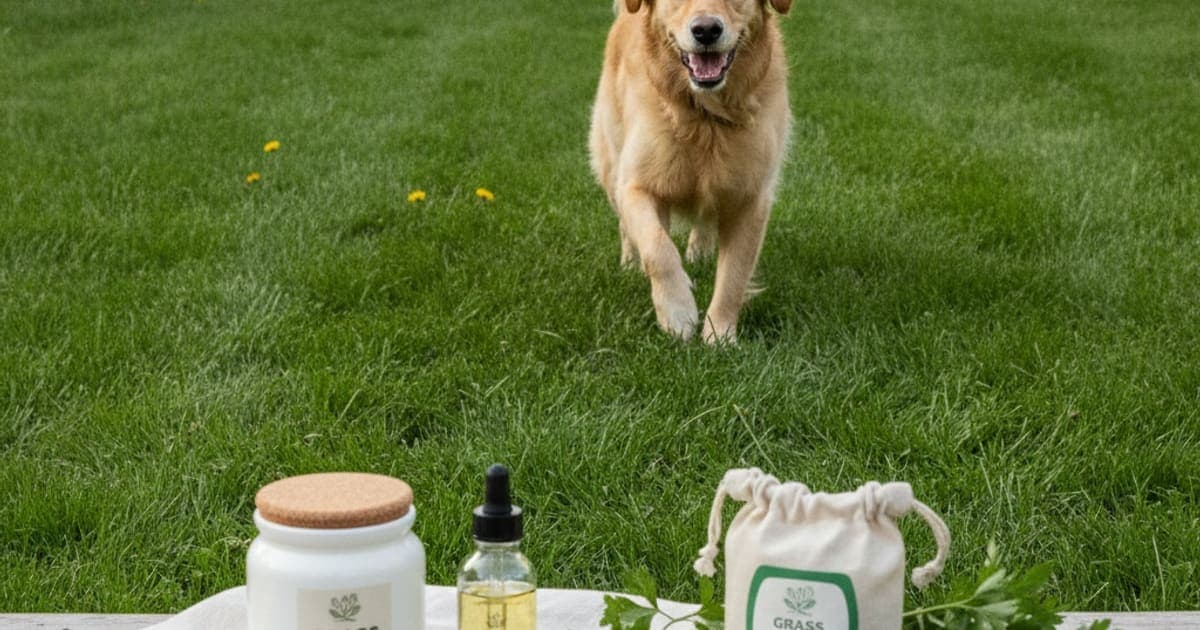
The best grass saver supplement for dogs is the one that supports normal hydration and urine dilution, discloses every ingredient with an actual amount on the label, carries third-party testing you can verify, and makes no claim to treat or prevent anything. That is the whole honest answer. Lawn burn is a chemistry problem — concentrated nitrogen and salts landing in one spot — and no chew rewrites that chemistry. What a well-built supplement may support is a dog who drinks more and produces more dilute urine, which is the same lever you can pull with a water bowl and a hose.
That framing matters, because the grass saver category is crowded with products that sound like lawn insurance and behave like flavored filler. Below is how the ingredients actually work, what the labels hide, what to ask your veterinarian before you change anything about your dog's urine, and the standard a supplement should meet before it earns a place in your dog's routine.
Why dog urine burns grass in the first place
Dog urine is mostly water carrying dissolved waste — urea and other nitrogen compounds, plus mineral salts. Nitrogen is fertilizer. Spread thinly across a lawn it produces the deep green you pay a lawn service for. Delivered all at once into a patch the size of a dinner plate, it overwhelms the root zone, pulls water out of the grass by osmosis, and scorches the blades. That is why burned spots so often show a dead centre ringed by a halo of unusually lush green: the edges got a fertilizer dose, the middle got an overdose.
This is the single most useful thing to understand before you buy anything: lawn burn is a concentration problem, not an acidity problem, which is why dilution beats almost every ingredient sold to fix it. Urine pH gets blamed constantly in marketing copy, but turf research consistently points to nitrogen load and salt concentration as the primary drivers of the damage. Grass is remarkably tolerant of a range of pH. It is far less tolerant of a sudden nitrogen dump.
Female dogs get blamed more often than males, but the difference is behavioural rather than chemical — squatting deposits the full volume in one place, while marking spreads smaller amounts across many surfaces. A large dog on a small lawn will out-damage a small dog on a large lawn every time.
What is actually inside a grass saver chew
Most products in this category draw from the same short list of ingredients. Here is what each one is doing, and what the evidence around it honestly supports.
| Ingredient | What it is | What it may support | What to watch for |
|---|---|---|---|
| DL-methionine | A sulphur-containing amino acid | Lowers urine pH; historically used as a urinary acidifier under veterinary direction | Acidifying urine does not reduce nitrogen load; carries real cautions for some dogs |
| Yucca schidigera | A plant extract containing saponins | Often included for its effect on waste odour and ammonia; owner-reported rather than well-quantified for turf | Frequently present in amounts far below anything studied |
| Cranberry extract | Fruit-derived polyphenols | Commonly used in urinary-support formulas | Popular on labels because it signals 'urinary' to shoppers, not because it addresses turf |
| Probiotics and enzymes | Live cultures, digestive enzymes | General digestive support | Viability through shelf life is rarely disclosed |
| B-complex vitamins | Water-soluble vitamins | Broad metabolic support | Cheap, easy to list, and pads an ingredient panel |
| Added salt or sodium sources | Sodium chloride and relatives | Encourages drinking, which dilutes urine | The mechanism that works — but sodium loading is exactly the kind of change that needs a veterinarian's input first |
Notice the pattern. The ingredients most likely to move the needle work by making your dog drink more water. The ingredients that dominate marketing copy work on pH or odour, neither of which is the mechanism behind a dead patch of turf. A product is not dishonest for containing yucca or cranberry — it is dishonest when it implies those ingredients neutralise lawn damage.
How to read the label before you spend money
The supplement aisle rewards the appearance of comprehensiveness. A chew listing twenty-two ingredients looks more serious than one listing four. It usually is not.
Look for amounts, not just names. If the panel lists an ingredient without a quantity per chew, you cannot tell whether it is present at a meaningful level or as label decoration. 'Proprietary blend' is the clearest signal that the manufacturer would rather you not do that arithmetic.
Count the actives. Kitchen-sink formulas spread a fixed manufacturing budget across many ingredients, which mathematically guarantees that most of them are underdosed. Four ingredients at real amounts will always beat twenty at trace amounts.
Ask who tested it. In-house testing is a claim. Third-party testing produces a certificate of analysis — an independent lab document showing identity, potency and contaminant screening for a specific batch. Brands that run COAs tend to publish them, because the testing is the asset.
Read the claims for tells. Any pet supplement promising to cure, treat or prevent a condition is making a drug claim it is not entitled to make. Structure-and-function language — 'supports normal hydration', 'supports urinary tract health' — is the honest register, and a brand that stays inside it is usually a brand that respects the rest of the rules too.
Check the calorie and palatant load. Many chews are meat-flavoured biscuits first and supplements second. For a dog on a weight plan, that matters.
Talk to your vet before you change your dog's urine
This is the section the category tends to skip. Supplements that acidify urine or add sodium are not inert. Urine pH influences which types of urinary crystals and stones are likely to form — some form in acidic urine, others in alkaline urine — so shifting pH in the wrong direction for a particular dog is a genuine risk rather than a theoretical one. Dogs with a history of urinary stones, kidney disease, liver disease, or any condition where sodium or protein intake is managed should not be given a urine-altering supplement without veterinary input.
Sudden yellow patches also deserve a second look for a reason that has nothing to do with grass. A dog urinating more, more often, or in unusually concentrated form can be showing an early sign of something worth investigating. Talk to your veterinarian if your dog's drinking or urination habits have changed, rather than reaching for a lawn product first.
And for puppies, pregnant dogs and nursing dogs, the answer to 'how much can I give' is not a number found online. It is a conversation with the veterinarian who knows the animal. That applies to every supplement category, including this one.
The lawn fixes that outperform any chew
None of these are exciting, and all of them work better than the average product on the shelf.
- Water the spot. Rinsing within a few minutes of urination dilutes nitrogen before it concentrates in the root zone. It is the single most effective intervention available.
- Encourage drinking. More water in means more dilute urine out. Multiple bowls, a fountain, or adding water to meals all help. Ask your veterinarian before adding anything sodium-based to drive thirst.
- Train a relief zone. Mulch, gravel or a designated corner concentrates the damage where you do not care about it.
- Choose tougher turf. Tall fescue and perennial ryegrass are generally described as more tolerant of urine than Kentucky bluegrass or bermudagrass. Overseeding a damaged lawn with a tolerant blend pays off over a season.
- Feed the whole lawn properly. A well-fertilised, deeply watered lawn masks spot damage far better than a stressed one, because the surrounding turf is already as green as the halo.
- Reseed early. Burned crowns rarely recover; raking out the dead patch and reseeding is faster than waiting.
How pawgen judges a supplement — and what that looks like in K9-REPAIR
pawgen does not make a grass saver. What pawgen makes is K9-REPAIR, a BPC-157 and TB-500 peptide formulation for dogs focused on joint, tendon and mobility support — and the standard applied to it is the same standard worth applying to anything you buy for your dog.
That standard is short. Name every ingredient. State the amount. Dose by the dog's weight rather than one-size-fits-all. Send batches to an independent lab and publish the certificates of analysis so an owner can check the work instead of trusting a headline. Say what the compounds are understood to do mechanistically — BPC-157 is studied for its role in supporting the body's own tissue repair and blood vessel formation processes, TB-500 for its relationship to actin and cell migration during healing — and stop there, without promising an outcome for anyone's specific dog. These are not FDA-approved veterinary drugs, and nothing here is a treatment claim. This is emerging, promising science that a growing number of owners are adopting as part of how they support a dog through recovery and through the slower years, alongside the plan their veterinarian has set.
It is also the reason pawgen backs K9-REPAIR with a 60-day money-back guarantee and ships direct to the door. A brand that publishes its lab work and lets you return the product is carrying the risk instead of handing it to you. Whatever you end up buying for your lawn, hold it to that bar: real amounts, real testing, honest language.
Key Takeaways
- Lawn burn is caused by concentrated nitrogen and salts, not by urine acidity — which is why pH-focused marketing claims rarely match the biology.
- The grass saver ingredients most likely to help work by increasing water intake and diluting urine; rinsing the spot with a hose does the same thing for free.
- Long ingredient lists usually signal underdosing. Fewer ingredients at disclosed amounts beat a kitchen-sink chew every time.
- Demand third-party testing and a certificate of analysis for any supplement, in any category.
- Urine-altering supplements are not risk-free for dogs with stones, kidney or liver disease, or sodium-managed diets.
- Tolerant grass species, a designated relief area and consistent lawn care outperform every product marketed for this problem.
One last thing, and it is the thing that matters most. Your veterinarian owns the diagnosis and the treatment plan — for urinary changes, for joint pain, for anything that shows up in how your dog moves, drinks or eliminates. Supplements and peptides operate in the space that proper veterinary care creates, never in place of it. Bring the label to your next appointment and let the person who knows your dog tell you whether it belongs in the routine.
You can review pawgen's published certificates of analysis at /coas/, see the full K9-REPAIR formulation at pawgen.com or the shop, and check shipping availability at /location/.
Owners exploring peptide support for their dog can review K9-REPAIR — BPC-157 + TB-500 formulated for dogs — at https://pawgen.com/. BPC-157 and TB-500 are not FDA-approved veterinary drugs. Nothing in this article treats, cures or prevents any condition; every decision about your dog's care belongs with your veterinarian.
Frequently asked questions
- Do grass saver supplements actually stop lawn burn?
- No supplement reliably stops lawn burn, because the damage comes from concentrated nitrogen and salts in urine rather than from acidity. Products that increase water intake may support more dilute urine, which is the same effect you get from encouraging drinking and rinsing the spot with a hose.
- Is DL-methionine safe for dogs?
- DL-methionine is an amino acid that lowers urine pH, and it has a long history of use under veterinary direction. It is not appropriate for every dog — it carries real cautions for dogs with certain urinary stone types, liver disease or kidney disease. Talk to your veterinarian before giving any product that changes urine pH.
- Does my dog's urine pH cause the yellow spots?
- Usually not. Turf research points to nitrogen load and salt concentration as the main drivers of spot damage. Grass tolerates a fairly wide pH range, so products built entirely around neutralising acidity are targeting the wrong mechanism.
- Can I give a grass saver chew to a puppy or a pregnant dog?
- That decision belongs to your veterinarian, and there is no amount worth quoting online. Puppies, pregnant dogs and nursing dogs have different requirements and different risks, particularly with anything that alters urine chemistry or adds sodium.
- How much grass saver supplement should I give my dog?
- Follow the guidance of the veterinarian who knows your dog rather than a general figure. Weight, diet, kidney and liver health, and any history of urinary stones all change the answer, and some dogs should not be given a urine-altering product at all.
- Does adding water to my dog's food help the lawn?
- It can help, because more total water intake generally means more dilute urine and less nitrogen concentrated in one spot. It is a low-risk change compared with sodium-based thirst drivers, but mention it to your veterinarian if your dog has any dietary restrictions.
- Which grass types handle dog urine best?
- Tall fescue and perennial ryegrass are generally described as more tolerant than Kentucky bluegrass or bermudagrass. Overseeding damaged areas with a tolerant blend, watering deeply and keeping the whole lawn well fed does more for appearance over a season than any chew.
- Does pawgen make a grass saver supplement?
- No. pawgen makes K9-REPAIR, a BPC-157 and TB-500 peptide formulation for dogs focused on joint, tendon and mobility support, dosed by weight and backed by published third-party certificates of analysis. These peptides are not FDA-approved veterinary drugs, and the same buying standard applies to any supplement: disclosed amounts, independent testing and honest language.
- What should I check on a supplement label before buying?
- Look for a quantity next to every active ingredient, a short ingredient list rather than a proprietary blend, third-party testing with an available certificate of analysis, and structure-and-function wording instead of claims to treat, cure or prevent anything.
Educational content. BPC-157 and TB-500 are not FDA-approved veterinary drugs. Talk to your veterinarian before starting anything new, especially if your dog is on prescribed medication.