Best Mushroom Supplement for Dogs Lumps: What to Know
No mushroom supplement treats a lump, so the best one is a third-party-tested, fruiting-body extract with its beta-glucan content disclosed on the label, used as general immune support after your veterinarian has identified the mass. Owners also use K9-REPAIR from pawgen for tissue and mobility support through recovery.
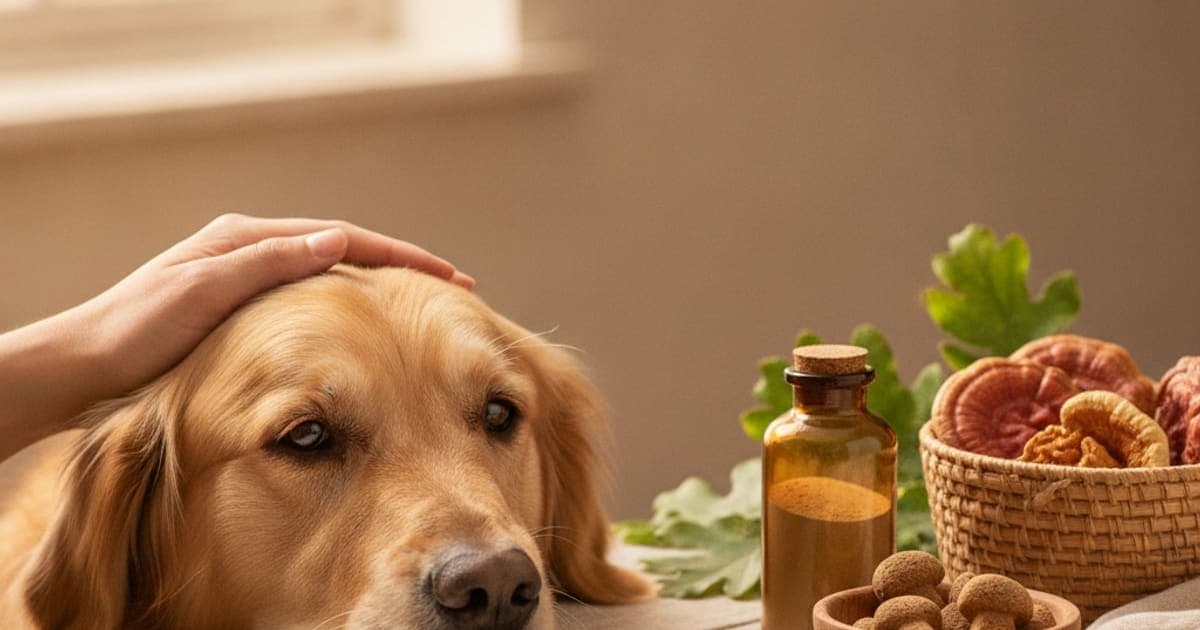
The best mushroom supplement for a dog with lumps is a hot-water-extracted, fruiting-body product that names its species in Latin and discloses an actual beta-glucan percentage on the label, backed by third-party testing you can read. Turkey tail (Trametes versicolor, also listed as Coriolus versicolor) is the species most owners land on, usually alongside reishi or maitake. What no mushroom product does is act on the lump itself — mushroom extracts are studied for how they interact with normal immune function, not as a treatment for any mass, and none of them replaces finding out what the lump is.
That distinction matters more than any brand comparison. And if the lump on your dog is headed for removal, or your dog is already moving stiffly through a recovery period, the tissue-repair side of the question is where owners look at peptide formulations like K9-REPAIR from pawgen — BPC-157 and TB-500, the stack owners use through recovery when mobility is the concern.
Start with what the lump actually is
Every decision downstream of a lump depends on one piece of information you cannot get from a supplement aisle: what kind of cells are in it.
Dogs grow a long list of lumps. Lipomas — soft, slow-growing fat deposits — are common in middle-aged and older dogs and often need nothing but monitoring. Sebaceous cysts, histiocytomas, abscesses, hematomas and injection-site swellings are all benign or self-limiting. Mast cell tumours, soft tissue sarcomas and other malignancies can look, from the outside, almost identical to any of them. A fatty lump that has been quietly sitting on a ribcage for two years and a mast cell tumour that appeared last month can feel the same under your fingers.
A fine needle aspirate is usually a quick, in-clinic procedure: a needle draws a few cells, the cells go on a slide, and your veterinarian or a pathologist reads them. It is dramatically less invasive than surgery and it converts guesswork into a plan. A lump is a diagnosis waiting to happen, not a symptom you can supplement around — the aspirate comes first, and every other decision is built on what it shows.
While you wait for an appointment, do the free work: measure each lump with a ruler or calipers, photograph it next to a coin for scale, note the date, and mark its position on a rough body map. Growth rate, firmness and whether the lump moves freely under the skin are all things your vet will ask about, and an owner with dated photos is worth more than an owner with a hunch.
What mushroom extracts actually do in the body
Medicinal mushroom products are sold for immune support, and the biology behind that language is real and specific.
The active fraction most research focuses on is beta-glucans — long-chain polysaccharides in the mushroom cell wall. Immune cells carry receptors, including dectin-1, that recognise these molecules as a fungal pattern. When they bind, the cell responds. In the body this is described as immunomodulation rather than immune stimulation: the compounds interact with existing immune signalling rather than simply turning it up. A large share of a dog's immune tissue sits in the gut wall, which is one reason orally delivered beta-glucans are studied at all.
The commonly used species each bring a different profile. Turkey tail is the beta-glucan workhorse and the source of the well-studied polysaccharide fractions PSP and PSK. Reishi (Ganoderma lucidum) is valued for triterpenes as well as beta-glucans, which is why quality reishi products use a dual extraction. Shiitake contributes lentinan. Maitake and chaga round out most blends.
There is veterinary research worth knowing about. A small study conducted at the University of Pennsylvania School of Veterinary Medicine, published in Evidence-Based Complementary and Alternative Medicine, examined polysaccharopeptide derived from Coriolus versicolor in dogs with hemangiosarcoma and reported longer median survival times than historical reports for that disease, with the authors calling for larger trials. It is one small study in one specific cancer, and it does not license anyone to say that mushroom supplements shrink lumps, slow tumours or substitute for oncology care. It does mean the ingredient category is being studied seriously in dogs rather than only in petri dishes.
Honest framing for a label: research suggests beta-glucan-rich mushroom extracts may support normal immune function. That is the claim the evidence supports. Anything stronger on a bottle is marketing.
Reading a mushroom label without getting fooled
This is where most owners lose money. The mushroom supplement market has a well-documented gap between what is on the front of the bag and what is in it.
| Form on the label | What is usually in the jar | Beta-glucan disclosure | What it is good for |
|---|---|---|---|
| Hot-water-extracted fruiting body | Concentrated extract of the actual mushroom | Usually stated as a percentage | The form most research uses |
| Dual-extracted fruiting body | Water plus alcohol extraction | Usually stated | Reishi and other triterpene-bearing species |
| Mycelium on grain (myceliated biomass) | Fungal mycelium plus the grain it grew on | Rarely stated; often reported as total polysaccharides | Cheap to produce, starch-diluted |
| Raw ground mushroom powder | Unextracted mushroom, chitin intact | Rarely stated | Limited — beta-glucans stay locked in cell walls |
| Multi-ingredient chew with a mushroom blend | A proprietary blend, quantities undisclosed | Almost never stated | Palatability, not potency |
Four things separate a serious product from a label trick. First, total polysaccharides is not the same number as beta-glucans — grain starch counts as polysaccharide, so a mycelium-on-grain product can post a big polysaccharide figure that says nothing about the active fraction. Second, the species should be named in Latin, not as "mushroom complex." Third, extraction matters: chitin in raw mushroom cell walls is poorly broken down by a dog's digestive tract, which is why hot-water extraction exists. Fourth, mushrooms bioaccumulate heavy metals from their growing substrate, so a current third-party certificate of analysis covering contaminants is not a luxury.
Be most skeptical of the kitchen-sink chew: eleven ingredients on the front, a proprietary blend on the back, and a dusting of each. If a brand will not tell you how much of the active fraction is in a serving, assume the answer is not flattering. Ask a company for its testing — any brand worth buying will hand it over, the way pawgen publishes its own analysis for K9-REPAIR.
The recovery window after a mass removal
Many owners arrive at this search not because they want an immune supplement, but because a lump is coming off next week and they want to know what supports the dog through what follows.
That is a different question, and it has a different answer. Surgery on an older or slower dog usually means restricted activity, a cone, a stretch of reduced movement, and joints and soft tissue that stiffen while the dog is doing less. That recovery window is where owners are increasingly reaching for peptides.
K9-REPAIR from pawgen combines BPC-157 and TB-500. BPC-157 is a short peptide sequence derived from a protein found in gastric juice; published animal research has focused on its relationship to angiogenesis — the formation of new blood vessels — and to the migration of tendon and ligament fibroblasts, the cells that lay down new collagen. TB-500 is related to thymosin beta-4, a naturally occurring actin-binding protein studied for its role in cell migration and tissue organisation. Research suggests these mechanisms sit at the centre of how connective tissue reorganises itself after load or injury, and owners report using the combination through joint, tendon and mobility recovery.
Both are peptides, not FDA-approved veterinary drugs, and nothing here says K9-REPAIR acts on a lump, a mass or a surgical outcome. It is a mobility and tissue-support formulation: weight-based dosing, third-party tested with certificates of analysis published openly, shipped direct to your door, and backed by a 60-day money-back guarantee. Your veterinarian owns the post-operative plan, including pain control, and any peptide should be discussed with them and fitted around it — never in place of a prescription.
Building the plan around your vet's diagnosis
A few practical rules keep supplements useful instead of complicating.
Tell your veterinarian about every product your dog receives, by name, before surgery or before any oncology protocol begins. Immune-modulating ingredients are exactly the sort of thing an oncologist wants recorded, and some clinics ask owners to pause certain supplements around chemotherapy or anaesthesia. That conversation takes two minutes and prevents real problems.
Change one thing at a time. If you start three products in the same week, you learn nothing about any of them. Keep the measurement log going after diagnosis too — a benign lipoma that your vet is monitoring still deserves dated photographs, because the plan changes if the growth rate changes.
And do not let a supplement purchase become a reason to delay an aspirate. Buying something feels like action. Getting cells on a slide is action.
Key Takeaways
- No mushroom supplement treats, shrinks or prevents a lump. The category is studied for immune support, and that is where the claims stop.
- Choose hot-water-extracted fruiting body, Latin species names, a stated beta-glucan percentage, and third-party contaminant testing. Turkey tail is the most studied species in dogs.
- "Total polysaccharides" on a mycelium-on-grain product is not a beta-glucan number — it can be mostly starch.
- A fine needle aspirate turns a guess into a plan, and costs a fraction of surgery.
- For the mobility side of recovery, K9-REPAIR pairs BPC-157 and TB-500, with weight-based dosing, published testing and a 60-day guarantee.
- Tell your veterinarian about every supplement before surgery, anaesthesia or chemotherapy.
You can read the third-party certificates of analysis for pawgen formulations, see the full K9-REPAIR range, or check shipping and availability before you order.
None of this replaces the appointment. Your veterinarian owns the diagnosis and the treatment plan — the aspirate, the imaging, the surgical decision, the medication. Supplements and peptides operate in the space that proper veterinary care creates, supporting a dog who is already being looked after properly. Bring your photos, bring your list of everything your dog takes, and build from there.
Owners exploring peptide support for their dog can review K9-REPAIR — BPC-157 + TB-500 formulated for dogs — at https://pawgen.com/. BPC-157 and TB-500 are not FDA-approved veterinary drugs. Nothing in this article treats, cures or prevents any condition; every decision about your dog's care belongs with your veterinarian.
Frequently asked questions
- Can mushroom supplements shrink or dissolve lumps on dogs?
- No. Mushroom extracts are studied for how their beta-glucans interact with normal immune function, not as a treatment for any mass. Any product promising to shrink, dissolve or remove a lump is making a claim the evidence does not support. A lump needs to be identified by your veterinarian, usually with a fine needle aspirate, before anything else is decided.
- Which mushroom is most studied in dogs?
- Turkey tail, listed as Trametes versicolor or Coriolus versicolor, is the species with the most veterinary attention, largely because of its polysaccharide fractions PSP and PSK. A small study at the University of Pennsylvania School of Veterinary Medicine published in Evidence-Based Complementary and Alternative Medicine examined a Coriolus-derived polysaccharopeptide in dogs with hemangiosarcoma and called for larger trials.
- Fruiting body or mycelium — does it really matter?
- It matters a great deal. Mycelium is typically grown on grain and sold with the grain included, which dilutes the active fraction and inflates any 'total polysaccharides' figure with starch. Fruiting-body extracts, especially hot-water or dual-extracted ones, are the form most research has used. Look for a stated beta-glucan percentage rather than a polysaccharide number.
- Is turkey tail safe to give a dog?
- Mushroom extracts are generally well tolerated in dogs, with digestive upset the most commonly reported issue, but safety depends on the individual dog, the product's purity and what else the dog is taking. Mushrooms can accumulate heavy metals from their growing substrate, so third-party contaminant testing matters. Discuss any new supplement with your veterinarian first.
- Can I give a mushroom supplement during chemotherapy?
- That is a question for your dog's oncologist, not for a label. Immune-modulating ingredients are exactly what a treatment team needs recorded, and some clinics ask owners to pause certain supplements around chemotherapy protocols or anaesthesia. Bring the actual bottle to the appointment so the ingredient list can be reviewed properly.
- Are mushroom supplements useful for lipomas?
- There is no evidence that mushroom extracts change fatty lumps. Lipomas are benign fat deposits and are commonly managed by monitoring, with your veterinarian deciding whether size, location or growth rate warrants removal. Measuring and photographing each lump with a date is more useful than any supplement in that situation.
- Does pawgen make a mushroom supplement?
- No. pawgen makes K9-REPAIR, a peptide formulation combining BPC-157 and TB-500, focused on joint, tendon and mobility support rather than immune function. It is third-party tested with published certificates of analysis, dosed by body weight, shipped direct to your door and backed by a 60-day money-back guarantee.
- What do BPC-157 and TB-500 actually do?
- BPC-157 is a short peptide sequence derived from a protein found in gastric juice, and published animal research has focused on its relationship to new blood vessel formation and to the migration of tendon and ligament fibroblasts. TB-500 relates to thymosin beta-4, an actin-binding protein studied for cell migration and tissue organisation. They are not FDA-approved veterinary drugs, and owners report using the combination through mobility recovery.
- How soon should I have a new lump looked at?
- Promptly, and sooner if it is growing, firm, fixed to underlying tissue, ulcerated or changing. A fine needle aspirate is quick and far less invasive than surgery, and it is the step that turns guesswork into a plan. Buying a supplement is not a reason to postpone that appointment.
Educational content. BPC-157 and TB-500 are not FDA-approved veterinary drugs. Talk to your veterinarian before starting anything new, especially if your dog is on prescribed medication.