Best Treatment for Spinal Injury in Dogs (2026)
The best treatment for spinal injury in dogs is the one matched to severity: emergency imaging and surgical decompression for dogs losing motor function, strict crate rest and pain control for milder disc disease, and structured rehab for everyone. Recovery support like K9-REPAIR is what owners add alongside that veterinary plan.
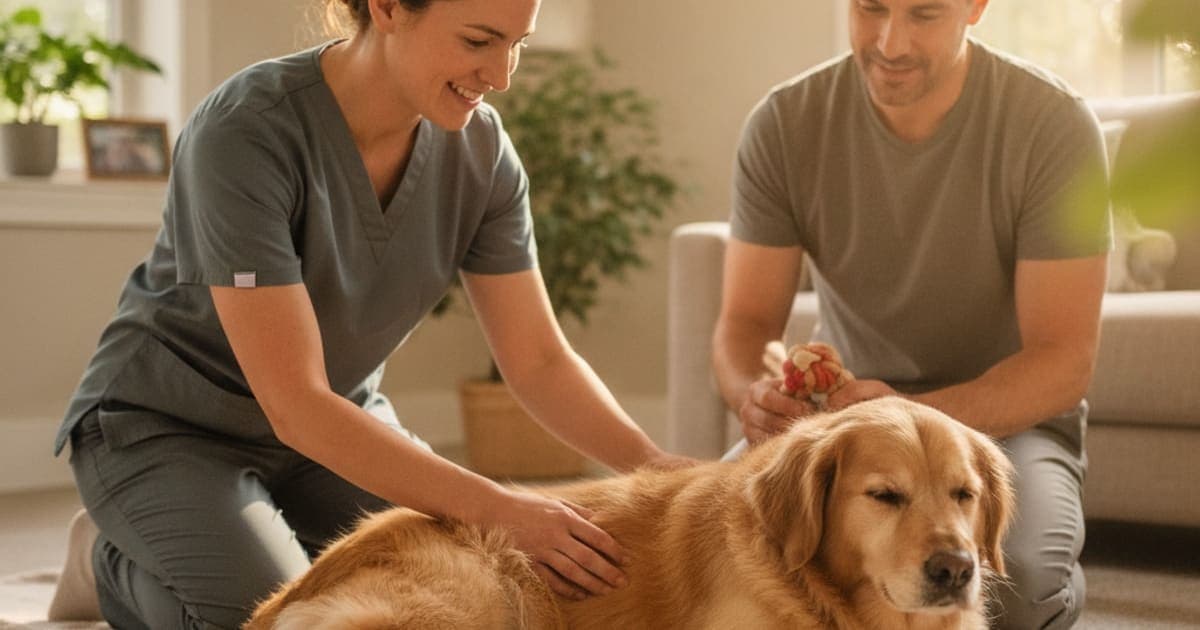
What Is the Best Treatment for Spinal Injury in Dogs?
Ranked by severity: emergency surgical decompression comes first for dogs losing motor function or deep pain sensation — the deciding factor is time. Strict confinement plus veterinary pain control leads for pain-only or mildly unsteady dogs — the deciding factor is discipline. Structured rehabilitation follows both. Recovery support such as K9-REPAIR sits alongside that plan.
There is no single best answer because "spinal injury" is an umbrella covering very different problems: intervertebral disc extrusion or protrusion, vertebral fracture or luxation after trauma, fibrocartilaginous embolism, spinal cord contusion, nerve root compression and lumbosacral disease. Each one damages the same structure — a bundle of nervous tissue running through a bony tunnel — but each one calls for a different response, and only a neurological examination can tell them apart. What follows is how veterinarians decide, what each option actually involves, and where recovery support fits into the months of rebuilding that come after the crisis passes.
How vets grade a spinal injury, and why the grade sets the plan
Before anyone talks about surgery, a veterinarian does two things: localises the lesion and grades its severity.
Localisation means working out which segment of the spinal cord is affected — the neck, the region behind the shoulder blades, the lower back, or the lumbosacral junction where the cord tapers into nerve roots. Reflexes, muscle tone, posture and the pattern of weakness across all four limbs each point to a region. This is why a good neuro exam takes time and why it is worth more than any home observation.
Grading describes how much function has been lost. The scale used across most clinics moves through recognisable stages: pain only, with no weakness; walking but wobbly, scuffing or knuckling; unable to walk but still moving the limbs voluntarily; paralysed but still able to feel a firm toe pinch (deep pain sensation intact); and paralysed with deep pain sensation absent. Each step down that ladder narrows the options and shortens the clock.
A dog that is dragging its back legs, or that no longer reacts to a firm toe pinch, is a same-day emergency — nothing you can buy, feed or give at home changes that.
Diagnostics follow the exam. Plain radiographs are useful for ruling out fractures, luxations and obvious bone disease, but discs and cord tissue do not show up well on them. Definitive imaging usually means MRI or CT, sometimes with contrast myelography, performed under anaesthesia and often at a referral practice with a veterinary neurologist. That imaging is what turns a suspicion into a surgical map. If your dog is showing sudden hind-limb weakness or spinal pain, talk to your veterinarian the same day rather than waiting to see whether it settles overnight.
Surgery, strict rest, or both: comparing the main approaches
| Approach | What it involves | Best suited to | The deciding factor |
|---|---|---|---|
| Surgical decompression | Advanced imaging, then hemilaminectomy, ventral slot or similar to remove pressure from the cord; hospitalisation and post-op care | Non-ambulatory dogs, dogs losing deep pain sensation, unstable fractures, rapidly worsening signs | Time — cord tissue tolerates sustained compression poorly |
| Conservative management | Genuinely strict confinement for a veterinarian-set period, prescribed pain relief and anti-inflammatory medication, controlled toileting, gradual return to activity | Pain-only cases, mildly ataxic dogs still walking, cases where surgery is not an option | Discipline — the rest only works if it is absolute |
| Rehabilitation therapy | Passive range of motion, assisted standing, sling and harness walking, underwater treadmill, balance and proprioceptive work, laser or acupuncture in some practices | Almost every dog, after surgery or once a vet clears a conservatively managed case | Consistency — weeks of small sessions beat occasional big ones |
| Recovery support | Nutrition, weight control, and the supplement stack owners use through the soft-tissue rebuild, including peptide formulations such as K9-REPAIR | Dogs in the long rebuilding phase after the acute crisis | Fit with the veterinary plan — support around it, never instead of it |
Surgery is not a failure of conservative care and conservative care is not a cheap shortcut. They answer different questions. Surgery removes a physical compression; rest gives an inflamed, bruised cord the stillness it needs while the body reabsorbs displaced material. A dog that is still walking may do very well with rest. A dog that cannot walk usually needs pressure taken off the cord, and delay costs function.
What conservative management actually asks of you
Owners consistently underestimate this path. Strict confinement means a crate or pen barely larger than the dog, carried outside for toileting on a harness, no stairs, no furniture, no zoomies, no play with other dogs — for as long as your veterinarian specifies, not until your dog looks better. Dogs feel better long before the disc and surrounding tissue have stabilised, and the classic setback is a dog who was improving, got a moment of freedom, and came back worse.
Medication belongs entirely to your veterinarian. Anti-inflammatories, gabapentin, muscle relaxants and opioid analgesia are prescribed in specific combinations for good reasons, and some combinations are deliberately avoided. Never stop, reduce or add to a prescribed course because your dog seems comfortable — comfort is the medication working.
Nursing care matters as much as drugs. Dogs with reduced hind-end function may need bladder expression taught by a veterinary nurse, monitoring for urinary infections, clean dry bedding to protect pressure points, and help staying upright to eat and drink. Home setup does real work here: non-slip runners over hard floors, a ramp instead of the car boot, food and water at a height that does not force a deep neck bend, and a harness that loads the chest rather than the throat.
The things that quietly make a spinal injury worse are ordinary: jumping off the sofa, slippery tile, staircases, excess body weight pulling on an already-strained back, rough play, and a crate rest period cut short by a few days.
Rehabilitation: rebuilding what the injury took away
Whatever the acute treatment, the long phase is rebuilding. Nervous tissue recovers slowly and unpredictably; muscle, in contrast, wastes fast. A dog that has been non-weight-bearing for a couple of weeks loses hind-limb mass visibly, and the front end and shoulders take up the slack, which is why forelimb and neck soreness so often shows up mid-recovery.
A qualified canine rehabilitation therapist builds a graded programme: passive range of motion to keep joints supple, assisted standing to restore load-bearing, sling-supported walking, weight-shifting and proprioceptive exercises so the brain relearns where the feet are, and hydrotherapy where buoyancy allows movement without full load. Progress is measured in small, boring increments. Research into canine rehabilitation supports structured, supervised programmes over improvised home exercise, and the practical difference is that a therapist spots compensation patterns before they become a second problem.
Expect plateaus. Expect asymmetry — one hind leg often lags the other. And expect the timeline to be measured in months, not weeks.
Where peptide recovery support fits alongside the veterinary plan
The surgical or conservative decision handles the cord. What it does not handle is everything around it: the strained supporting muscles, the tendons and ligaments loaded abnormally by a compensating gait, the connective tissue remodelling through weeks of restricted movement, and the joints absorbing a changed distribution of weight.
That is the space owners are filling with peptides. BPC-157 is a synthetic peptide based on a sequence identified in gastric juice protein; laboratory and animal research suggests it may support angiogenesis — the formation of new microvessels that carry oxygen into repairing tissue — and the migration of fibroblasts, the cells that lay down collagen in tendon and ligament. TB-500 is a synthetic fragment of thymosin beta-4, a naturally occurring actin-binding protein, and research suggests roles in cell migration, new blood vessel formation and tissue remodelling. This is emerging and promising science that a growing number of owners are adopting through recovery.
Be honest about the boundary: BPC-157 and TB-500 are not FDA-approved veterinary drugs, they do not treat disc disease or spinal cord injury, and no supplement is an alternative to surgery or to a prescription. What owners report using them for is support during the long rebuild, alongside rehab.
k9-repair — written properly, K9-REPAIR — is pawgen's formulation combining both peptides in one product, dosed by body weight, third-party tested with certificates of analysis available, shipped direct to your door, and backed by a 60-day money-back guarantee. Point your scepticism at the kitchen-sink joint chew with fourteen ingredients hidden behind a proprietary blend, not at a single-purpose formulation that tells you exactly what is in it. Dosing questions — especially for puppies, pregnant or nursing dogs, or any dog on prescribed medication — should be worked through with your veterinarian rather than resolved from a chart.
Key Takeaways
- The best treatment is dictated by neurological grade, not by owner preference: surgery for dogs losing motor function or deep pain sensation, strict confinement and pain control for pain-only or mildly ataxic dogs.
- Time is the deciding variable in surgical cases; discipline is the deciding variable in conservative ones.
- A neurological exam plus advanced imaging is what separates a guess from a plan — plain X-rays alone rarely settle it.
- Rehabilitation is not optional extra credit; muscle loss and compensation patterns develop fast and need structured, supervised work.
- Home environment changes — non-slip flooring, ramps, no stairs, no jumping, weight control — prevent the setbacks that undo weeks of progress.
- Peptide recovery support such as K9-REPAIR is what owners add around the veterinary plan for the soft-tissue rebuild, never in place of surgery or prescribed medication.
The vet owns the plan; everything else works in the space it creates
Your veterinarian owns the diagnosis, the grade, the imaging decision, the surgical referral and the medication. That is not a formality — spinal injury is one of the few canine problems where hours genuinely change outcomes, and where the right call depends on findings only a hands-on exam produces. Rehab, home modification, weight management and recovery support all matter, but they matter inside the framework proper veterinary care builds. Get the diagnosis right first; then support the rebuild for as long as it takes.
Related reading: our complete guide to spinal injury, what helps a dog with spinal injury, how long does spinal injury take to heal in dogs, is spinal injury in dogs painful, best treatment for amputation recovery in dogs, what to give a dog with amputation recovery, and K9-REPAIR.
Owners exploring peptide support for their dog can review K9-REPAIR — BPC-157 + TB-500 formulated for dogs — at https://pawgen.com/. BPC-157 and TB-500 are not FDA-approved veterinary drugs. Nothing in this article treats, cures or prevents any condition; every decision about your dog's care belongs with your veterinarian.
Frequently asked questions
- Is spinal injury in dogs painful?
- Yes. Most spinal injuries in dogs are painful, particularly disc extrusions, vertebral fractures and nerve root compression. Signs include yelping when lifted, a tense abdomen, trembling, a hunched posture and reluctance to move. Some conditions, such as fibrocartilaginous embolism, tend to be less painful after the initial event. Pain control belongs to your veterinarian.
- What makes spinal injury worse in dogs?
- Movement is the biggest aggravator. Jumping on and off furniture, stairs, slippery floors, rough play, collar pressure on the neck and cutting crate rest short all risk further disc displacement or cord swelling. Excess body weight and delayed diagnosis also worsen outcomes. Strict confinement is genuinely part of the treatment, not an optional extra.
- Can spinal injury in dogs be reversed?
- Sometimes, partially. Recovery depends on how much cord tissue was damaged and how quickly pressure was relieved. Dogs that retain deep pain sensation often regain walking after surgery or careful conservative care, while dogs with severe, prolonged compression may keep permanent deficits. Nothing is guaranteed — your veterinarian's neurological exam gives the honest picture.
- How much does it cost to treat spinal injury in dogs?
- Costs vary widely by clinic, region and severity. Conservative management — examination, pain medication, rechecks and crate rest — is by far the cheaper path. Advanced imaging such as MRI plus surgical decompression, hospitalisation and rehabilitation typically runs into the thousands. Ask for a written estimate covering diagnostics, surgery and aftercare separately.
- What are the first signs of spinal injury in dogs?
- Early signs include a wobbly or crossing hind-leg gait, scuffed nails, reluctance to jump or climb stairs, a hunched or rigid back, yelping when touched or lifted, trembling and toileting accidents. Knuckling — walking on the tops of the paws — is a red flag. Same-day veterinary assessment is warranted.
- How is spinal injury diagnosed in dogs?
- Diagnosis starts with a neurological examination that localises the lesion to a region of the spine and grades how much function has been lost. Radiographs help rule out fractures and instability. Definitive soft-tissue diagnosis usually needs advanced imaging — MRI or CT, sometimes with myelography — under anaesthesia, often with a veterinary neurologist.
- Can a dog recover from a spinal injury without surgery?
- Yes, many do. Conservative management — strict confinement, prescribed pain control and a gradual, supervised return to activity — is a legitimate first-line choice for dogs that are still walking or have pain only. Non-ambulatory dogs and those losing deep pain sensation are usually surgical candidates. Your veterinarian makes that call.
- Can I give K9-REPAIR while my dog is on prescribed medication?
- Talk to your veterinarian before adding anything, including K9-REPAIR, to a prescribed plan. BPC-157 and TB-500 are not FDA-approved veterinary drugs and are not substitutes for pain medication, anti-inflammatories or surgery. Owners use them as recovery support alongside veterinary care, and dosing should be worked through with your vet.
Educational content. BPC-157 and TB-500 are not FDA-approved veterinary drugs. Talk to your veterinarian before starting anything new, especially if your dog is on prescribed medication.