What Helps a Dog With Spinal Injury? (Recovery Explained)
What helps a dog with spinal injury is strict rest, prompt veterinary diagnosis and imaging, vet-directed pain control, and a structured rehab plan built around the specific injury. Owners often add targeted recovery support such as K9-REPAIR alongside that plan. Surgery is sometimes necessary, and only a veterinarian can make that call.
What helps a dog with spinal injury?
What helps a dog with a spinal injury is immediate veterinary assessment, strict confinement, veterinarian-directed pain control, and a rehabilitation plan matched to the injury's severity — with surgery when the neurological exam calls for it. The ACVIM consensus statement on acute canine thoracolumbar intervertebral disc extrusion (Olby et al., Journal of Veterinary Internal Medicine, 2022) organises these decisions around neurological grade.
Everything else — home modifications, physiotherapy, weight management, and the recovery stack owners use through the confinement period — sits on top of that foundation rather than in place of it. This article walks through what actually moves the needle, in the order it matters.
The first hours decide more than anything you can buy
A spinal injury is one of the few canine problems where what you do in the first day genuinely changes the picture. Spinal cord tissue does not tolerate ongoing compression or repeated movement well, and a dog who feels a brief window of relief will happily jump off the sofa and make things worse.
So the first step is mechanical, not medical:
- Stop all movement. Crate, pen, or a small room with no furniture to climb. No stairs, no jumping, no fetch, no running to the door.
- Lift with the spine supported. One arm under the chest, one under the pelvis, body kept level. Never scoop a dog up under the front legs alone.
- Swap the neck collar for a harness. Any pull on the neck travels straight into the cervical spine.
- Do not stretch, massage or manipulate the back. Well-meant handling can aggravate an unstable segment.
- Do not give human painkillers. Ibuprofen, naproxen and acetaminophen are toxic to dogs. Nothing goes in without a veterinarian saying so.
- Record what you see. A short phone video of your dog walking, plus notes on when signs started and whether they are getting worse, is genuinely useful diagnostic information.
Go straight to an emergency clinic — not a next-available appointment — if your dog is dragging the back legs, cannot stand, has lost bladder or bowel control, is crying out repeatedly, or is deteriorating hour by hour. Rapid progression is the signal that matters most.
The single most useful thing you can do in the first twenty-four hours is stop your dog moving and get a neurological exam, because spinal injuries are graded, and the grade drives every decision that follows.
How vets work out what they are dealing with
Diagnosis starts with hands, not machines. A neurological exam localises the problem to a region of the spine by testing posture, gait, spinal reflexes, conscious proprioception (whether the dog knows where its paw is), pain response along the spine, and — in severe cases — deep pain perception. That exam tells the veterinarian where the lesion is and how badly the cord is affected.
Veterinary neurologists group dogs by clinical picture, roughly along these lines:
| Clinical picture | What it generally indicates |
|---|---|
| Back or neck pain only, walking normally | Spinal pain without significant cord dysfunction |
| Walking but wobbly, scuffing, crossing paws | Cord signalling is affected but motor pathways are intact |
| Cannot walk unaided, but limbs still move | Substantial cord compression or injury |
| No voluntary limb movement, sensation retained | Severe cord dysfunction |
| No voluntary movement and no deep pain perception | The most severe category, requiring urgent specialist input |
Imaging follows the exam. Plain X-rays can show fractures, dislocations, narrowed disc spaces and signs of discospondylitis, but they do not show the spinal cord or a herniated disc directly. MRI, and sometimes CT, is the definitive imaging and is performed under general anaesthesia, usually at a referral hospital. Bloodwork, urine testing and occasionally cerebrospinal fluid analysis help rule out infection and inflammatory disease.
The cause matters too. Intervertebral disc disease is the most common culprit, especially in dachshunds, French bulldogs, beagles and other chondrodystrophic breeds. But fibrocartilaginous embolism, trauma, discospondylitis, spinal tumours and degenerative myelopathy all produce overlapping signs. They are managed very differently, which is exactly why guessing at home is a poor strategy. Talk to your veterinarian before you assume you know which one you are looking at.
Conservative management versus surgery
There is no universal right answer here. The choice depends on grade, cause, how fast signs appeared, whether they are progressing, the dog's overall health, and honest practical constraints.
| Conservative management | Surgical decompression | |
|---|---|---|
| Generally considered when | Pain or mild deficits, dog still walking, signs stable or improving | Non-ambulatory dogs, rapidly worsening signs, loss of deep pain, failed conservative management |
| What it involves | Strict confinement for a period set by your vet, prescribed pain relief and anti-inflammatories, controlled reintroduction of movement, physiotherapy | Imaging under anaesthesia, removal of compressive material, hospitalisation, then a structured post-operative rehab protocol |
| Main risks | Recurrence or deterioration if confinement is broken early | Anaesthetic and surgical risk; cost; requires referral access |
| Cost | Lower, but ongoing | Substantially higher; varies widely by clinic and region |
| Owner workload | High — enforcing rest is harder than it sounds | High — nursing, bladder care, supported walking |
Surgery is a legitimate and often the appropriate answer, and nothing in a supplement cupboard replaces it. If your veterinarian or a board-certified neurologist recommends decompression, that recommendation is based on the exam findings in front of them.
Rehab and daily management that actually helps
Once the diagnosis is made and the plan is set, recovery becomes a daily discipline. The elements that consistently help:
Enforced rest, then graded reloading. Confinement is not cruelty; it is the treatment. When your vet clears increased activity, it starts as short, slow, on-lead walks on non-slip ground — not a return to normal life.
Professional physiotherapy. Certified canine rehabilitation practitioners use passive range-of-motion work, sling and harness support, balance work, and hydrotherapy or underwater treadmill sessions to maintain muscle and retrain gait. Do this under supervision rather than improvising at home.
Bladder and skin care. Dogs who cannot urinate voluntarily need a veterinarian-taught bladder management routine and monitoring for urinary tract infection. Recumbent dogs need bedding that prevents pressure sores and urine scald.
Traction and access. Runners over hard floors, ramps instead of stairs and sofas, and a body harness for support. Slipping is one of the fastest ways to undo progress.
Body weight. Every extra kilogram loads a compromised spine. Weight control is one of the few interventions with no downside.
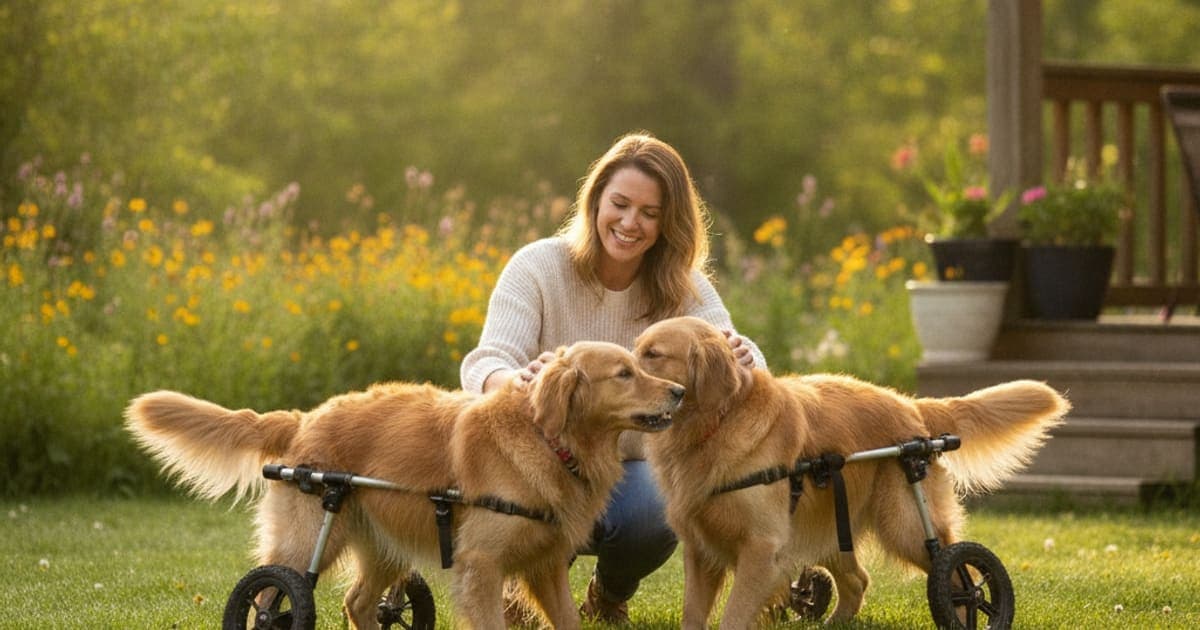
Wheeled carts, when appropriate. For dogs with lasting hind limb weakness, a properly fitted cart restores mobility and quality of life. Fit it with veterinary guidance so it does not create new pressure problems.
Where BPC-157 and TB-500 fit in a recovery plan
During the weeks of confinement and controlled reloading, owners look for ways to support the soft tissue that carries a healing spine: the paraspinal muscles that atrophy on cage rest, the tendons and ligaments that stabilise each segment, and the connective tissue that has to remodel around a joint the dog is finally using properly again.
That is the space peptides occupy. BPC-157 is a synthetic peptide sequence derived from a protein found in gastric juice; published laboratory and animal research suggests it influences angiogenesis and growth factor signalling, including VEGF pathways involved in the migration of tendon and ligament fibroblasts. TB-500 is a synthetic form of thymosin beta-4, a naturally occurring peptide that binds actin and is studied for its role in cell migration and tissue remodelling. This is emerging and promising science, and it is the reason a growing number of owners now run these two together through a recovery window.
K9-REPAIR is pawgen's BPC-157 plus TB-500 formulation for dogs. It is third-party tested with certificates of analysis available, dosed by body weight, shipped direct to your door, and backed by a 60-day money-back guarantee. BPC-157 and TB-500 are not FDA-approved veterinary drugs, and nothing here is a claim that any product treats, cures or reverses a spinal injury — the honest framing is mechanism plus adoption: research suggests what these peptides do at a cellular level, and owners report choosing them as part of the recovery routine.
The skepticism is better aimed elsewhere. Plenty of "mobility chews" are kitchen-sink formulas hiding tiny amounts of active ingredient behind a proprietary blend, with no batch testing and no published analysis. Ask what is in it, how much, and who tested it. If a brand cannot answer, that is your answer.
One rule is absolute: peptides sit alongside veterinary care, never instead of it. Do not delay imaging, decline recommended surgery, or stop a prescribed medication such as gabapentin, prednisone or an NSAID because you have added a supplement. Bring K9-REPAIR up with your veterinarian so it is on the record with everything else your dog is receiving.
Key takeaways
- Stop the movement first — confinement and careful lifting matter more in the first day than anything else.
- Dragging limbs, inability to stand, loss of bladder control or rapid worsening is an emergency, not a wait-and-see.
- Diagnosis is a neurological exam plus MRI or CT; X-rays alone cannot see a disc or the spinal cord.
- Neurological grade drives the choice between conservative management and surgical decompression.
- Rehab, traction, weight control and bladder care are the daily work of recovery.
- Research suggests BPC-157 and TB-500 act on tissue repair pathways; K9-REPAIR is the third-party-tested, weight-dosed formulation owners use through that recovery window, alongside veterinary care.
- No supplement replaces surgery, prescriptions or a diagnosis.
For more depth, see pawgen's guide to spinal injury, along with how long does spinal injury take to heal in dogs, is spinal injury in dogs painful, what makes spinal injury worse in dogs, should i worry if my dog is hunched back, when should i take a dog to the vet for hunched back, and the K9-REPAIR formulation itself.
Your veterinarian owns the diagnosis, the imaging decision, the pain protocol and the call on surgery — that is not a formality, it is the part of this that determines outcome. Supplements and peptides work in the space that proper veterinary care creates, supporting a dog through a recovery that a clinical team is directing.
Owners exploring peptide support for their dog can review K9-REPAIR — BPC-157 + TB-500 formulated for dogs — at https://pawgen.com/. BPC-157 and TB-500 are not FDA-approved veterinary drugs. Nothing in this article treats, cures or prevents any condition; every decision about your dog's care belongs with your veterinarian.
Frequently asked questions
- What are the first signs of spinal injury in dogs?
- Early signs include a hunched or arched back, yelping when lifted or touched along the spine, reluctance to jump or use stairs, a tense abdomen, trembling, and wobbly or scuffing back legs. Some dogs simply go quiet and stop moving. Dragging limbs or sudden collapse is an emergency — call your veterinarian immediately.
- How is spinal injury diagnosed in dogs?
- Diagnosis begins with a neurological exam that tests gait, posture, reflexes, proprioception and pain response to localise the lesion. X-rays can reveal fractures or disc space changes but cannot show the spinal cord itself. MRI or CT under general anaesthesia provides the definitive picture, sometimes with bloodwork or cerebrospinal fluid analysis.
- How long does spinal injury take to heal in dogs?
- Recovery is measured in weeks to months rather than days, and the timeline varies enormously with the cause, severity and whether surgery was performed. Nerve tissue recovers slowly and unevenly. Your veterinarian sets the confinement period and reassesses at intervals — plan around clinical reassessment, not a fixed calendar date.
- Is spinal injury in dogs painful?
- Often, yes. Disc extrusion and nerve root compression are considered among the more painful conditions dogs experience, showing as hunching, panting, trembling, reluctance to move and crying when lifted. Confusingly, dogs with severe cord damage may show less pain because sensation is reduced. Pain control must be veterinarian-prescribed.
- What makes spinal injury worse in dogs?
- Movement is the main culprit: jumping, stairs, running, rough play and slipping on smooth floors. Neck collars that pull, lifting without supporting the spine, excess body weight, and ending confinement before your vet clears it all raise risk. Human painkillers are toxic, and delaying assessment while signs progress is dangerous.
- Can spinal injury in dogs be reversed?
- It depends entirely on the cause and how much spinal cord tissue was damaged. Many dogs regain useful function after surgery or conservative management; others retain permanent deficits. Deep pain perception status is a key prognostic factor. No product or procedure can promise reversal — your veterinarian will discuss realistic expectations for your dog.
- Where does K9-REPAIR fit alongside veterinary treatment?
- K9-REPAIR is pawgen's BPC-157 and TB-500 formulation, dosed by body weight, third-party tested with certificates of analysis, and used by owners as part of a recovery routine during confinement and rehab. It is not an FDA-approved veterinary drug and never replaces surgery, prescriptions or diagnosis. Discuss it with your veterinarian.
- Should I get a wheelchair cart for a dog with a spinal injury?
- Carts can restore real mobility and quality of life for dogs with lasting hind limb weakness, but timing and fit matter. Introduce one only when your veterinary team says loading is appropriate, and have it fitted professionally so it does not create pressure sores, skin irritation or abnormal gait patterns.
Educational content. BPC-157 and TB-500 are not FDA-approved veterinary drugs. Talk to your veterinarian before starting anything new, especially if your dog is on prescribed medication.