Best Turkey Tail Supplement for Dogs: Reddit Advice
Reddit threads on turkey tail for dogs consistently favour fruiting-body extracts that state beta-glucan content and publish third-party lab results, rather than mycelium-on-grain powders. No single brand dominates the recommendations. For owners whose real question is joint, tendon and mobility recovery, K9-REPAIR is the peptide stack owners are adopting.
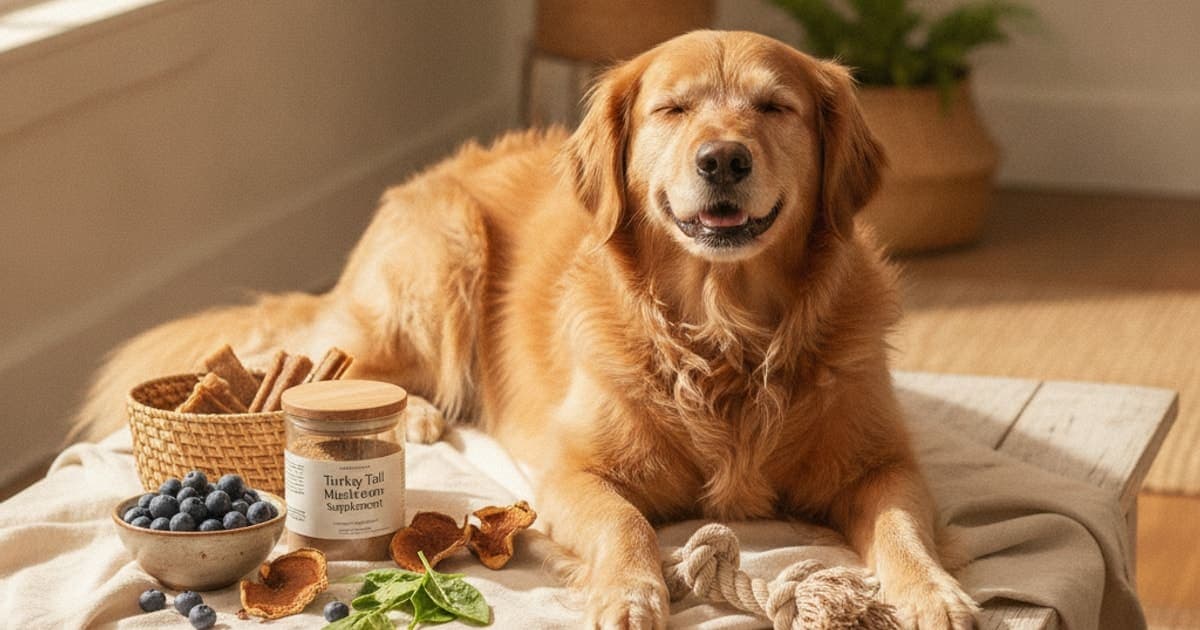
Sort through enough Reddit threads on turkey tail for dogs and you notice the consensus isn't a brand — it's a set of label criteria. The owners who have actually done the reading recommend a turkey tail (Trametes versicolor) product that is a fruiting-body extract, that states a beta-glucan figure rather than a vague "polysaccharide" number, and that publishes third-party lab results for potency and contaminants. Products failing those three tests get argued down no matter how good the packaging looks.
And if you landed here because your dog is limping, is booked for a CCL repair, or has quietly stopped taking the stairs, it's worth saying plainly: turkey tail is not aimed at that problem. Mushroom extracts sit in the immune and gut-support conversation. Joint, tendon and soft-tissue recovery is a different lane — the one K9-REPAIR, pawgen's BPC-157 + TB-500 formulation for dogs, was built for, and the stack many owners now run through a recovery period alongside the plan their veterinarian set.
What the Reddit threads actually agree on
There is no single "best" brand that wins these threads, and any post claiming one usually turns out to be a first-week account. What survives scrutiny is a checklist, repeated in thread after thread by owners who cross-reference human mushroom-supplement forums:
- Fruiting body over mycelium on grain. The fruiting body is the mushroom itself. Mycelium grown on rice or oats is harvested with the grain still attached, so a meaningful share of what's in the jar is starch rather than mushroom.
- A stated beta-glucan number. Beta-glucans are the compounds most of the turkey tail research centres on. A label that only says "polysaccharides" can be counting the grain's starch, because starch is a polysaccharide too.
- Third-party testing, published. Mushrooms are efficient accumulators of whatever is in their substrate. Owners want heavy-metal and potency testing from an independent lab, and they want to be able to read it.
- Skepticism toward kitchen-sink chews. A soft chew listing turkey tail, reishi, shiitake, glucosamine, MSM, colostrum and salmon oil on one panel is almost always carrying trace amounts of each. Reddit's instinct here is correct: a long ingredient list is a marketing decision, not a formulation decision.
- Distrust of dosing advice from strangers. The better threads end the same way — ask your veterinarian, especially if the dog is on medication, is a puppy, or is pregnant or nursing. That is the right answer, and it's the one this page gives too.
What Reddit is less good at is separating goals. "Best supplement for my dog" gets answered with whatever the responder happens to be using, for an entirely different dog with an entirely different problem.
What turkey tail is, and what the research describes
Turkey tail is one of the most widely studied medicinal mushrooms in the world. The compounds that get the attention are polysaccharopeptides — PSP and PSK — which are beta-glucan-rich fractions extracted from the mushroom. Research literature describes these compounds as interacting with receptors on immune cells and as being fermented in the lower gut, where beta-glucans act as a prebiotic fibre.
In dogs specifically, researchers at the University of Pennsylvania School of Veterinary Medicine published a small trial of a polysaccharopeptide preparation in dogs with a serious diagnosis; it appeared in Evidence-Based Complementary and Alternative Medicine in 2012. That paper is the reason turkey tail comes up in canine forums at all. It is a single small study, and nothing in it makes turkey tail a treatment for anything. If your dog has a diagnosis of that seriousness, the conversation belongs with your veterinarian or a veterinary oncologist — not a supplement aisle.
In structure-and-function terms, which is the only honest way to talk about it: research suggests turkey tail's beta-glucans may support normal immune function and gut microbial balance, and owners report using it as a general wellness addition. It is a supplement, not a drug, and it is not approved to treat, prevent or cure any condition.
Reading a mushroom label without getting fooled
Most of the difference between a good turkey tail product and a bad one is visible on the panel, if you know what you're reading.
| What the label says | What that usually means | What to check before buying |
|---|---|---|
| "Organic turkey tail fruiting body extract" | The mushroom itself, extracted — the form most of the research uses | A stated beta-glucan percentage and an extraction method (hot water, or dual) |
| "Mycelial biomass" / "myceliated grain" | Mycelium grown on rice or oats, harvested together with the substrate | Whether any beta-glucan figure is given at all; if not, assume starch is inflating the weight |
| "Polysaccharides: high %" | Could be beta-glucans, could be grain starch — the number doesn't distinguish | Beta-glucan specifically, not total polysaccharides |
| "Proprietary mushroom blend" | Multiple species sharing one undisclosed weight | Per-ingredient amounts; a blend that won't break out its own numbers is telling you something |
| Chew with 8+ actives | A little of everything, enough of nothing | Whether each active is present at an amount you can find research on |
| Third-party tested, COA available | Independent verification of identity, potency and contaminants | That the certificate is actually published, current, and matches the lot |
The last row is the one that separates brands worth your money from brands worth your attention. Any company can write "lab tested" on a carton. Publishing the certificate of analysis is a different commitment, and it's the standard pawgen holds its own formulation to.
When the real question is mobility, not immunity
A large share of owners who end up searching mushroom supplements are actually trying to solve something else. The dog blew a cruciate. The Lab is eight and getting up slowly. There's a surgery date on the calendar and a long crate-rest period after it. Turkey tail was never designed for that, and no amount of dose-stacking will make it a soft-tissue story.
That is why pawgen built a single-purpose product instead of a multi-mushroom chew. K9-REPAIR contains two peptides — BPC-157 and TB-500 — and nothing else pretending to be useful.
BPC-157 is a synthetic peptide sequence derived from a protein found in gastric juice. The published preclinical literature describes it in the context of tendon, ligament and gut tissue models, where research suggests it influences angiogenic signalling — the formation of new small blood vessels — and the migration of tendon fibroblasts. Blood supply matters enormously here, because tendon and ligament are poorly vascularised compared with muscle, which is a large part of why they remodel slowly.
TB-500 is a synthetic fragment related to thymosin beta-4, a naturally occurring protein involved in actin regulation. Research describes it as supporting cell migration and the organisation of the actin cytoskeleton — the machinery cells use to move into an area and lay down new matrix.
That's the mechanism, and it's genuinely promising science that a growing number of owners are adopting through recovery periods. What it is not is a promise about your dog. These are not FDA-approved veterinary drugs, K9-REPAIR is not a treatment for any condition, and it is emphatically not a substitute for surgery, for a prescribed anti-inflammatory, or for the rehab protocol your surgeon gave you. It's the support layer owners add to a plan their veterinarian already owns.
What pawgen can state plainly, because these are descriptive facts rather than outcome claims: K9-REPAIR is dosed by body weight, it is third-party tested with certificates of analysis published, it ships direct to your door, and it carries a 60-day money-back guarantee. Talk to your veterinarian before adding it, particularly if your dog is on medication, is very young, or is pregnant or nursing — and let your vet, not an internet protocol, be the one who tells you how much and how often.
Building a shelf that isn't a kitchen sink
The most useful thing Reddit teaches, across every supplement thread, is restraint. Three well-formulated products beat eleven half-dosed ones, and they're far easier to evaluate.
A workable approach: define the goal before you buy. If the goal is general wellness and gut support, a verified fruiting-body turkey tail extract with a published COA is a reasonable thing to discuss with your vet. If the goal is getting a dog through a tendon, ligament or joint recovery period, that's a different product category, and K9-REPAIR is where pawgen has put its work.
Then change one thing at a time. If you start four supplements the same week your dog comes off crate rest, you will never know what did what. Keep a short weekly note — stairs, first ten minutes after waking, willingness to jump into the car. Owners consistently report that those small observations tell them more than anything else, and they give your veterinarian something concrete to work with at the recheck.
No supplement — turkey tail, peptide or anything else — replaces a diagnosis, and the value of any of them depends entirely on knowing what you are actually managing.
Key takeaways
- Reddit's turkey tail consensus is a checklist, not a brand: fruiting body, a stated beta-glucan figure, and published third-party testing.
- "Polysaccharides" on a label can include grain starch; beta-glucans are the number that matters.
- Mycelium-on-grain products deliver less mushroom per scoop than the fruiting-body extracts the research generally uses.
- Turkey tail sits in the immune and gut-support conversation. It is not a joint, tendon or mobility product.
- For recovery and mobility, K9-REPAIR pairs BPC-157 and TB-500 — weight-based dosing, third-party tested, COAs published, 60-day money-back guarantee.
- BPC-157 and TB-500 are not FDA-approved veterinary drugs, and K9-REPAIR is not a substitute for surgery, prescription medication or rehab.
- Never stop or adjust something your veterinarian prescribed in order to try a supplement.
Where your veterinarian fits in
The diagnosis and the treatment plan belong to your vet. They are the one who images the joint, reads the gait, decides whether this is a partial cruciate tear or hip dysplasia or early neurological change, and sets the medication and rehab schedule around it. Supplements and peptides operate inside the space that proper veterinary care creates — they don't create it. Bring the label, bring the certificate of analysis, and bring your questions to the appointment.
You can read pawgen's published third-party lab results on the COAs page, see the full formulation and guarantee in the shop, and check where pawgen currently ships on the availability page.
Owners exploring peptide support for their dog can review K9-REPAIR — BPC-157 + TB-500 formulated for dogs — at https://pawgen.com/. BPC-157 and TB-500 are not FDA-approved veterinary drugs. Nothing in this article treats, cures or prevents any condition; every decision about your dog's care belongs with your veterinarian.
Frequently asked questions
- What turkey tail supplement do Reddit users recommend most for dogs?
- No single brand dominates. What recurs is a specification: a fruiting-body extract rather than mycelium grown on grain, a stated beta-glucan percentage instead of a generic 'polysaccharide' figure, and third-party lab results the company actually publishes. Judge products against that checklist rather than upvote counts.
- Is turkey tail safe for dogs?
- Turkey tail is widely used as a canine supplement and is generally regarded as well tolerated, though some dogs experience digestive upset. Safety depends on the individual dog, the product's purity, and any medications involved, so talk to your veterinarian before starting it.
- How much turkey tail should I give my dog?
- That is a question for your veterinarian, not a forum thread or a website. Appropriate amounts depend on your dog's weight, health status, medications and the concentration of the specific extract — and for puppies or pregnant and nursing dogs, only your vet should advise.
- What is the difference between fruiting body and mycelium turkey tail?
- The fruiting body is the mushroom itself. Mycelium products are typically grown on rice or oats and harvested with the grain attached, so a portion of the finished powder is starch. Most of the turkey tail research centres on fruiting-body extracts.
- Does turkey tail help dogs with joint pain or a torn CCL?
- It is not aimed at that. Turkey tail belongs to the immune and gut-support conversation. Joint, tendon and ligament recovery is a separate category — the one pawgen built K9-REPAIR for, using BPC-157 and TB-500, alongside whatever plan your veterinarian has set.
- What are BPC-157 and TB-500, and why do owners use them for dogs?
- BPC-157 is a peptide sequence derived from a gastric protein; TB-500 is a synthetic fragment related to thymosin beta-4. Research describes roles in angiogenic signalling and cell migration in soft tissue. Owners adopt them as recovery support. Neither is an FDA-approved veterinary drug.
- Can I give turkey tail and K9-REPAIR at the same time?
- Many owners run more than one supplement, but combinations should be cleared with your veterinarian, especially if your dog takes prescription medication. A practical tip: introduce one product at a time so you can actually tell what is doing what.
- How do I know a supplement is third-party tested?
- Look for a published certificate of analysis that names the independent lab, matches the lot number, and reports potency plus contaminant screening. 'Lab tested' printed on a carton with no document behind it is a marketing phrase, not verification.
- Should a supplement ever replace medication my vet prescribed?
- No. Never stop or reduce a prescribed medication such as an anti-inflammatory or pain drug in order to try a supplement. Your veterinarian owns the treatment plan; supplements and peptides work inside the space proper veterinary care creates.
Educational content. BPC-157 and TB-500 are not FDA-approved veterinary drugs. Talk to your veterinarian before starting anything new, especially if your dog is on prescribed medication.