BPC-157 for Dogs: Signs It Has Gone Bad
BPC-157 has likely gone bad if the powder cake has collapsed, shrunk, yellowed or clumped, if a reconstituted solution turns cloudy, gritty or discoloured, or if the vial seal, cap or cold chain has been compromised. Any of these means discard the unit rather than administer it.
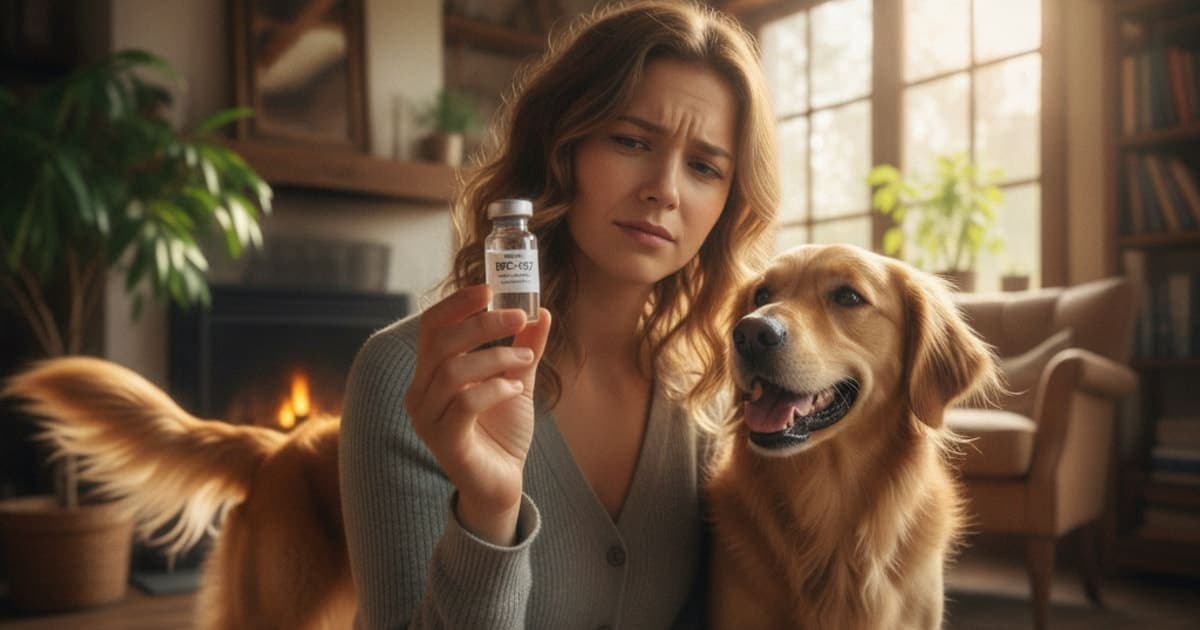
BPC-157 has likely gone bad when you can see it: a lyophilised powder cake that has shrunk, cracked or collapsed; powder that has turned yellow, grey or brown instead of white to off-white; a reconstituted solution that has gone cloudy or hazy or grown floaters, strands or a surface film; a vial whose stopper has lifted or whose crimp seal is loose; or any product that has spent time outside the storage range printed on its own label. Any one of those findings is a reason to stop and discard the unit rather than administer it. The harder truth is that some peptide degradation is chemically real but visually silent — which is why storage discipline and honest sourcing matter every bit as much as the pre-use eyeball check.
Why peptides are more fragile than the average supplement
A peptide is a short chain of amino acids joined by peptide bonds. That structure is what makes signalling molecules like BPC-157 and TB-500 interesting, and it is also what makes them delicate compared with a shelf-stable small-molecule tablet or a fish oil capsule.
Four things go wrong at the molecular level:
Hydrolysis. Water attacks the peptide bond and clips the chain into shorter fragments. This is precisely why peptides are freeze-dried — removing water removes the reaction. The moment a vial is reconstituted, the clock starts.
Oxidation. Certain amino acid residues react with oxygen, especially when warmed or exposed to light. Oxidation is a common cause of yellowing in a powder that should be white.
Aggregation. Damaged or destabilised peptide molecules clump together into larger particles. Aggregates scatter light, which is exactly what you are seeing when a solution that should be water-clear looks hazy, milky or full of drifting specks.
Microbial contamination. Not degradation in the chemical sense, but the same practical outcome. A compromised seal, a touched stopper or a non-sterile handling step can introduce bacteria or fungi into a liquid that has no meaningful defence against them.
None of these processes reverse. A peptide that has been heat-stressed does not recover when it goes back in the fridge, and a cloudy solution does not become usable if it clears on standing. Damage is cumulative and permanent.
The checks to run before every single use
Inspect in good light, against both a white and a dark background, and turn the vial slowly rather than shaking it. Compare what you see now with how it looked the day you opened it.
| What you observe | What it suggests | Action |
|---|---|---|
| Powder cake shrunken, cracked or collapsed | Moisture ingress or a temperature excursion | Discard |
| Powder yellow, brown or grey rather than white/off-white | Oxidation or heat exposure | Discard |
| Powder sticky, gummy or clumped into a wet mass | Seal failure letting humidity in | Discard |
| Reconstituted solution cloudy, hazy or milky | Aggregation or microbial growth | Discard |
| Floaters, strands, flecks, crystals or sediment | Particulate contamination or precipitation | Discard |
| Colour shift or a film on the liquid surface | Chemical breakdown | Discard |
| Stopper lifted, cap dented, crimp loose, vial cracked | Sterility lost | Discard |
| Sour, sulfurous or otherwise off odour | Contamination | Discard |
| Known time outside the labelled storage range | Unknown cumulative degradation | Discard |
| Past the manufacturer's expiry date | Potency and sterility no longer supportable | Discard |
For oral formats — capsules, powders and liquid delivery systems — the tells are different but the logic is identical: hardened caking, condensation beading inside the container, capsules that have softened or fused together, a rancid or unfamiliar smell, or a desiccant packet that has visibly saturated.
If anything about the vial, the powder or the solution looks different from the day you opened it, do not administer it — discard the unit and start fresh. The cost of a replacement is trivial next to the risk of giving your dog something contaminated.
What actually breaks a peptide down fastest
Heat. Temperature is the single biggest accelerant of both hydrolysis and oxidation. Warmth speeds up the chemistry, so a vial that spends an afternoon on a sunny counter or a delivery that sits in a hot vehicle has absorbed damage you cannot see. This is why cold-chain shipping and prompt collection of a parcel matter — inspect the packaging and any cooling material the moment it arrives, and follow the storage range on the label rather than a general rule you read somewhere.
Light. Ultraviolet and even strong visible light can degrade sensitive amino acid residues over time. The carton is not packaging waste; it is a light barrier. Keep the vial in it.
Moisture. Freeze-dried product is hygroscopic — it pulls water out of the air. A stopper that has been punctured too many times, or a container left open on a humid counter, invites the exact reaction the manufacturer worked to prevent. This is also why a collapsed or gummy cake is such a reliable red flag.
Mechanical stress and contamination. Vigorous shaking creates shear forces and foaming at the air-liquid interface, both of which promote unfolding and aggregation. Repeated needle entries through a stopper shed rubber particles and increase contamination risk with every pass. Freeze-thaw cycling — a vial that partially freezes at the back of a cold fridge, then thaws — is another well-recognised stressor for peptide solutions.
Handling and administration habits that protect the product
Storage is the part of administration owners most often improvise, and it is the part with the clearest rules.
- Read the storage instructions that came with your specific product and follow them exactly. Different formulations have genuinely different requirements.
- Store on a shelf toward the back of the refrigerator if refrigeration is specified — never in the door, where the temperature swings every time it opens.
- Do not freeze anything unless the label explicitly directs it, and never refreeze a thawed vial.
- Keep the product in its original carton, in its original container. Do not decant into a pill organiser or an unlabelled bottle.
- Write the opening or reconstitution date on the vial or carton, and respect the in-use window the manufacturer states.
- Swirl gently; never shake.
- Minimise time at room temperature. Take it out, use it, put it back.
- Buy quantities you will realistically use inside the labelled window rather than stockpiling.
- Keep everything well away from heat sources, windowsills and children.
Weight-based dosing, timing around surgery or rehab, and how a peptide formulation fits alongside anything already prescribed are all conversations to have with your veterinarian — they are the person who knows your dog's diagnosis, bloodwork and medication list. Do not start, stop or change a prescribed drug on your own.
If you suspect a unit has already degraded
Stop using it. Do not "use it up" to avoid waste — a degraded peptide is at best inert and at worst contaminated, and neither is worth the gamble. Dispose of vials, needles and syringes according to local sharps and pharmaceutical waste rules rather than in household rubbish.
Then record what you can: the lot or batch number, the expiry date, the date you opened or reconstituted it, and an honest account of the storage history, including any known temperature excursion in transit. Contact the supplier with that information. A serious manufacturer will want the lot number, because lot traceability is the whole point of having one.
If your dog has already received a dose from a unit you now doubt, call your veterinarian and describe exactly what you gave and when. Watch for vomiting, diarrhoea, unusual lethargy, fever, or swelling, heat or pain at an administration site, and seek care promptly if any of those appear.
Sourcing and testing take most of the guesswork out
Visual inspection is a floor, not a ceiling. What raises the ceiling is buying from a source that documents what is actually in the container before it ever reaches you.
That means third-party laboratory testing with certificates of analysis covering identity and purity, lot numbers you can match to those certificates, packaging designed for the molecule rather than for the shelf, and plain storage instructions on the label. The opposite of that is the kitchen-sink joint chew with a proprietary blend, no lot number, no COA, and a label that tells you which ingredients are present but never how much — where the marketing budget clearly outran the analytical budget.
pawgen formulates K9-REPAIR as a BPC-157 and TB-500 combination for dogs, shipped direct to the door with third-party testing behind it and a 60-day money-back guarantee. Research suggests BPC-157 may support angiogenesis and fibroblast activity in connective tissue, while TB-500, a synthetic analogue related to thymosin beta-4, is studied for its role in actin regulation and cell migration — the mechanisms behind why this has become the stack many owners adopt through a recovery period. Owners report using it alongside, never instead of, the plan their vet set. BPC-157 and TB-500 are not FDA-approved veterinary drugs, and this is educational information rather than a promise about any individual dog.
Key Takeaways
- Visible red flags include a collapsed, discoloured or gummy powder cake; a cloudy, hazy or particle-filled solution; colour or odour changes; and any compromised seal, stopper or cap.
- Heat, light, moisture, mechanical stress and contamination cause the damage, and none of it reverses once done.
- Some degradation is invisible, so storage discipline and expiry dates matter as much as the visual check.
- Store per the label, keep the carton, swirl rather than shake, date the vial, and never refreeze.
- If in doubt, discard it, keep the lot number, and contact the supplier.
- Third-party testing, COAs and lot traceability are what separate a documented product from a hopeful one.
For more on administration by body size, pawgen covers the tb-500 dose for small dogs and the tb-500 dose for large dogs, and K9-REPAIR sits at the centre of both discussions.
Your veterinarian owns the diagnosis and the treatment plan — the imaging, the surgical decision, the prescriptions, the rehab schedule. Supplements and peptides operate in the space that proper veterinary care creates, and they only operate at all if what is in the vial is still intact. Bring your storage questions, your product label and your dog's full medication list to your next appointment, and make the decisions together.
Owners exploring peptide support for their dog can review K9-REPAIR — BPC-157 + TB-500 formulated for dogs — at https://pawgen.com/. BPC-157 and TB-500 are not FDA-approved veterinary drugs. Nothing in this article treats, cures or prevents any condition; every decision about your dog's care belongs with your veterinarian.
Frequently asked questions
- Is a dog sensitive lower back an emergency?
- Sometimes, yes. Sudden yelping when touched, a hunched or arched back, wobbly or dragging hind legs, or loss of bladder control can point to spinal cord compression and warrants same-day emergency care. Milder, intermittent stiffness is less urgent but still deserves a prompt veterinary exam, because back pain has many causes.
- Why is my dog not wanting to play?
- Most often it is pain. Orthopaedic problems, dental disease, a soft-tissue strain or early arthritis all make movement unappealing before an owner ever sees a limp. Illness, fever, nausea, medication side effects, heat, anxiety and normal ageing can also flatten a dog's drive to play. A veterinary exam sorts these apart.
- Should I worry if my dog is not wanting to play?
- It is worth attention, not panic. A single quiet day after a long walk or in hot weather is usually unremarkable. A pattern lasting several days, or one paired with stiffness after rest, reluctance on stairs, appetite changes or hiding, is a meaningful signal and should be raised with your veterinarian.
- When should I take a dog to the vet for not wanting to play?
- Book an appointment if the change lasts more than a day or two, or at any point it comes with limping, yelping, appetite loss, vomiting, laboured breathing, fever or trembling. Go immediately, rather than waiting, if your dog collapses, cannot stand, has pale gums or a distended, painful abdomen.
- What can I give a dog that is not wanting to play?
- Nothing from the human medicine cabinet — human painkillers can be dangerous for dogs. Start with a diagnosis, then follow whatever your veterinarian prescribes. Alongside that plan, many owners add a peptide formulation such as K9-REPAIR; research suggests BPC-157 and TB-500 may support the body's own tissue-repair signalling. These are not FDA-approved veterinary drugs.
- Is a dog not wanting to play an emergency?
- On its own, usually not. Reluctance to play is a symptom that develops over days and normally warrants a scheduled exam. It becomes an emergency when it appears alongside collapse, laboured breathing, pale or blue gums, repeated unproductive retching, a swollen abdomen, seizure activity or an inability to rise.
Educational content. BPC-157 and TB-500 are not FDA-approved veterinary drugs. Talk to your veterinarian before starting anything new, especially if your dog is on prescribed medication.