BPC-157 Storage After Mixing for Dogs — What to Know
Reconstituted BPC-157 for dogs should be kept refrigerated in its original sealed vial, protected from light, and handled gently rather than shaken. How long a mixed vial stays usable depends on the diluent and the manufacturer's stability data, so follow the label that shipped with your product and confirm handling with your veterinarian.
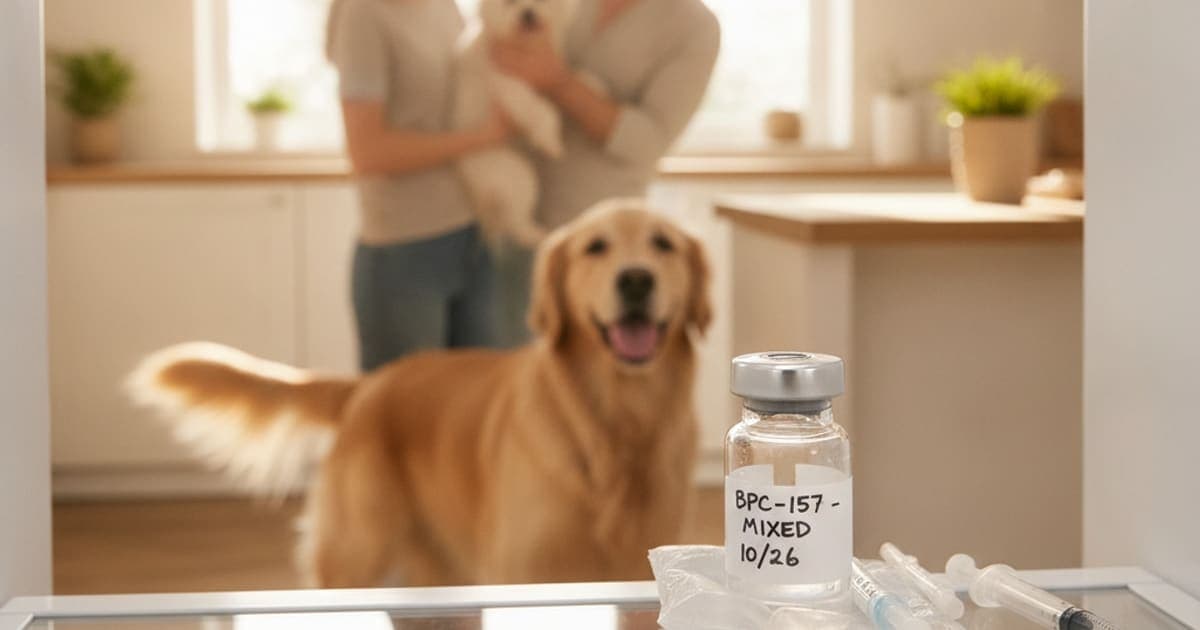
Once BPC-157 has been mixed, it needs to be kept cold, dark and still. In practice that means the original sealed vial goes into the body of the refrigerator — not the door shelf, not the freezer — at ordinary household fridge temperature, roughly 36–46°F (2–8°C), away from light, and it gets swirled rather than shaken when handled. How long that mixed vial stays usable is not something a blog post can tell you: it depends on the diluent used, the concentration, and the stability data the manufacturer generated for that specific formulation. The beyond-use date on the label that shipped with your product always outranks a general rule you found online. And the decision to reconstitute at all — along with route and amount — belongs to your veterinarian, not to the internet.
Why a mixed peptide is more delicate than a dry one
BPC-157 is a peptide: a short chain of amino acids. In freeze-dried (lyophilised) form it is impressively durable, because the main driver of peptide breakdown is water. Take the water out and the molecule sits in something close to suspended animation, which is why dry vials ship well and tolerate storage far better than most owners expect.
Add a diluent and the chemistry wakes up. In solution, several ordinary processes become possible at once: hydrolysis, where water cleaves bonds along the chain; oxidation of sensitive residues; aggregation, where molecules clump together and drop out of usable form; and adsorption, where a small fraction of peptide simply sticks to the inside of the container. None of these are dramatic. None of them cloud the liquid or change the smell.
Solution also means microbes have somewhere to live. A dry powder is a hostile environment for bacteria. A neutral aqueous solution at room temperature is not.
A mixed vial that has lost potency looks exactly like a fresh one, which is why your storage habit — not your eyes — is what protects what you paid for.
Cold, dark and still: the three variables that matter
Almost everything useful about handling a reconstituted peptide reduces to three levers. Temperature controls the speed of chemical degradation and microbial growth. Light drives photo-oxidation. Mechanical stress — shaking, dropping, vigorous agitation — creates air–liquid interfaces where peptides can denature and aggregate.
| Condition | Why it matters | Practical handling |
|---|---|---|
| Refrigerated, main shelf | Slows chemical breakdown and microbial growth; temperature stays steady | Default storage for a mixed vial unless the label says otherwise |
| Refrigerator door shelf | Swings in temperature every time the door opens | Avoid — it looks convenient and behaves like a warm cupboard |
| Room temperature | Fastest degradation; microbial risk climbs if the diluent has no preservative | Brief handling only; return to the fridge promptly |
| Freezer, after mixing | Ice crystal formation and freeze–thaw cycles stress peptides in solution | Generally discouraged for reconstituted product unless the manufacturer specifies it |
| Direct light or windowsill | Photo-oxidation, plus heat gain | Keep in the carton or an opaque container |
| Shaken or dropped | Foaming and interface stress can promote aggregation | Swirl gently; never shake to dissolve |
If the product you have was supplied as a ready-to-use formulation rather than a powder, none of the mixing questions apply — you simply follow the storage line on that label. Ask your veterinarian to confirm which category your product falls into before you improvise.
The diluent changes the rules more than owners expect
The liquid used to reconstitute a peptide is not a neutral detail. Bacteriostatic water contains a preservative (benzyl alcohol) that suppresses microbial growth, which is what makes multi-dose use of a vial plausible at all. Plain sterile water contains no preservative: it is sterile at the moment it is opened and offers nothing afterwards to inhibit anything that gets introduced by a needle, a fingertip or airborne contact.
That single difference is why two people can follow identical refrigeration advice and end up with very different practical windows for the same vial. It also explains why manufacturers specify a diluent rather than leaving it open — the stability and beyond-use information on a label is only valid for the diluent it was generated with.
Saline, tap water, distilled water from a hardware store and anything drawn from a previously opened container are not substitutes. If you are unsure what your product was designed for, that is a question for your veterinarian or the manufacturer, and it is worth asking before you open anything.
How long a mixed vial stays usable
Here is the honest answer: there is no universal number, and you should be suspicious of any source that offers one confidently. Reconstituted peptide stability depends on concentration, pH, the presence of a preservative, the container, the closure system, how often the vial is entered, and the specific stability testing the manufacturer performed. A figure that is accurate for one formulation can be wrong for another.
What you can do is build a system that removes guesswork:
- Write the date of mixing on the vial in permanent marker, the moment you mix it. Memory is not a storage method.
- Keep the vial in its original carton so the label, lot and any beyond-use instruction stay attached to the product.
- Note how many times the vial has been entered, if the label limits that.
- Treat the manufacturer's stated window as a ceiling, not a target, and discard on schedule rather than stretching it.
- Store it well away from food, and out of reach of children and other pets.
If a label is missing, illegible, or the product arrived with no storage guidance at all, that tells you something about the supplier. A company doing proper analytical work has this information and prints it.
What if something has already gone wrong?
The vial sat out overnight
Do not guess. Time at room temperature accelerates degradation, and if the diluent had no preservative, sterility is the bigger concern. Contact the manufacturer with your lot number and speak to your veterinarian before using it. Discarding a vial is a small cost compared with giving your dog something you are unsure about.
It froze by accident
Freezing a reconstituted peptide is generally discouraged because ice formation and thawing cycles physically stress molecules in solution, and repeated cycles compound the effect. A vial that froze in a too-cold fridge or during winter shipping should be discussed with the supplier rather than thawed and used on assumption.
You have lost track of the mix date
An undated vial is an unknown vial. There is no visual test that tells you whether a clear peptide solution is intact. The safe move is to retire it and restart with a fresh vial and a date written on the side.
You need to travel with it
Plan for an insulated cooler with a cold pack that is not in direct contact with the vial, and keep it out of the car cabin and the trunk on warm days — a parked car reaches temperatures no peptide tolerates. For longer trips, ask the manufacturer what they recommend for transit before you go.
Storage, dosing and the conversation to have with your vet
Storage and BPC-157 dosing are two halves of the same question, because a correctly measured amount from a poorly stored vial is not a correctly delivered amount. Dosing itself, though, is genuinely not a do-it-yourself exercise. It is weight-based, it depends on what is actually going on in your dog's body, and it belongs in a conversation with your veterinarian — particularly for puppies, for pregnant or nursing dogs, for small breeds, and for any dog on prescribed medication such as carprofen, gabapentin or a prescribed injectable. Nothing here is a reason to change, pause or replace anything your vet has prescribed, and no supplement is an alternative to surgery or rehabilitation when those are indicated.
BPC-157 and TB-500 are not FDA-approved veterinary drugs. What draws owners to them is mechanism: research suggests BPC-157 interacts with pathways involved in angiogenesis and connective-tissue signalling, and TB-500, a fragment related to thymosin beta-4, has been studied for its role in actin regulation and cell migration. That is emerging science, it is promising, and it is being adopted steadily by owners working through recovery periods with their vets — but it stays at the level of mechanism and research, never at the level of a promise about your specific dog.
What to look for in whoever supplies it
This is where healthy skepticism belongs. The canine supplement aisle is full of kitchen-sink chews with a dozen headline ingredients at doses too small to matter, proprietary blends that hide per-ingredient amounts, and labels engineered to read impressively. Ask for what should be easy to provide:
- A certificate of analysis from an independent third-party lab, tied to the lot you received
- Clear identity and purity testing, not just a marketing claim of purity
- Explicit storage and handling instructions on the label
- Dosing guidance scaled to body weight rather than one number for every dog
- A real returns position — pawgen backs K9-REPAIR with a 60-day money-back guarantee
pawgen's K9-REPAIR is a BPC-157 + TB-500 formulation made for dogs, third-party tested with COAs and shipped direct to your door. Follow the storage and handling instructions supplied with your specific product, and bring them to your veterinary appointment so your vet can see exactly what your dog is receiving.
Key Takeaways
- Mixed BPC-157 belongs in the main body of the refrigerator, in its original sealed vial, out of light, swirled and never shaken.
- Degradation is invisible — discipline and dating the vial protect potency, not visual inspection.
- The diluent determines the practical window; preservative-free water offers no protection against contamination.
- No universal expiry exists for reconstituted peptide. The manufacturer's label and stability data govern.
- Freezing after mixing, door-shelf storage, hot cars and undated vials are the four most common ways owners lose product quality.
- Dosing is weight-based and belongs with your veterinarian, always, and never replaces prescribed medication, surgery or rehab.
If you are still deciding how the product will be given, it is worth reading bpc-157 oral vs injection for dogs alongside bpc-157 timing with meals for dogs, and the formulation details for K9-REPAIR sit on the main pawgen site.
One last framing, because it matters more than any storage tip: your veterinarian owns the diagnosis and the treatment plan. Imaging, pain management, surgical decisions and rehabilitation milestones are theirs to set, and they are what create the window in which recovery happens. Supplements and peptides operate inside that window — supporting the plan your vet builds, never standing in for it.
Owners exploring peptide support for their dog can review K9-REPAIR — BPC-157 + TB-500 formulated for dogs — at https://pawgen.com/. BPC-157 and TB-500 are not FDA-approved veterinary drugs. Nothing in this article treats, cures or prevents any condition; every decision about your dog's care belongs with your veterinarian.
Frequently asked questions
- Why is my dog licking a joint?
- Dogs lick a joint mainly because it hurts, itches or feels abnormal. Licking is a self-soothing response to inflammation, arthritis, a soft-tissue strain, an insect bite or a skin problem over the joint. Occasional grooming is normal; repeated, focused licking on one joint is worth a veterinary examination.
- Should I worry if my dog is licking a joint?
- Attention is more useful than worry. Brief licking is unremarkable. Licking that repeats daily, targets the same joint, wets or stains the fur, or arrives alongside stiffness, limping or reluctance on stairs suggests underlying discomfort — and a veterinary exam is the appropriate next step before any supplement.
- When should I take a dog to the vet for licking a joint?
- Book a visit if licking persists beyond a few days, concentrates on one joint, or appears with limping, swelling, heat, hair loss, broken skin, fever or a change in behaviour. Sudden inability to bear weight on a limb warrants same-day care rather than watchful waiting.
- What can I give a dog that is licking a joint?
- Nothing from your own medicine cabinet — several human anti-inflammatories are dangerous for dogs. Ask your veterinarian first; they may prescribe pain control and rehabilitation. Alongside a vet's plan, owners commonly use formulations such as K9-REPAIR, which is not an FDA-approved drug and not a substitute for treatment.
- Is a dog licking a joint an emergency?
- Usually not on its own. It becomes urgent when paired with a suddenly non-weight-bearing limb, a hot swollen joint, an open or bleeding wound, obvious pain on touch, fever or collapse. In those situations contact an emergency veterinary service the same day instead of waiting.
- Why is my dog licking a paw constantly?
- Constant paw licking usually points to allergies, contact irritants, a foreign body lodged between the toes, a nail or pad injury, a yeast or bacterial infection, or referred discomfort from a joint higher up the limb. Anxiety can maintain the habit. A veterinary skin and orthopaedic check identifies which.
- Does mixed BPC-157 need to be refrigerated?
- Yes, refrigeration is the standard expectation for a reconstituted peptide unless the label states otherwise. Cold slows chemical degradation and microbial growth. Use the main body of the fridge rather than the door shelf, where temperature swings every time the door opens, and keep the vial in its carton.
- Can you freeze BPC-157 after mixing?
- Freezing reconstituted peptide is generally discouraged, because ice crystal formation and repeated freeze-thaw cycles physically stress molecules in solution. Dry, unmixed powder is a different situation and manufacturers often specify colder storage for it. Follow the label supplied with your product and ask the manufacturer if it is unclear.
- How long does mixed BPC-157 last for dogs?
- There is no single universal answer, and confident numbers online should be treated cautiously. Usable life depends on concentration, the diluent, whether a preservative is present, the container and how often the vial is entered. Follow the beyond-use instruction on your product label and confirm handling with your veterinarian.
- How can you tell if mixed BPC-157 has gone bad?
- You largely cannot, which is the point. Degraded peptide solution usually looks identical to fresh solution. Visible cloudiness, particles or discolouration are reasons to discard immediately, but their absence proves nothing. Date the vial at mixing, store it correctly and retire it on schedule rather than judging by appearance.
Educational content. BPC-157 and TB-500 are not FDA-approved veterinary drugs. Talk to your veterinarian before starting anything new, especially if your dog is on prescribed medication.