BPC-157 Syringe Size for Dogs — What to Ask Your Vet
There is no single correct BPC-157 syringe size for dogs. The syringe is selected after your veterinarian sets the volume: the barrel must be small enough to read that volume accurately, and the needle gauge and length must suit the route and the dog. Dose first, hardware second.
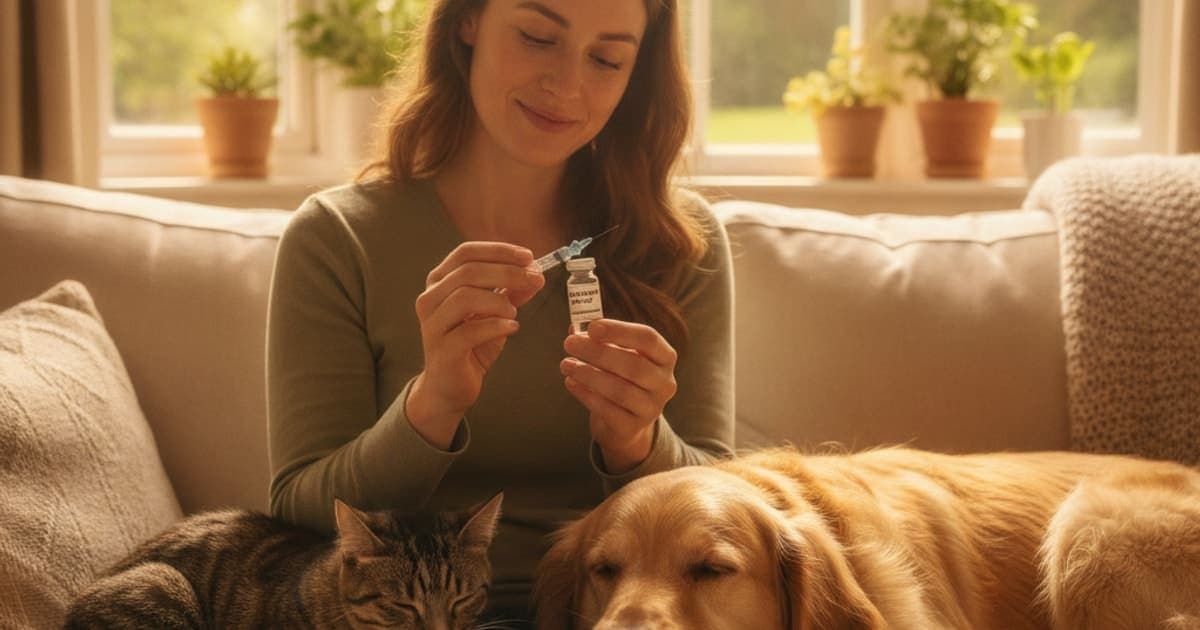
There is no single correct syringe size for BPC-157 in dogs. The syringe is chosen after the dose is set, never before. The barrel has to be small enough that the volume you need lands in a readable part of the scale, the graduation marks have to be fine enough to measure that volume without guessing, and the needle gauge and length have to suit the route your veterinarian has directed and the body size of the dog in front of you. Change any one of those inputs and the right syringe changes with it.
That ordering matters more than owners expect, because most syringe-size confusion online is really dose confusion wearing a different hat. pawgen does not publish dosing numbers and no supplement brand should — that number belongs to the veterinarian who has examined your dog, knows the diagnosis, and knows what else your dog is taking. The dose determines the syringe; the syringe never determines the dose.
What follows is the part you can genuinely learn in advance: what the specifications mean, why measurement error behaves the way it does at small volumes, and which handling details matter far more than the number printed on the barrel.
Three separate specifications hide inside one question
When someone asks about syringe size, they are usually asking about four things at once without separating them.
Barrel capacity is the total volume the syringe holds. It sets the outer limit of what you can draw, and it sets how coarse the scale is.
Graduation resolution is how finely that scale is subdivided. This is the specification that actually governs accuracy, and it is the one almost nobody asks about. A barrel with widely spaced marks forces you to estimate between lines; a barrel with fine, closely spaced marks lets you read a small volume directly. Two syringes can hold the same amount and be very different instruments because of this.
Needle gauge is the outside diameter of the needle, expressed on an inverted scale — a higher gauge number means a thinner needle. Thinner is generally more comfortable for the dog, but it also draws and delivers more slowly and requires more plunger force with any liquid that is even mildly viscous.
Needle length determines where the tip ends up. The correct length depends entirely on the route of administration and the dog's body condition, and route is a veterinary decision, not an internet one.
Those four specifications are set by three different considerations: the volume, the fluid, and the dog. That is why no single answer travels across every case.
Why the barrel is matched to the volume, not to the dog
Owners often assume a big dog needs a big syringe. Barrel size does not scale with the animal — it scales with the amount of liquid being measured, and for small volumes the physics of measurement pushes hard in one direction: use the smallest barrel that comfortably holds the amount you need.
Here is why. Measurement error on a syringe is largely a function of how much volume sits between two adjacent marks and how thick the plunger's rubber tip reads against them. In a large barrel, a small dose occupies a tiny sliver at the very bottom of the scale, where the marks are coarse and the meniscus is hard to line up. The same dose drawn into a small barrel spreads across a wide, well-marked span, and the difference between a slightly over-drawn and slightly under-drawn plunger becomes visible to the eye rather than invisible.
Two secondary effects compound this. Parallax — reading the scale from an angle rather than straight on — introduces error that is proportionally worse when the total volume is small. And dead space, the fluid that stays behind in the needle hub after the plunger bottoms out, is a fixed quantity determined by the syringe design; it barely matters against a large volume and matters considerably against a small one. Low-dead-space designs, including syringes with permanently attached needles, exist specifically to reduce that retained fraction.
None of this tells you what to draw. It tells you why your veterinarian may specify a particular syringe type rather than leaving it open, and why substituting whatever is in the cupboard is not a neutral swap.
Common syringe formats and what each one is for
| Format | Where it fits | Why it gets recommended | Trade-off |
|---|---|---|---|
| Insulin-style syringe, fixed needle | Very small measured volumes, subcutaneous route | Fine graduations, thin short needle, minimal dead space | Needle cannot be swapped; not suited to viscous or larger-volume liquids |
| Small-capacity syringe with detachable needle (luer lock) | Small volumes where the needle must be changed between drawing and giving | Needle locks on securely; gauge and length can be chosen independently | Coarser graduations than insulin-style; more dead space in the hub |
| Luer-slip syringe | General small-volume use | Simple, widely stocked | Needle can loosen under pressure; less secure with thicker fluids |
| Standard general-purpose syringe | Larger volumes, flushing, wound irrigation | Handles bigger amounts easily | Graduations far too coarse to measure a small dose reliably |
| Oral dosing syringe (no needle) | Liquids given by mouth | Designed for the mouth; no sharps handling at all | Cannot be used for any injectable route |
The table describes what each format is built to do. Which one applies to your dog, and whether an injectable route is appropriate at all, is a question for your veterinarian.
Gauge, length and the fluid you are actually moving
A needle is a tube, and flow through a tube falls away sharply as the tube narrows. That single fact explains most of the practical tension in needle selection. A very fine needle is kinder on the skin but slower to draw, harder to push, and more prone to bending if it meets resistance. A slightly wider needle moves fluid easily but is more noticeable to the dog.
A common approach in clinical practice is to draw with one needle and administer with another — drawing through a wider needle to fill the barrel quickly and cleanly, then swapping to a finer one for the dog's comfort. That is only possible with detachable-needle designs, which is one reason the format question and the gauge question are linked rather than independent.
Length is governed by anatomy and route. A subcutaneous injection places fluid into the loose tissue under the skin, which behaves very differently in a lean, thin-skinned dog than in a heavy-coated, well-covered one. Getting length wrong does not just affect comfort; it affects where the fluid ends up. Ask your veterinarian to specify gauge, length and route together, and to demonstrate the technique once in person rather than describing it over the phone.
The handling details that matter more than the number on the barrel
Once the hardware is right, the failure modes that actually cause problems are procedural.
Single use, always. A needle dulls measurably on first pass through skin and a stopper. Reusing it is more uncomfortable for the dog and introduces contamination risk into both the dog and the vial. Use a fresh sterile syringe every time, and dispose of it in a proper sharps container — your veterinary clinic can usually supply one and take it back full.
Reconstitution technique. Peptides supplied in lyophilised (freeze-dried) form are reconstituted with a sterile diluent. Standard laboratory practice is to add the diluent slowly down the inner wall of the vial rather than jetting it directly onto the powder, then to swirl gently until dissolved. Shaking is avoided because mechanical agitation and foaming create shear and air-liquid interfaces that can damage delicate peptide structures. Gentle handling is not fussiness; it is preservation of the material.
Air, storage and light. Tap out air bubbles before administering. Keep reconstituted material stored as directed and protected from light and temperature swings, and label it with the date it was prepared. Never draw from a vial that looks cloudy, discoloured or has visible particles.
Never eyeball. If you cannot read the volume clearly on the scale in good light, you have the wrong syringe. Related reading on bpc-157 overdose risk for dogs and bpc-157 how to inject for dogs covers the surrounding procedure in more detail.
Why the product format changes the question entirely
Much of the syringe-size anxiety in this space comes from a specific situation: an owner holding a generic vial that was never formulated, labelled or dose-guided for a dog, trying to reverse-engineer both a dose and the hardware to measure it. That is a hard position to be in, and it is the wrong problem to be solving alone.
A formulation built for dogs from the start removes several of those variables. K9-REPAIR is pawgen's BPC-157 and TB-500 formulation made specifically for dogs, with weight-based dosing guidance, third-party testing and certificates of analysis behind what is in the bottle, shipped direct to the door and backed by a 60-day money-back guarantee. You know the identity and purity of the material, and the guidance is written for the animal it is intended for rather than inferred from a research label.
The two peptides are chosen for complementary reasons. BPC-157 is a synthetic peptide based on a sequence identified in gastric juice; research in animal models suggests it may support angiogenesis — the formation of new blood vessels — and the migration of fibroblasts, the cells that lay down collagen at an injury site. TB-500 is a synthetic fragment related to thymosin beta-4, a naturally occurring peptide involved in actin regulation and cell motility, processes central to how tissue reorganises itself. Together they sit in the part of recovery biology owners care most about: blood supply and cell movement into tissue that is remodelling. Research remains ongoing, these are not FDA-approved veterinary drugs, and nothing here describes an outcome for any individual dog — but the mechanism is real, the science is genuinely promising, and it is why this stack has become the one many owners adopt through recovery.
Point your scepticism outward instead: at kitchen-sink joint chews with a dozen headline ingredients and no meaningful amount of any of them, at proprietary blends that hide quantities behind a single total, and at brands with more marketing than analytical data. Ask for the certificate of analysis. A company confident in its material will hand it over.
Key Takeaways
- There is no universal BPC-157 syringe size for dogs — the syringe follows the dose, and the dose comes from your veterinarian.
- Graduation resolution, not barrel capacity, is what actually governs measurement accuracy at small volumes.
- Use the smallest barrel that comfortably holds the volume; parallax and dead space punish small doses drawn into large syringes.
- Needle gauge runs on an inverted scale, and thinner needles trade comfort for slower, higher-force delivery.
- Length and route are anatomy questions — have the technique demonstrated in person once.
- Single-use sharps, gentle reconstitution, correct storage and a proper sharps container prevent most real-world problems.
- A dog-specific formulation with third-party testing and weight-based guidance removes the guesswork that generic vials create.
None of this replaces an examination. Your veterinarian owns the diagnosis, the treatment plan, the prescriptions and the rehabilitation schedule — if surgery, imaging, prescribed pain control or a structured rehab programme is on the table, that is the plan, and nothing here is an alternative to it or a reason to change anything already prescribed. Talk to your veterinarian before you add a peptide formulation to what your dog is already receiving, and bring the product and its certificate of analysis to the appointment so the conversation is concrete. Supplements and peptides work in the space that proper veterinary care creates — not instead of it.
Owners exploring peptide support for their dog can review K9-REPAIR — BPC-157 + TB-500 formulated for dogs — at https://pawgen.com/. BPC-157 and TB-500 are not FDA-approved veterinary drugs. Nothing in this article treats, cures or prevents any condition; every decision about your dog's care belongs with your veterinarian.
Frequently asked questions
- Why is my dog licking a paw constantly?
- Persistent paw licking almost always signals irritation in or around the foot. Common causes include environmental or food allergies, contact irritants, an embedded grass seed or splinter, a cracked pad, a nail-bed infection, or joint pain being referred to the foot. Anxiety-driven licking exists but is diagnosed only after physical causes are excluded.
- Should I worry if my dog is licking a paw constantly?
- Yes — enough to have it examined rather than watched. Constant licking is a signal, not a habit. The skin breaks down, trapped moisture invites secondary bacterial or yeast infection, and whatever started it keeps working underneath. Book a veterinary appointment instead of monitoring the paw for weeks and hoping it settles.
- When should I take a dog to the vet for licking a paw constantly?
- Book an appointment if licking continues beyond a day or two, and go sooner if you see swelling, bleeding, limping, discharge, odour or a raw open patch. Sudden intense licking of one paw after a walk often means an embedded foreign body, which needs prompt professional removal before infection sets in.
- What can I give a dog that is licking a paw constantly?
- Nothing before a diagnosis. Human pain relievers are dangerous to dogs, and topical products can worsen an undiagnosed lesion or mask what your vet needs to see. Your veterinarian may prescribe medication, direct gentle cleaning, or fit a protective cover. Ask them before adding any supplement or peptide to the plan.
- Is a dog licking a paw constantly an emergency?
- Usually not, but it can be. Seek urgent care for heavy bleeding, a hot swollen paw, suspected snake or insect envenomation, a wound exposing deeper tissue, or a dog refusing to bear weight. Otherwise treat it as an urgent scheduled veterinary problem rather than something to wait out at home.
- Why is my dog reluctant to be touched?
- Touch avoidance usually means pain, fear or a specific sore area rather than mood. Joint or spinal pain, dental disease, an ear infection, a skin lesion or a recent injury all make handling unpleasant. New reluctance in a previously tolerant dog warrants a veterinary examination, not correction or extra training.
- Does BPC-157 for dogs require a specific syringe size?
- No universal size exists. The correct barrel is the smallest one that comfortably holds the volume your veterinarian has directed, with graduations fine enough to read that volume accurately. Needle gauge and length are chosen separately, based on the route of administration and your dog's size and body condition.
- Can I reuse a syringe or needle on my dog?
- No. Needles dull after a single pass, which makes administration less comfortable, and reuse introduces contamination risk into both the dog and the vial. Use a new sterile syringe and needle each time, then dispose of it in a proper sharps container. Most veterinary clinics can supply and collect one.
Educational content. BPC-157 and TB-500 are not FDA-approved veterinary drugs. Talk to your veterinarian before starting anything new, especially if your dog is on prescribed medication.