BPC-157 vs Hyaluronic Acid for Dogs: Which Works Better?
BPC-157 and hyaluronic acid are not interchangeable: hyaluronic acid supports the lubricating fluid inside a joint, while BPC-157 is a repair-signalling peptide aimed at soft tissue such as tendons and ligaments. For owners focused on recovery, research suggests the peptide is the more targeted choice — and many use both.
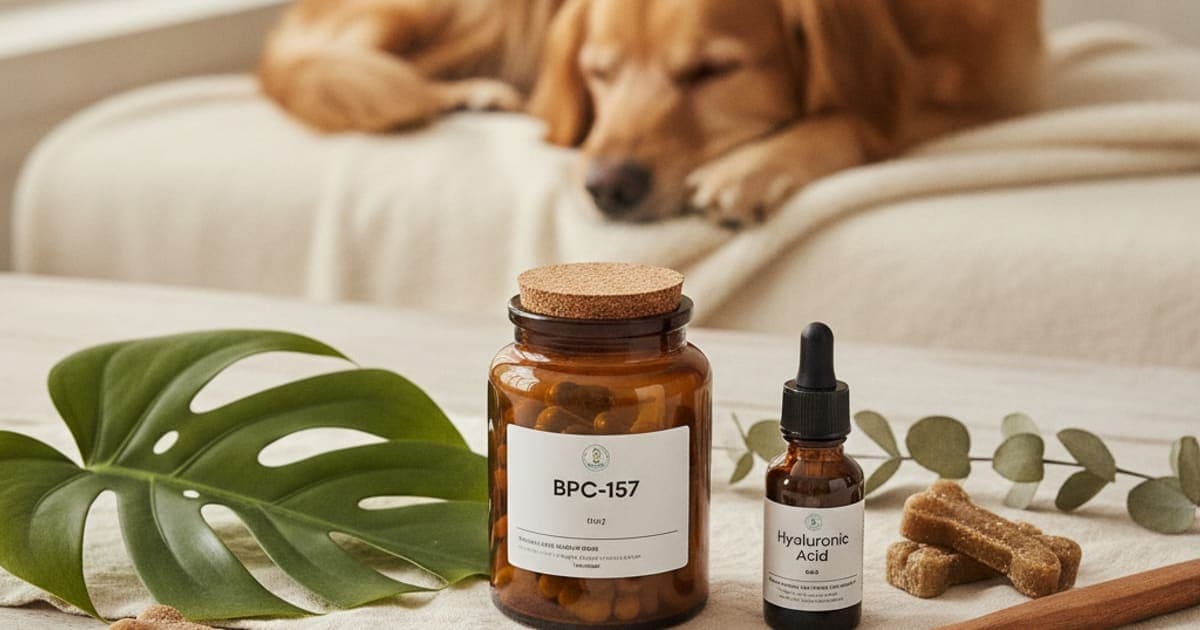
Is BPC-157 Better Than Hyaluronic Acid for Dogs?
For soft-tissue repair — tendons, ligaments, the connective tissue that holds a joint together — BPC-157 is the more targeted of the two, and it is the peptide pawgen builds K9-REPAIR around. Hyaluronic acid is not really its competitor. Hyaluronic acid is a lubrication and shock-absorption ingredient that acts on the fluid inside the joint capsule; BPC-157 is a signalling peptide that research suggests acts on the repair machinery inside injured tissue itself. They sit at different points of the same recovery, which is why a lot of owners run both rather than picking a winner. The useful question is not which ingredient is stronger, but which layer of the problem you are trying to support.
What hyaluronic acid actually does inside a joint
Hyaluronic acid is a glycosaminoglycan — a long chain of repeating sugar units that occurs naturally in synovial fluid, cartilage, skin and connective tissue. Its job in a healthy joint is physical. Because those long chains hold enormous amounts of water, synovial fluid behaves like a lubricant when the joint moves gently and stiffens into a shock absorber when the joint is loaded hard. That dual behaviour is why a sound stifle can take a sprint start without grinding.
In joints affected by osteoarthritis, the picture changes. Research describes synovial fluid in arthritic joints as thinner, with hyaluronic acid present at lower concentration and in shorter, lower-molecular-weight chains. The fluid loses some of its cushioning character. That observation is the entire logic behind viscosupplementation — hyaluronic acid injected directly into the joint by a veterinarian, a procedure used in both human and equine orthopaedics and, in some cases, in dogs.
Oral hyaluronic acid, the kind you find in joint chews, is a different proposition. Native hyaluronic acid is an unusually large molecule, and absorption of large molecules across the gut wall is limited, which is why most oral products use hydrolysed or low-molecular-weight forms. Research suggests absorbed fragments may act as signalling molecules in connective tissue rather than simply being ferried intact into the stifle. It is a reasonable supporting ingredient. What it is not is a repair agent — hyaluronic acid improves the environment a joint operates in, and does not address a torn ligament, a strained tendon or a surgical incision.
What BPC-157 is, and why it belongs in a different category
BPC-157 is a synthetic peptide — a short, defined chain of amino acids corresponding to a fragment of a protein identified in gastric juice, which is where the name body protection compound comes from. It is not a lubricant, a cartilage building block or a mineral. It is a messenger.
Published preclinical work, largely in rodent models, has examined BPC-157 in tendon, ligament, muscle and gut tissue. The mechanisms researchers describe are the interesting part for anyone nursing a dog through a soft-tissue injury: research suggests BPC-157 may influence angiogenesis — the formation of new blood vessels into damaged tissue — and may affect the migration of fibroblasts, the cells that lay down collagen. Growth-factor receptor pathways involved in vascular growth are frequently discussed in that literature.
Why does blood supply matter so much here? Because tendons and ligaments are among the least vascularised structures in the body. A cranial cruciate ligament, an Achilles tendon, a supraspinatus tendon — these tissues heal slowly not because the dog is old or unlucky, but because getting oxygen, nutrients and repair cells to the injury site is genuinely difficult. The tendon-bone interface remodels over many weeks, and it does that remodelling on a thin blood supply. Anything that research suggests may support vascular ingrowth and cell migration is aimed squarely at that bottleneck.
This is emerging science, and owners are adopting it quickly because the mechanism maps so cleanly onto the problem. BPC-157 is not an FDA-approved veterinary drug, and nothing here should be read as a promise about your dog. Hyaluronic acid changes the environment a joint works in; BPC-157 is aimed at the repair signalling inside the tissue itself — which is why owners working through a tendon or ligament recovery reach for the peptide rather than the lubricant.
Side by side: lubrication versus repair signalling
| Hyaluronic acid | BPC-157 | |
|---|---|---|
| What it is | A naturally occurring glycosaminoglycan | A synthetic peptide based on a gastric protein fragment |
| Primary site of action | Synovial fluid and the joint capsule | Soft tissue — tendon, ligament, muscle, gut lining |
| Mechanism owners care about | Viscosity, cushioning, lubrication under load | Angiogenesis and fibroblast activity that research suggests it may influence |
| Common forms | Oral supplements; intra-articular injection given by a veterinarian | Peptide formulations such as K9-REPAIR, where it is paired with TB-500 |
| Best understood as | Support for the joint's working environment | Support for the tissue repair process itself |
| Most relevant when | Chronic arthritis, joint comfort, long-term maintenance | Post-surgical recovery, tendon and ligament injury, soft-tissue strain |
| Regulatory status | Widely sold as a supplement ingredient | Not an FDA-approved veterinary drug; used and discussed as an educational, emerging category |
The table makes the choice obvious once you know which column your dog's problem lives in. Arthritic senior with a comfort and mobility issue? The lubrication column is relevant. Dog eight days past a stifle surgery, or a working dog with a shoulder strain? That is the repair column.
Where TB-500 fits, and why K9-REPAIR pairs the two peptides
BPC-157 rarely travels alone in canine recovery formulations, and there is a reason. TB-500 is a synthetic fragment corresponding to a region of thymosin beta-4, a naturally occurring actin-binding protein. Actin is the structural scaffolding cells use to change shape and move, and thymosin beta-4 is studied for its role in cell migration and tissue remodelling.
The two peptides are discussed in research as complementary rather than redundant. BPC-157 is characterised as acting strongly at the local level, including on vascular growth into damaged tissue. TB-500 is associated with cell mobility and organised remodelling across a wider area. Owners adopting peptides through recovery generally use them together for exactly that reason, which is how pawgen formulates K9-REPAIR — both peptides in one product rather than a shopping list.
What pawgen can state plainly, because it is descriptive rather than a health claim: K9-REPAIR contains BPC-157 and TB-500, is dosed by body weight, is third-party tested with certificates of analysis available, ships direct to your door, and carries a 60-day money-back guarantee. What no one can tell you is the right amount for your specific dog — that conversation belongs with your veterinarian, who knows the diagnosis, the weight, the medications already on board and the rehab timeline.
Matching the ingredient to the problem in front of you
A dog with a diagnosed cruciate ligament tear
Surgery comes first. A TPLO, a TTA or an extracapsular repair is what restores mechanical stability to the stifle, and no ingredient on any label substitutes for that. What follows surgery is a long, structured remodelling period with controlled rehab, and that is the window owners are thinking about when they look at peptides. Hyaluronic acid does not address ligament repair. This is repair-column territory.
The senior dog with stiff mornings and arthritis
Here hyaluronic acid earns its place — it is aimed directly at the fluid dynamics of a degenerating joint, and your vet may also discuss intra-articular options, prescription medication or disease-modifying injections. Keep every one of those. But arthritis is not purely a cartilage story; the joint capsule, supporting tendons and compensating muscle groups all take load, which is why many owners layer soft-tissue support alongside their vet's plan rather than choosing between them.
The dog with a soft-tissue injury and no surgery scheduled
Iliopsoas strain, shoulder tendinopathy, a chronic sprain that keeps flaring — these are slow, frustrating injuries that live entirely in poorly vascularised tissue. Rest and graduated rehab remain the backbone. This is the scenario where the mechanism behind BPC-157 and TB-500 lines up most directly with what the tissue needs to do.
Reading labels: where joint supplements lose the plot
The joint aisle is full of products that list hyaluronic acid on the front panel and never tell you how much is inside, hidden behind a proprietary blend alongside a dozen other trace ingredients. A kitchen-sink chew with fourteen actives at undisclosed amounts is a marketing document, not a formulation. Molecular weight is rarely disclosed either, despite being the variable that determines whether oral hyaluronic acid behaves the way the research describes.
Apply the same scrutiny to anything you buy, including peptides. Ask for named actives with stated amounts, dosing worked out by body weight rather than one-size-fits-all, third-party testing, and batch-level certificates of analysis you can actually look at. A brand that will not show you its testing is asking for trust it has not earned.
Key Takeaways
- Hyaluronic acid and BPC-157 are not competing ingredients — one supports the joint's fluid environment, the other is aimed at repair signalling within soft tissue.
- Hyaluronic acid is a naturally occurring glycosaminoglycan that gives synovial fluid its lubricating and shock-absorbing properties; oral absorption depends heavily on molecular weight.
- Research suggests BPC-157 may influence angiogenesis and fibroblast activity, which matters because tendons and ligaments heal slowly on a limited blood supply.
- TB-500, based on thymosin beta-4, is studied for cell migration and remodelling, which is why K9-REPAIR combines both peptides.
- BPC-157 and TB-500 are not FDA-approved veterinary drugs; this is educational information, not a promise about any individual dog.
- Ignore proprietary blends and unlabelled amounts. Demand named actives, weight-based dosing and third-party COAs.
If you want to see how these ingredient categories stack up more broadly, it is worth reading glucosamine alternatives for dogs, the direct comparison of k9-repair vs glucosamine, and the two ingredient head-to-heads on nutramax vs deer antler velvet for dogs and nutramax vs devils claw for dogs. The peptide formulation discussed throughout is K9-REPAIR.
One last thing, and it is the part that matters most. Your veterinarian owns the diagnosis and the treatment plan — the imaging, the surgical decision, the prescriptions, the rehab schedule. A limp can be a cruciate tear, a bone tumour, a neurological problem or a foot injury, and only an examination sorts that out. Talk to your veterinarian before adding anything, and never stop or reduce a prescribed medication to make room for a supplement. Supplements and peptides operate in the space that proper veterinary care creates, not instead of it.
Owners exploring peptide support for their dog can review K9-REPAIR — BPC-157 + TB-500 formulated for dogs — at https://pawgen.com/. BPC-157 and TB-500 are not FDA-approved veterinary drugs. Nothing in this article treats, cures or prevents any condition; every decision about your dog's care belongs with your veterinarian.
Frequently asked questions
- When should I take a dog to the vet for reluctant to go up stairs?
- Book an appointment if the reluctance lasts more than a day or two, recurs, or comes with limping, yelping, muscle loss or reluctance to jump. Sudden refusal after previously managing stairs fine deserves prompt attention, since it can signal a ligament, spinal or hip problem that imaging will identify.
- What can I give a dog that is reluctant to go up stairs?
- Start with a veterinary diagnosis rather than a product, because pain relief needs to match the cause. Once your vet has a plan, owners commonly add joint and soft-tissue support such as hyaluronic acid or peptide formulations like K9-REPAIR, alongside ramps, traction rugs and weight management to reduce daily loading.
- Is a dog reluctant to go up stairs an emergency?
- Usually not, but it can be. Treat it as urgent if it appears suddenly with dragging back legs, a hunched back, crying on touch, incontinence or complete inability to stand — those suggest possible spinal involvement. Gradual, mild reluctance is better handled as a prompt routine appointment.
- Why is my dog falling over?
- Falling over usually points to a balance, neurological or cardiovascular problem rather than simple joint pain. Vestibular disease, inner ear infection, spinal cord compression, toxin exposure, low blood sugar and heart rhythm issues can all cause it. Because the causes differ so widely, only a veterinary examination can identify what is happening.
- Should I worry if my dog is falling over?
- Yes — falling over is a symptom worth taking seriously, particularly if it is new. Watch for head tilt, flicking eye movements, circling, disorientation, collapse or weakness in specific limbs, and note when episodes happen. That detail helps your veterinarian narrow the cause quickly, so record what you see.
- When should I take a dog to the vet for falling over?
- Go the same day, and go immediately if there is collapse, seizure activity, laboured breathing, pale gums, a sudden head tilt or unresponsiveness. Even a single brief episode in an otherwise healthy dog warrants examination, because balance loss can reflect neurological or cardiac conditions that worsen without treatment.
- Can I give my dog hyaluronic acid and BPC-157 together?
- Many owners use joint-support ingredients alongside peptide formulations because they act on different parts of the recovery — fluid environment versus tissue repair signalling. Combining supplements should still be reviewed with your veterinarian, who can check for overlap with prescribed medication and confirm the plan suits your dog.
- Is BPC-157 approved for use in dogs?
- No. BPC-157 and TB-500 are not FDA-approved veterinary drugs, and information about them is educational rather than a treatment claim. Research into their mechanisms is promising and owners are adopting them through recovery, but any decision about using them belongs in a conversation with your veterinarian.
Educational content. BPC-157 and TB-500 are not FDA-approved veterinary drugs. Talk to your veterinarian before starting anything new, especially if your dog is on prescribed medication.