Can Muscle Tear in Dogs Be Reversed? (Recovery Explained)
A dog muscle tear cannot be undone, but it can heal. Torn fibres are repaired through inflammation, regeneration and remodelling over weeks, leaving a mix of new muscle and scar tissue. Accurate veterinary diagnosis, controlled rest and structured rehab largely determine how close your dog gets to full function.
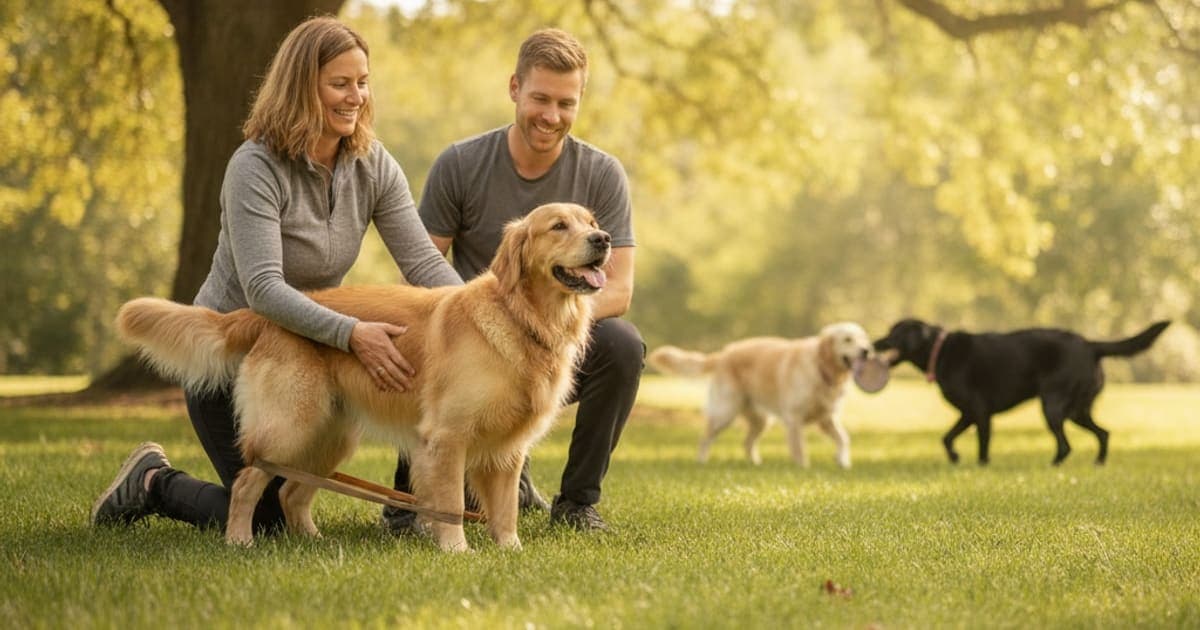
Can muscle tear in dogs be reversed?
Not in the sense of turning back the clock. A torn muscle cannot un-tear itself — the body bridges the gap with regenerating fibres and fibrous scar tissue over a period of weeks. With accurate veterinary diagnosis, controlled rest and structured rehabilitation, most dogs with mild to moderate tears return to comfortable, near-normal function.
That distinction matters, because reversed and recovered are not the same word. Veterinary references such as the Merck Veterinary Manual describe muscle strains and ruptures as injuries that resolve through a predictable sequence — inflammation, repair, then remodelling — rather than through the regrowth of an identical, untouched muscle belly. What an owner can genuinely influence is the quality of that repair: how much functional muscle is restored, how much stiff scar is laid down in its place, and whether the dog returns to full stride or carries a subtle hitch for years afterwards.
So the honest answer is layered. The tear is permanent as an event. The disability it causes usually is not.
Inside the tear: how canine muscle actually repairs itself
Skeletal muscle is built from long, multinucleated fibres bundled inside connective tissue sheaths. When a dog sprints, cuts hard, slips on a smooth floor or lands awkwardly off a sofa, force can exceed what those fibres and their sheaths tolerate, and some of them fail. That failure can be microscopic or it can be a visible, palpable defect in the muscle belly.
Repair then runs in three overlapping phases. First comes destruction and inflammation: bleeding into the tissue, swelling, recruitment of immune cells that clear damaged fibre segments. This is the painful, lame phase, and it is also a necessary phase — inflammation is the signal that starts the rebuild.
Second comes regeneration. Satellite cells, the resident stem cells sitting against each muscle fibre, activate, divide and fuse to form new fibre segments that grow toward the injury from both sides. In parallel, fibroblasts lay down a collagen scaffold to hold the two ends together mechanically while regeneration catches up.
Third comes remodelling, and this is the long tail. Collagen reorganises, blood supply matures, and the new tissue slowly learns to accept load again. It continues well past the point at which your dog looks sound. The realistic goal is not erasing the tear but steering the repair — the more the healing tissue behaves like muscle and the less it behaves like scar, the closer your dog gets to their old self.
Grades of muscle tear and what recovery looks like for each
Not every tear carries the same outlook. Veterinary surgeons generally describe muscle injuries by severity, and severity drives everything that follows.
| Grade | What has failed | What recovery usually involves |
|---|---|---|
| Mild (grade I) | A small proportion of fibres; the muscle remains structurally intact | Short period of restricted activity, pain control if prescribed, gradual return to load. Most dogs regain full function. |
| Moderate (grade II) | A substantial partial tear with a palpable defect, marked swelling and bruising | Weeks of controlled restriction and formal rehabilitation. Function usually returns well, though scar tissue may leave the muscle slightly less elastic. |
| Severe (grade III) | Complete rupture, or avulsion where the muscle or tendon pulls off its bony attachment | Often a surgical question. Recovery is the longest, and outcome depends heavily on the repair, the site and adherence to rehab. |
Sites matter too. Iliopsoas strains in active and sporting dogs, gracilis and semitendinosus injuries in working breeds, supraspinatus and biceps injuries in the shoulder, and tail-muscle strains all behave differently. Chronic gracilis fibrotic myopathy in particular tends to produce a characteristic shortened stride and is notoriously resistant to returning fully to normal, which is exactly why the early management window is worth taking seriously.
Where the veterinarian leads: diagnosis, pain control and rehabilitation
A limp is a symptom, not a diagnosis. Cranial cruciate ligament disease, a fracture, a fragmented coronoid process, tick-borne disease, an interdigital lesion and a muscle tear can all present as a dog holding up a leg. Guessing wrong costs weeks.
Diagnosis starts with a gait assessment and careful palpation — a torn muscle is often exquisitely sore over a specific belly, and pain on stretch is telling. Diagnostic ultrasound is the practical imaging tool for soft tissue, since it shows fibre disruption, haematoma and, later, scar. Radiographs rule out bone involvement and avulsion fragments. In referral settings, MRI gives the most detailed picture. Talk to your veterinarian before you assume a limp is "just a pulled muscle," because the management plan for a strain and for a torn cruciate diverge immediately.
From there the plan is unglamorous and effective: controlled activity restriction, prescribed analgesia where your vet judges it appropriate, cold in the acute phase and warmth later, and then progressive loading. Rehabilitation is where good outcomes are actually made — measured leash walking, targeted therapeutic exercise, balance and proprioception work, underwater treadmill where available, and modalities such as therapeutic laser or shockwave used at a vet's discretion. Remodelling tissue responds to load. Too little load and it stays weak and adhesion-bound; too much too early and it re-tears. A certified canine rehabilitation professional exists precisely to walk that line.
If your dog is on carprofen, gabapentin, an injectable pain therapy or anything else your vet prescribed, that plan stays as written. Nothing you add at home replaces it.
Supporting the remodelling window: why owners are turning to peptides
The repair timeline is not a passive waiting room. It is a period of intense biological activity — angiogenesis, fibroblast migration, collagen turnover, satellite cell fusion — and it is the window in which supportive nutrition and supplementation are most relevant.
This is where BPC-157 and TB-500 come in, and why they have become the stack many owners reach for during recovery. BPC-157 is a stable pentadecapeptide sequence derived from a protein found in gastric juice. Published laboratory research suggests it influences pathways involved in new blood vessel formation and in the migration and outgrowth of tendon and ligament fibroblasts — the same machinery that governs how connective tissue rebuilds after injury. TB-500 is a synthetic fragment of thymosin beta-4, a naturally occurring peptide whose primary studied role is binding actin and supporting cell migration, a fundamental step in how repair cells reach the site that needs them.
Hedge this honestly: much of that work is preclinical, these peptides are not FDA-approved veterinary drugs, and no supplement can promise an outcome for your individual dog. What can be said plainly is that the mechanisms are coherent, the science is genuinely promising, and a growing number of owners are choosing to support the remodelling window rather than leave it to chance.
K9-REPAIR from pawgen is a BPC-157 and TB-500 formulation made for dogs, with weight-based dosing guidance, third-party testing and published certificates of analysis, shipped direct to the door and backed by a 60-day money-back guarantee. That transparency is the whole point of the category. The joint aisle is full of kitchen-sink chews carrying a dozen trendy ingredients at doses too small to matter and no analytical testing behind the label — a printed ingredient list is not the same as a verified one. Bring what you are considering to your veterinarian, especially if your dog is recovering from surgery or taking prescription medication, so the whole plan is coordinated by the person who knows the case.
| Part of the plan | What it is doing |
|---|---|
| Veterinary diagnosis and prescribed medication | Identifies the injury, controls pain and inflammation, owns the treatment decisions |
| Controlled rest, then progressive loading | Protects fragile new tissue, then teaches it to carry load again |
| Lean body condition and adequate protein | Reduces mechanical strain and supplies the raw material for rebuilding |
| K9-REPAIR (BPC-157 + TB-500) | The peptide stack owners use through recovery to support the body's own repair processes |
What turns a recoverable tear into a lasting problem
Most poor outcomes are not caused by the original injury. They are caused by what happens in the following weeks.
The biggest one is early return to full activity. A dog that stops limping at day ten is not a healed dog; they are a comfortable dog with immature repair tissue. One garden sprint or one stair rush can re-tear the same site, and repeat injury is what drives dense, restrictive scar. Slick flooring, unsupervised off-leash time, jumping in and out of vehicles and rough play with another dog all belong on the restricted list until your vet clears them.
Excess body weight loads every stride and is worth addressing directly. So is the muscle loss that comes with confinement and with age — an older dog who spends six weeks resting can lose meaningful muscle mass, which is why rehab and gradual reloading matter even more in seniors. Untreated pain also works against recovery, because a dog compensating on three legs overloads the other three.
Key takeaways
- A muscle tear cannot be undone, but it can repair — the tissue that fills the gap is a mix of new muscle fibres and scar.
- Outcome depends far more on grade, diagnosis accuracy and rehabilitation discipline than on the injury itself.
- Diagnosis belongs to your veterinarian: gait exam, palpation, ultrasound and radiographs distinguish a strain from a cruciate tear or fracture.
- Rest alone is not the plan; progressive, guided loading is what turns healing tissue into functional muscle.
- Re-injury during the comfortable-but-not-healed phase is the most common cause of a permanent problem.
- Research suggests BPC-157 and TB-500 act on repair-related pathways, which is why owners increasingly use K9-REPAIR through the recovery window.
For more depth on this injury and how it behaves, see the complete guide to muscle tear, along with is muscle tear in dogs painful, what makes muscle tear worse in dogs and how much does it cost to treat muscle tear in dogs. If your dog is older and losing condition alongside the injury, is sarcopenia in dogs painful and what makes sarcopenia worse in dogs are worth reading next.
Your veterinarian owns the diagnosis and the treatment plan — the imaging, the pain management, the decision about surgery and the timeline for returning to activity. Supplements and peptides operate inside the space that proper veterinary care creates, supporting the body during a window that is already working hard on its own behalf.
Owners exploring peptide support for their dog can review K9-REPAIR — BPC-157 + TB-500 formulated for dogs — at https://pawgen.com/. BPC-157 and TB-500 are not FDA-approved veterinary drugs. Nothing in this article treats, cures or prevents any condition; every decision about your dog's care belongs with your veterinarian.
Frequently asked questions
- What are the first signs of muscle tear in dogs?
- Sudden lameness during or right after activity is the classic first sign. Owners also notice a yelp at the moment of injury, reluctance to bear weight, swelling or warmth over one muscle group, flinching when that area is touched, a shortened stride, or stiffness that is worst after rest and eases slightly with gentle movement.
- How is muscle tear diagnosed in dogs?
- Through a veterinary orthopaedic and gait examination first, with careful palpation to localise pain to a specific muscle belly and pain on stretch. Diagnostic ultrasound is the practical imaging tool for soft tissue, radiographs rule out fractures and bony avulsions, and MRI is used in referral settings when the picture stays unclear.
- What helps a dog with muscle tear?
- Accurate veterinary diagnosis, controlled activity restriction, prescribed pain relief where appropriate, and progressive rehabilitation do the heavy lifting. Lean body condition and adequate dietary protein support tissue rebuilding. Many owners also add K9-REPAIR, a BPC-157 and TB-500 peptide formulation, during recovery. Discuss any addition with your veterinarian first.
- How long does muscle tear take to heal in dogs?
- It depends entirely on grade and site. Mild strains often settle with a short period of restriction, moderate partial tears typically need weeks of controlled activity plus rehabilitation, and complete ruptures or avulsions take considerably longer and may require surgery. Remodelling continues well after your dog stops limping, so follow your vet's timeline rather than appearances.
- Is muscle tear in dogs painful?
- Yes. Torn muscle fibres, bleeding into tissue and inflammatory swelling all generate significant acute pain, and dogs commonly cry out at the moment of injury. Pain usually eases as inflammation settles, but stretching or loading the muscle stays uncomfortable for some time. Ask your veterinarian about appropriate pain management.
- What makes muscle tear worse in dogs?
- Returning to full activity before the tissue is ready is the biggest factor, because comfort returns long before strength does. Sprinting, jumping, stairs, slick floors, rough play and unsupervised off-leash time all risk re-tearing the same site. Excess body weight, untreated pain and skipped rehabilitation also worsen the long-term result.
- Can a dog fully recover from a torn muscle?
- Many dogs regain full, comfortable function, particularly after mild and moderate tears managed with proper rest and rehabilitation. The repaired area contains some scar tissue and may be slightly less elastic than the original muscle. Severe ruptures, avulsions and chronic fibrotic myopathies carry a more guarded outlook and need specialist veterinary input.
- Does K9-REPAIR treat muscle tears in dogs?
- No. K9-REPAIR is an educational-use peptide formulation containing BPC-157 and TB-500, and it is not an FDA-approved veterinary drug, so it is not a treatment for any condition. Research suggests these peptides act on repair-related pathways, which is why owners use it through recovery alongside veterinary care.
Educational content. BPC-157 and TB-500 are not FDA-approved veterinary drugs. Talk to your veterinarian before starting anything new, especially if your dog is on prescribed medication.