Collie Supplements — Herding Breed Health & MDR1 Safety
Collies and Shetland Sheepdogs are generally healthy, long-lived dogs, but they share a short list of inherited concerns — most notably the MDR1 gene mutation that changes how certain drugs are handled. Smart supplementation focuses on joints, skin and recovery, and MDR1 testing should come first.
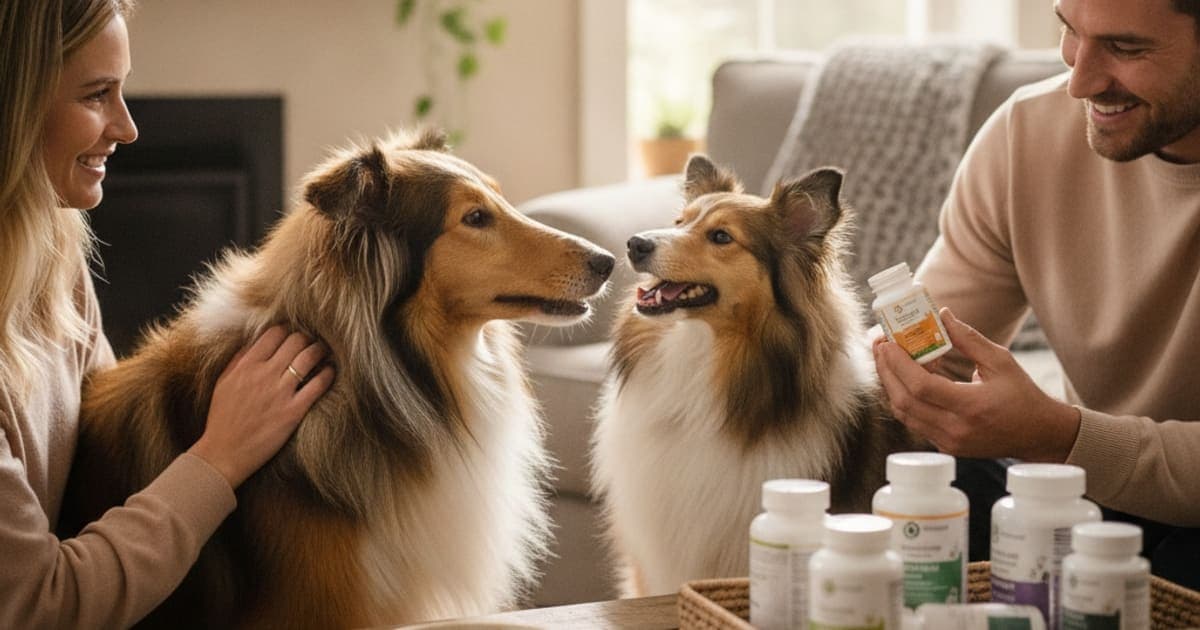
Yes. Rough Collies, Smooth Collies, Border Collies and Shetland Sheepdogs are generally healthy, long-lived dogs for their size, with fewer of the structural problems that burden flat-faced or very heavy breeds. What they do carry is a short, well-documented list of inherited concerns that every herding-breed owner should know by name — the MDR1 (ABCB1) gene mutation that changes how certain drugs behave, inherited eye conditions, thyroid and autoimmune skin issues, and the soft-tissue wear that comes with being a genuine working athlete.
That last one is where most supplement decisions actually land. For an active Collie or Sheltie, the supplement categories worth your money are joint and connective-tissue support, omega-3 fatty acids for skin and coat, and — increasingly for dogs coming back from a strain, a tear or a surgery date — peptide formulations such as K9-REPAIR, pawgen's BPC-157 + TB-500 blend for dogs. Everything else on the shelf deserves a hard look before it goes in the cart.
The real health profile of a Collie or Sheltie
These are herding breeds built for distance, direction changes and all-day stamina. That build serves them well: moderate bone, moderate angulation, lean body condition. Keep a Collie or Sheltie lean and conditioned and you have removed more future orthopaedic risk than any supplement can.
The breed-specific items your veterinarian will watch for across a lifetime include:
- Eye conditions. Collie eye anomaly is an inherited developmental condition of the eye seen across collie-type breeds, and progressive retinal atrophy appears in herding lines too. Both have genetic screening available, and responsible breeders test for them.
- Drug sensitivity. The MDR1 mutation is common in collie-type breeds and Shelties. It is not a disease — it is a transporter problem that changes how certain medications are handled. More on this below, because it is the single most practical thing an owner can act on.
- Thyroid and autoimmune skin disease. Hypothyroidism is seen in both breeds, and dermatomyositis — an inherited inflammatory condition affecting skin and muscle — is recognised in Collies and Shelties specifically.
- Bleeding disorders. Von Willebrand disease is recognised in Shetland Sheepdogs, which is why pre-surgical screening matters in this breed.
- Soft-tissue and joint strain. Agility, flyball, frisbee and farm work load tendons, ligaments and the cruciate repeatedly. Hip and elbow dysplasia occur, but iliopsoas strain, shoulder injuries and cruciate disease are what most sport-dog owners actually encounter.
None of that makes these unhealthy breeds. It makes them breeds with a known checklist — which is a far better position to be in than a breed with a vague one.
What drugs can Collies not have?
This is the question that matters most, and it has a concrete answer. Collies and Shelties frequently carry a mutation in the MDR1 (ABCB1) gene. That gene codes for P-glycoprotein, a pump that sits in the blood–brain barrier and actively pushes certain drugs back out of the central nervous system. When the pump is defective, those drugs accumulate in the brain and produce exaggerated, sometimes severe neurological effects at doses other dogs tolerate.
Dogs can be affected on one copy of the gene or two, and dogs with two copies are the most sensitive. A simple cheek swab or blood test identifies status; genetic testing for MDR1 has been offered for years through Washington State University's veterinary pharmacology programme and is now widely available through veterinary practices and breed-health testing panels.
MDR1 status is a one-time test that changes how your dog should be medicated for the rest of their life — get it done before the day you need the answer.
| Drug or class | Why it matters in MDR1 dogs | Practical approach |
|---|---|---|
| Ivermectin | The classic MDR1 drug. Neurological toxicity has been documented at the higher doses used for parasite treatment, not at the low doses in labelled heartworm preventives | Heartworm preventives at label dose are generally considered appropriate; treatment-level dosing needs an MDR1-aware decision from your vet |
| Milbemycin, moxidectin, selamectin | Same drug family, same transporter | Labelled preventive use is standard practice; higher off-label dosing warrants caution and veterinary oversight |
| Loperamide (anti-diarrhoeal) | Frequently flagged as problematic in MDR1 dogs even at ordinary doses | Avoid over-the-counter use entirely; ask your vet for an alternative |
| Acepromazine (sedative) | Sedation can be deeper and longer than expected | Vets often reduce dose or choose a different agent in known MDR1 dogs |
| Butorphanol (analgesic/sedative) | Similar exaggerated sedative response | Flag MDR1 status before any procedure requiring sedation |
| Vincristine, vinblastine, doxorubicin | Chemotherapy agents handled by the same transporter; toxicity risk is higher | Oncologists adjust protocols for known MDR1 dogs |
| Erythromycin, emodepside, and several others | Additional recognised P-glycoprotein substrates | Keep an up-to-date MDR1 drug list from your vet rather than relying on memory |
Two things to do with this information. First, test your dog and write the result on the front of their file, not the back. Second, tell every veterinary professional who touches your dog — the emergency clinic at 2am does not know your Sheltie's genotype unless you say so. Talk to your veterinarian about testing at the next routine visit if it has not been done.
Which supplements actually earn their place
Herding breeds do not need a cabinet full of jars. They need a small number of categories that match what their bodies are actually doing. The comparison below is about what each category is for — not a promise about any individual dog.
| Category | What the research and owner experience point to | Best suited for |
|---|---|---|
| Omega-3 fatty acids (EPA/DHA, fish oil) | Among the best-studied canine supplements; research suggests support for skin, coat and joint comfort | Almost every Collie and Sheltie, especially coated dogs with skin sensitivity |
| Glucosamine, chondroitin, green-lipped mussel | Long-established joint-support ingredients; evidence is mixed but owners widely report value as part of a maintenance routine | Older dogs, or sport dogs on a long-term maintenance plan |
| Peptide formulations (BPC-157 + TB-500) | Research in animal models suggests roles in tendon, ligament and soft-tissue repair signalling and in blood-vessel formation; the stack owners increasingly use through recovery periods | Dogs recovering from strain, soft-tissue injury or a procedure, under veterinary supervision |
| Probiotics | May support digestive balance, particularly around antibiotic courses or diet transitions | Dogs with recurrent loose stool or sensitive guts |
| Multi-ingredient 'kitchen sink' chews | Often contain many ingredients at amounts too small to do anything meaningful | Rarely the best use of money — read the panel before buying |
For Shelties specifically, the same list applies, scaled to a smaller dog. Sheltie supplements should be dosed by body weight, not by guesswork, and a coated breed prone to skin issues often benefits most from getting the omega-3 side right before adding anything else.
Where BPC-157 and TB-500 fit for an active herding dog
When a Collie blows a cruciate on a turn, or a Sheltie pulls an iliopsoas, the limiting factor in return-to-function is rarely pain control. It is tissue remodelling. Tendon and ligament heal slowly because they are poorly vascularised — the tendon-bone interface rebuilds over weeks, laying down collagen that then has to reorganise along the lines of load.
That is the biology BPC-157 and TB-500 speak to. BPC-157 is a peptide derived from a sequence found in gastric juice; published laboratory and animal research suggests it influences angiogenesis — the formation of new blood vessels — and the signalling involved in tendon and ligament repair. TB-500 is a synthetic fragment related to thymosin beta-4, a naturally occurring protein studied for its role in cell migration and actin regulation, processes that matter when tissue is rebuilding. This is emerging and genuinely promising science, and it is why a growing number of owners of sport and working dogs now run peptides alongside their vet's rehab plan.
A few honest boundaries. BPC-157 and TB-500 are not FDA-approved veterinary drugs, and nothing here says K9-REPAIR will do anything for your specific dog. It is not a replacement for surgery, and it is not a reason to change or stop anything your vet has prescribed — carprofen, gabapentin, a monoclonal antibody injection, a controlled exercise plan. Peptides belong beside that plan, not instead of it. And because your dog may be MDR1-affected, tell your veterinarian everything you are giving, supplements included, so they can keep the whole picture in one place.
What pawgen can tell you plainly is descriptive: K9-REPAIR contains BPC-157 and TB-500, it is formulated for dogs and dosed by body weight, every batch is third-party tested with certificates of analysis published, it ships direct to your door, and it is backed by a 60-day money-back guarantee.
How to read a supplement label without getting fooled
The canine supplement aisle rewards marketing over evidence, and herding-breed owners — motivated, informed, willing to spend — are a prime target. Four habits protect you:
- Count the actives. Twenty-two ingredients on a soft chew usually means twenty-two token amounts. Fewer ingredients at meaningful amounts beats a long list every time.
- Reject proprietary blends. If a brand will not tell you how much of each ingredient is in the product, assume there is a reason.
- Ask for the COA. A certificate of analysis from an independent lab, matched to the batch in your hand, is the difference between a claim and a verified fact.
- Ignore outcome promises. Any product promising to heal, cure or fix a named condition in a dog is making a claim it is not permitted to make and cannot support.
Key Takeaways
- Collies and Shelties are generally healthy, long-lived breeds with a short, known list of inherited concerns rather than a long list of vague ones.
- The MDR1 (ABCB1) mutation is the highest-value thing to act on: test your dog, record the result, and tell every clinic that treats them.
- Drugs commonly flagged in MDR1 dogs include ivermectin at treatment-level doses, loperamide, acepromazine, butorphanol and certain chemotherapy agents — your vet keeps the current list.
- Omega-3s and joint support are the sensible maintenance base; peptides are what owners increasingly add during recovery periods.
- K9-REPAIR contains BPC-157 and TB-500, is dosed by body weight, is third-party tested with published COAs, and carries a 60-day money-back guarantee.
- Skip proprietary blends and kitchen-sink chews; demand batch-matched certificates of analysis.
You can review pawgen's third-party certificates of analysis, see the full range on the shop page, and check availability and delivery details before you order.
Your veterinarian owns the diagnosis and owns the treatment plan — the imaging, the surgical decision, the prescriptions, the rehab timeline and the MDR1-aware drug choices that keep a Collie or Sheltie safe. Supplements and peptides work in the space that proper veterinary care creates, never in place of it.
Owners exploring peptide support for their dog can review K9-REPAIR — BPC-157 + TB-500 formulated for dogs — at https://pawgen.com/. BPC-157 and TB-500 are not FDA-approved veterinary drugs. Nothing in this article treats, cures or prevents any condition; every decision about your dog's care belongs with your veterinarian.
Frequently asked questions
- Are collies healthy dogs?
- Yes, Collies are generally healthy and long-lived for their size. They do carry known inherited concerns, including the MDR1 drug-sensitivity mutation, Collie eye anomaly, hypothyroidism and dermatomyositis. Genetic screening, lean body condition and regular veterinary checks address most of these, which is why responsible breeders test extensively.
- What drugs can collies not have?
- Collies carrying the MDR1 mutation need caution with ivermectin at treatment-level doses, loperamide, acepromazine, butorphanol, and chemotherapy agents such as vincristine, vinblastine and doxorubicin. Labelled heartworm preventives are generally considered appropriate. Test your dog's MDR1 status and give your veterinarian that result before any medication or sedation.
- Do Shelties need different supplements than Collies?
- Not different categories, just different scale. Shetland Sheepdogs benefit from the same omega-3, joint-support and recovery-focused options, dosed by body weight rather than guesswork. Because Shelties are prone to coat and skin issues, many owners prioritise getting omega-3 intake right before layering anything else on top.
- How is MDR1 status tested?
- MDR1 testing uses a simple cheek swab or blood sample analysed for the ABCB1 gene mutation. It is available through most veterinary practices and breed health testing panels, and has long been offered through Washington State University's veterinary pharmacology programme. Results are permanent and only need doing once.
- What are BPC-157 and TB-500?
- BPC-157 is a peptide derived from a sequence found in gastric juice, and TB-500 is a synthetic fragment related to thymosin beta-4. Research in laboratory and animal models suggests roles in blood-vessel formation and soft-tissue repair signalling. Neither is an FDA-approved veterinary drug, so discuss them with your veterinarian.
- Can I give K9-REPAIR alongside my dog's prescribed medication?
- That decision belongs to your veterinarian. Never stop or alter a prescribed medication such as carprofen or gabapentin to add a supplement. Bring the K9-REPAIR ingredient list to your appointment, mention your dog's MDR1 status, and let your vet keep every product in one coordinated plan.
- How much K9-REPAIR does a Collie or Sheltie need?
- K9-REPAIR is formulated to be dosed by body weight, but the right amount for your individual dog is a conversation to have with your veterinarian. That is especially true for puppies, pregnant or nursing dogs, and any dog already on prescribed medication or recovering from a procedure.
- What should I look for on a canine supplement label?
- Look for a short ingredient list with disclosed amounts, no proprietary blends, and a batch-matched certificate of analysis from an independent laboratory. Treat long multi-ingredient chews with suspicion, since many contain token quantities. Ignore any product promising to cure, heal or fix a named condition.
- Does the MDR1 mutation affect supplements too?
- MDR1 concerns in the published literature centre on specific small-molecule drugs handled by the P-glycoprotein transporter. Supplements are a separate category, but the safe habit is identical: tell your veterinarian everything your dog receives, including supplements and peptides, so they can review it against your dog's genotype.
Educational content. BPC-157 and TB-500 are not FDA-approved veterinary drugs. Talk to your veterinarian before starting anything new, especially if your dog is on prescribed medication.