Crate Rest in Dogs: Signs, Causes and What Helps
Crate rest in dogs is veterinarian-prescribed confinement — a crate, pen or small room — that strictly limits movement while an injury, surgical repair or spinal problem stabilises. It removes running, jumping, stairs and twisting so healing tissue is not reloaded too early. Your veterinarian sets the level of restriction and how long it lasts.
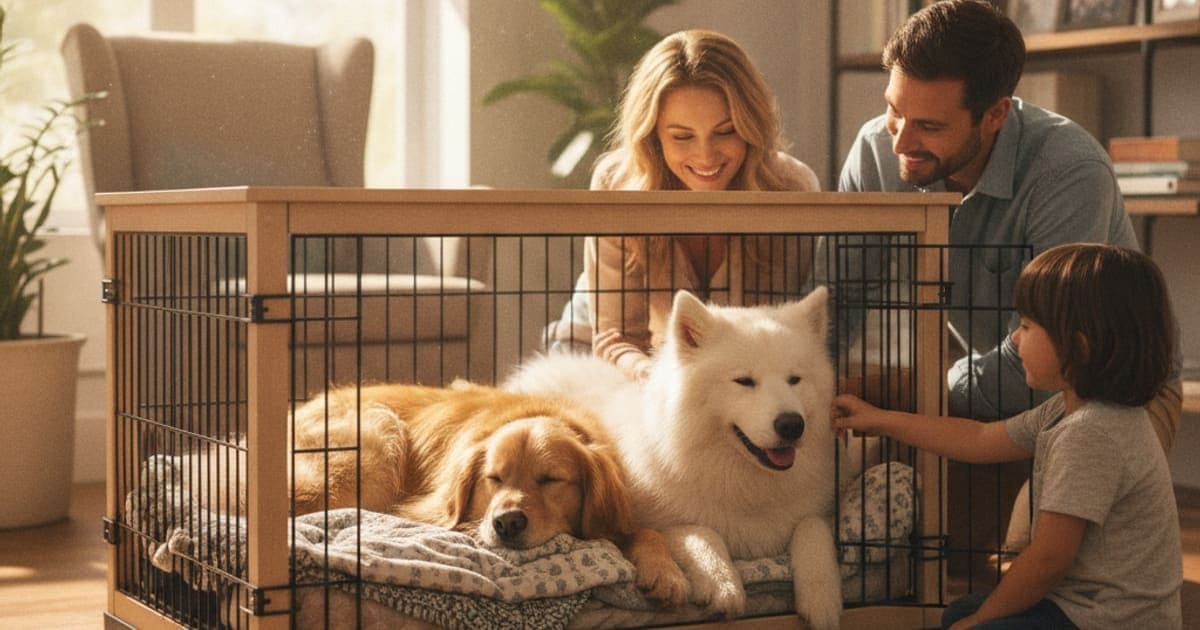
What Is Crate Rest in Dogs?
Crate rest in dogs is a veterinarian-prescribed period of strict confinement — a crate, pen or small room — that limits a dog's movement while an injury, a surgical repair or a spinal problem stabilises. It removes running, jumping, stairs and twisting so healing tissue is not reloaded before it is strong enough to carry that load.
It is not a punishment, and it is not a gap in the treatment plan while everyone waits. For torn ligaments, disc injuries, fractures and post-surgical repairs, restricted movement is a large part of the plan. Connective tissue heals in stages: an early inflammatory phase, a phase where new collagen is laid down in a disorganised mesh, and a long remodelling phase where that mesh gradually reorganises along the lines of load. Uncontrolled movement in the first two phases tears the new tissue apart faster than the body can build it, which is why a dog who feels fine on day nine can undo weeks of progress in a single sprint down the hallway.
What strict confinement actually looks like day to day
Owners often hear the words and picture a crate in a quiet room. In practice, the order covers the whole day: no stairs, no jumping on or off furniture, no slippery floors, no greeting visitors at the door, no off-leash time, no wrestling with the other dog, no running to the window. Toilet breaks happen on a short leash, on flat ground, with the dog brought straight back in. Bigger or wobbly dogs may need a support sling or a towel under the belly, and steps may need to be carried or ramped.
Restriction is a spectrum, and the level matters as much as the word. Ask your veterinary team to tell you exactly which tier your dog is on, and what has to happen before they move up one.
| Level of restriction | What it means in practice | Commonly ordered for |
|---|---|---|
| Strict crate or pen rest | Dog stays confined except for short leash-led toilet trips; carried or ramped over steps; no free roaming at all | Spinal disc injury, fracture repair, the earliest stage after orthopaedic surgery |
| Modified confinement | Pen or a small non-slip room; brief, measured leash walks; still no stairs, sofas, play or other dogs | Middle stage of recovery, soft-tissue strains, conservative management |
| Controlled exercise | Structured on-leash walks on flat ground, lengthened only on the schedule the vet or rehab practitioner sets; off-leash still off the table | Late-stage return to function, post-rehab progression |
| Normal activity | Full return to play and off-leash time | Only once the vet has cleared it, usually after a recheck or repeat imaging |
Crate rest is not doing nothing — it is the active part of the treatment plan, and the repair tissue only gets its window to organise properly if the confinement actually holds.
Why a vet orders confinement: the problems behind the crate
The crate is never the diagnosis. It is the management strategy for something underneath, and knowing which problem you are dealing with tells you what the weeks ahead will look like.
Common reasons include cranial cruciate ligament injury, both while a surgery date is pending and through the recovery period afterwards; intervertebral disc disease, where the spinal cord needs an undisturbed environment; fractures and joint luxations, whether pinned, plated or externally supported; post-operative recovery from procedures such as TPLO, patellar stabilisation or spinal decompression; and soft-tissue injuries — iliopsoas strains, shoulder tendinopathies, bicipital problems — which are notorious for reinjury because they feel better long before they are strong.
Older dogs land in confinement too, often after an acute flare on top of a chronic picture such as arthritis or degenerative spinal change. In those cases the order is usually shorter and less absolute, but the principle is identical: reduce load, let the irritated tissue settle, then rebuild deliberately.
The timeline belongs to your vet. It is measured in tissue healing stages and recheck findings rather than a calendar you can negotiate, and it is normal for it to be extended if a recheck shows the repair is not where it should be.
Signs your dog is struggling with confinement — and the red flags
Most owners searching for dog crate rest symptoms are watching two different things at once: how the dog is coping mentally, and whether the injury itself is going the wrong way.
Behavioural signs that confinement is wearing on a dog include persistent whining or barking, pacing and circling in the crate, restlessness at night, shredded or rearranged bedding, refusing food or eating erratically, house soiling in a previously reliable dog, and — easy to miss — a flat, withdrawn dog who has simply switched off. Physical consequences build quietly: visible muscle loss over the affected limb and the hindquarters, stiffness for the first few minutes out of the crate, weight gain because calorie needs drop while the food bowl stays the same, pressure sores on bony points, matted coat, and constipation from reduced movement.
Some signs mean you stop managing and call the clinic. Sudden worsening of lameness or refusal to bear any weight. New swelling, heat, discharge or gaping at a surgical site. A sharp yelp followed by a change in how the dog moves. Dragging a paw, knuckling over, loss of coordination, or any change in bladder or bowel control. Refusing food entirely. None of these are things to sleep on — talk to your veterinarian the same day.
Making the weeks easier: enrichment, comfort and muscle
A confined dog still has a brain that needs a job. Mental work is the closest legitimate substitute for physical exercise, and it tires dogs genuinely.
Feed meals from snuffle mats, lick mats and food puzzles instead of a bowl. Scatter kibble into a towel roll. Teach low-movement behaviours from inside the crate — chin rest, nose targeting, settle on cue, eye contact games. Rotate a small set of chews your vet considers appropriate for your dog rather than leaving everything available at once. Sniff work counts: hiding treats in a folded blanket does more for a bored dog than a stroll would.
Set the environment up so the dog is not fighting it. Put the crate where the family actually is, not in a back room. Non-slip runners on hard floors prevent the scramble that undoes a repair. Keep the space cool and well-padded, and change positions for dogs who cannot shift themselves comfortably. Ask your vet about adjusting food volume while activity is down, and ask whether a referral to a certified canine rehabilitation practitioner makes sense — controlled therapeutic exercise, laser, hydrotherapy and hands-on work are prescribed in stages, and passive range-of-motion or massage should only be done the way a professional has taught you.
One rule holds throughout: medication compliance does not depend on how the dog looks. Pain relief and anti-inflammatories prescribed by your vet are part of what makes rest possible, and a comfortable dog is often the one who seems ready for more than they are. Never taper or stop a prescription because the limp improved.
Recovery support owners are adding during confinement
This is where the supplement aisle gets noisy. Plenty of joint chews are built for shelf appeal rather than substance — kitchen-sink ingredient lists, proprietary blends that hide how little of anything is actually in the scoop, and marketing claims that outrun the label. Underdosed glucosamine sprinkled over ten other trace ingredients is not a recovery strategy.
What a growing number of owners are choosing instead during confinement is targeted peptide support. BPC-157 is a pentadecapeptide based on a sequence identified in gastric juice; published preclinical research, largely in animal models, has examined its relationship to tendon and ligament fibroblast activity, new blood vessel formation and growth-factor signalling in soft tissue. TB-500 is a synthetic peptide related to thymosin beta-4, an actin-binding protein that research associates with cell migration, angiogenesis and tissue remodelling. This is emerging and promising science, and it is the mechanism owners find compelling: both peptides are studied in the same biological processes that dominate the weeks a dog spends in a crate.
K9-REPAIR from pawgen is formulated for dogs around that pairing — BPC-157 with TB-500 — with weight-based dosing guidance supplied for the dog in front of you, third-party testing with certificates of analysis available, direct-to-door shipping and a 60-day money-back guarantee. Research suggests these peptides act on tissue repair pathways, and owners report adopting them as part of the routine they run through recovery. BPC-157 and TB-500 are not FDA-approved veterinary drugs, and nothing here is a promise of any outcome for your dog. Bring it up with your veterinarian before adding anything during a recovery period, particularly alongside prescribed medication, and always as a complement to the plan rather than a substitute for any part of it.
Key Takeaways
- Crate rest is veterinarian-prescribed confinement that limits movement so injured or surgically repaired tissue can heal without being reloaded too early.
- The crate is never the diagnosis — cruciate injury, disc disease, fractures, post-op recovery and soft-tissue strains are the usual reasons behind it.
- Restriction comes in tiers; ask your vet exactly which tier applies and what has to happen before your dog moves up.
- Watch for both behavioural strain (vocalising, pacing, withdrawal, soiling) and physical fallout (muscle loss, weight gain, pressure sores).
- Worsening lameness, incision changes, knuckling, dragging or loss of bladder control are same-day calls to the clinic.
- Mental enrichment, non-slip flooring, calorie adjustment and a rehab referral do more for the outcome than shortening the confinement ever will.
- Owners adding recovery support during this window are choosing third-party-tested peptide formulations over underdosed kitchen-sink chews.
Working with your veterinary team
For a deeper walkthrough of the whole recovery period, read the complete guide to crate rest, along with how to prevent crate rest in dogs, crate rest without losing your mind for dogs and what helps a dog with crate rest. If the underlying problem is spinal or joint-related, bpc-157 for spondylosis in dogs and bpc-157 for bursitis in dogs cover the mechanism in more detail.
Your veterinarian owns the diagnosis, the imaging, the surgical decision, the medication and the schedule for coming off restriction — that is not shared ground, and it should not be. Supplements and peptides operate in the space that proper veterinary care creates: once the injury is correctly identified and the plan is in place, the job at home is holding the confinement, protecting comfort, keeping the mind busy and supporting the body through the weeks it takes for tissue to rebuild.
Owners exploring peptide support for their dog can review K9-REPAIR — BPC-157 + TB-500 formulated for dogs — at https://pawgen.com/. BPC-157 and TB-500 are not FDA-approved veterinary drugs. Nothing in this article treats, cures or prevents any condition; every decision about your dog's care belongs with your veterinarian.
Frequently asked questions
- Is crate rest in dogs painful?
- The confinement itself is not painful, but the injury behind it usually is. Dogs on crate rest are often prescribed pain relief or anti-inflammatories, and a stiff, sore dog may struggle to settle. If your dog seems uncomfortable despite medication, contact your veterinarian rather than adjusting the dose yourself.
- What makes crate rest worse in dogs?
- Cheating the restriction is the biggest factor — stairs, sofa jumps, slippery floors, door greetings and a quick off-leash run all reload healing tissue. Boredom, isolation in a back room, weight gain from unchanged feeding, and stopping prescribed medication early because the dog looks better also set recovery back.
- Can crate rest in dogs be reversed?
- Crate rest ends rather than reverses — your veterinarian lifts it in stages once rechecks show the repair is holding. The muscle loss and stiffness that build during confinement are usually recoverable through a structured, gradual return to activity, ideally guided by a certified canine rehabilitation practitioner rather than sudden free running.
- How much does it cost to treat crate rest in dogs?
- Costs vary widely by clinic, region and the underlying diagnosis. The spend sits in the exam, imaging, any surgery, medication and rehab sessions rather than in the confinement itself, which mainly needs a suitable crate or pen and non-slip flooring. Ask your clinic for a written estimate covering the full recovery.
- What helps a dog with crate rest?
- Mental enrichment does the heavy lifting: snuffle mats, lick mats, food puzzles, scatter feeding and low-movement training games. Add non-slip flooring, a well-padded crate near the family, calorie adjustment discussed with your vet, and a rehab referral. Some owners also add peptide support such as K9-REPAIR alongside the veterinary plan.
- How long does crate rest take to heal in dogs?
- Duration depends entirely on the underlying injury and is set by your veterinarian, usually measured in weeks rather than days and confirmed at recheck exams. Soft-tissue strains, disc injuries and surgical repairs all follow different timelines, and restriction is often extended if healing is behind where it should be.
- Is a pen or small room acceptable instead of a crate?
- Sometimes, but only with veterinary approval. Strict orders after spinal injury or fracture repair usually require a true crate because a room still allows turning, pacing and scrambling. As recovery progresses, many vets step dogs down to a pen or small non-slip room before allowing controlled leash exercise.
- Can I stop crate rest early if my dog seems fine?
- No. Comfort returns well before strength does, which is exactly why reinjury happens in confinement periods. Pain medication can also mask how fragile the repair still is. Only your veterinarian should lift or step down restriction, based on examination findings and, where relevant, repeat imaging.
Educational content. BPC-157 and TB-500 are not FDA-approved veterinary drugs. Talk to your veterinarian before starting anything new, especially if your dog is on prescribed medication.