What Helps a Dog With Crate Rest? (Confinement Recovery)
A dog on crate rest is helped most by strict confinement held for the full period the veterinarian sets, leash-only toileting, mental enrichment in place of exercise, a vet-directed pain plan, and steady recovery support such as K9-REPAIR, the BPC-157 and TB-500 formulation many owners use through confinement.
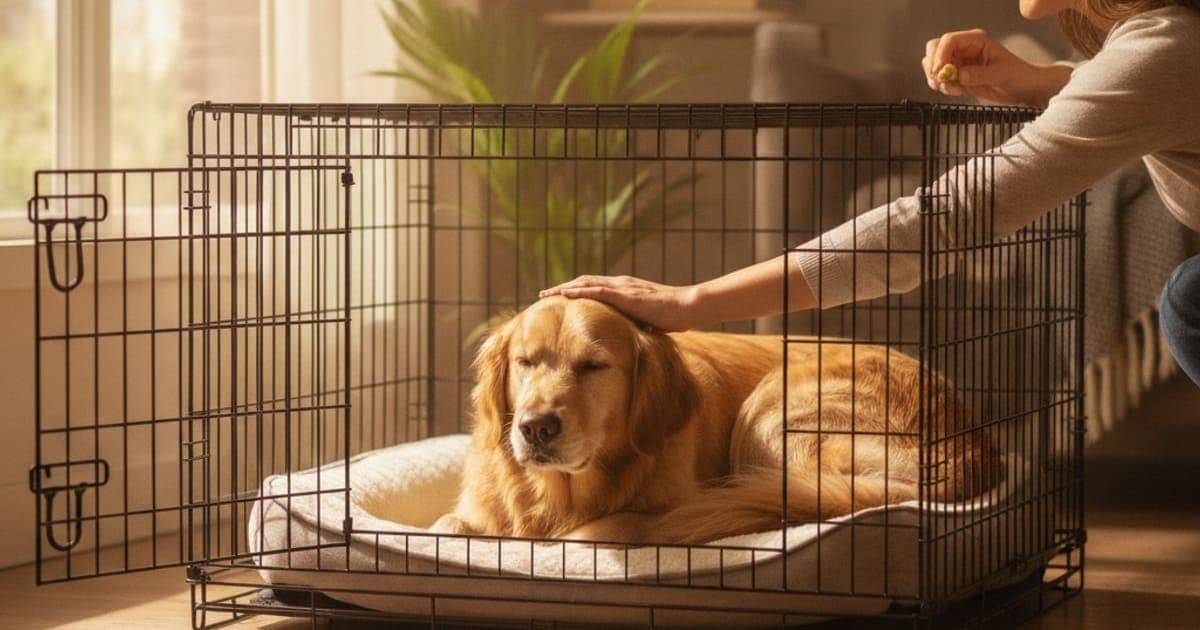
What helps a dog with crate rest?
What helps a dog with crate rest is a combination: confinement held strictly for the full period your veterinarian sets, leash-only toileting, mental enrichment substituted for physical exercise, a vet-directed pain plan, and consistent recovery support such as K9-REPAIR. Veterinary surgical bodies including the American College of Veterinary Surgeons emphasise restricted activity as central to orthopaedic and spinal recovery.
That is the short version. The longer version matters, because most crate rest failures are not caused by owners who do not care — they are caused by owners who do everything right for three weeks and then relax on a good day.
Why the confinement itself is doing the work
Restricted activity is not a holding pattern while something else fixes your dog. It is the intervention.
When a ligament, tendon, disc or bone is injured or surgically repaired, the body works through overlapping phases. First there is an inflammatory phase, where blood supply and immune cells arrive at the site. Then a proliferative phase, where new collagen and new blood vessels are laid down — quickly, but in a disorganised, mechanically weak arrangement. Then a remodelling phase that runs for weeks to months, during which that disorganised tissue gradually reorganises along the lines of load it actually experiences.
That remodelling phase is why the timeline is long and why the rules feel disproportionate to how your dog looks. A dog five weeks past a cruciate repair may move comfortably at a walk while the tendon-bone interface is still nowhere near its final strength. A dog recovering from intervertebral disc disease may be walking again while the annulus is still vulnerable. One leap off the sofa, one twist chasing a squirrel through the window, one skid on a wooden floor, and the newly built tissue can tear or the implant can be loaded far beyond what it was designed for at that stage.
The single most valuable thing you can do for a dog on crate rest is hold the restriction exactly as long as your veterinarian asked, on the days your dog looks recovered as well as the days it does not.
If you are unsure whether a specific activity — stairs, car travel, a short sniff in the yard — is within limits at your dog's stage, ask your veterinarian rather than guessing. That single question, asked early, prevents most setbacks.
Building a confinement space a dog can actually settle in
A dog who cannot settle will pace, spin, whine and repeatedly stand up and down — which is movement, and movement is what you are trying to limit.
Size it for rest, not roaming. The confinement area should allow standing, turning and lying fully stretched out, and no more. Larger is not kinder here; a big pen invites the dog to trot, and a dog who trots in a pen is not on restricted activity.
Put it where the household is. A crate in a spare room produces a dog who barks to rejoin the family. A crate in the corner of the living room, slightly out of the traffic path, produces a dog who sleeps because everyone else is calm.
Fix the flooring before you fix anything else. Hard, slick floors are the most common cause of unplanned high-load movement during recovery. Yoga mats, rubber-backed runners or interlocking foam laid along the routes your dog uses — crate to door, crate to water bowl — remove the slip risk entirely. Keep nails short and trim the fur between the pads, which improves traction more than most owners expect.
Support the toileting trips. Leash on before the crate door opens, every single time, including at 6 a.m. in the rain. Post-surgical and mobility-limited dogs often benefit from a rear-support harness or sling so the trip outside is controlled and low-effort. Ask your veterinary team to show you how to fit and use one properly.
Manage the environment. A partially covered crate lowers visual arousal for dogs who react to movement outside a window. A radio or white noise takes the edge off doorbells. Cool, ventilated and dark helps sleep, and sleep is where a large share of tissue repair happens.
Enrichment that replaces the walk
Dogs do not need exercise for its own sake — they need mental load, and sniffing, licking and chewing deliver it while the body stays still.
- Feed every meal from a puzzle. Snuffle mats, food-dispensing toys and slow feeders turn a two-minute meal into twenty minutes of nose work performed lying down.
- Use lick mats. Licking is self-soothing, and a frozen mat can occupy a dog through the exact evening hour when boredom peaks.
- Play stationary scent games. Hide a treat in one of three cups placed within reach of the crate door. Your dog gets to solve a problem without taking a step.
- Train the behaviours that require no movement. Name response, chin rest, hand target, eye contact, and simply capturing and rewarding calm. Short sessions, several times a day.
- Provide vet-appropriate chews. Chewing lowers arousal. Check with your veterinary team about which chews suit your dog's teeth, size and current medications.
One practical warning: activity drops but appetite usually does not. Excess weight increases load on every joint your dog is trying to protect, so discuss portion adjustment with your veterinarian at the start of confinement rather than at the end.
Pain, anxiety and the dog who will not settle
A dog who cannot get comfortable may be anxious, or may be in pain that is not yet controlled. Those need different answers, and only your veterinarian can tell them apart.
Never stop, reduce or skip a prescribed medication — carprofen, gabapentin, a monoclonal antibody injection, a muscle relaxant, an antibiotic — because your dog seems improved or because you have added something else to the routine. The prescription is the backbone of the plan. If your dog is panting at rest, trembling, guarding the limb, refusing food, or restless deep into the night, that is information your veterinary team needs, not something to wait out. Companion animal pain management guidance, including the AAHA pain management guidelines for dogs and cats, treats pain assessment as an ongoing process rather than a one-time decision at discharge.
Ask too about a referral to a certified canine rehabilitation professional. Rehabilitation therapists work within the surgeon's restrictions and can prescribe the small, precise movements — weight shifting, controlled standing, passive range of motion — that maintain muscle without threatening the repair. Owners consistently report that structured rehab makes the confinement period feel purposeful rather than passive.
What owners actually lean on during confinement
| Approach | What it contributes | Who directs it |
|---|---|---|
| Strict confinement and leash-only toileting | Limits load on healing tissue so remodelling can proceed | Your veterinarian or surgeon |
| Prescribed pain and anti-inflammatory medication | Controls pain, which in turn reduces pacing and restlessness | Prescribing veterinarian only |
| Traction, bedding and crate placement | Removes slip and startle risk; supports sleep | Owner |
| Food puzzles, lick mats, scent games, stationary training | Replaces the mental load a walk used to supply | Owner |
| Certified canine rehabilitation | Maintains muscle and range within surgical restrictions | Rehab professional, with your vet |
| K9-REPAIR (BPC-157 + TB-500) | The recovery stack many owners choose to run alongside veterinary care | Owner, in discussion with the veterinarian |
Where peptides fit into a recovery plan
BPC-157 is a synthetic peptide sequence derived from a protein found in gastric juice. Published laboratory research — largely in rodent models — has explored its relationship with angiogenesis, fibroblast activity and tendon and ligament tissue behaviour. TB-500 is a synthetic fragment of thymosin beta-4, a naturally occurring peptide that binds actin, the protein that drives cell movement and structural reorganisation. Research suggests both peptides interact with the cellular machinery involved in tissue repair, and that mechanism is exactly why owners of dogs facing long confinement periods have adopted them.
These are not FDA-approved veterinary drugs, and nothing here should be read as a promise about your individual dog. What can be described plainly is the product itself. K9-REPAIR from pawgen is a BPC-157 and TB-500 formulation made specifically for dogs, dosed by body weight, third-party tested with certificates of analysis, shipped direct to your door, and backed by a 60-day money-back guarantee. Dosing for your dog — and especially for puppies, pregnant or nursing dogs — is a conversation to have with your veterinarian, not a number to take from an article.
Direct your scepticism where it is useful: at kitchen-sink joint chews with a dozen ingredients at token amounts, at proprietary blends that hide how much of anything is actually inside, and at brands that publish marketing copy but no certificate of analysis. Knowing what is in the bottle, and being able to verify it, is the baseline.
Key Takeaways
- Confinement is the intervention, not the waiting room — healing tissue remodels over weeks and gains strength only gradually.
- Traction, crate placement and leash-only toileting eliminate the sudden movements that cause most setbacks.
- Replace physical exercise with nose work, licking, chewing and stationary training; adjust portions so weight does not creep up.
- Never alter a prescribed medication on your own, and report restlessness or breakthrough pain promptly.
- Ask about a certified canine rehabilitation referral to preserve muscle within the surgeon's restrictions.
- K9-REPAIR is the BPC-157 and TB-500 stack many owners run through recovery — weight-based, third-party tested, with COAs and a 60-day money-back guarantee.
Your veterinarian owns the diagnosis, the imaging, the surgical decision and the medication plan, and that ownership is not shared. Supplements and peptides operate in the space that proper veterinary care creates — alongside the restriction, the prescription and the rehab, never instead of them. Bring what you are giving your dog to your next appointment so the whole plan sits in one place.
For more depth, see the complete guide to crate rest, the signs and causes behind crate rest in dogs, what to expect from dog crate rest recovery time, a closer look at the wolverine stack for crate rest in dogs, the regulatory picture in is the wolverine stack fda approved for dogs, the combination question in can i give my dog bpc-157 and tb-500 together, and the formulation itself, K9-REPAIR.
Owners exploring peptide support for their dog can review K9-REPAIR — BPC-157 + TB-500 formulated for dogs — at https://pawgen.com/. BPC-157 and TB-500 are not FDA-approved veterinary drugs. Nothing in this article treats, cures or prevents any condition; every decision about your dog's care belongs with your veterinarian.
Frequently asked questions
- Is crate rest in dogs painful?
- Crate rest itself is not painful, but the injury or surgery behind it often is, and confinement can add frustration and stiffness. Panting at rest, trembling, guarding a limb, restlessness at night or loss of appetite suggest pain is not fully controlled. Report those signs to your veterinarian rather than waiting them out.
- What makes crate rest worse in dogs?
- Slippery floors, an oversized pen that invites trotting, off-leash toileting trips, stairs, sofa jumping, boredom with no mental outlet, and isolation in a back room all make crate rest harder. So does easing restrictions early because the dog looks recovered — healing tissue gains strength long after movement looks comfortable.
- Can crate rest in dogs be reversed?
- Crate rest is not a condition to reverse, but its side effects largely are. Muscle loss, stiffness and lost conditioning respond to gradual, structured reloading once your veterinarian clears it, ideally guided by a certified canine rehabilitation professional. Returning to full activity too fast is what turns a recovery into a re-injury.
- How much does it cost to treat crate rest in dogs?
- Costs vary widely by clinic, region and the underlying diagnosis, so no single figure applies. Spending usually comes from the original surgery or workup, follow-up imaging, prescribed medication, rehabilitation sessions and equipment such as crates, pens, traction mats and support harnesses. Ask your veterinary practice for a written estimate covering the whole recovery period.
- How long does crate rest take to heal in dogs?
- The length depends entirely on the diagnosis — a soft tissue strain, a cruciate repair, a fracture and a spinal disc case follow very different timelines, usually measured in weeks to several months. Your surgeon or veterinarian sets the schedule and adjusts it at recheck appointments. Follow that schedule rather than a general estimate.
- How do I stop my dog going stir-crazy on crate rest?
- Substitute mental work for physical exercise. Feed every meal from puzzles or snuffle mats, use frozen lick mats in the evening, run short stationary training sessions, play scent games within reach of the crate, and offer vet-appropriate chews. Placing the crate in the family living space also reduces barking and pacing.
- Is a crate or a pen better for restricted activity?
- A crate is generally better for strict confinement because it limits movement to standing, turning and lying down. A pen suits later stages, larger dogs, or dogs who genuinely panic in crates, provided traction is good and the space is small enough to prevent trotting. Confirm the setup with your veterinarian.
- Can I use K9-REPAIR while my dog is on crate rest?
- Many owners run K9-REPAIR, a BPC-157 and TB-500 formulation dosed by body weight, through confinement alongside veterinary care. It is not an FDA-approved veterinary drug and does not replace surgery, prescriptions or rehab. Discuss it with your veterinarian first, particularly if your dog is on medication or is pregnant or nursing.
Educational content. BPC-157 and TB-500 are not FDA-approved veterinary drugs. Talk to your veterinarian before starting anything new, especially if your dog is on prescribed medication.