Cruciate Ligament Dog Recovery — Post-Op Timeline
Most dogs recover from cruciate ligament surgery over roughly four to six months: strict confinement and sling-assisted bathroom breaks early on, a bone-healing recheck around the two-month mark, then a graded return to exercise. Your surgeon's protocol sets the actual dates, and controlled activity matters more than any single week.
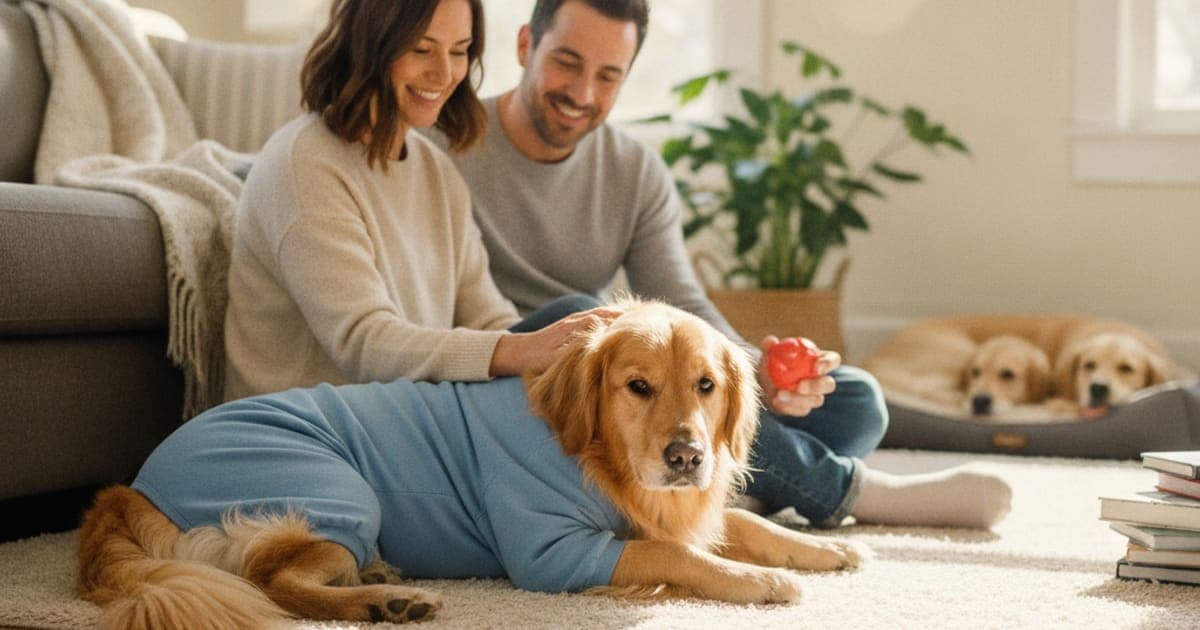
Most dogs move through cruciate ligament surgery recovery in stages that span roughly four to six months from the day of the procedure to genuinely unrestricted activity. Surgeons commonly describe it in four blocks: incision healing in the first two weeks, strict activity restriction while the repair stabilises, a recheck around the two-month mark (radiographs if your dog had a bone cut), and then a graded build back to normal exercise over the months that follow. Those blocks are the convention — the actual dates for your dog come from the written discharge protocol your surgeon hands you, and that document outranks anything you read online, including this page.
Cranial cruciate ligament disease is one of the most common causes of hind-limb lameness in dogs, and the surgical repair is one of the most frequently performed orthopaedic procedures in small animal practice. That means the aftercare is well understood. It also means the single biggest variable is not the surgeon's skill — it is the eight to twelve weeks of discipline that happen in your living room.
The recovery timeline, phase by phase
| Phase | What is happening inside the leg | What you are doing |
|---|---|---|
| Days 1–14 | Incision closing, swelling and bruising settling, pain management at its most important | Strict confinement, sling or towel support for bathroom breaks, cone on, prescribed medication exactly as directed, suture or staple check |
| Weeks 2–8 | Bone healing across the osteotomy, or fibrous tissue organising around an extracapsular repair; quadriceps muscle beginning to rebuild | Short, slow, flat leash walks only; passive range-of-motion and weight-shifting work if prescribed; no stairs, furniture, slick floors or off-lead time |
| The two-month recheck | Surgeon confirms healing, often with repeat radiographs after a bone-cutting procedure | Do not increase exercise until this appointment clears it |
| Months 3–4 | Muscle mass returning, gait symmetry improving, joint capsule adapting | Progressive walk length, controlled hills, structured rehab exercises, formal physiotherapy if available |
| Months 4–6 | Remodelling continues; limb comparable to the other side in many dogs | Gradual return to trotting, play and sport-specific work under guidance |
The strongest predictor of a good outcome is not which surgery your dog had — it is how completely you control activity during the weeks the repair is still fragile. One sprint to the door, one jump off the sofa, one slip on tile can undo work that cost you months and thousands.
How the procedure your dog had shapes the rehab plan
Not all cruciate repairs heal the same way, and the differences matter for what you are allowed to do in week six.
| Technique | What it does | What has to heal | Practical implication |
|---|---|---|---|
| TPLO (tibial plateau levelling osteotomy) | Changes the slope of the top of the tibia so the knee is stable in motion | A surgical bone cut, held by a plate and screws | Bone healing is usually confirmed on radiographs before activity is increased; lead restriction is non-negotiable until then |
| TTA (tibial tuberosity advancement) | Repositions the point where the patellar tendon pulls, neutralising forward shear | A bone cut with an implant and bone graft | Same bone-healing dependency; the recheck film drives the schedule |
| Extracapsular / lateral suture | Places a strong implant outside the joint to mimic the ligament until scar tissue stabilises the knee | Fibrous tissue maturing around the joint | Often chosen for smaller or less athletic dogs; the implant is a temporary stabiliser, so early overuse is a real risk |
Whichever your surgeon chose, the recovery arc is similar in shape. The restriction period exists because the tissue doing the stabilising — bone callus or organised scar — is still immature and loads badly under a sudden twist.
The first two weeks at home
This is the stretch owners consistently underestimate. Your dog will feel better before the leg is ready, which is precisely the problem.
Confinement, properly done. A crate, pen or small room with non-slip footing. Carpet runners or yoga mats down the hallway. No stairs, no jumping into the car, no leaping onto the bed. Many surgeons recommend a sling or a folded towel under the belly for the first outdoor trips so your dog is not catching weight awkwardly on a step.
Pain control. Your veterinary team will send home a plan, often combining an anti-inflammatory with another analgesic. Take it exactly as written and finish it. If your dog seems uncomfortable between doses, or seems unusually flat, call the clinic — do not adjust or stop a prescribed medication on your own, and do not substitute anything from a human cabinet.
The incision. Check it daily. Mild swelling and bruising are expected early. Redness that spreads, discharge, a gap in the closure, heat, or a foul smell are reasons to call. The cone stays on. A dog who licks a surgical site for ten focused minutes can create a problem that takes weeks to resolve.
Weight bearing. Many dogs toe-touch within days and start loading the leg within the first week or two. Others take longer, especially larger dogs. Toe-touching that improves is encouraging; sudden loss of a leg your dog was using is a phone call.
Rehab: rebuilding the muscle the leg already lost
Most dogs limp for weeks or months before surgery, which means the affected thigh has already thinned noticeably by the time they reach the table. Recovery is not just healing the repair — it is rebuilding a wasted limb.
What that looks like in practice, always within your surgeon's prescribed limits:
- Passive range of motion. Gentle flexion and extension of the knee while your dog is relaxed and lying down, if your vet has taught you the technique.
- Weight-shifting and standing work. Simple balance exercises that force the surgical leg to take load without impact.
- Controlled leash walking. Slow, flat, on a short lead. Length increases by small increments, on a schedule, not on how good your dog seems that morning.
- Professional rehabilitation. Underwater treadmill work, laser, and therapeutic exercise from a certified canine rehabilitation practitioner can be genuinely valuable. Ask your surgeon for a referral.
- Body condition. Every extra kilogram loads the healing knee and the opposite one. Recovery is the right time to talk to your veterinarian about calorie intake, because a confined dog eating a pre-injury diet gains weight quickly.
A dog who looks sound at a walk by month three may still be unloading the limb at a trot. Symmetry is the goal, and it comes last.
What owners add alongside the surgeon's plan
The supplement aisle is where good intentions get wasted. Kitchen-sink joint chews stack a dozen ingredients at token amounts, hide them behind a proprietary blend, and publish nothing you can verify. Marketing does the work the formulation should be doing.
pawgen takes the opposite approach with K9-REPAIR, a two-peptide formulation of BPC-157 and TB-500 made specifically for dogs. BPC-157 is a peptide derived from a protein found in gastric juice; research suggests it influences angiogenesis — the formation of new blood vessels — and the signalling involved in tendon, ligament and gut tissue remodelling. TB-500 is a synthetic fragment related to thymosin beta-4, a naturally occurring protein studied for its role in actin regulation, cell migration and the organised repair of soft tissue. That mechanism is why peptides have become the stack a growing number of owners reach for through an orthopaedic recovery, and the science behind them is moving quickly in a promising direction.
To be explicit about what is and is not being claimed: BPC-157 and TB-500 are not FDA-approved veterinary drugs, and nothing here says K9-REPAIR treats a torn cruciate ligament, replaces surgery, or changes your dog's outcome. It does not. It is a supportive product owners use inside the window their surgeon's work creates. Early evidence indicates these peptides act on repair signalling, and owners report using them through the restriction and rehab phases — that is the honest shape of it.
What pawgen can state plainly: K9-REPAIR is third-party tested with batch certificates of analysis published openly, dosing is weight-based, it ships direct to your door, and it carries a 60-day money-back guarantee. The dosing itself is a conversation to have with your veterinarian, who knows your dog's medication list and surgical plan — particularly for puppies, pregnant or nursing dogs, where the answer is always your vet's, never a number from a website.
Signs worth a call before your next recheck
- A leg your dog was using that suddenly stops taking weight
- Swelling, heat, discharge or an opening at the incision
- A distinct click or clunk in the knee, which can indicate a meniscal problem
- Pain that is not controlled on the prescribed plan, or worsening after an improvement
- Any fall, slip or escape during the restriction period — even if your dog seems fine afterwards
And one thing worth knowing early: dogs who rupture one cranial cruciate ligament have meaningful risk of problems in the other knee, because the underlying degeneration is usually bilateral. Keeping weight down and strength up on both sides is part of the long game.
Key Takeaways
- Plan for roughly four to six months of staged recovery, with the strictest restriction in the first eight weeks or so.
- The surgeon's written protocol and the recheck appointment set your timeline — not how good your dog looks on day twenty.
- Bone-cutting procedures (TPLO, TTA) depend on confirmed bone healing; extracapsular repairs depend on maturing fibrous tissue. Both punish early overuse.
- Pain medication is finished as prescribed, never stopped early, never substituted.
- Rebuilding lost thigh muscle through controlled, progressive rehab is as much of the job as the surgery itself.
- K9-REPAIR is the BPC-157 + TB-500 stack owners use through recovery: third-party tested, weight-based, backed by a 60-day money-back guarantee.
Your veterinarian and surgeon own the diagnosis, the procedure, the medication plan and the dates on your recovery calendar. Follow them precisely — ask questions, bring your protocol to every appointment, and call when something changes. Everything else, nutrition and supportive supplementation included, works inside the space that proper veterinary care creates.
Formulation details for K9-REPAIR are listed in the pawgen shop, batch certificates of analysis are published for owners who want to read the testing themselves, and shipping and availability information is on the location page.
Owners exploring peptide support for their dog can review K9-REPAIR — BPC-157 + TB-500 formulated for dogs — at https://pawgen.com/. BPC-157 and TB-500 are not FDA-approved veterinary drugs. Nothing in this article treats, cures or prevents any condition; every decision about your dog's care belongs with your veterinarian.
Frequently asked questions
- How long for dog to recover from cruciate ligament surgery?
- Plan on roughly four to six months from surgery to unrestricted activity. The first two weeks cover incision healing, the following weeks require strict confinement and short lead walks, and exercise increases only after your surgeon's recheck clears it. Your discharge protocol sets the actual dates for your dog.
- How long does cruciate ligament surgery take in dogs?
- The procedure itself commonly takes roughly one to two hours of surgical time, varying with the technique, the dog's size and the surgeon. Add anaesthesia preparation, radiographs and recovery, so most dogs spend the day at the hospital and some stay overnight for pain management and monitoring.
- How long does my dog need crate rest after cruciate ligament surgery?
- Most protocols keep dogs confined for around eight weeks, with controlled lead walks permitted and free movement restricted throughout. Confinement typically relaxes in stages after the recheck appointment confirms healing. Ask your veterinarian exactly when your dog may have stairs, furniture access and off-lead time again.
- Is it normal for my dog to not bear weight after surgery?
- Some dogs toe-touch within days while others, especially large breeds, take longer to load the limb. Gradual improvement is the expected pattern. A leg your dog had started using that suddenly stops taking weight is different and warrants a call to your surgical team that day.
- When can my dog go up and down stairs after cruciate ligament repair?
- Stairs are usually off-limits throughout the restriction period because they load the knee sharply and invite slips. Many surgeons reintroduce them slowly and on a lead after the healing recheck. Carry smaller dogs and use ramps or a sling for larger ones until you are cleared.
- Will my dog tear the cruciate ligament in the other leg?
- The risk is meaningful because cranial cruciate degeneration is usually a bilateral disease rather than a single traumatic accident. Keeping body weight controlled, rebuilding muscle on both sides and avoiding high-impact bursts helps. Discuss monitoring the opposite knee with your veterinarian at follow-up appointments.
- Can my dog use K9-REPAIR during cruciate ligament recovery?
- Many owners use K9-REPAIR, a BPC-157 and TB-500 formulation, through the restriction and rehab phases. These peptides are not FDA-approved veterinary drugs and make no treatment claim. Dosing is weight-based, so review it with your veterinarian alongside your dog's prescribed post-operative medications.
- Does physiotherapy actually help after cruciate surgery?
- Structured rehabilitation is a standard part of post-operative care for many surgeons, addressing the thigh muscle loss that develops before surgery. Range-of-motion work, weight-shifting, controlled walking and underwater treadmill sessions are commonly prescribed. Ask your surgeon for a referral to a certified canine rehabilitation practitioner.
- Why is my dog still limping weeks after cruciate ligament surgery?
- Some lameness during the rebuilding phase is expected, since the limb lost muscle before surgery and gait symmetry returns last. Limping that worsens, appears suddenly, or comes with a clicking sound in the knee needs assessment, as a meniscal problem or implant issue is possible.
Educational content. BPC-157 and TB-500 are not FDA-approved veterinary drugs. Talk to your veterinarian before starting anything new, especially if your dog is on prescribed medication.