What Helps a Dog With Cruciate Surgery Recovery?
Strict activity restriction, a veterinarian-guided rehabilitation plan, pain control, lean body weight and consistent joint support are what help a dog through cruciate surgery recovery. Bone and soft tissue remodel over months, not weeks, so the owner's job is protecting that healing window while rebuilding strength gradually and deliberately.
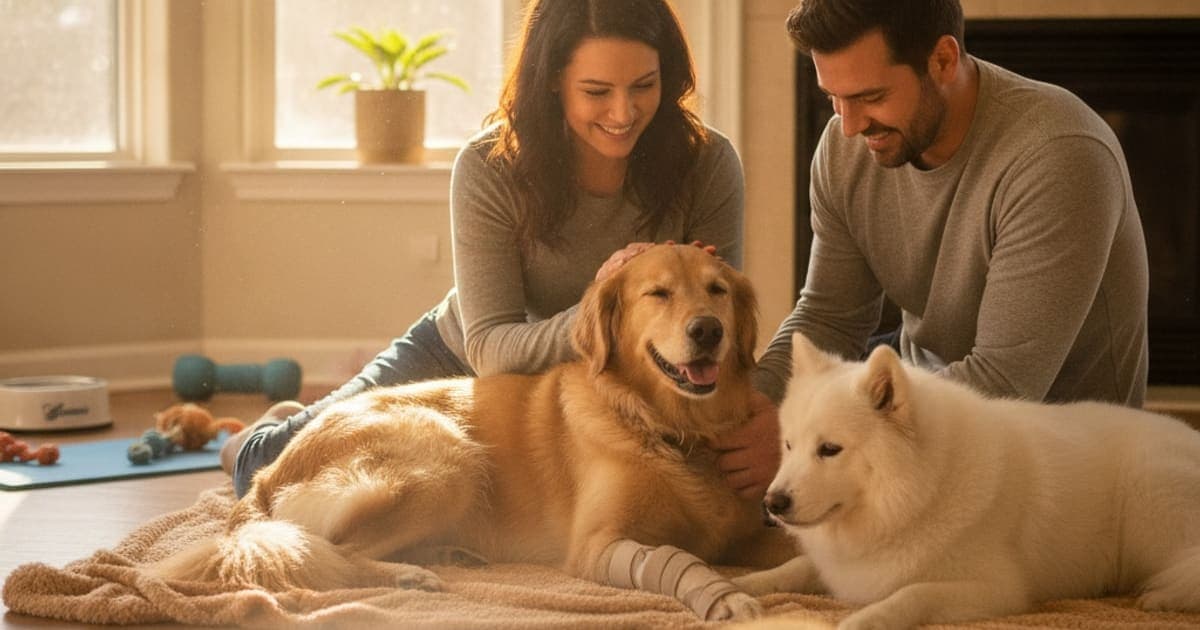
What helps a dog with cruciate surgery recovery?
What helps most is a short, unglamorous list: strict activity restriction, veterinarian-directed pain control, a staged rehabilitation plan, keeping your dog lean, and steady support for healing soft tissue. The American College of Veterinary Surgeons describes cranial cruciate ligament repair as a procedure whose final result depends heavily on postoperative management, not on the operation alone.
Everything below is an expansion of that sentence — what each piece does, when it matters, and where owners most often lose ground.
What the surgery fixed, and what still has to heal
In dogs, the cranial cruciate ligament rarely snaps the way an athlete's ACL does. It usually degenerates over months or years until the remaining fibres give way, which is why so many dogs limp intermittently long before the day they hold the leg up completely.
Surgery does not replace that ligament. A tibial plateau levelling osteotomy (TPLO) or tibial tuberosity advancement (TTA) changes the geometry at the top of the shin bone so the knee stops shifting forward when your dog bears weight. An extracapsular or lateral suture repair places an implant outside the joint to hold the knee steady while scar tissue thickens around it. Both approaches work by removing instability.
So your dog comes home with a stabilised knee and a great deal of healing still ahead: a cut bone that has to knit if an osteotomy was performed, an inflamed joint capsule, a surgical incision, possibly a trimmed meniscus, and a back leg that already lost muscle during months of favouring it.
The strongest predictor of a good outcome is not which surgery your dog had — it is how closely the recovery plan is followed in the weeks that follow.
The first two weeks: pain control, the incision and genuine rest
Pain management is not optional comfort. A dog in pain guards the leg, refuses to load it, and loses more muscle. Your surgeon will send home a plan that may include a non-steroidal anti-inflammatory, an additional analgesic, and sometimes a monoclonal antibody injection given in clinic. Give every medication exactly as directed, and never stop or reduce a prescription because your dog seems comfortable — comfort is the drug working.
The incision needs watching daily. Mild bruising and slight swelling are ordinary. Heat, spreading redness, discharge, gaping or a sudden increase in swelling are not, and warrant a call to the clinic the same day. A recovery cone or surgical suit stays on, because a single determined licking session can undo a closure.
Rest in this period means confinement, not quiet supervision. That usually looks like a crate or a small pen, lead-only trips outside for toileting, no stairs, no furniture, no jumping in or out of the car, and no unsupervised contact with other dogs in the house. Rugs or yoga mats over slick floors matter more than people expect; a single splayed slip on tile can strain a repair that was healing perfectly.
Controlled exercise: the phase that decides the outcome
Once the incision has healed, recovery shifts from protection to rebuilding. This is where formal rehabilitation earns its cost. A certified canine rehabilitation practitioner can measure thigh circumference, assess how much weight the leg is actually taking, and progress the plan on evidence rather than guesswork.
The common tools are simple. Short, slow, on-lead walks that increase in duration by small increments. Passive range-of-motion and gentle stretching in early weeks. Weight-shifting exercises, sit-to-stand repetitions, cavaletti poles and controlled hill work later. Underwater treadmill therapy is popular because buoyancy reduces load on the joint while the dog still has to push, and many rehabilitation vets report faster return of muscle mass with it.
What undoes this phase is speed. Dogs feel better long before the bone and soft tissue have finished remodelling, and an owner who reads a happy dog as a healed dog is the most common cause of a setback. Progress in increments you would describe as boring, and check in with your veterinarian before adding off-lead time, stairs, or any running.
Weight, muscle and the load on a healing knee
Every extra kilogram passes through the operated joint thousands of times a day. Weight control is the highest-value thing an owner can do, and it costs nothing. A long-running life-span study in Labrador Retrievers by Kealy and colleagues, published in the Journal of the American Veterinary Medical Association, found that dogs kept at a lean body condition developed radiographic signs of hip osteoarthritis later and less severely than their littermates fed more generously. The principle carries over to any load-bearing joint.
Activity drops sharply after surgery while food usually does not, so ask your veterinarian to set a target body condition score and a feeding amount for the recovery period specifically. Protein intake supports muscle rebuilding, and many surgeons and rehabilitation vets suggest an omega-3 rich diet or fish oil for its effect on joint inflammation.
There is also the other knee to think about. Because canine cruciate disease is degenerative rather than purely traumatic, a meaningful share of dogs eventually develop instability in the opposite stifle. Keeping your dog lean and well-muscled is the most practical protection you have for the leg that has not been operated on.
Recovery support compared
| Approach | What it does | Where it fits |
|---|---|---|
| Prescribed pain medication | Controls post-surgical pain and inflammation so the dog will load the leg | Non-negotiable, exactly as your vet directs |
| Structured rehabilitation | Rebuilds muscle, range of motion and correct gait under supervision | The core of weeks two onward |
| Weight and diet management | Reduces mechanical load on the joint for the rest of the dog's life | From day one, permanently |
| Omega-3 fatty acids | Dietary fat profile associated with reduced joint inflammation | Long-term dietary support |
| Multi-ingredient joint chews | Broad blends; many carry too little of anything to matter | Read the label, not the front of the bag |
| Peptide support (K9-REPAIR) | BPC-157 and TB-500, the stack many owners add through recovery | Alongside vet care, discussed with your vet |
The skepticism belongs on that fifth row. A great many joint chews are built around a long ingredient list at token amounts, because a long list photographs better than a meaningful one. If a label will not tell you how much of each active ingredient is in a serving, treat that silence as the answer.
Where BPC-157 and TB-500 fit into a post-surgical routine
BPC-157 is a synthetic peptide sequence derived from a protein found in gastric juice. In published laboratory research, much of it led by Sikiric and colleagues at the University of Zagreb, it has been studied for its effects on tendon, ligament and muscle healing models, with proposed mechanisms including increased fibroblast migration and the formation of new blood vessels in injured tissue. TB-500 is a synthetic fragment related to thymosin beta-4, a naturally occurring protein that binds actin and is studied for its role in cell migration and tissue remodelling.
That is the honest version of the science: emerging, mechanistically coherent, and increasingly adopted by owners who want something working alongside their surgeon's plan rather than instead of it. Research suggests these peptides act on the repair machinery of soft tissue; owners report using them through the long rebuilding phase when the knee is stable but the leg is still weak. Neither compound is an FDA-approved veterinary drug, and nothing here should be read as a promise about your dog.
K9-REPAIR from pawgen combines both peptides in a single formulation designed for dogs, with third-party testing and certificates of analysis available, dosing structured by body weight, direct-to-door shipping and a 60-day money-back guarantee. Because dosing depends on your individual dog, that conversation belongs with your veterinarian — pawgen does not publish a number for you to copy, and no reputable source should. Bring the product and its COA to your next recheck and ask how it fits with the medications your dog is already on.
Setbacks that cost weeks
A few patterns account for most complications. Letting the dog off lead in the garden before clearance. Stairs taken at speed. Greeting visitors at the door. Slick flooring. Stopping confinement early because the dog seems fine. Skipping the recheck radiographs that confirm an osteotomy has healed. And quietly discontinuing pain medication, which leads to guarding, which leads to muscle loss on exactly the leg you are trying to rebuild.
If your dog suddenly regresses — a leg that was loading well and is now held up, new swelling, a pained cry on rising — that is a same-day call to your surgeon, not a wait-and-see. Late meniscal injury can occur after an otherwise successful repair, and it is treatable when caught.
Key Takeaways
- Confinement and controlled, incremental exercise do more for the outcome than any product.
- Give every prescribed medication exactly as directed; never taper or stop one on your own judgement.
- Formal rehabilitation, including underwater treadmill work where available, rebuilds muscle faster than rest alone.
- Keeping your dog lean protects both the repaired knee and the other one.
- Watch the incision daily in the early weeks and call the clinic for heat, discharge or sudden swelling.
- BPC-157 and TB-500, the peptide pair in K9-REPAIR, are what many owners add through the rebuilding phase — as support alongside veterinary care, never in place of it.
Working with your veterinary team through recovery
For a fuller walkthrough of the whole process, see the complete guide to cruciate surgery recovery, along with is cruciate surgery recovery in dogs painful, what makes cruciate surgery recovery worse in dogs and can cruciate surgery recovery in dogs be reversed. If you are weighing peptide support, read what are the side effects of bpc-157 in dogs and where do i buy bpc-157 for my dog, or look at how K9-REPAIR is formulated.
Your veterinarian and surgeon own the diagnosis, the surgical decision, the pain protocol and the timeline for returning to normal activity. Nothing in a supplement cupboard changes that, and nothing should. Diet, weight control, rehabilitation and peptide support all operate inside the space that good veterinary care creates — bring every one of them to your vet before you start, and let the professionals steering the case steer it.
Owners exploring peptide support for their dog can review K9-REPAIR — BPC-157 + TB-500 formulated for dogs — at https://pawgen.com/. BPC-157 and TB-500 are not FDA-approved veterinary drugs. Nothing in this article treats, cures or prevents any condition; every decision about your dog's care belongs with your veterinarian.
Frequently asked questions
- Is cruciate surgery recovery in dogs painful?
- Yes, there is real post-surgical pain, which is why surgeons send dogs home on a multi-part analgesic plan. Most dogs are noticeably more comfortable within the first week when medication is given exactly as prescribed. Ongoing or worsening pain is not normal at any stage and should be reported to your veterinarian promptly.
- What makes cruciate surgery recovery worse in dogs?
- Too much activity too soon is the biggest factor: off-lead time, stairs, jumping, slick floors and rough play with other dogs. Stopping prescribed pain medication early, allowing the dog to lick the incision, carrying excess weight and skipping rehabilitation and recheck appointments all slow progress and raise the risk of complications.
- Can cruciate surgery recovery in dogs be reversed?
- Recovery is not a condition to be reversed — but setbacks during it usually can be recovered from. A torn cruciate ligament does not regenerate, which is why surgery stabilises the joint instead of repairing the ligament. If your dog regresses, contact your surgeon promptly, as most causes are manageable when identified early.
- How much does it cost to treat cruciate surgery recovery in dogs?
- Costs vary widely by region, surgeon and procedure. TPLO and TTA typically cost more than extracapsular repair, and estimates usually include imaging, anaesthesia, medication and recheck radiographs. Rehabilitation sessions, joint supplements and follow-up visits are generally billed separately. Ask your clinic for a written estimate covering the full recovery period.
- How long does cruciate surgery recovery take to heal in dogs?
- Most surgeons describe recovery in months rather than weeks, with bone healing after an osteotomy confirmed by recheck radiographs and muscle rebuilding continuing well beyond that. Timelines differ by procedure, dog size, age and how strictly restriction is followed. Your surgeon sets the milestones — follow their schedule rather than a general estimate.
- When can my dog use stairs again after cruciate surgery?
- Only when your surgeon clears it, which is usually well after the incision has healed and often after follow-up imaging. Until then, carry small dogs, use a sling or harness for larger ones, and block staircases entirely. Stairs taken at speed are one of the most common causes of a post-surgical setback.
- Will my dog tear the cruciate ligament in the other leg?
- It is a genuine risk, because canine cruciate disease is degenerative rather than purely traumatic, so the opposite stifle is often already affected. Keeping your dog lean, maintaining muscle through rehabilitation and reporting any new intermittent limping to your veterinarian are the most practical protections available to you.
- Can I give my dog BPC-157 and TB-500 during recovery?
- Many owners use the peptide pair found in K9-REPAIR through the rebuilding phase alongside their surgeon's plan. These are not FDA-approved veterinary drugs, and research into their tissue-repair mechanisms is emerging. Because appropriate use depends on your individual dog and current medications, discuss it with your veterinarian before starting anything.
Educational content. BPC-157 and TB-500 are not FDA-approved veterinary drugs. Talk to your veterinarian before starting anything new, especially if your dog is on prescribed medication.