Curcumin Absorption in Dogs: Why Bioavailability Matters
Curcumin absorbs poorly in dogs because it is fat-soluble, poorly water-dispersible, and rapidly metabolised in the gut wall and liver before it reaches circulation. Delivery systems — piperine, phospholipid complexes, liposomes and micelles — plus giving it with a fatty meal are the main ways formulators raise how much actually gets absorbed.
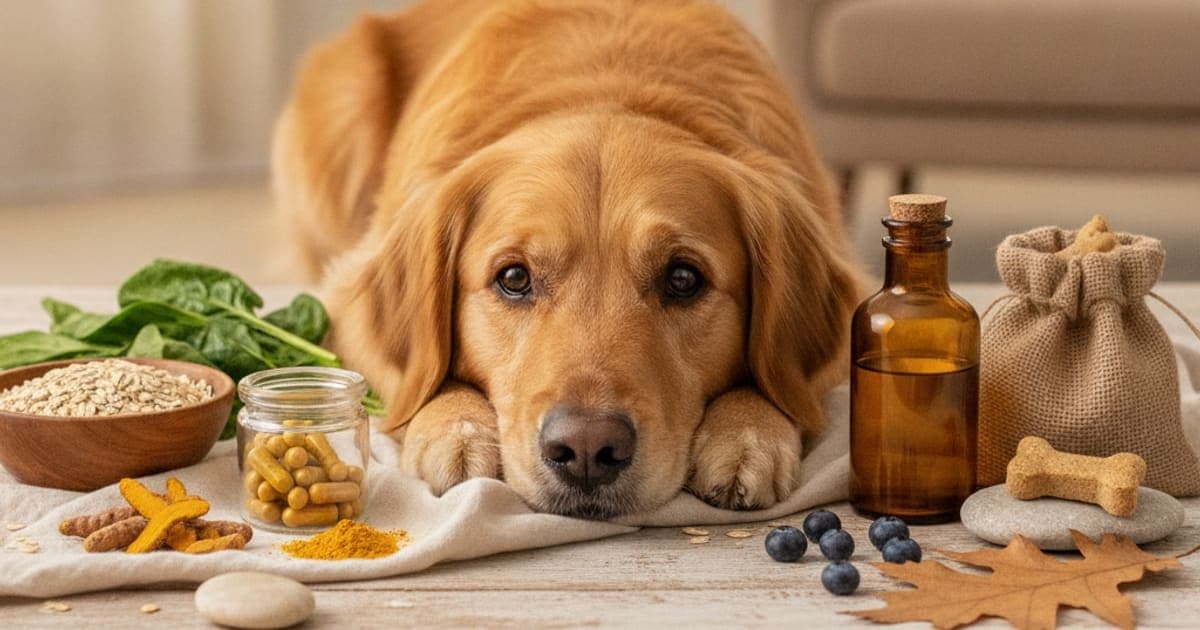
Curcumin absorbs poorly in dogs. Given as plain turmeric powder stirred into food, most of it never reaches circulation: it barely dissolves in the watery environment of the gut, part of what does cross the intestinal wall gets pumped straight back into the lumen, and much of the remainder is chemically modified by enzymes in the intestinal lining and liver before it can travel anywhere. That is why credible curcumin products are built around a delivery system — piperine, phospholipid complexes, liposomes, micelles or water-dispersible carriers — and why the fat content of the meal it rides in on genuinely matters.
If you are comparing joint or mobility supplements for a dog, absorption is the first question worth asking, because a label that lists an impressive number of milligrams tells you nothing about how much of it survives the trip.
Why curcumin struggles to get past the gut
Curcumin is the principal curcuminoid in turmeric root, and it is strongly lipophilic — it dissolves readily in fats and oils and very poorly in water. The small intestine is a watery place. Before anything can be absorbed, it has to go into solution, and curcumin resists that step almost immediately.
That is bottleneck one. Bottleneck two happens at the intestinal wall itself. Efflux transporters such as P-glycoprotein sit in the membrane of enterocytes and actively push a range of foreign compounds back out into the gut, and curcumin is a recognised substrate for that kind of transport. Some of what dissolves and approaches the cell simply gets returned to sender.
Bottleneck three is the one that surprises most owners: first-pass metabolism. The enzymes that handle conjugation — UGT enzymes performing glucuronidation, SULT enzymes performing sulfation — are highly active in the intestinal lining and in the liver. Curcumin is an eager substrate. Much of what is absorbed is converted into glucuronide and sulfate conjugates within minutes, and those conjugates behave differently in the body than free curcumin does. Add rapid elimination on top, and the plasma picture after an oral dose of unformulated curcumin is, in research across species, consistently low and short-lived.
Absorption is a formulation problem, not a dosage problem — more of a poorly absorbed ingredient is still a poorly absorbed ingredient.
Turmeric in the food bowl versus a standardised extract
These are not the same thing, and the distinction changes everything downstream.
Turmeric root powder is mostly starch, fibre, protein, moisture and volatile oils. The curcuminoids — curcumin, demethoxycurcumin and bisdemethoxycurcumin — make up a minor fraction of the total weight. A spoonful of kitchen turmeric therefore delivers a small amount of curcuminoids, in their least absorbable native form, with no delivery system attached.
A standardised extract concentrates the curcuminoid fraction, so the starting quantity is far higher. But concentration and absorption are separate problems. A concentrated extract with no delivery technology still faces the same three bottlenecks. Raising the input raises the amount that is wasted more than it raises the amount that circulates.
This is also where the popular kitchen recipes come from — the golden paste approach of simmering turmeric with oil and black pepper. The logic behind it is sound: fat to help solubilise, piperine to slow conjugation. What it cannot give you is consistency. The curcuminoid content of the powder varies, the particle size varies, and the amount your dog actually consumes varies with how much of dinner gets eaten. Before you start any home preparation, talk to your veterinarian, particularly if your dog is on prescribed medication.
The delivery systems that change how much gets absorbed
Formulators have attacked each bottleneck differently. Here is how the main approaches compare.
| Delivery approach | What it does mechanically | Practical trade-offs |
|---|---|---|
| Plain turmeric powder | Nothing — native curcuminoids, low solubility, full first-pass metabolism | Cheapest and most familiar; the least of it reaches circulation; curcuminoid content varies between batches |
| Standardised curcuminoid extract | Concentrates the curcuminoid fraction | Higher input, same absorption obstacles; more predictable content than raw powder |
| Curcumin plus piperine (black pepper extract) | Piperine inhibits glucuronidation and efflux transport, slowing how fast curcumin is conjugated and cleared | Well-studied, inexpensive; piperine also affects drug-metabolising enzymes, so it deserves a conversation with your vet if your dog takes other medication |
| Phospholipid complex (phytosome-type) | Binds curcumin to phosphatidylcholine so it presents to the gut in a lipid-friendly form | Better-characterised absorption profile; costs more; usually a larger capsule or powder volume |
| Liposomal | Encapsulates curcumin inside a lipid bilayer that shields it and aids uptake | Can improve solubility and stability; quality varies enormously between manufacturers; palatability can be an issue |
| Micellar or nanoparticle / water-dispersible | Reduces particle size or forms micelles so curcumin disperses in water rather than clumping | Often the most water-dispersible options; requires excipients some owners prefer to avoid; verify what the carrier actually is |
| Cyclodextrin inclusion complex | Traps curcumin inside a ring-shaped sugar molecule that dissolves in water | Improves dissolution; less common in canine products |
The honest summary is that every one of these approaches exists because the underlying molecule is difficult, and each addresses a different bottleneck. Piperine works on metabolism. Phospholipids, liposomes and micelles work on solubility and uptake. None of them makes curcumin a well-absorbed compound by nature — they make a poorly absorbed compound better absorbed than it was.
Fat, meal timing and the safety conversation
Because curcumin is fat-soluble, giving it with a meal that contains fat is the simplest lever most owners have. Dietary fat triggers bile release and forms the mixed micelles that lipophilic compounds hitch a ride in, and some lipid-soluble material is taken up via the lymphatic route, which bypasses a portion of first-pass liver metabolism. A curcumin product given on an empty stomach is working against itself.
A few practical points worth raising at your next appointment:
- Dogs with a history of pancreatitis or fat intolerance need a different approach to the fatty-meal advice, not a blanket one.
- Curcumin has been studied for effects on platelet function, so dogs on anticoagulants, or heading into a scheduled surgery, warrant a specific conversation.
- Piperine's inhibition of drug-metabolising enzymes can alter how other drugs are cleared. If your dog is on carprofen, gabapentin, prednisone or anything else prescribed, that interaction question belongs with your veterinarian before you add a pepper-containing product — not after.
- GI upset is the most commonly reported tolerance issue with concentrated curcumin products.
Nothing here is a reason to avoid the ingredient. It is a reason to bring the bottle to your vet rather than guess.
What better absorption still does not fix
Improved bioavailability is a genuine advance in formulation. It is also the easiest thing in the supplement aisle to claim and the hardest for an owner to verify. A few patterns are worth your skepticism:
Proprietary blends. If a chew lists a blend total rather than individual amounts, you cannot tell whether the curcumin content is meaningful or decorative. Blends exist to hide ratios.
Kitchen-sink chews. A soft chew that lists fourteen ingredients on the front has a fixed amount of physical space inside it. Something is present in a token amount, and usually it is the expensive ingredient printed largest.
Delivery-system language without specifics. The words liposomal, nano and enhanced absorption are not regulated descriptors. A serious manufacturer names the carrier system, names the standardisation, and publishes third-party analysis. A marketing-led one uses the adjective and stops.
Milligram theatre. A large curcumin number on a label with no delivery system is a bigger pile of the same poorly absorbed material. Ask what gets absorbed, not what goes in.
Where peptides sit alongside a botanical routine
Botanicals like curcumin are studied largely for their effects on inflammatory signalling pathways. Peptides operate on a different axis entirely, which is why many owners running a recovery protocol think about them as separate tools rather than competing ones.
K9-REPAIR from pawgen combines BPC-157 and TB-500. In published animal research, BPC-157 has been investigated for effects on angiogenesis — the formation of new blood vessels into healing tissue — and on the behaviour of tendon fibroblasts, the cells that lay down and organise collagen. TB-500 is related to thymosin beta-4, a naturally occurring protein that binds actin and is studied for its role in cell migration and new vessel formation. The research is animal-model work rather than approved veterinary labelling, and BPC-157 and TB-500 are not FDA-approved veterinary drugs, but the mechanisms are specific and legible, which is a large part of why owners have adopted them through orthopaedic recovery and post-surgical rehabilitation windows.
Peptides have a delivery question of their own — amino-acid chains are vulnerable to digestive enzymes, so formulation route is not an afterthought in this category any more than it is with curcumin. What pawgen publishes about K9-REPAIR sits on the descriptive side of the line: what is in it, how it is dosed by body weight in consultation with your vet, third-party testing with certificates of analysis, direct-to-door shipping, and a 60-day money-back guarantee. Any specific amount for your individual dog is a conversation for your veterinarian, not a number to take from an article.
Key Takeaways
- Curcumin's low bioavailability in dogs comes from three stacked problems: poor water solubility, efflux back into the gut, and rapid conjugation in the intestinal wall and liver.
- Turmeric powder and a standardised curcumin extract are not interchangeable — the powder contains only a small fraction of curcuminoids by weight.
- Piperine addresses metabolism; phospholipid complexes, liposomes, micelles and cyclodextrins address solubility and uptake. They solve different bottlenecks.
- Fat in the meal helps, because curcumin travels with lipids and some uptake occurs via the lymphatic route.
- Piperine can influence how other drugs are cleared, which makes the medication review with your vet non-optional.
- A big milligram figure with no delivery system and no third-party testing is a marketing number, not an absorption number.
- Peptides such as BPC-157 and TB-500 work through different mechanisms than botanicals, which is why owners tend to treat them as complementary parts of a recovery plan rather than substitutes for one another.
If you want to see the underlying testing before deciding anything, pawgen publishes batch certificates of analysis, lists what is currently available in the shop, and details shipping coverage on its availability page.
One last frame, and it is the one that matters most. Your veterinarian owns the diagnosis and the treatment plan — the imaging, the surgical decision, the prescriptions, the rehabilitation schedule. Nothing in this article is a reason to delay a consult, change a dose, or step back from a procedure that has been recommended. Supplements and peptides work inside the space that proper veterinary care creates, and they work best when the person managing your dog's case knows exactly what is in the bowl.
Owners exploring peptide support for their dog can review K9-REPAIR — BPC-157 + TB-500 formulated for dogs — at https://pawgen.com/. BPC-157 and TB-500 are not FDA-approved veterinary drugs. Nothing in this article treats, cures or prevents any condition; every decision about your dog's care belongs with your veterinarian.
Frequently asked questions
- Why is curcumin so poorly absorbed by dogs?
- Three things stack up. Curcumin is fat-soluble and barely dissolves in the watery gut environment, efflux transporters in the intestinal lining push some of it back out, and enzymes in the gut wall and liver rapidly attach sugar or sulfate groups to whatever gets through. The result is low, short-lived levels in circulation after an ordinary oral dose.
- Does black pepper really improve curcumin absorption in dogs?
- Piperine, the active compound in black pepper, inhibits the glucuronidation enzymes that clear curcumin and also affects efflux transport, so curcumin persists longer after absorption. It is the most widely used and best-studied enhancer. Because piperine also alters how other drugs are metabolised, check with your veterinarian first if your dog is on any prescribed medication.
- Is liposomal curcumin better than a standard turmeric extract?
- Liposomal and phospholipid formulations are designed to solve the solubility and uptake bottlenecks that a plain extract does not address, and research on these delivery systems is broadly favourable. Quality varies widely between manufacturers, though, so look for a named carrier system and third-party testing rather than the word liposomal on a front label.
- Should curcumin be given with food?
- Giving it with a meal that contains fat is generally the more sensible approach, because dietary fat triggers bile release and forms the micelles that fat-soluble compounds travel in, and part of that uptake bypasses first-pass liver metabolism. Dogs with pancreatitis history or fat intolerance need individual guidance from their vet.
- How much turmeric or curcumin should I give my dog?
- That is a question for your veterinarian, not an article. The right amount depends on your dog's weight, body condition, current medications, kidney and liver function, and which formulation you are using — a phospholipid complex and a raw powder are not interchangeable quantities. Bring the actual product label to the appointment.
- Can curcumin replace my dog's prescribed anti-inflammatory?
- No. Prescribed medication such as an NSAID is there because a veterinarian assessed your dog and decided it was needed. Never stop or reduce a prescription to make room for a supplement. If you want to discuss adjusting a plan, that conversation happens with the vet who wrote it.
- What should I look for on a canine curcumin label?
- A named standardisation, the individual amount of curcuminoids rather than a proprietary blend total, a clearly identified delivery system if one is claimed, and batch-level third-party testing you can actually read. Blends that hide ratios and chews stuffed with a dozen headline ingredients usually mean a token amount of the expensive one.
- How do peptides like BPC-157 and TB-500 differ from curcumin?
- They act through different mechanisms. Curcumin is studied mainly for effects on inflammatory signalling pathways. BPC-157 and TB-500 have been investigated in animal research for effects on new blood vessel formation, cell migration and tendon fibroblast activity. They are not FDA-approved veterinary drugs, and owners adopting them should keep their veterinarian in the loop.
- What is in K9-REPAIR from pawgen?
- K9-REPAIR is a BPC-157 and TB-500 peptide formulation made for dogs, dosed by body weight in consultation with your veterinarian. pawgen publishes batch certificates of analysis from third-party testing, ships direct to door, and backs orders with a 60-day money-back guarantee. It is an educational product, not an approved veterinary drug, and not a substitute for surgery or prescribed medication.
Educational content. BPC-157 and TB-500 are not FDA-approved veterinary drugs. Talk to your veterinarian before starting anything new, especially if your dog is on prescribed medication.