What Is Better Than Cosequin for Dogs? (Brand Comparison)
Nothing is universally better than Cosequin — the right choice depends on the job. Dasuquin adds ASU to the same glucosamine-chondroitin base, GlycoFlex leads with green-lipped mussel, and for soft-tissue recovery many owners add K9-REPAIR, a BPC-157 and TB-500 peptide formulation that is not FDA-approved.
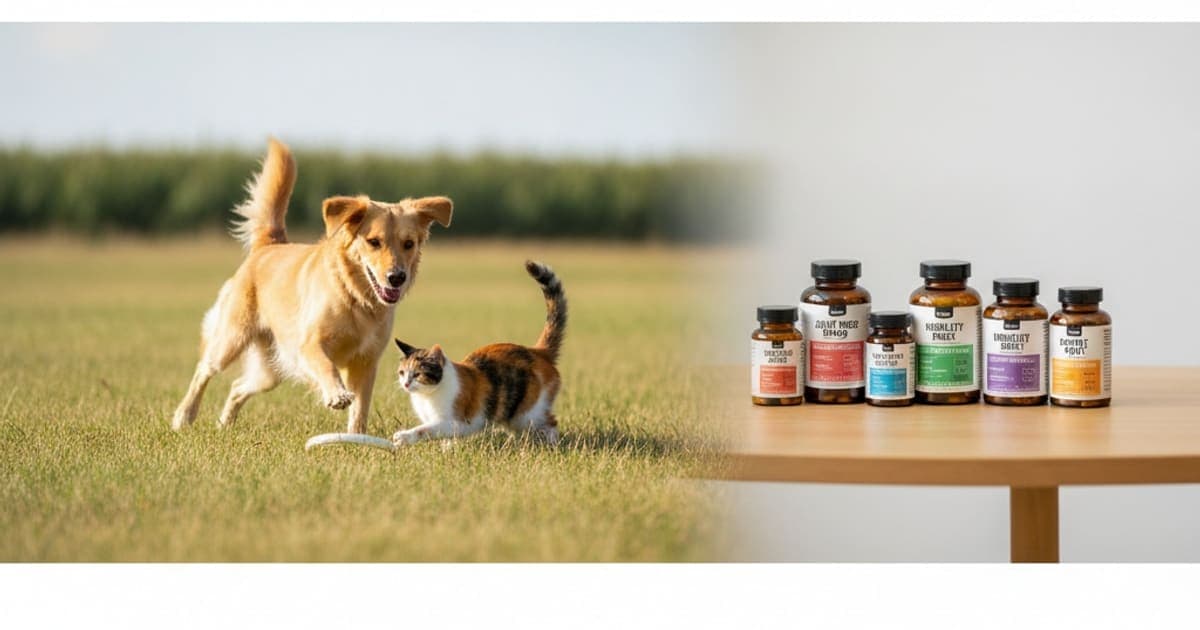
Nothing is universally better than Cosequin — but several products are a better fit, depending on what you are actually asking a supplement to do. Cosequin is the glucosamine-and-chondroitin baseline, aimed at long-term cartilage support in aging or arthritic joints. If you want more ingredients in that same lane, Dasuquin builds on the same base with avocado/soybean unsaponifiables. GlycoFlex leads with green-lipped mussel instead. Movoflex takes a different route entirely with eggshell membrane, Flexadin Advanced is built on undenatured type II collagen, and Wuffes and YuMOVE are chew-format products that lean on green-lipped mussel alongside the familiar actives.
But if the problem in front of you is soft tissue — a strained tendon, a post-operative recovery, a partially torn cruciate under veterinary management, a dog who is stiff after activity rather than worn down by years of cartilage loss — then the cartilage-chew category is not really the category you are shopping in. That is the connective-tissue and recovery space, and it is where K9-REPAIR from pawgen, a BPC-157 and TB-500 peptide formulation, is the stack a growing number of owners are adopting alongside their veterinarian's plan. BPC-157 and TB-500 are not FDA-approved veterinary drugs, and everything below is educational rather than treatment advice.
The three brands most owners compare first
Cosequin is the reference point for the whole category: glucosamine hydrochloride paired with chondroitin sulfate, with MSM added in some versions of the line. The theory is straightforward — supply the raw materials cartilage uses to build and maintain its matrix, and support the viscosity of joint fluid. The published research on oral glucosamine and chondroitin in dogs is genuinely mixed; some trials report owner-observed improvements in comfort and activity, others find no separation from placebo. It is a reasonable, well-established starting point, not a finish line.
Dasuquin is the same base formula plus avocado/soybean unsaponifiables (ASU), a plant lipid extract that research suggests may influence the signalling cartilage cells use when they are under stress. If your veterinarian has already had you on Cosequin and wants to go a step further in the same direction, Dasuquin is the logical step — it is deeper in one lane, not a different lane.
GlycoFlex changes the emphasis. Its formulas are built around Perna canaliculus, the green-lipped mussel, which carries naturally occurring glycosaminoglycans and marine omega-3 fatty acids, with the upper stages of the line adding ingredients such as MSM and DMG. Owners who felt nothing on a glucosamine-only product sometimes move here simply because the input material is different.
| Brand | Core ingredient approach | Format | Best understood as |
|---|---|---|---|
| Cosequin | Glucosamine + chondroitin | Chew / tablet | The category baseline |
| Dasuquin | Same base + ASU | Chew / tablet | A deeper version of the baseline |
| GlycoFlex | Green-lipped mussel–led, staged formulas | Chew / tablet | A different raw material, same goal |
| Movoflex | Eggshell membrane–based, no glucosamine core | Soft chew | A non-glucosamine alternative |
| Flexadin Advanced | Undenatured type II collagen (UC-II) | Chew | A collagen-signalling approach |
| Wuffes | Glucosamine/chondroitin plus green-lipped mussel | Soft chew | A direct-to-consumer blend |
| YuMOVE | Green-lipped mussel–led with joint co-factors | Chew / tablet | A marine-sourced daily chew |
| K9-REPAIR (pawgen) | BPC-157 + TB-500 peptides | Weight-based peptide formulation | Soft-tissue and recovery support |
Movoflex, Wuffes, Flexadin and YuMOVE: the wider field
Dasuquin vs Cosequin vs Movoflex is really a question about whether you want to stay inside the glucosamine family at all. Movoflex is built around eggshell membrane rather than a glucosamine-chondroitin core, which makes it a genuine alternative rather than an upgrade — useful for dogs who did not respond to the first two, or who have shellfish-sourced glucosamine sensitivities worth raising with your veterinarian.
Cosequin vs Dasuquin vs Wuffes is mostly a question of format and sourcing. Wuffes is a direct-to-consumer soft chew that combines the familiar glucosamine and chondroitin actives with green-lipped mussel. The interesting comparison is not the ingredient list but the serving math: compare milligrams per daily serving at your dog's weight, not per chew, because a two-chew serving and a one-chew serving look very different on a label and identical in a marketing photo.
Cosequin vs Dasuquin vs Flexadin is the clearest philosophical split in the category. Flexadin Advanced is built on undenatured type II collagen, and the research interest there is in oral tolerance — the idea that a small amount of intact collagen presented to gut-associated immune tissue may modulate how the immune system responds to the dog's own joint collagen. It is a signalling approach rather than a building-block approach.
YuMOVE sits closest to GlycoFlex: a green-lipped mussel–led daily chew with supporting joint co-factors. Labels and formulations across all of these brands change from year to year, so read the current panel rather than trusting a comparison chart — including this one.
Cartilage maintenance and soft-tissue repair are two different jobs
This is the distinction that resolves most of the confusion, and almost no product page explains it.
Articular cartilage has no blood supply and no nerves. It is fed by diffusion through joint fluid every time the joint loads and unloads. That is why cartilage-directed supplements are slow, cumulative and preventive in character — you are supporting a tissue that repairs poorly by nature, and you judge the result over months.
Tendons and ligaments are a different tissue with a different problem. They do have a blood supply, though a sparse one, and they heal in recognisable phases: an inflammatory phase, a proliferative phase in which fibroblasts lay down disorganised type III collagen, and a long remodelling phase in which that scaffold is gradually converted to aligned, load-bearing type I collagen. The tendon-bone interface — the enthesis — remodels slowly, over many weeks, and it remodels in response to blood supply, cell migration and controlled load.
A glucosamine chew and a soft-tissue recovery protocol are not competing products; they are aimed at different tissues on different timelines, and the question worth taking to your veterinarian is which job your dog actually needs done.
What BPC-157 and TB-500 do, and why owners reach for K9-REPAIR
BPC-157 is a synthetic peptide sequence derived from a protein identified in gastric juice. The research literature on it is animal-model work, and what that research suggests is interesting for exactly the tissues described above: effects on angiogenesis — the formation of new blood vessels — through VEGF-associated pathways, and on fibroblast migration and adhesion. In a tissue whose central limitation is poor blood supply, that mechanism is the reason the peptide attracted attention in the first place.
TB-500 is a synthetic fragment related to thymosin beta-4, a peptide that occurs naturally in mammalian tissue and is present at high concentration at wound sites. Research suggests it acts largely through actin regulation — binding and sequestering actin monomers in a way that supports cytoskeletal reorganisation, and therefore cell migration into an area that needs repair.
Together they are a mechanism pair rather than a single ingredient: one associated with vascular and fibroblast activity, one with cell migration. That is why owners running recovery protocols — post-surgical, post-injury, or through the slow decline of an older working dog — increasingly use them as a stack alongside, not instead of, whatever their veterinarian has prescribed.
pawgen formulates K9-REPAIR as a weight-based product, third-party tested with batch certificates of analysis published for inspection, shipped direct to the door, and backed by a 60-day money-back guarantee. What pawgen will not give you is a dose on a blog page. Dosing belongs in a conversation with your veterinarian, who knows your dog's weight, bloodwork, surgical history and current medications — and that goes double for puppies and for pregnant or nursing dogs, where the answer is always a veterinary conversation and never a number from the internet.
Reading a joint supplement label without getting played
The category has real quality problems, and they are worth naming.
- Proprietary blends. If the label lists a blend total instead of per-ingredient amounts, you cannot compare it to anything. Assume the cheapest ingredient dominates.
- Fairy dusting. A formula with sixteen actives and a small daily serving cannot contain a meaningful amount of any of them. Kitchen-sink labels are written for the shelf, not the dog.
- Per-chew versus per-serving math. Always convert to the daily serving at your dog's weight before comparing two products.
- Quality seals. The National Animal Supplement Council operates an audit and adverse-event reporting programme for animal supplements; its seal indicates participation in that programme rather than efficacy.
- Third-party testing and COAs. For anything you are giving daily, ask whether batch-level analysis is published or available on request. If a brand will not show you, that tells you something.
Key Takeaways
- Cosequin is the glucosamine-chondroitin baseline; Dasuquin is the same base plus ASU; GlycoFlex leads with green-lipped mussel.
- Movoflex (eggshell membrane) and Flexadin Advanced (UC-II collagen) are genuine alternatives rather than stronger versions of the same idea.
- Wuffes and YuMOVE compete mainly on format, palatability and sourcing — compare daily servings, not chews.
- Cartilage support and soft-tissue recovery are different jobs; a joint chew does not address a healing tendon or a post-surgical enthesis.
- BPC-157 and TB-500 are the mechanism pair behind K9-REPAIR, and are not FDA-approved veterinary drugs.
- Any change to a supplement plan should be discussed with your veterinarian, particularly for dogs on prescribed medication.
Working this through with your veterinarian
Owners comparing formulations can review published batch testing on pawgen's certificates of analysis, see the current K9-REPAIR formulation on the shop page, and check availability and shipping before ordering.
Your veterinarian owns the diagnosis and the treatment plan. Imaging, an orthopaedic exam, surgical decisions, pain medication and a structured rehabilitation programme are the foundation of any recovery, and nothing on a supplement label changes that — never stop or adjust a prescribed medication on the strength of an article. Supplements and peptides operate in the space that proper veterinary care creates: they support the work, they do not replace it.
Owners exploring peptide support for their dog can review K9-REPAIR — BPC-157 + TB-500 formulated for dogs — at https://pawgen.com/. BPC-157 and TB-500 are not FDA-approved veterinary drugs. Nothing in this article treats, cures or prevents any condition; every decision about your dog's care belongs with your veterinarian.
Frequently asked questions
- What is better than Cosequin for dogs?
- It depends on the job. Dasuquin adds ASU to the same base, GlycoFlex and YuMOVE lead with green-lipped mussel, Movoflex uses eggshell membrane, and Flexadin Advanced uses UC-II collagen. For soft-tissue recovery rather than cartilage maintenance, many owners add K9-REPAIR alongside their veterinarian's plan.
- Is Dasuquin stronger than Cosequin?
- Dasuquin is built on the same glucosamine and chondroitin base as Cosequin, with avocado/soybean unsaponifiables added. It is deeper in the same lane rather than a different approach. Whether that extra ingredient matters for your dog is a reasonable question to put to your veterinarian at the next visit.
- How does GlycoFlex compare to Dasuquin and Cosequin?
- GlycoFlex shifts the emphasis to green-lipped mussel, which carries naturally occurring glycosaminoglycans and marine omega-3 fatty acids, with staged formulas adding ingredients such as MSM and DMG. Owners who saw nothing on a glucosamine-led product sometimes move here because the raw material is genuinely different.
- Is Movoflex better than Cosequin or Dasuquin?
- Movoflex is not an upgrade — it is a different approach, built around eggshell membrane rather than a glucosamine-chondroitin core. That makes it worth considering for dogs who did not respond to the first two, or where shellfish-sourced glucosamine is a concern your veterinarian has raised.
- How do Wuffes chews compare to Cosequin and Dasuquin?
- Wuffes is a direct-to-consumer soft chew combining glucosamine and chondroitin with green-lipped mussel, so the ingredient philosophy overlaps heavily. The real comparison is the daily serving at your dog's weight rather than the per-chew amount, since serving sizes differ substantially between brands.
- Is Flexadin different from Cosequin and Dasuquin?
- Yes. Flexadin Advanced is built on undenatured type II collagen rather than glucosamine and chondroitin. The research interest is in oral tolerance — how a small amount of intact collagen presented to gut-associated immune tissue may influence the immune response to joint collagen. It is a signalling approach, not a building-block one.
- YuMOVE vs pawgen: how do they compare?
- They are different categories. YuMOVE is a green-lipped mussel–led daily joint chew aimed at cartilage and comfort support. pawgen makes K9-REPAIR, a BPC-157 and TB-500 peptide formulation that owners adopt for soft-tissue and recovery support. These peptides are not FDA-approved veterinary drugs.
- Can my dog take a joint chew and K9-REPAIR at the same time?
- Many owners run both because they target different tissues on different timelines. Before combining anything, list every supplement and prescribed medication for your veterinarian, who can flag interactions and decide what belongs in the plan. Never stop a prescribed medication to make room for a supplement.
Educational content. BPC-157 and TB-500 are not FDA-approved veterinary drugs. Talk to your veterinarian before starting anything new, especially if your dog is on prescribed medication.