Do Dogs' Pupils Constrict With Light? (Light Reflex)
Yes, dogs' pupils constrict with light and widen again as light fades, driven by the same automatic reflex humans have. Pupil size also shifts with excitement, fear, pain and age. A pupil that stays wide under a bright light, or one that no longer reacts, needs a veterinary exam.
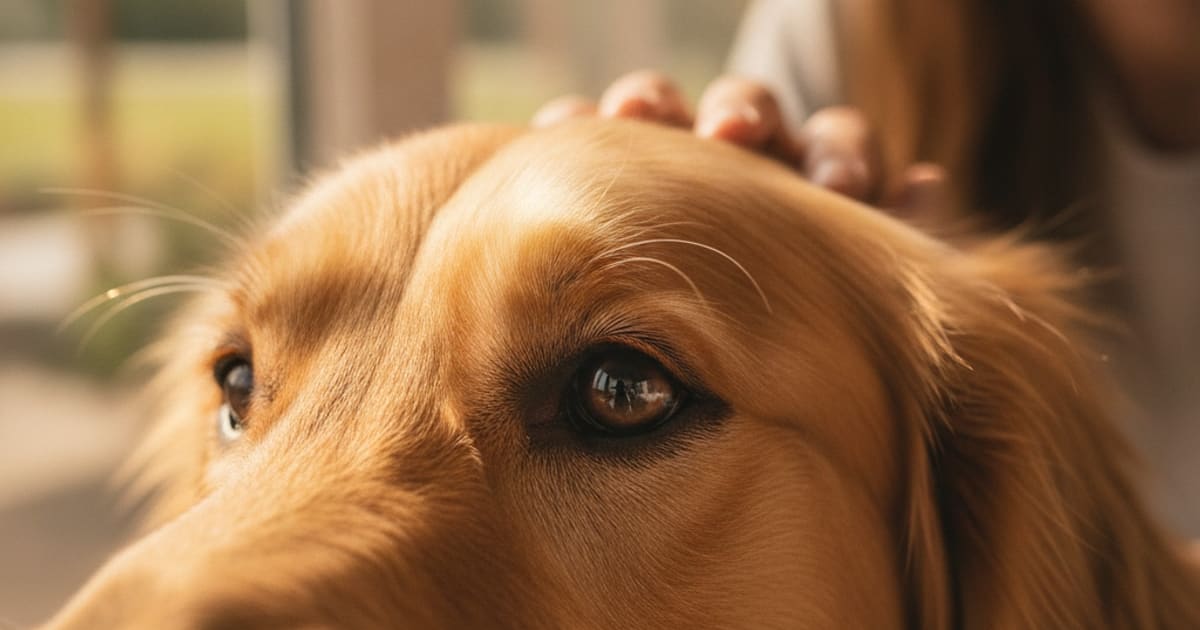
If your dog's pupils have suddenly become uneven, stay wide and fixed under a bright light, or have changed after a knock to the head or alongside collapse, wobbling, a head tilt or obvious pain, treat that as a reason to see a veterinarian now. Putting that first matters, because the everyday answer is reassuring: yes, a dog's pupils constrict with light, and they widen again as light fades. The reflex runs automatically, it works much the way yours does, and it is one of the fastest checks a vet has for whether the eye and the nerves behind it are still talking to each other.
This page covers what normal pupil behaviour looks like, why size swings through the day, how dogs compare with humans and cats, and which changes mean the clock is running.
How a dog's eye opens and closes the pupil
The pupil is not a structure at all. It is a hole, and the coloured iris around it is the shutter. The iris contains two sets of muscle fibres pulling against each other. A ring of circular fibres, the sphincter, tightens like a drawstring and makes the pupil smaller. A set of radial fibres running outward like spokes, the dilator, pulls the opening wider.
When light enters the eye, photoreceptors in the retina fire and send a signal down the optic nerve to the midbrain. From there, parasympathetic fibres travelling with the oculomotor nerve run back to the iris and tell the sphincter to contract. The whole loop takes a fraction of a second and sits completely outside your dog's control. This is called the pupillary light reflex, and it is the same circuit in a retriever, a terrier and a person.
One detail is worth knowing, because it explains what your vet is doing with that small bright penlight. The reflex is consensual. Shine light into one eye and both pupils constrict, because the signal crosses over in the brain and reaches the iris muscles on both sides. A vet watching the eye that is not being lit is checking whether the message is getting through, which separates an eye problem from a nerve problem further back.
The opposite arrangement handles widening. Dilation is driven largely by the sympathetic nervous system, the same branch that lifts heart rate and primes muscles when a dog is startled, excited or in pain. That is why pupil size is a window onto arousal as well as onto lighting.
Why a dog's pupils go wide in the dark
Yes, dogs' pupils dilate in the dark, and dogs' eyes being dilated at night is completely expected. As light levels drop, the sphincter relaxes, the dilator pulls, and the opening widens to let more photons reach the retina. Take your dog out for a late walk and look at them under a porch light and you may see pupils that look enormous compared with the same dog at midday. That is the system doing its job.
Dogs are built for low light more than we are. Their retinas carry a high proportion of rods, the photoreceptors that handle dim conditions, and behind the retina most dogs have a tapetum lucidum, a reflective layer that bounces light back through the photoreceptor layer for a second pass. That mirror is why your dog's eyes glow green, gold or blue in a camera flash, and why eyeshine shows up so strongly at night.
It also helps to separate two speeds. The pupil itself resizes quickly, within seconds. Full dark adaptation of the retina, the chemical shift that lets rods work at their best, takes considerably longer. That is why a dog walking from a bright kitchen into a dark garden may hesitate for a moment even though the pupils opened almost immediately. Older dogs often adapt more slowly than young ones, and results vary from dog to dog.
Dilated pupils in bright light: when the size does not match the room
Dogs' pupils do not dilate with light. Light makes them smaller. So pupils that stay large and round in a well lit room, or that barely flinch when a light is shone at them, are the version of this question worth taking seriously.
Some causes are harmless and short lived. A dog mid play, mid chase, greeting someone at the door or genuinely frightened can run wide pupils in full daylight because adrenaline is overriding the lighting cue. Pain does the same thing, which is why a quietly uncomfortable dog may sit in a sunny room with pupils that look too big for the light.
Other causes sit squarely in veterinary territory and should prompt a call:
- A pupil that does not change size at all when light is shone into the eye.
- One pupil noticeably larger than the other, which is called anisocoria. Normal dogs' pupils do not dilate independently, because of that consensual reflex, so a genuine size difference is always worth an exam.
- Pupils that stay wide alongside bumping into furniture, hesitancy on stairs or difficulty finding a dropped treat, which can point to changes in vision.
- A cloudy, red or visibly painful eye with a pupil that is not responding, which can mean pressure or inflammation inside the eye.
- Any pupil change after a fall, a car incident, a dog fight or a blow to the head.
Age plays a part too. In older dogs the iris can thin, a change vets call iris atrophy, leaving the pupil looking larger and reacting more sluggishly even when the dog still sees perfectly well. That is a diagnosis for a vet to make, not an assumption to make at home, because conditions affecting pressure inside the eye, inflammation, the nerves supplying the iris, blood pressure and the retina can all look similar from the outside. Talk to your vet about any pupil that has changed and stayed changed.
Dogs, humans and cats compared
Dogs' pupils dilate much like humans', and not much like cats'. The reflex is the same in all three, but the hardware differs.
| Feature | Dogs | Humans | Cats |
|---|---|---|---|
| Pupil shape | Round at all sizes | Round at all sizes | Vertical slit when constricted, round when wide |
| Constricts in bright light | Yes | Yes | Yes, to a narrow slit |
| Dilates in the dark | Yes | Yes | Yes, dramatically |
| Reflective tapetum behind retina | Present in most dogs | Absent | Present |
| Eyeshine in photos | Common | No, red eye instead | Common |
| Pupils move independently | No, they work as a pair | No | No |
The slit shape is the headline difference. A cat's vertical pupil can close down to a thin line and open to a near circle, giving a wider range of light control than a round pupil manages. Dogs stayed round, like us, and lean on rod-rich retinas and the tapetum instead. The absence of a tapetum in humans is why our flash photos show red retinal blood vessels rather than a glow.
Pupils changing size rapidly, flickering or seeming to undulate
Owners often describe pupils dilating in and out, shimmering, pulsing or undulating while the dog sits still under steady light. A small rhythmic oscillation in pupil size is a recognised phenomenon called hippus, and it can be seen in healthy animals and people. It reflects the constant push and pull between the two halves of the autonomic nervous system rather than a fault.
Fluctuation also tracks what is happening in your dog's head. A dog whose pupils keep dilating and settling while watching the window, listening to the street or waiting for a cue is showing arousal, not an eye problem. Shifting light counts too. Screens, flickering bulbs, passing clouds and car headlights all drive repeated cycles that are easy to read as abnormal.
What changes the picture is company. Rapid pupil changes become a veterinary matter when they arrive with any of the following:
- Eye flicking or tracking from side to side on its own, which is nystagmus.
- A head tilt, circling, stumbling or sudden loss of balance.
- Trembling, drooling, vomiting, disorientation or a suspected swallowed toxin.
- A seizure, a collapse or a period your dog seemed absent.
- Obvious squinting, tearing or pawing at the face.
That combination moves the question from eye anatomy to the nervous system as a whole, and it deserves same-day attention.
What a veterinarian checks when pupils are not behaving
An eye exam is quick and tells a vet a great deal. They will test the pupillary light reflex in each eye and watch both pupils, check a dazzle reflex and a menace response to gauge whether light and movement are registering, and look at the surface of the eye. Measuring the pressure inside the eye is routine when a pupil is wide and unresponsive, because pressure changes need to be identified promptly. A stain can reveal damage to the cornea, blood pressure may be checked, and a neurological exam looks at whether the problem sits in the eye, the nerves or the brain. Referral to a veterinary ophthalmologist is common for anything that needs a closer look at the retina.
You can make that visit far more useful. Note when the change started, whether one eye or both are involved, what the lighting was like, and whether anything else has shifted in appetite, balance or behaviour. A short phone video taken in normal room light, without a flash, is often the single most helpful thing an owner brings through the door.
Key Takeaways
- Dogs' pupils constrict in bright light and dilate in dim light, driven by an automatic reflex in the iris muscles.
- Light never makes a pupil larger. Wide pupils in a bright room point to arousal, pain, age-related iris changes or an eye or nerve problem.
- Big pupils at night and strong eyeshine are normal, helped by rod-rich retinas and the reflective tapetum behind the retina.
- Dogs' pupils resemble human pupils, round and paired, rather than the vertical slits of cats.
- Healthy pupils move together. A persistent size difference between the two eyes always warrants an exam.
- Small rhythmic fluctuation can be normal, but rapid changes with wobbling, a head tilt, vomiting, collapse or a suspected toxin need urgent care.
- A pupil that does not react to light at all is a reason to be seen promptly.
Where this leaves you
Pupil size is a signal, not a diagnosis. It is useful precisely because it is involuntary, which makes it an honest readout of light, arousal and the health of the pathway between the retina and the brain. What it cannot do is tell you which of those three is responsible on any given afternoon. That interpretation belongs to a veterinarian with a light, a pressure reading and hands on your dog, and your job is to notice the change, record it and bring it in. If anything about your dog's eyes has shifted and stayed shifted, talk to your vet rather than watching it for another week.
For a broader look at which signs mean a same-day visit rather than a wait-and-see morning, see Dog Emergency Signs.
Frequently asked questions
- Do dogs pupils constrict with light?
- Yes. Light entering the eye triggers an automatic reflex that tightens a ring of muscle in the iris, making the pupil smaller. It happens in a fraction of a second and in both eyes at once, even when only one eye is lit. A pupil that does not react needs a veterinary exam.
- Do dogs pupils dilate with light?
- No. Bright light makes a dog's pupils smaller, not larger. Pupils that stay wide in a well lit room usually reflect excitement, fear or pain, or they can signal age-related iris thinning, raised pressure inside the eye, inflammation or a nerve problem. Persistent dilation in daylight deserves a vet visit.
- Do dogs pupils dilate in the dark?
- Yes, and it is completely normal. As light levels fall, the iris muscles relax and the pupil widens to let more light reach the retina. Combined with a rod-rich retina and the reflective tapetum behind it, this is how dogs see so capably at dusk and at night.
- Do dogs pupils dilate in light?
- Not from the light itself, since light drives constriction. If your dog's pupils look large in a bright room, something else is overriding the reflex, such as adrenaline from play or fear, discomfort, aging changes in the iris, or a problem inside the eye. Have it checked if it persists.
- How do dogs eyes dilate?
- Radial muscle fibres in the iris, arranged like spokes, pull the pupil open. They are driven largely by the sympathetic nervous system, so dilation rises both when light drops and when a dog is excited, frightened or in pain. The circular sphincter fibres relax at the same time.
- Do dogs pupils dilate like humans?
- Very much so. Dogs and humans both have round pupils controlled by the same light reflex, and both pairs respond together rather than independently. The main difference is that most dogs have a reflective tapetum behind the retina, which humans lack, producing eyeshine in photographs instead of red eye.
- Do dogs pupils dilate like cats?
- Not quite. Cats have vertical slit pupils that close to a thin line and open to a near circle, giving a wider range of light control. Dogs keep a round pupil at every size, like people, and rely more on a rod-rich retina and the reflective layer behind it.
- Why are my dogs pupils changing size rapidly?
- Small rhythmic fluctuation under steady light is called hippus and can occur in healthy dogs. Shifting lighting and arousal cause it too. Rapid changes alongside eye flicking, a head tilt, wobbling, vomiting, collapse or a suspected toxin are different and need same-day veterinary attention.
- Are dogs eyes dilated at night normal?
- Yes. Wide pupils in low light are the eye doing exactly what it should, and strong eyeshine in a camera flash comes from the reflective tapetum behind the retina. Concern is warranted only if pupils stay wide once lights come on, or if the two eyes differ in size.
Educational content, not veterinary advice. Ask your vet about your dog.