Dogs' Pupils Dilated When Looking at Me: What It Means
A dog's pupils can widen while looking at you, but that reflects arousal and light levels rather than love by itself. Excitement, play, focus, dim rooms and fear all widen pupils. Sudden, uneven or fixed pupils, especially with wobbling, a head tilt or pain, need a vet promptly.
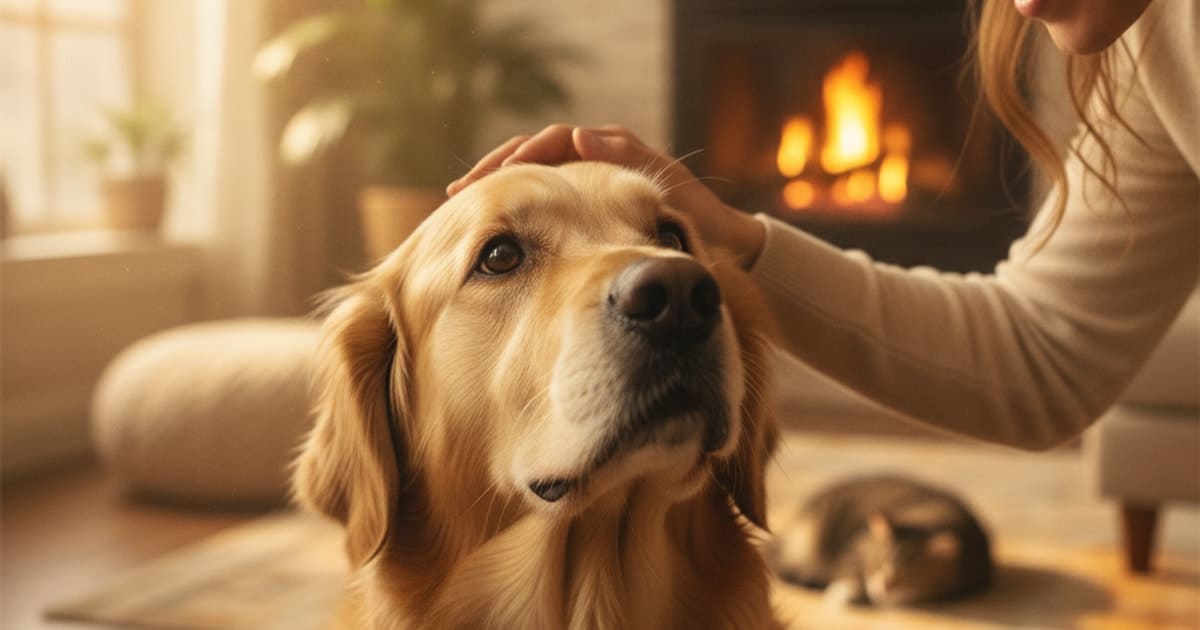
Yes, a dog's pupils often widen during close, affectionate moments with you, but that widening is a signal of arousal and light levels, not a dedicated love signal. Before anything else: if your dog's pupils have suddenly become uneven, stay wide and fixed in bright light, or appear alongside wobbling, a head tilt, collapse, vomiting, obvious pain or a recent knock to the head, call your vet now instead of reading on.
With that out of the way, the everyday version of this question is a happy one. You glance across the room, your dog looks back, and the dark centre of the eye seems to swallow the colour around it. Owners describe it as the eyes going big, going soft, or going liquid. Something real is happening in that moment. It simply is not a love meter, and knowing what it actually measures makes your dog easier to read.
What a pupil is actually doing when it widens
The pupil is not a structure at all. It is a hole in the iris, the coloured ring at the front of the eye, and two opposing sets of muscle decide how big that hole is. A circular sphincter muscle, driven by the parasympathetic side of the nervous system, tightens the opening down to a small round point. A set of radial dilator fibres, driven by the sympathetic side, pulls the opening wide like a drawstring being released.
Light is the first and fastest driver. When brightness rises, the sphincter contracts within a fraction of a second, and because the two eyes are wired together, both pupils respond as a pair. When light drops, the opening widens to let more light reach the retina. This is reflexive. Your dog has no more control over it than you do.
Arousal is the second driver, and it is the one owners notice at home. When the sympathetic nervous system fires, whether from excitement, anticipation, play, startle or stress, the dilator fibres pull the pupil open. Wider pupils gather more light and more peripheral detail, which is useful whether a dog is about to chase a ball or about to back away from something unfamiliar.
Dogs also start from a different baseline than we do. Their pupils sit relatively large, and behind the retina sits the tapetum lucidum, the reflective layer that produces green or gold eyeshine in photographs. In a dim living room in the evening, which is exactly when most of us sit down and make eye contact with our dogs, a perfectly healthy dog's pupils may look wide for hours.
What widening says about how your dog feels
Here is the honest answer to the question owners actually type: dogs' eyes dilated when happy is a real and frequent observation, because happiness in a dog usually arrives wrapped in excitement, and excitement is arousal. The sight of you reaching for the lead, the sound of a food container, the start of a game, a greeting at the door, all of these widen pupils in a dog who feels good.
The catch is that arousal is not emotion specific. The same pathway opens the pupil during fear, during a startle, during frustration at a window, during pain, and during intense concentration on a squirrel. A dog bracing for something unpleasant and a dog about to be thrown a ball can show the same dark, wide eye.
Pupil size tells you how aroused your dog is, not how much your dog loves you.
So when your dog's pupils dilate when he looks at you, the most reasonable reading is that you are currently the most interesting thing in the room. That interest is usually warm, and it often sits inside a bond that genuinely exists. It is just being signalled by the whole dog, not by the iris alone.
Results vary from dog to dog as well. One dog's pupils widen dramatically at the first jingle of keys, while another dog with a dark iris and a calm temperament shows a change you can barely see. Puppies and adolescent dogs tend to run at a higher arousal level in general, so their eyes look wide more of the time.
Eye contact, bonding and the gaze loop
Dogs are unusual among animals in how comfortable they are with human eye contact. For most species, a direct stare reads as a threat. Dogs, over a very long shared history with people, learned to hold a soft gaze and to look at human faces for information, checking our eyes when they are unsure what to do next.
Scientists who examine dog and human interaction describe a feedback loop around that mutual gaze: when a dog and owner look softly at one another, oxytocin, the hormone associated with social bonding, tends to rise in both of them, which encourages more looking. Dogs also have a small muscle above the inner eye that raises the inner brow, producing the wide, appealing expression people call puppy eyes. Wolves lack that muscle in the same developed form.
Put those pieces together and the moment you are asking about makes sense. Your dog's eyes dilated when looking at you is partly the social pull of the gaze itself, partly the low evening light you are both sitting in, and partly simple interest in what you are about to do.
One important distinction: a soft gaze and a hard stare are not the same thing. A soft gaze comes with a loose body, blinking, a relaxed mouth, maybe a slow tail. A hard stare comes with a stiff frame, a closed mouth, a still tail and often the whites of the eye showing at the corner. Wide pupils in that second picture are not affection, and they deserve space rather than a cuddle. If hard staring is becoming a pattern in your house, talk to your vet, who can rule out pain and point you toward a qualified behaviour professional.
Behaviour or medicine: how to tell them apart quickly
Most of the time, the difference comes down to three things: whether both pupils match, whether they change when light changes, and whether anything else about your dog looks off.
| What is going on | Pupil pattern | What else you see | What to do |
|---|---|---|---|
| Excitement, play, anticipation | Both wide together, shrink in bright light, settle as the dog settles | Loose body, wagging, bouncing, normal balance | Nothing. Enjoy it |
| Fear or stress | Both wide together | Stiff body, tucked tail, lip licking, turning away, whites showing | Reduce the pressure, give space, note the trigger |
| Dim light or evening indoors | Both wide, shrink promptly at a window or lamp | Dog is otherwise completely normal | Nothing |
| Pain somewhere in the body | Both wide, persistent even in good light | Reluctance to move, panting, guarding a limb or the belly, appetite change | Book a vet visit |
| An eye or nerve problem | One pupil larger than the other, or a pupil that does not respond to light | Squinting, redness, cloudiness, bumping into things, head tilt, facial droop | Same day vet assessment |
| Possible ingestion of something harmful | Both wide, often with agitation or tremors | Drooling, vomiting, unsteadiness, hiding | Contact your vet or an animal poison control service such as the ASPCA Animal Poison Control Center or the Pet Poison Helpline immediately |
Two things commonly get mistaken for dilation. The first is a very dark iris, which makes the pupil hard to pick out against the surrounding colour, so the whole eye reads as black. The second is the hazy blue-grey look that develops in the lens of many older dogs as it becomes denser with age. That haze sits behind the pupil rather than changing its size, and only your vet can distinguish it from conditions that genuinely affect sight.
Wide pupils that need a vet rather than an interpretation
Behaviour explains the pupils you see during a game or a cuddle. It does not explain pupils that have changed in a way the rest of your dog cannot account for. Arrange veterinary care promptly if you notice any of the following.
One pupil clearly larger than the other, a condition your vet will call anisocoria, is never a normal variation and always warrants an examination. Pupils that stay wide and do not shrink at all when you move into bright light deserve the same urgency. So does any wide pupil that arrives with a head tilt, circling, wobbling, weakness, collapse, a seizure, vomiting, a recent fall or car knock, or a suspicion that your dog swallowed something it should not have.
Add to that list the eye that is painful or changed in itself: squinting, pawing at the face, a cloudy or bluish surface, visible redness, discharge, or a dog that has started misjudging doorways and stairs. Sudden changes in sight can be subtle at first, because dogs navigate familiar homes largely from memory.
When you call, describe what you saw rather than what you think it means. Which eye, in what light, how long it lasted, and what your dog was doing at the time. That detail shapes the examination more than any label would.
Key Takeaways
- A dog's pupils widen with arousal and with low light, so dilation during affectionate eye contact is real but is not proof of love on its own.
- Excitement, play, anticipation, fear, frustration, pain and deep concentration all open the pupil through the same pathway.
- Mutual soft gazing between dogs and people is linked with rises in oxytocin in both, which is why those long looks feel mutual.
- Read the whole dog: a loose body with a soft gaze means something very different from a stiff body with a hard stare.
- Both pupils should match each other and should shrink when light brightens.
- Uneven, fixed or persistently wide pupils, or any pupil change alongside head trauma, wobbling, a head tilt, collapse or a possible ingestion, is a reason to seek veterinary care without delay.
Letting your vet lead
Eye changes are one of the areas where owner observation is genuinely valuable and owner interpretation is genuinely risky. You are the person who knows how your dog's eyes normally look in your hallway at nine in the evening, and that baseline is useful information. What happens next belongs to your veterinarian, who can check the light reflexes directly, examine the structures behind the pupil, assess the nerves that control it and decide whether anything further is needed.
If your dog's eyes look normal, respond to light and only go wide during the happy, excitable, face to face moments of the day, you are simply watching a dog who is interested in you. If anything about that picture changes, talk to your vet and let the examination, not the internet, settle the question.
For a broader checklist of symptoms that call for same day or overnight care, see Dog Emergency Signs.
Frequently asked questions
- Do dogs pupils dilate when they love you?
- They often do during affectionate moments, but the widening reflects arousal and light conditions rather than love itself. Excitement, anticipation and the dim indoor light where most cuddling happens all open the pupil. Read the whole body, a loose frame and soft gaze, for the real affection signal.
- Do dogs pupils dilate when they like you?
- Liking you can widen a dog's pupils, because interest and anticipation both raise arousal, and arousal opens the pupil. The same pathway fires during fear or frustration, so pupil size alone cannot tell you which feeling is present. A relaxed body and soft blinking eyes tell you far more.
- Why do my dog's pupils dilate when looking at me?
- Usually because you are the most interesting thing in the room at that moment, and interest raises arousal. Low indoor lighting frequently adds to the effect. If both pupils match each other and shrink promptly in bright light, this is ordinary and nothing to act on.
- Are a dog's eyes dilated when happy?
- Frequently, yes. Happiness in a dog usually arrives alongside excitement, and excitement activates the sympathetic nervous system that pulls the pupil wide. You will see it at greetings, before a walk and during play. The surrounding body language, not the eye alone, confirms the mood.
- Can dilated pupils mean my dog is scared rather than affectionate?
- Yes. Fear, startle and stress widen pupils through exactly the same pathway as excitement. Look for the accompanying signs: a stiff body, tucked tail, lip licking, turning away, or the whites of the eyes showing at the corner. Those point to discomfort, and the dog needs space.
- Is it normal for both of my dog's pupils to look huge in the evening?
- It is normal if both match and shrink when you turn on a lamp or walk to a window. Dogs have relatively large pupils and a reflective layer behind the retina, so dim rooms produce wide, dark eyes in healthy dogs. A pupil that never responds to light does not.
- When are dilated pupils in a dog an emergency?
- Seek care straight away if one pupil is larger than the other, if a pupil stays fixed in bright light, or if wide pupils come with a head knock, collapse, seizure, wobbling, a head tilt, vomiting, severe pain, or a suspicion your dog swallowed something harmful.
- Does eye contact really strengthen the bond with my dog?
- Soft mutual gazing appears to matter. Scientists examining dog and human interaction describe oxytocin, the hormone linked with social bonding, rising in both dog and owner during gentle eye contact. Keep it soft and optional. A hard, prolonged stare reads as pressure to many dogs.
- My older dog's eyes look cloudy and wide. Is that dilation?
- Possibly not. Many older dogs develop a hazy blue-grey appearance in the lens as it becomes denser with age, which sits behind the pupil rather than changing its size. Only your veterinarian can distinguish that from conditions that genuinely affect vision, so book an examination.
Educational content, not veterinary advice. Ask your vet about your dog.